Module 8 (Renal system)
 Call Kai
 Learn
Learn Practice Test
 Spaced Repetition
 Match
Match Flashcards
 Knowt Play
1/4

There's no tags or description
Looks like no tags are added yet.
Name | Mastery | Learn | Test | Matching | Spaced | Call with Kai |
|---|
No analytics yet
Send a link to your students to track their progress
5 Terms
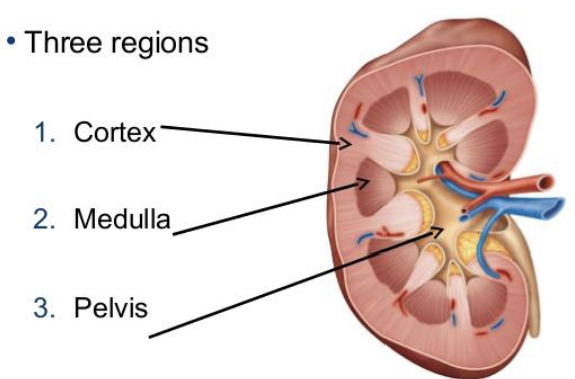
Describe the structure and functions of the kidney.
Structure:
Cortex – outer region containing glomeruli and convoluted tubules.
Medulla – inner region containing loops of Henle and collecting ducts.
Renal pelvis – collects urine before it enters the ureter.
Functions:
Excretes waste products and drugs.
Maintains long-term acid-base balance.
Regulates blood pressure.
Filters ~180 L of plasma/day.
What is the nephron and what are its components?
The nephron is the functional unit of the kidney (~1 million per kidney).
It consists of:
Vascular components (blood vessels)
Tubular components (renal tubules)
Each nephron contains a glomerulus attached to a tubule.
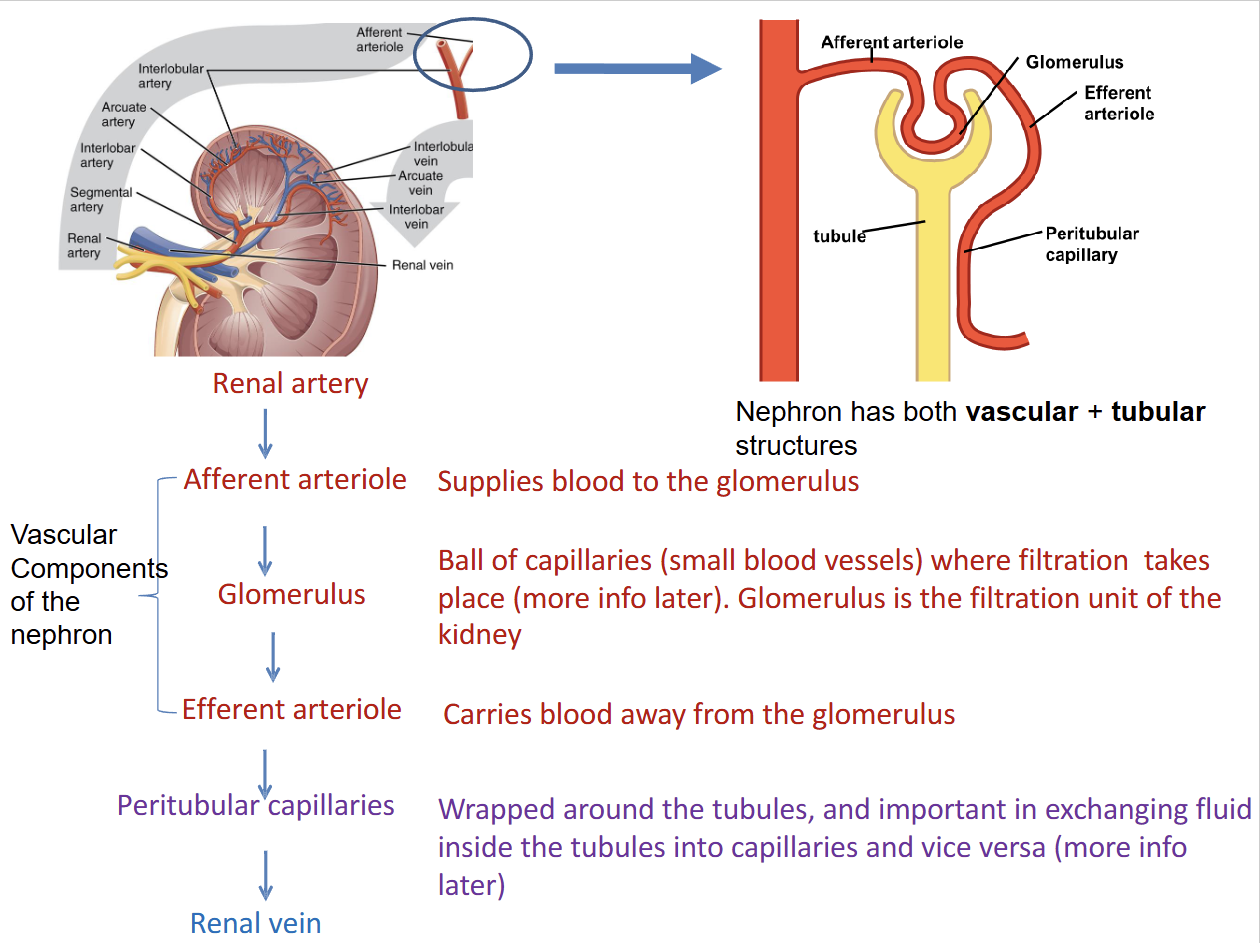
Describe the vascular components of the nephron.
Blood flow pathway:
Renal artery → Afferent arteriole → Glomerulus → Efferent arteriole → Peritubular capillaries → Renal vein
Renal artery: Brings blood into the kidneys
Afferent arteriole: Delivers blood to the glomerulus.
Glomerulus: Capillary network where plasma filtration occurs.
Efferent arteriole: Carries blood away from the glomerulus.
Peritubular capillaries: Surround tubules and allow reabsorption and secretion.
Renal vein: Takes the filtered blood out of the kidneys and back into the body
Describe the tubular components of the nephron and their functions.
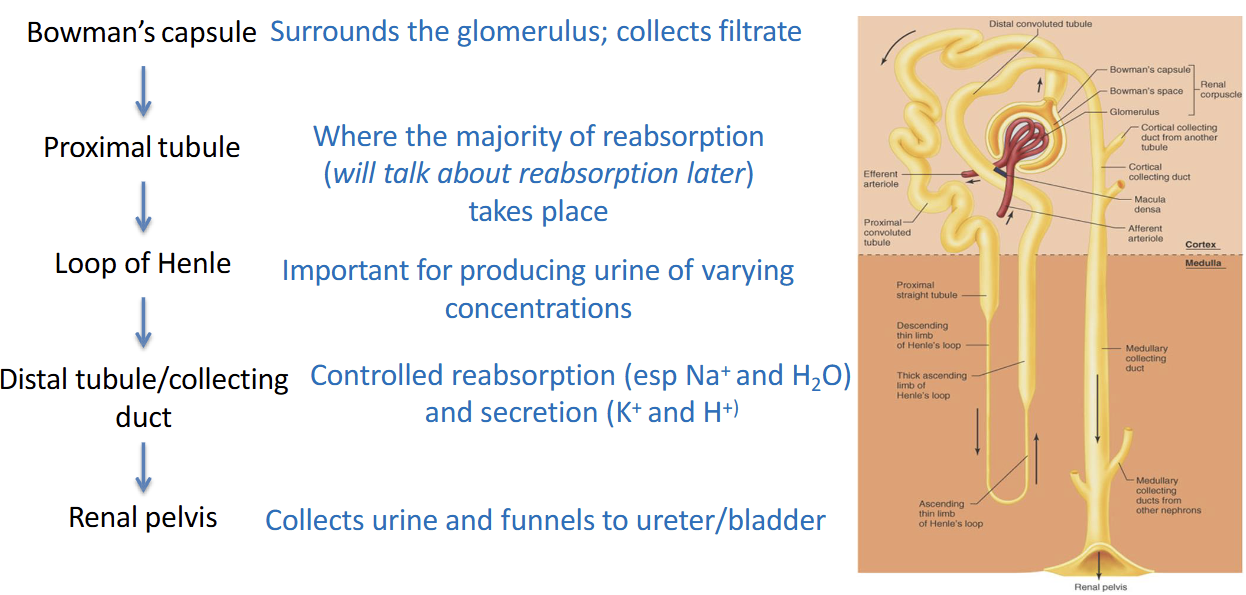
Bowman's capsule: Collects the filtrate from the glomerulus.
Proximal tubule: Site of most reabsorption of water, Na⁺, and nutrients.
Loop of Henle: Creates urine concentration gradients.
Distal tubule: Fine-tunes ion reabsorption (water and sodium) and secretion (potassium and hydrogen).
Collecting duct: Final regulation of water balance and urine concentration
Renal pelvis: Collects urine and funnels it to the bladder
What are the four main processes of urine formation and plasma filteration?
Filtration: Plasma enters the glomerulus, where water and small solutes (Na⁺, K⁺, H⁺, glucose, amino acids) from the blood are filtered into Bowman's capsule; proteins and blood cells remain in the blood.
Reabsorption: The nephron returns needed substances (water, Na⁺, glucose, amino acids) to the blood.
Secretion: Substances such as K⁺, H⁺, drugs, and toxins move from blood into the tubule.
Excretion: The remaining filtrate is eliminated as urine.