Neuroscience Study Questions - Gaze Control
 Call Kai
 Learn
Learn Practice Test
 Spaced Repetition
 Match
Match Flashcards
 Knowt Play
1/20

There's no tags or description
Looks like no tags are added yet.
Name | Mastery | Learn | Test | Matching | Spaced | Call with Kai |
|---|
No analytics yet
Send a link to your students to track their progress
21 Terms
Saccades
Rapid steplike eye movement used to acquire and image on the fovea
Speed 700-900 degree per second
5000º per sec2 (elevates)
Conjugate (same direction)
Smooth Pursuit Movement
Head is Stationary
Allows you to maintain a fixed gaze on a target as it moves (can only occur w/a target)
Slow phase eye movement (can generate with auditory target too)
Only works for tracking objects up to ~100-120º per second (any faster it doesn’t work - start to lag)
Conjugate (same direction)
Vestibulo-Ocular Reflexes (VOR)
Reflex responsible for holding image on fovea during head movements.
Very short latency.
Occurs in all directions of head movement.
Conjugate (same direction)
Optokinetic Movement
Used to track and re-aquire moving images.
Best though of a combination of smooth pursuit tracking and saccadic re-acquisition
Combination of slow & fast pace movements (smooth pursuit → Saccade)
Vergence
Used to get or keep objects at different distances centered on the fovea. Convergence for near objects, divergence for distance objects.
Only type of disconjugate eye movement
Cross-Eyed
Accommodation (Convergence + Constriction)
Dipolia = Double vision (caused by eyes drifting apart)
Fixation
Maintenance of focus on an object.
Requires active suppression of other movements
No eye movement (neither conjugate or disconjugate)
Why is the fovea important to gaze control
Central portion of retina, contains only cones and is specialized for color vision with the highest acuity
Keep whatever we are looking at centered at the fovea
Why is gaze important in gaze control
The control of eye and head movement to direct the fovea to an image of interest
Gaze System (2 components)
Oculomotor system and head movement system and head movement system with the goal to keep an image of interest centered on the retina
Cortical Areas
Frontal eye field/visual cortex, reticular formation (CN III, IV, VI), superior colliculi, Basal Ganglia, cerebellum
What are the cerebellar regions associated with saccades
Oculomotor Vermis
Coordinates fast phase eye movements
What are the cerebellar regions associated with smooth pursuit
Flocularnodual Lobe/IZ:
Also VOR and vengeance
Coordination of Slow phased eye movements
If someone has a basal ganglia dysfunction what might we expect to observe on a test of saccades? Cerebellar issue?
In normal vision what asking to look at a pen and nose there is a smooth transition between the two
In basal ganglia dysfunction we would expect to see dysmetria (difficulty with fine-point accuracy, with 2+ corrections)
This is associated with the vermis in the cerebrum.
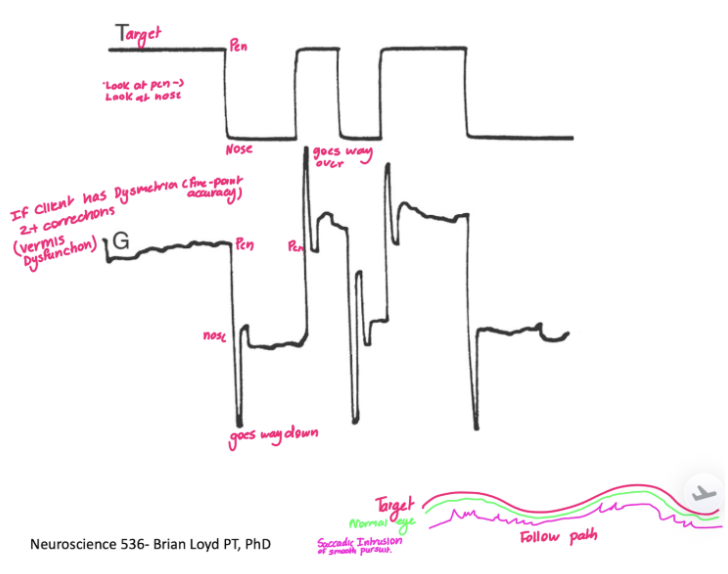
CNS Centers Responsible for Types of Eye Movement: Saccades (oculomotor movements)
Frontal eye field - Don’t need visual target → Superior colliculi → Reticular formation (CN III, IV, VI) ← Also getting input from oculomotor vermis (OV)
CNS Centers Responsible for Types of Eye Movement: Smooth Pursuit (oculomotor movements)
Actually a movement triggered by cerebellum
Visual cortex → frontal eye field → cerebellum (FNL) → CN III, IV, & VI → Requires a target
CNS Centers Responsible for Types of Eye Movement: VOR (Reflex)
Vestibular apparatus → VNC → MLF → CN III (ipsilateral), CN VI (contralateral), CN IV (Up & Down) → LR, MR, or SO
CNS Centers Responsible for Types of Eye Movement: Vergance (oculomotor movements)
Visual cortex → Sup. Colliculi (bilateral input) → Exits CN III (Inhibit IV and VI)
CNS Centers Responsible for Types of Eye Movement: Fixation (oculomotor movements)
Descending suppression from B.S. areas, cerebellum from visual cortex, and frontal eye fields.
Areas Associated With Gaze Control: Frontal Eye Fields/Superior Colliculus
Inhibition of Saccades, to control vergance and fixation
Organize smooth pursuit → Movement from both eyes are equal
Areas Associated With Gaze Control: Pontine/Medullary Reticular Formations
Inhibition of Saccades, to control vergance and fixation
Triggered in CN III, IV, & VI
Areas Associated With Gaze Control: Basal Ganglia/Cerebellum
Amplitude & Speed of Movement Through Cortical Drive
Amplitude & latency of saccades
Cerebellum = Pin-point accuracy