Dialectical Thinking
 Call Kai
 Learn
Learn Practice Test
 Spaced Repetition
 Match
Match Flashcards
 Knowt Play
1/26

There's no tags or description
Looks like no tags are added yet.
Name | Mastery | Learn | Test | Matching | Spaced | Call with Kai |
|---|
No analytics yet
Send a link to your students to track their progress
27 Terms
What is dialectical thinking?
A style of thinking wherein people tolerate and accept apparently contradictory information.
What is another term for dialectical thinking?
Naïve dialecticism.
In which cultures is dialectical thinking more prevalent?
East Asian cultures.
How does dialectical thinking relate to holistic thinking?
It is heavily related and contrasts with analytic thinking, originating from Eastern philosophies.
What does the outline border symbolize in cultural thinking styles?
Context.
What does the inside of the symbol represent in cultural thinking styles?
Interconnection.
What does the turning symbol signify in cultural thinking styles?
Change.
What do the contrasting colored dots represent in cultural thinking styles?
Contradiction.
What are the three laws of Ancient Greek philosophy?
Law of Identity, Law of the Excluded Middle, Law of Noncontradiction.
What does the Law of Identity state?
Everything is equal to itself (A = A).
What does the Law of the Excluded Middle assert?
Any statement must be either true or false.
What does the Law of Noncontradiction indicate?
No statement can be both true and false (If A = A, then A ≠ B).
What did the study by Peng & Nisbett (1999) reveal about American and Chinese participants?
Americans viewed only one set of contradictory findings as plausible, while Chinese viewed both as plausible.
How do American and Chinese participants differ in conflict resolution according to Peng & Nisbett (1999)?
Americans are more likely to choose sides, while Chinese are more likely to conclude both parties are to blame.
What is subjective ambivalence?
The psychological experience of felt conflict or indecision toward an object.
What is objective ambivalence?
The degree to which people report having both positive and negative evaluations.
How is objective ambivalence calculated?
(POS + NEG) / 2 - |POS - NEG|.
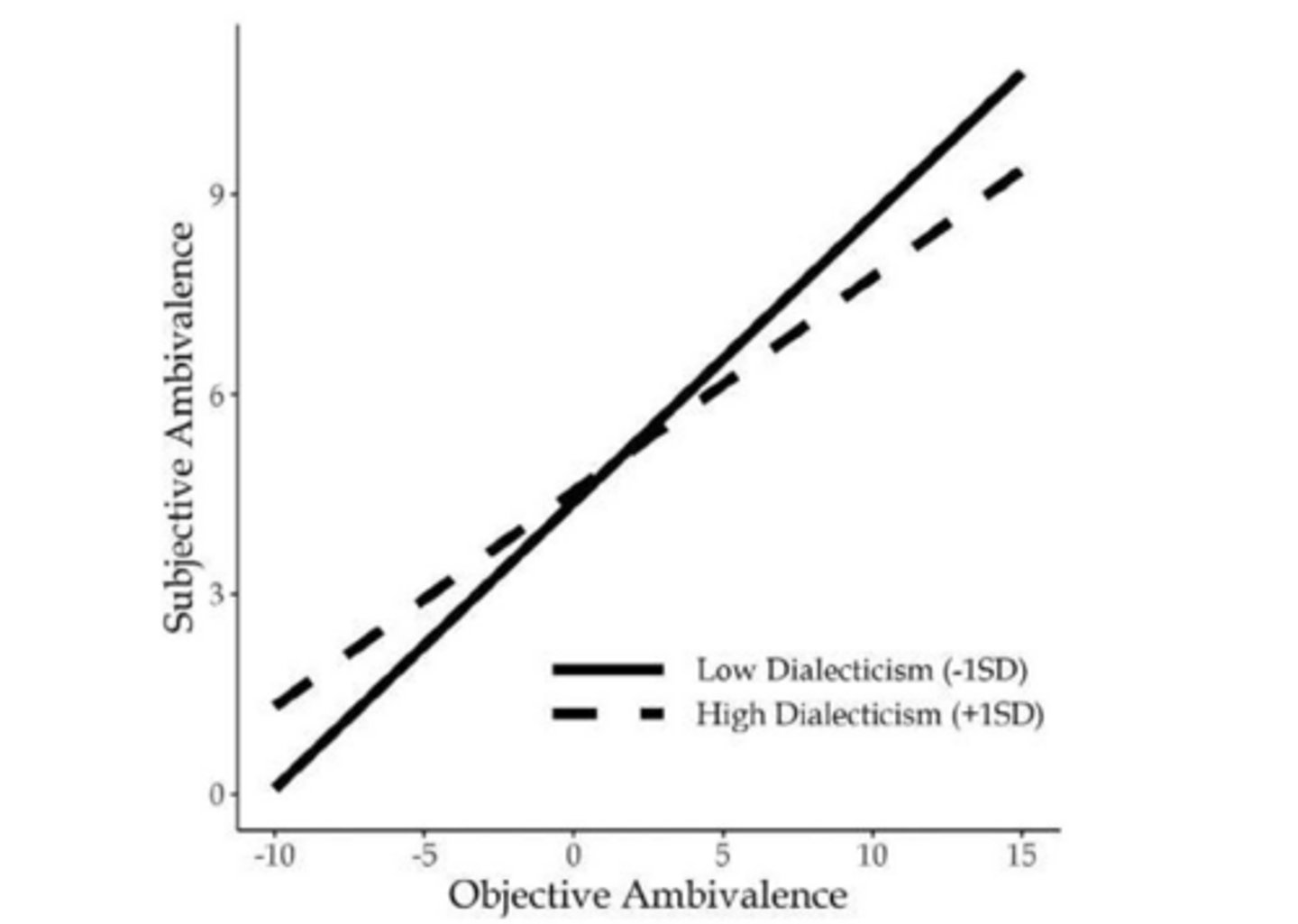
What does greater dialecticism predict regarding attitudinal ambivalence?
It should attenuate the relationship between attitudinal ambivalence and mixed emotions.
What is fluency in the context of cognitive processing?
The extent to which information is cognitively easy to process.
How does fluency affect attitudes?
Greater fluency results in more positive attitudes.
What was the result of the experiment by Song & Schwarz (2008) regarding font characteristics?
Easier-to-read font fostered fluency, leading to viewing tasks as easier and greater likelihood of incorporating them into daily routines.
What discomfort do non-dialectical thinkers experience?
Cognitive disfluency when processing contradictory information.
What cultural bias is observed in North America regarding ambivalent political opinions?
People dislike others who hold ambivalent opinions, even if they agree with the perspective.
What is the significance of the Chinese idiom 'A Blessing in Disguise'?
It implies that a misfortune can turn out to be beneficial.
What is the predicted outcome of greater dialecticism on subjective ambivalence?
It should lead to less discomfort in holding ambivalent attitudes.
What were the results of Study 1 on individual differences in dialectical thinking among American participants?
Participants who thought more dialectically were less bothered by holding ambivalent attitudes.
What were the results of Study 2 comparing Americans and Taiwanese participants regarding ambivalence?
Taiwanese participants were less bothered by holding ambivalent attitudes compared to American participants.