Lecture 22: Morphogenesis II: Limb Development in Tetrapods
 Call Kai
 Learn
Learn Practice Test
 Spaced Repetition
 Match
Match Flashcards
 Knowt Play
1/59

There's no tags or description
Looks like no tags are added yet.
Name | Mastery | Learn | Test | Matching | Spaced | Call with Kai |
|---|
No analytics yet
Send a link to your students to track their progress
60 Terms
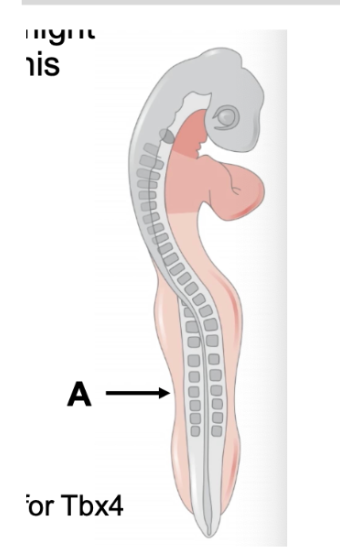
Which of the following “move it” experiments might
result in an extra leg growing from point A in this
chick embryo?
A. Transplant an extra AER
B. Transplant leg mesenchyme
C. Insert a bead containing Fgf8
D. Insert a bead containing Fgf10
E. Insert a bead containing Fgf10 and an activator for Tbx4
F. Insert a bead containing Fgf10 and an activator for Tbx5
E
1. Which of the following groups of animals are tetrapods?
A) Fish, amphibians, reptiles, and birds B) Amphibians, reptiles, birds, and mammals C) Reptiles, birds, mammals, and fish D) All vertebrates including fish
Answer: B — Tetrapods are animals with four limbs: amphibians, reptiles, birds, and mammals.
Which molecule induces the forelimb field?
A) Fgf10 B) Tbx5 C) Retinoic acid (RA) D) Shh
Answer: C — Retinoic acid (RA) is a transcriptional regulator that induces the forelimb field.
Answer: C — Retinoic acid (RA) is a transcriptional regulator that induces the forelimb field.
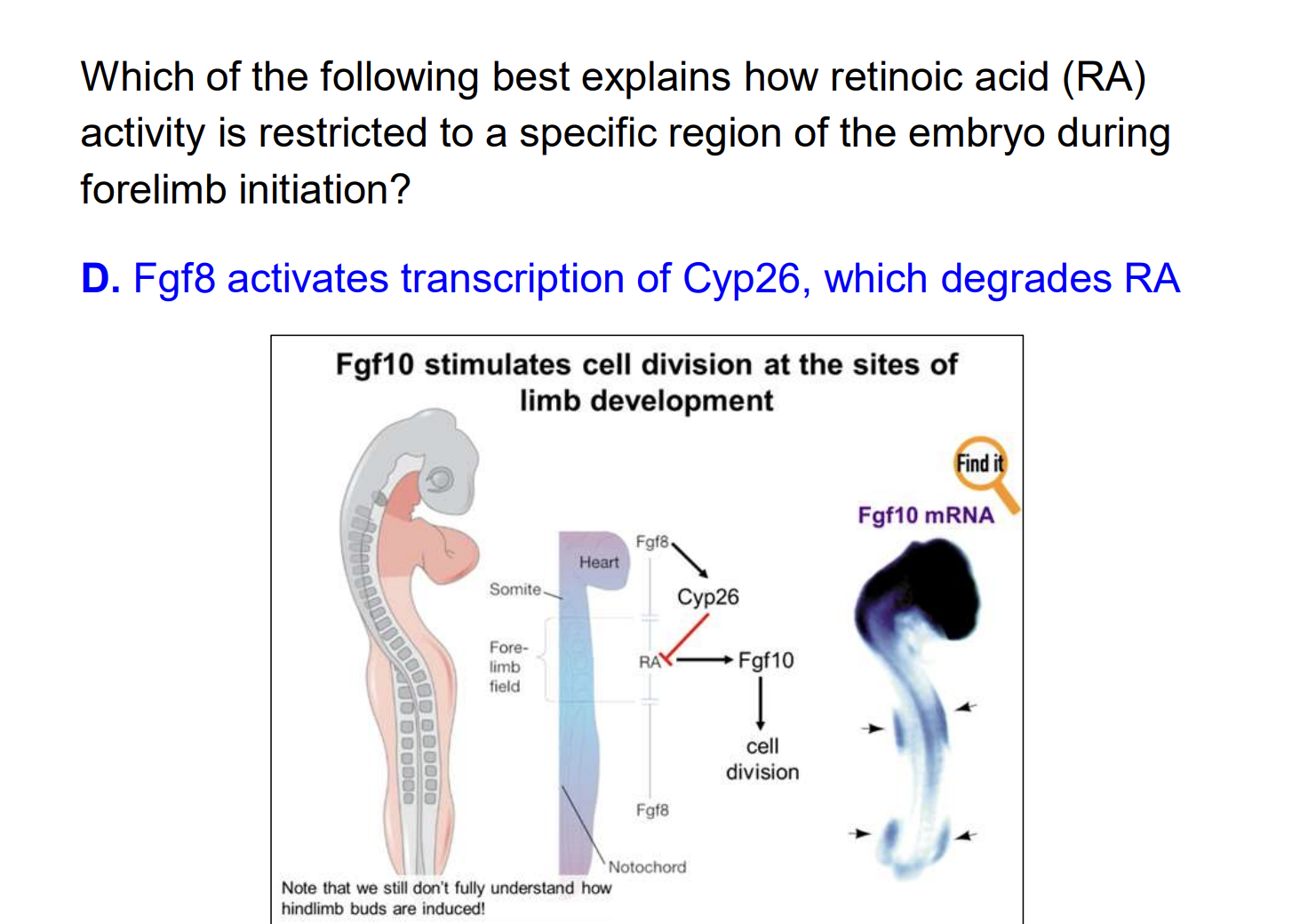
How is retinoic acid (RA) activity limited to the correct region for forelimb development?
A) Tbx5 directly degrades RA outside the forelimb field B) Fgf8 stimulates synthesis of Cyp26, an enzyme that degrades RA C) Shh represses RA transcription in non-forelimb regions D) RA is only synthesized in forelimb progenitor cells
Answer: B — Fgf8 stimulates Cyp26 synthesis, which degrades RA and limits its activity to the forelimb region.
What is the role of Fgf10 in early limb development?
A) It degrades retinoic acid to limit the forelimb field B) It determines whether the limb will be a forelimb or hindlimb C) It stimulates cell division in the limb field D) It patterns digit identity along the anterior-posterior axis
Answer: C — Fgf10 stimulates cell division in the limb field, driving limb bud formation.
What determines whether a limb bud becomes a forelimb versus a hindlimb?
A) The concentration of retinoic acid in the limb bud B) The expression of Tbx5 (forelimb) or Tbx4 (hindlimb) C) The position of the AER along the limb bud D) The timing of Fgf10 activation
Answer: B — Tbx5 expression leads to forelimb development and Tbx4 expression leads to hindlimb development.
A researcher ablates the AER from a developing chick limb bud. What would most likely happen?
A) The limb would develop extra digits due to loss of BMP inhibition B) Limb outgrowth would stop because Fgf8 is lost C) The limb would switch from forelimb to hindlimb identity D) Shh signaling would be upregulated to compensate
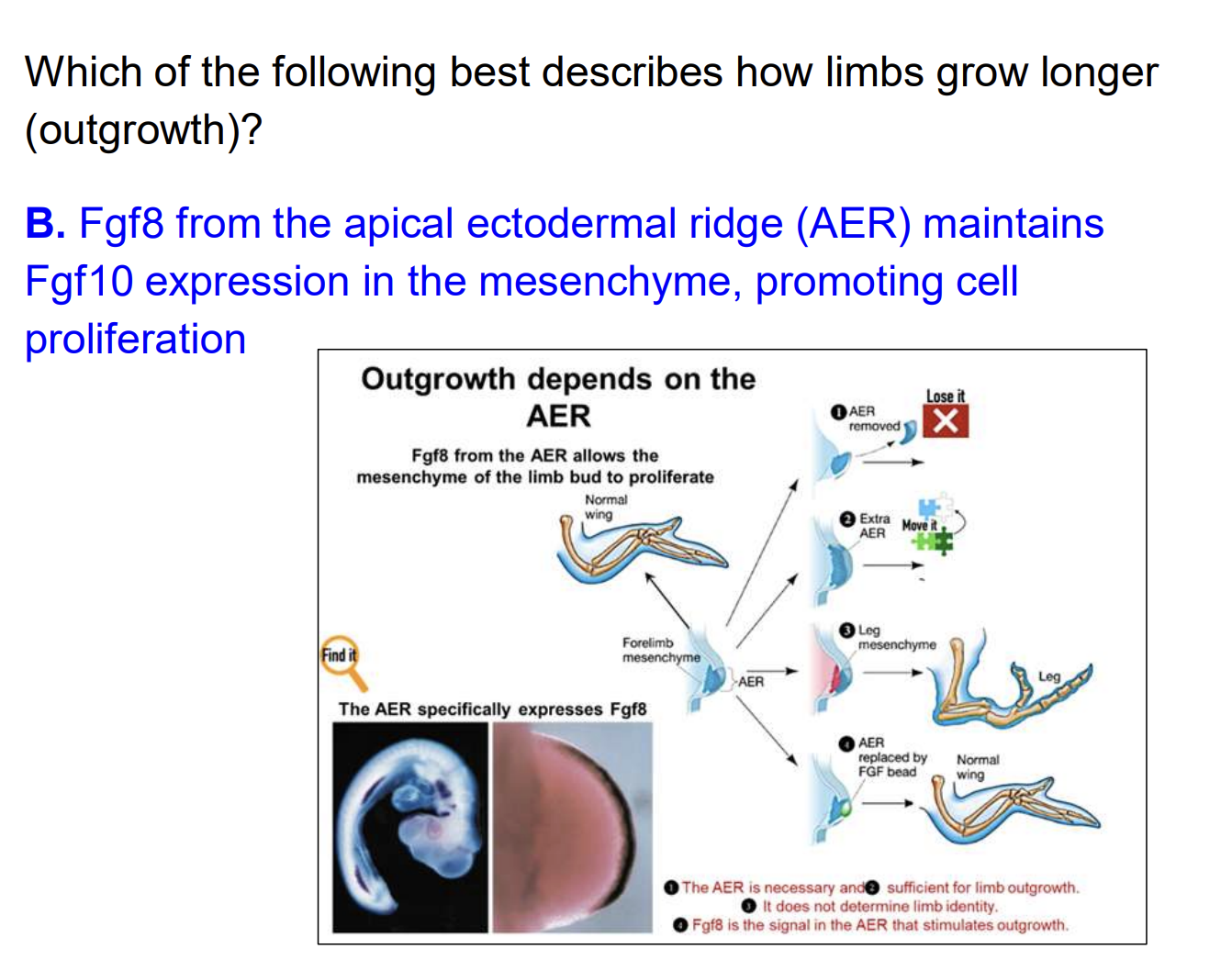
Answer: B — The AER is necessary and sufficient for limb outgrowth because it produces Fgf8, which drives cell proliferation in the mesenchyme.
How does Fgf8 from the AER promote limb outgrowth?
A) It directly stimulates cell division in the AER itself B) It activates Fgf10 expression in the mesenchyme, causing cells to proliferate C) It activates Shh to pattern the digits distally D) It inhibits Hox gene expression to keep cells undifferentiated
Answer: B — Fgf8 from the AER activates Fgf10 expression in the mesenchyme, driving continued cell proliferation and limb outgrowth.
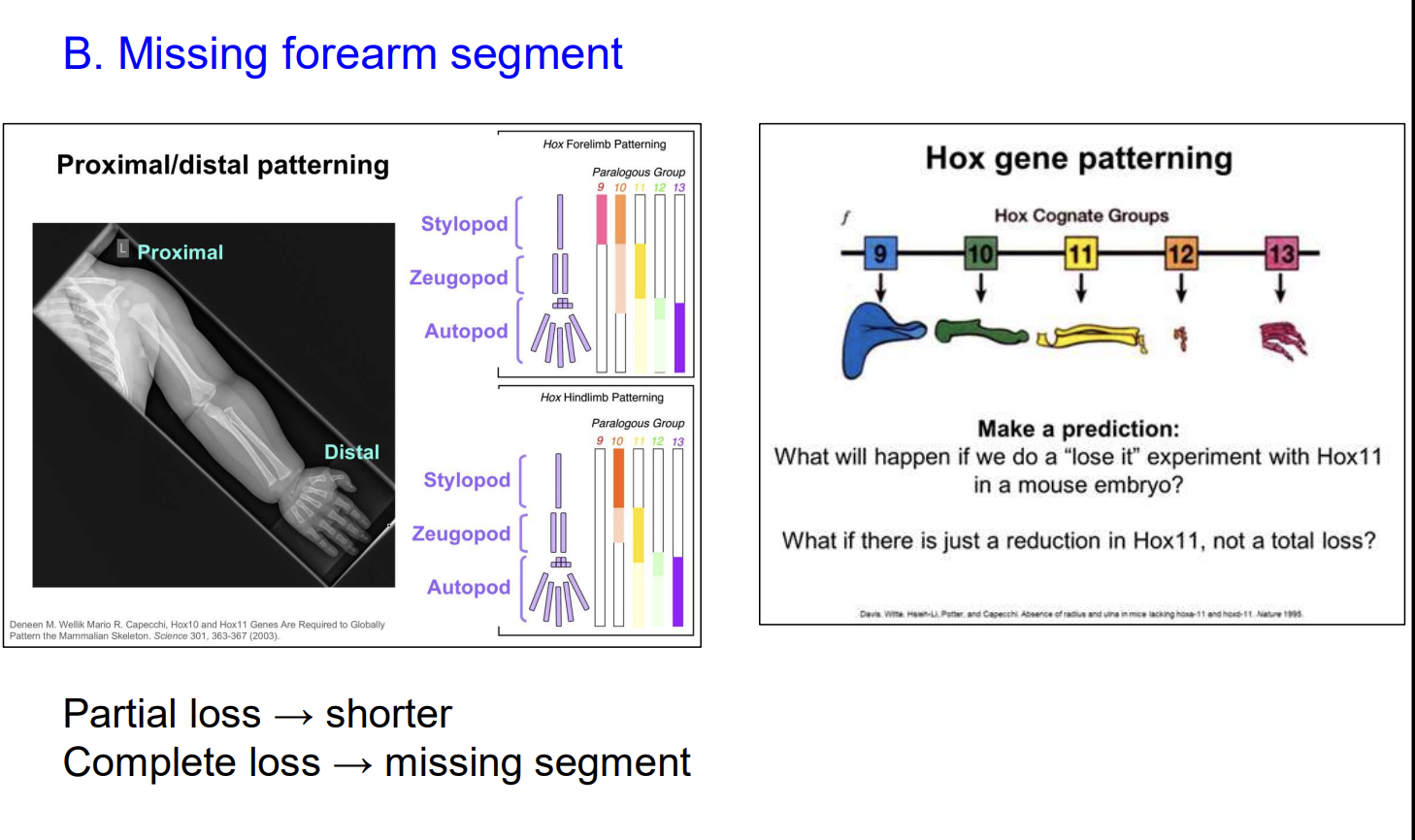
Which genes determine the identity of segments along the length of the limb?
A) Tbx genes B) Fgf genes C) Hox genes D) Shh and BMP genes
Answer: C — Hox genes determine the identity of segments along the limb.
How are Hox genes expressed along the limb axis?
A) Hox genes with lower numbers are expressed more distally B) Hox genes with higher numbers are expressed more distally C) All Hox genes are expressed uniformly throughout the limb D) Hox genes are only expressed at the proximal end near the body
Answer: B — Hox genes with higher numbers are expressed more distally in the limb.
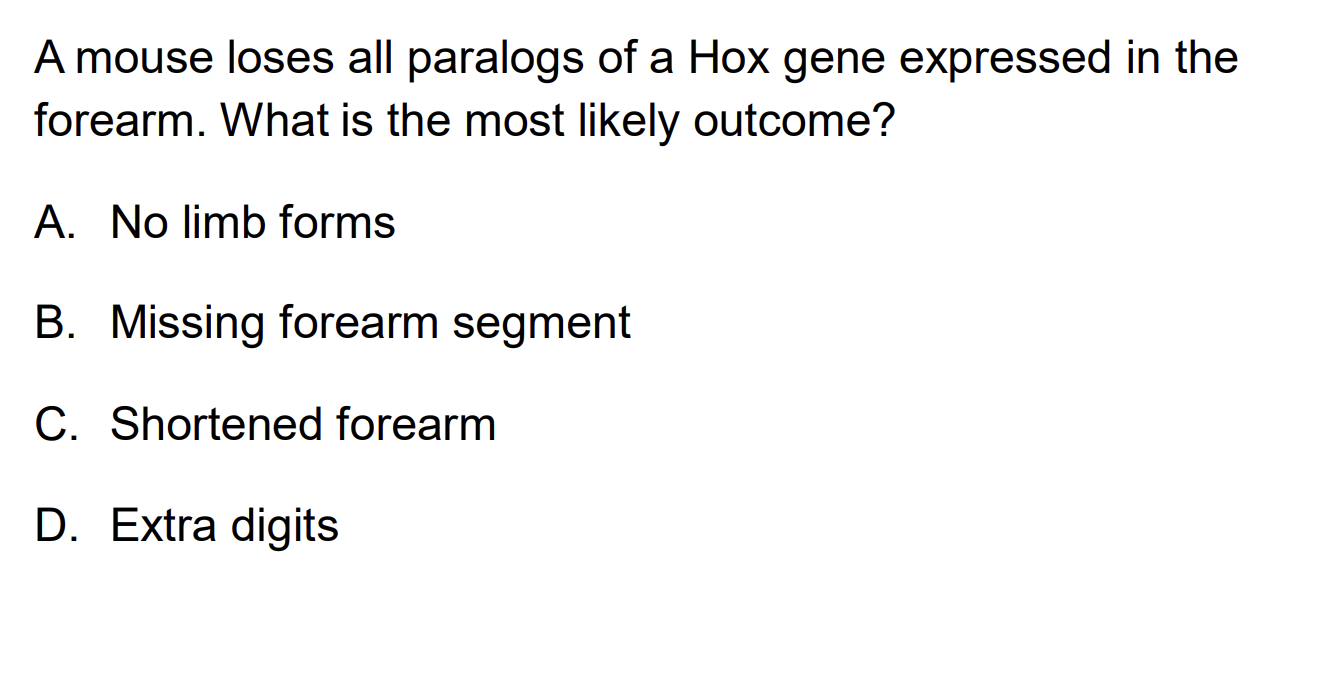
What is the result of losing ALL paralogs of a particular Hox gene (e.g., Hoxa11, Hoxc11, and Hoxd11)?
A) A shorter-than-normal limb segment B) Complete loss of the limb segment where those genes are normally expressed C) Loss of digit identity without affecting limb length D) Conversion of that limb segment into a more proximal segment identity
Answer: B — Loss of all paralogs results in complete loss of the limb segment where those genes are normally expressed.
What is the result of losing only ONE paralog of a Hox gene?
A) Complete loss of that limb segment B) No noticeable phenotype due to compensation C) A shorter-than-normal limb segment D) Conversion of the limb segment to a different identity
Answer: C — Partial loss (one paralog) results in a shorter-than-normal limb segment, while complete loss of all paralogs removes the segment entirely.
Sonic hedgehog (Shh) patterns the digits along which axis?
A) Proximal-distal axis B) Dorsal-ventral axis C) Posterior-anterior axis D) Medial-lateral axis
Answer: C — Shh forms a morphogen gradient along the posterior-anterior axis to pattern digit identity.
Which digits are specified by HIGH concentrations of Shh?
A) Digits 1 and 2 B) Digits 2 and 3 C) Digits 3 and 4 D) Digits 4 and 5
Answer: D — High levels of Shh specify the identity of digits 4 and 5 (ring finger and pinky).
Which digit develops independently of Shh signaling?
A) Digit 2 B) Digit 3 C) Digit 1 D) Digit 5
Answer: C — Digit 1 (the thumb) develops independent of Shh signaling.
Digit identity is determined by which of the following?
A) Shh concentration alone B) The timing of Shh exposure alone C) A combination of Shh concentration and the time at which Shh reaches the tissue D) BMP concentration along the anterior-posterior axis
Answer: C — Digit identity is determined by both the concentration of Shh AND the timing of when Shh reaches that tissue.
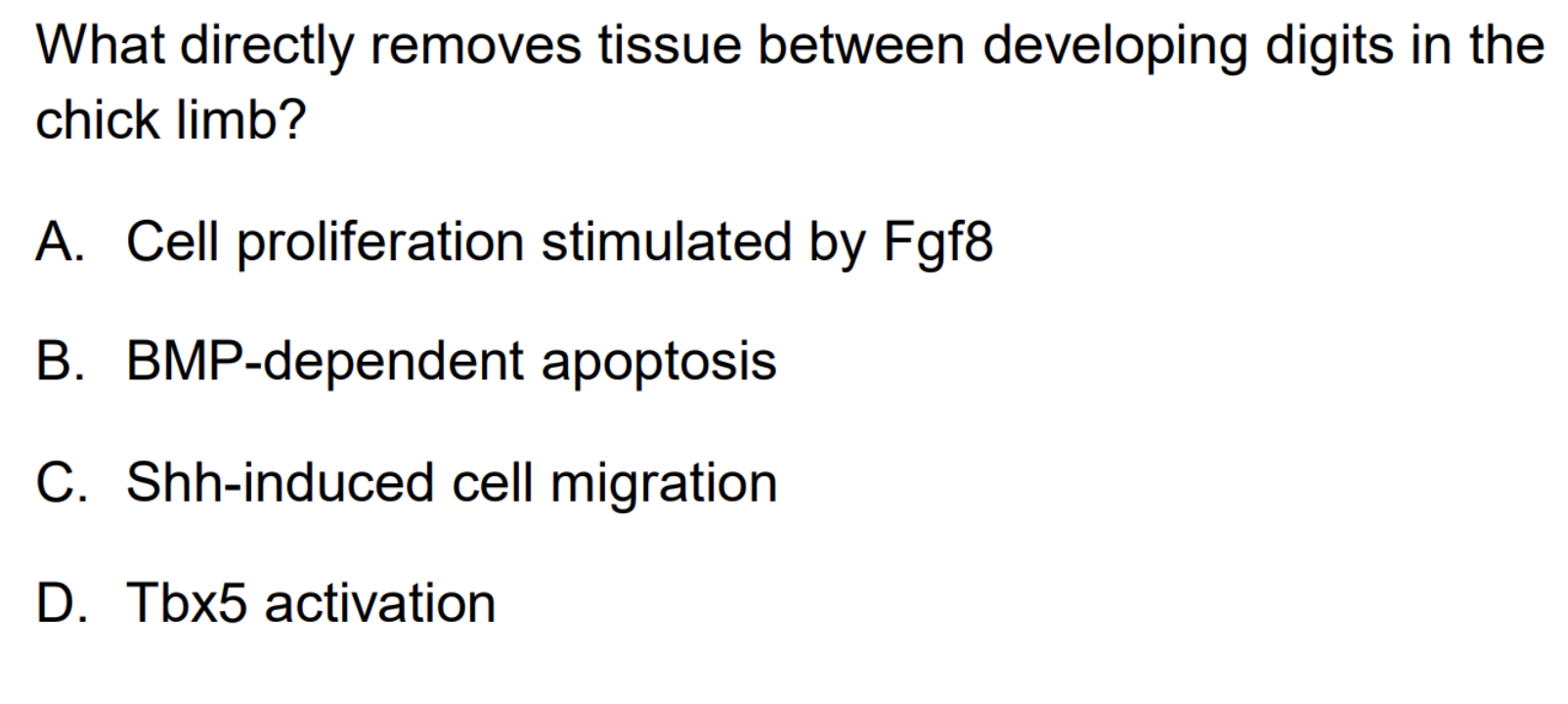
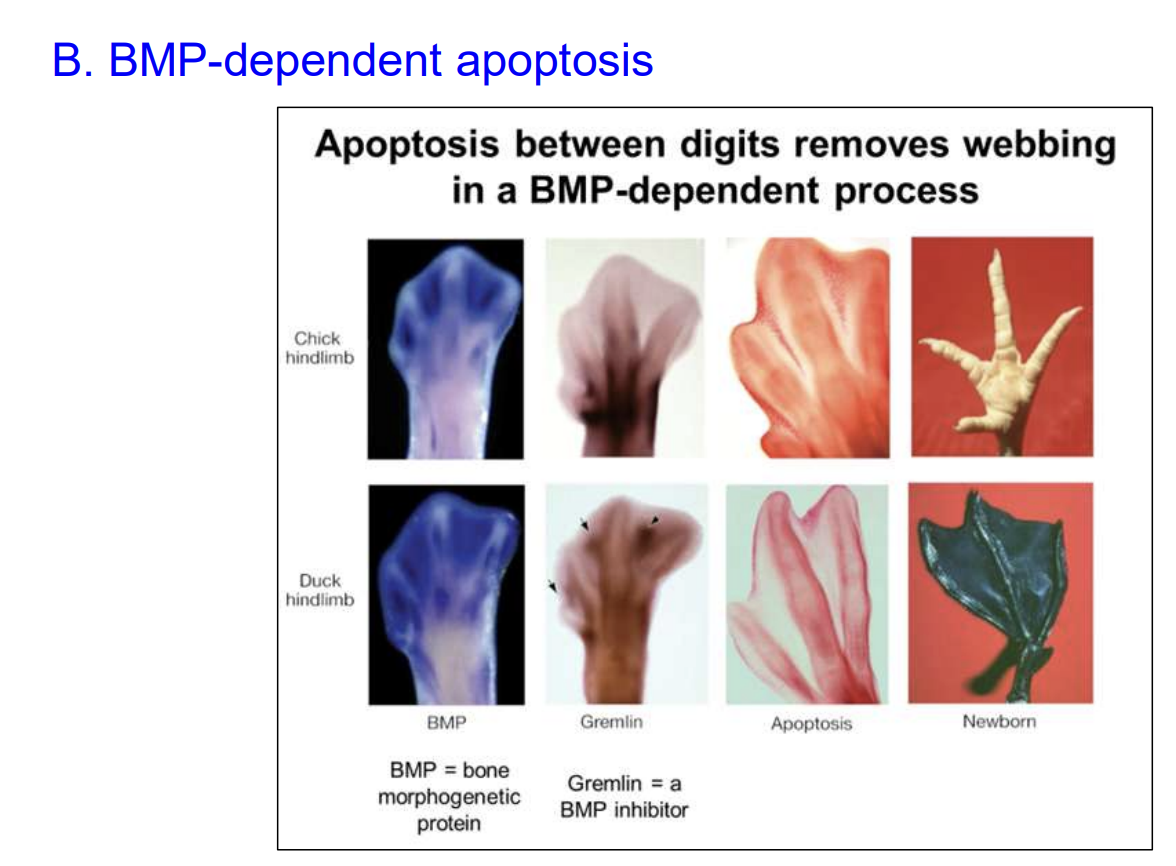
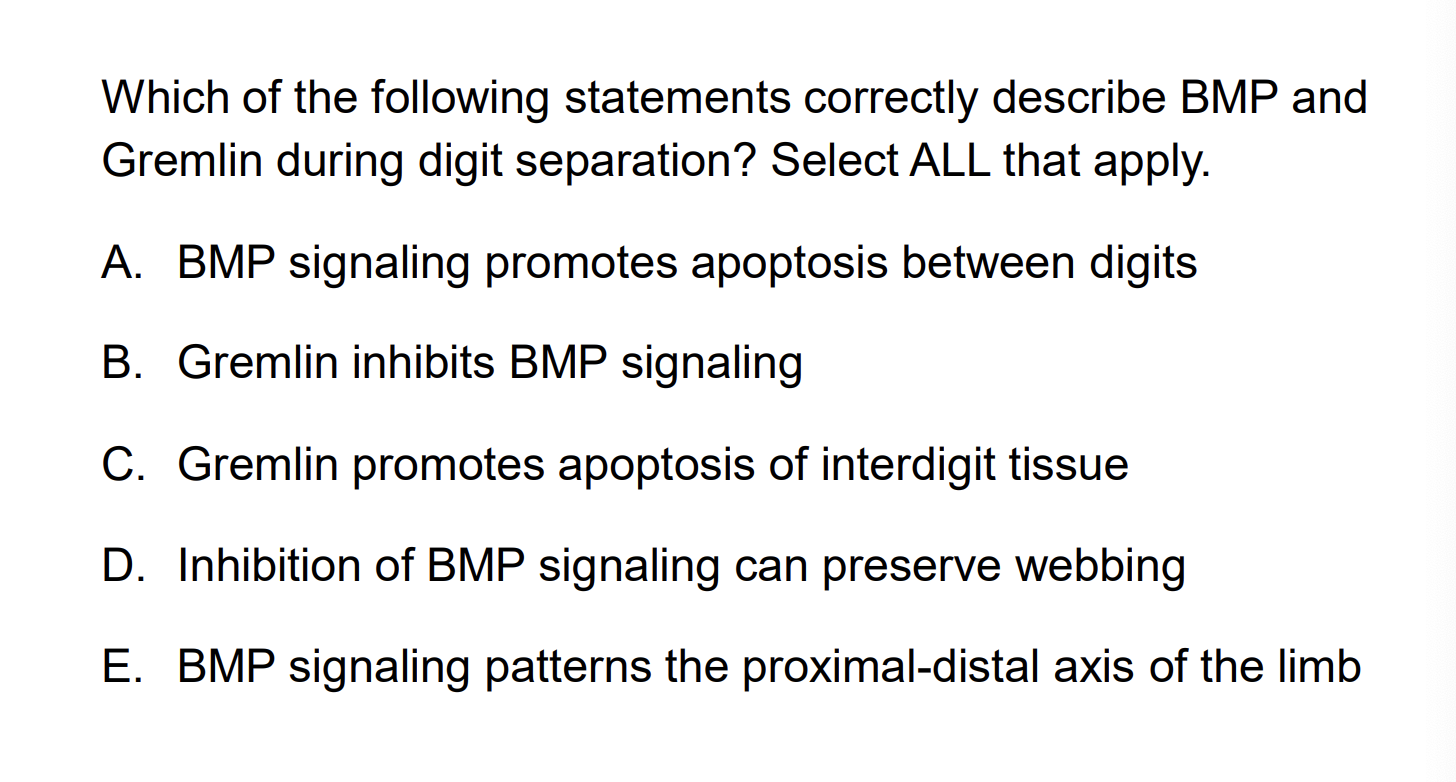
What is the normal role of BMP signaling in digit development?
A) It stimulates digit outgrowth by activating Fgf10 B) It causes apoptosis of interdigit tissue, resulting in separate digits C) It inhibits Shh to prevent extra digit formation D) It specifies digit identity along the posterior-anterior axis
Answer: B — BMP activity in the interdigit tissue causes apoptosis of those cells, resulting in non-webbed digits.
What happens when Gremlin inhibits BMP in the interdigit tissue?
A) Extra digits form due to increased cell proliferation B) The interdigit tissue survives and digits remain connected by webbing C) Digit identity shifts toward more posterior identities D) The AER expands and produces more Fgf8
Answer: B — When Gremlin inhibits BMP, interdigit cells are not killed and the digits remain webbed.
Which of the following animals would you expect to have reduced or absent Gremlin activity in their interdigit tissue?
A) Ducks B) Humans C) Chickens D) None of the above
Answer: C — Chickens (and other birds without webbing) would have active BMP causing interdigit apoptosis. Ducks, which have webbed feet, would have more Gremlin activity inhibiting BMP.
All of the following are true about the AER EXCEPT:
A) It is located at the most distal part of the limb bud B) It produces Fgf8 C) It is necessary and sufficient for limb outgrowth D) It directly expresses Hox genes to determine limb segment identity
Answer: D — The AER produces Fgf8 for limb outgrowth. Hox genes are expressed in the mesenchyme, not the AER.
The mechanism that triggers hindlimb Fgf10 expression, unlike the forelimb, is described in the lecture as:
A) Retinoic acid signaling B) Tbx4 induction by Shh C) An unknown mechanism D) BMP inhibition by Gremlin
Answer: C — The lecture specifically states that an unknown mechanism leads to Fgf10 expression at the site of the future hindlimbs.
A mutation causes Tbx5 to be expressed in the hindlimb bud instead of the forelimb bud. What would most likely result?
A) The hindlimb would fail to develop entirely B) The hindlimb would develop forelimb-like characteristics C) The forelimb would develop hindlimb-like characteristics D) Both limbs would develop normally due to compensation by Tbx4
Answer: B — Tbx5 expression drives forelimb identity, so expressing it in the hindlimb bud would cause the hindlimb to develop forelimb-like characteristics.
Which of the following best explains the diversity of tetrapod limbs despite conserved developmental mechanisms?
A) Each species has completely different sets of developmental genes B) Tetrapods do not actually share conserved limb development mechanisms C) Gene expression can be tweaked to achieve different limb structures using conserved mechanisms D) Limb diversity arises entirely from differences in ECM composition
Answer: C — All tetrapod limbs begin as limb buds using conserved mechanisms, but gene expression can be tweaked to produce the wide diversity of limb structures seen across species.
Which of the following correctly pairs the signaling molecule with its function in limb development?
A) Shh — drives limb outgrowth from the AER B) Fgf8 — patterns digit identity along the posterior-anterior axis C) BMP — causes apoptosis of interdigit tissue D) Retinoic acid — specifies hindlimb identity via Tbx4
Answer: C — BMP causes apoptosis of interdigit tissue. Shh patterns digits, Fgf8 drives outgrowth, and RA induces the forelimb field.
If you grafted an extra AER onto the anterior side of a developing limb bud, what would you predict?
A) The limb would switch to hindlimb identity B) The limb would grow longer or form duplicated structures due to extra Fgf8 C) Digit 1 would be lost because Shh signaling would be disrupted D) No effect because AER activity is regulated by the mesenchyme
Answer: B — Since the AER produces Fgf8 which is necessary and sufficient for outgrowth, an extra AER would provide additional Fgf8 and likely cause extra or duplicated limb growth.
Which of the following represents the correct sequence of events in forelimb initiation?
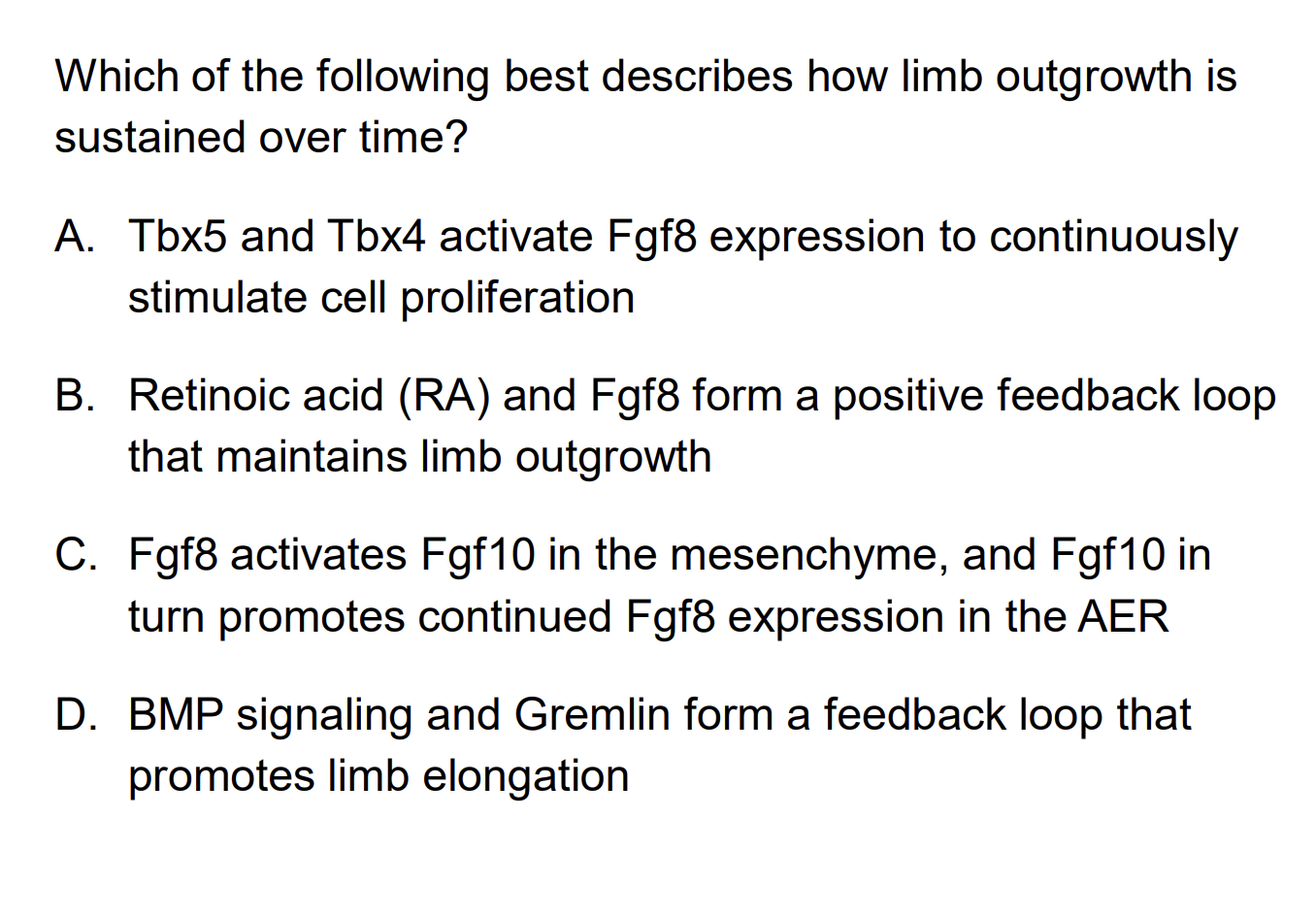
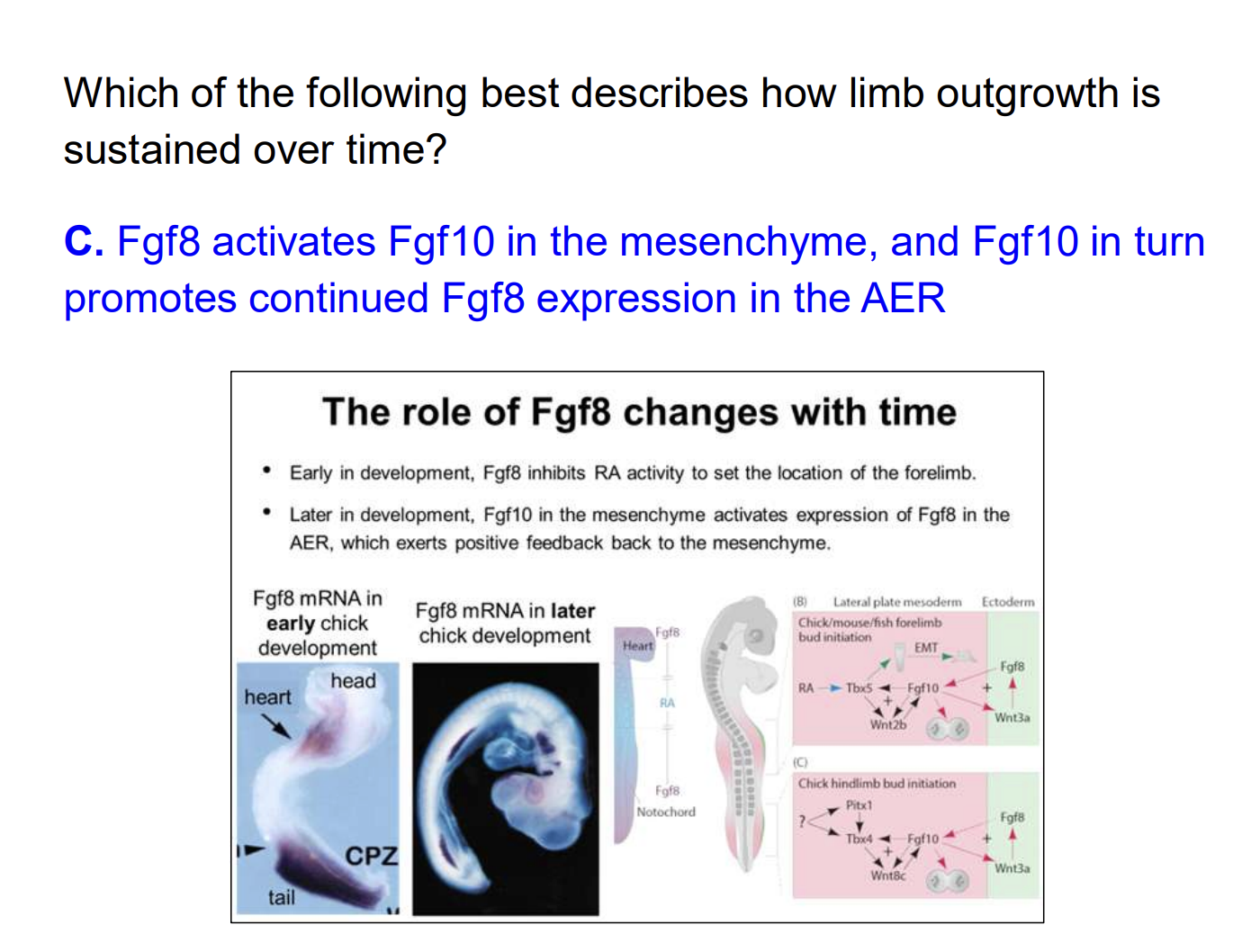
A) Fgf10 → RA → Cyp26 → cell division B) RA → Fgf10 → Cyp26 → cell division C) RA → Cyp26 → Fgf8 → Fgf10 → cell division D) RA activates Fgf10 → Fgf8 stimulates Cyp26 to degrade RA → cell division continues
Answer: D — RA induces the forelimb field and activates Fgf10, which stimulates cell division. Fgf8 stimulates Cyp26 to degrade RA and limit its activity, while Fgf10 continues driving cell proliferation.
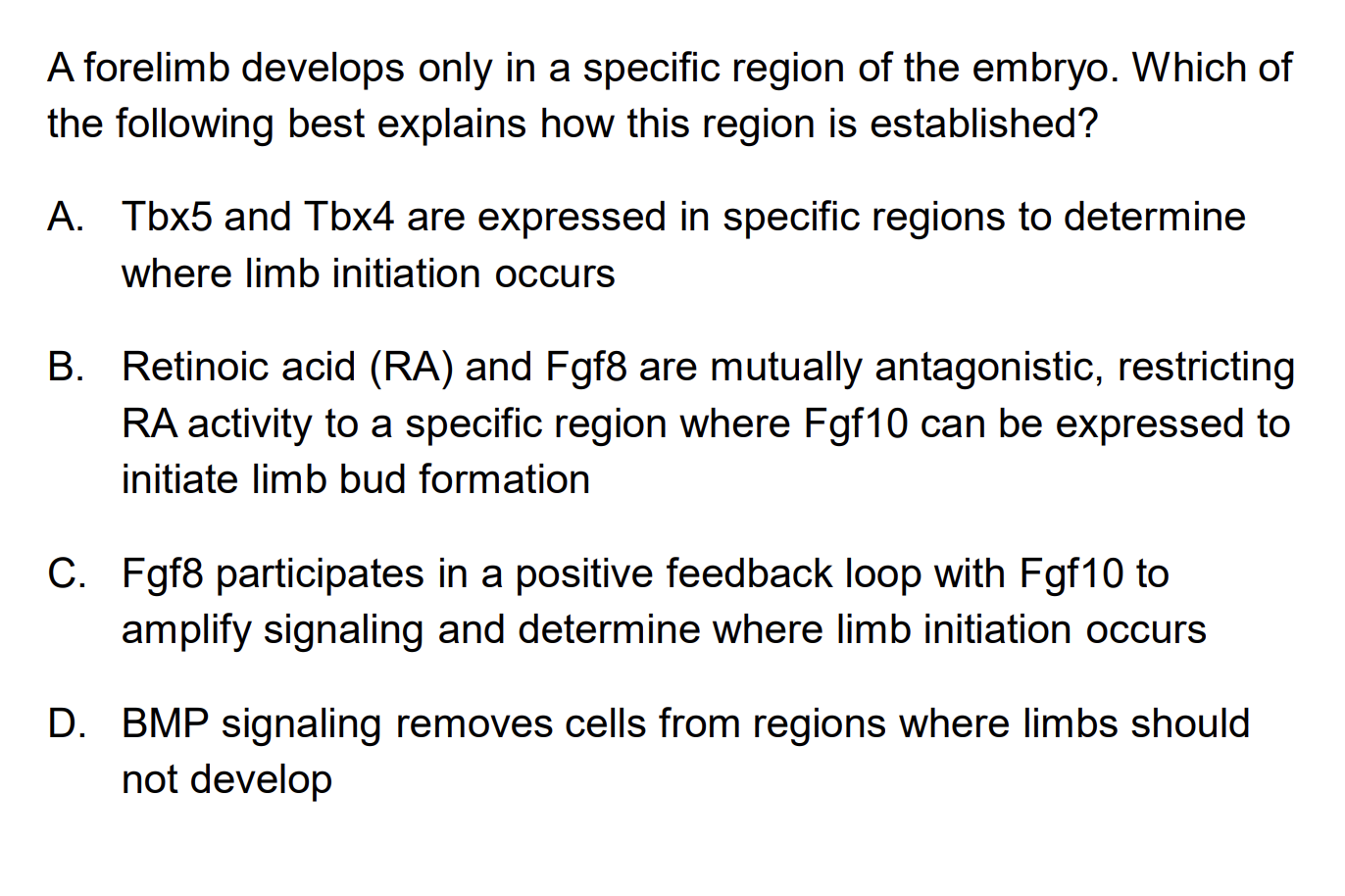
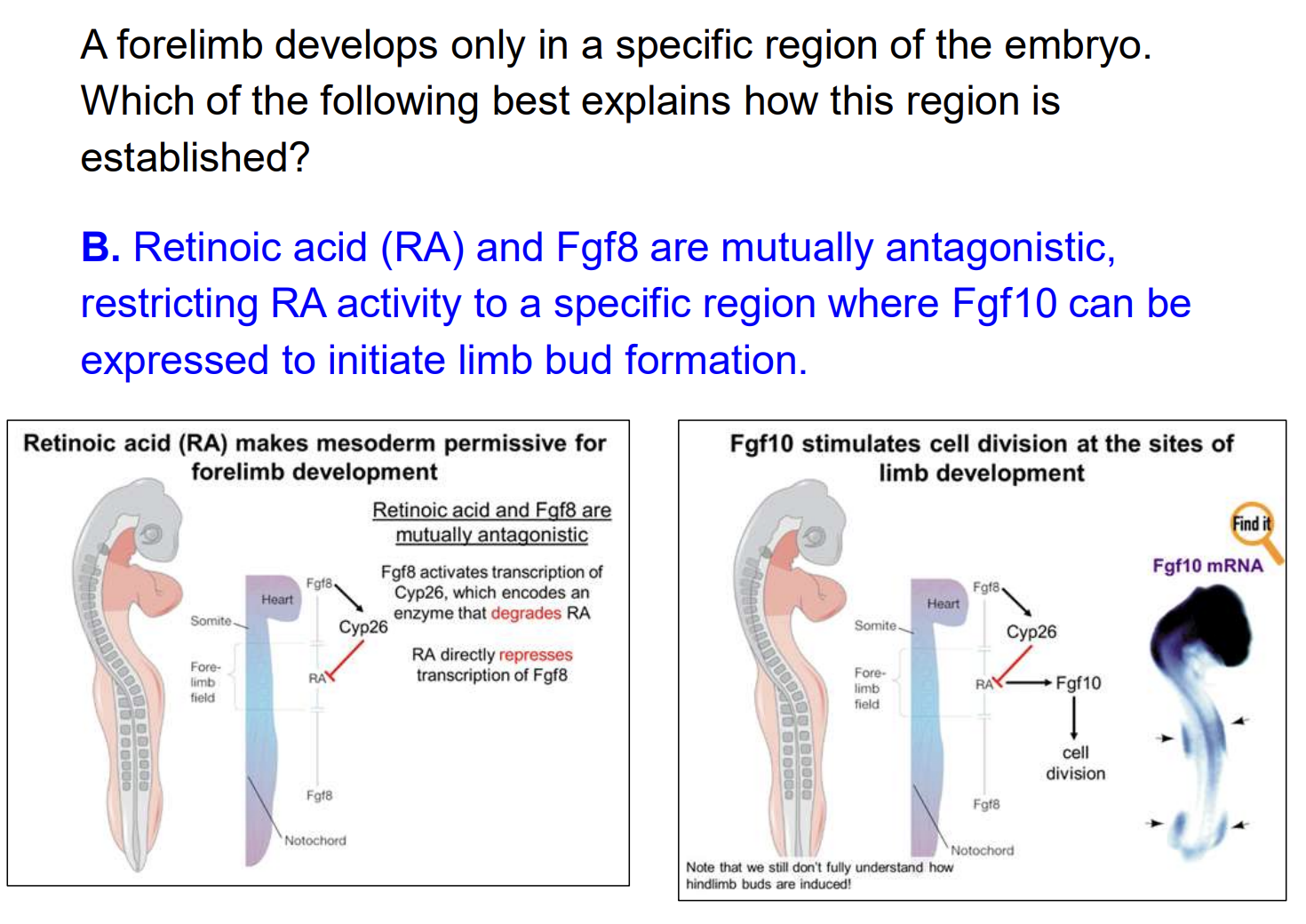
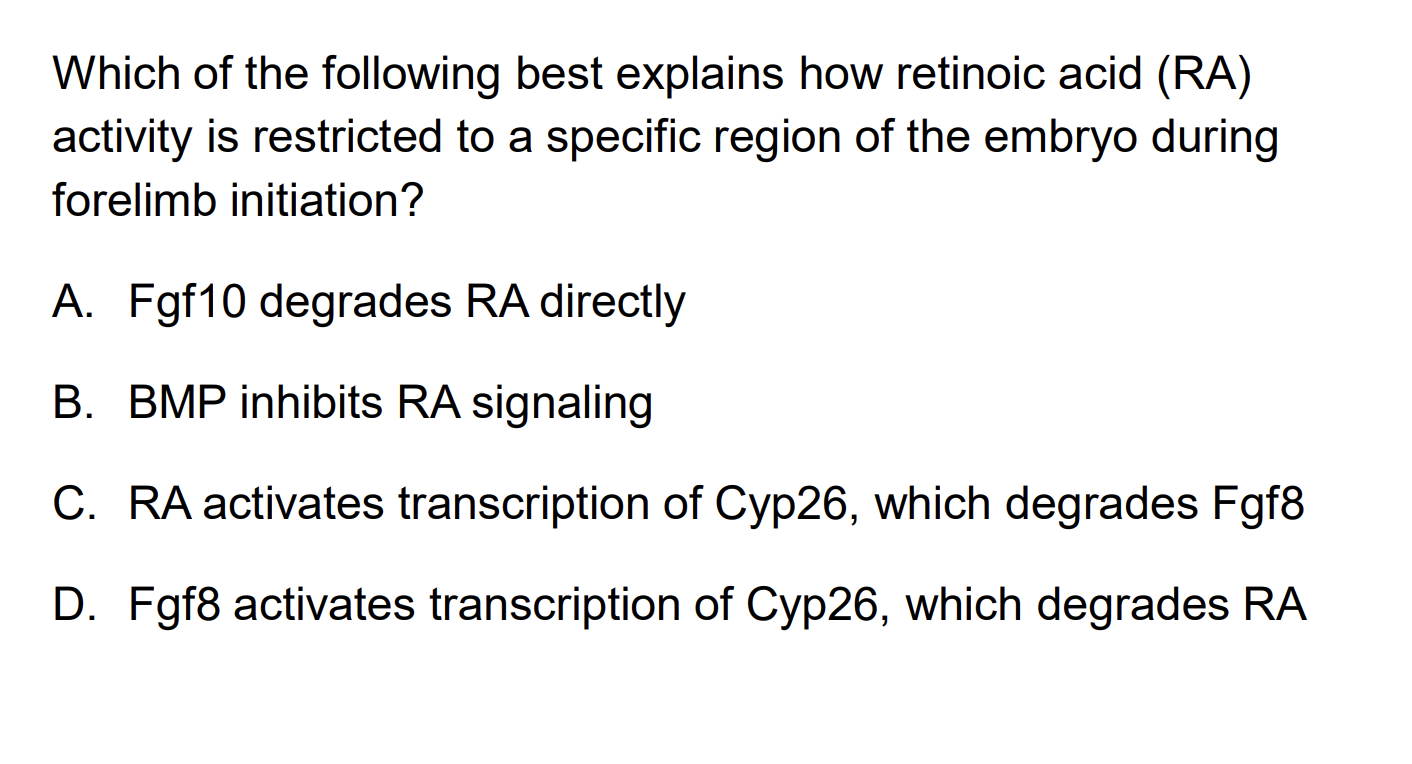
Which structure is most proximal along the proximal-distal axis of the developing limb?
A) Digits B) Wrist C) Elbow D) Shoulder
D
Which side of the developing forelimb corresponds to the thumb?
A) Proximal B) Anterior C) Ventral D) Posterior
B
What is the primary role of retinoic acid (RA) in initiating forelimb development?
A) Determines forelimb vs hindlimb identity B) Directly drives cell proliferation for limb growth C) Patterns digits along the anterior-posterior axis D) Activates transcription of Fgf10 in the mesoderm, which stimulates cell division
D
Which statements describe how RA and Fgf8 interact to set forelimb position? Select ALL that apply.
A) RA directly represses Fgf8 transcription B) Fgf8 activates transcription of Cyp26, which encodes an enzyme that degrades RA C) Their antagonism restricts RA to a specific region, defining where the forelimb forms D) They cooperate to pattern digits along the anterior-posterior axis
A, B, and C
What is one role of early Fgf8 expression before the AER forms?
A) It specifies forelimb identity by activating Tbx5 in the mesoderm B) It forms the digits by activating BMP in the interdigit tissue C) It enables Fgf10 expression throughout the trunk so multiple limb buds can form D) It activates Cyp26 to degrade RA in the heart and tail regions, preventing limb initiation where limbs should not form
D
How does mutual antagonism between RA and Fgf8 contribute to correct forelimb positioning?
A) RA and Fgf8 both pattern digits along the anterior-posterior axis B) RA promotes Fgf8 transcription in anterior regions, ensuring limbs form near the head C) RA allows Fgf10 expression in a permissive zone, while Fgf8 limits RA activity in surrounding regions where limbs should not form D) RA and Fgf8 work together to increase Fgf10 everywhere so limbs can form at any level
C
What is the primary role of RA in specifying where the forelimb will form?
A) RA determines whether the limb becomes a forelimb or hindlimb B) RA makes mesoderm competent to express Fgf10 C) RA directly stimulates rapid growth of the limb bud D) RA activates apoptosis to create digits
B
Blocking RA before forelimb initiation will result in which of the following?
A) Extra forelimbs forming B) A limb with extra digits C) Prevention of forelimb formation D) Swapping of forelimb for hindlimb identity
C
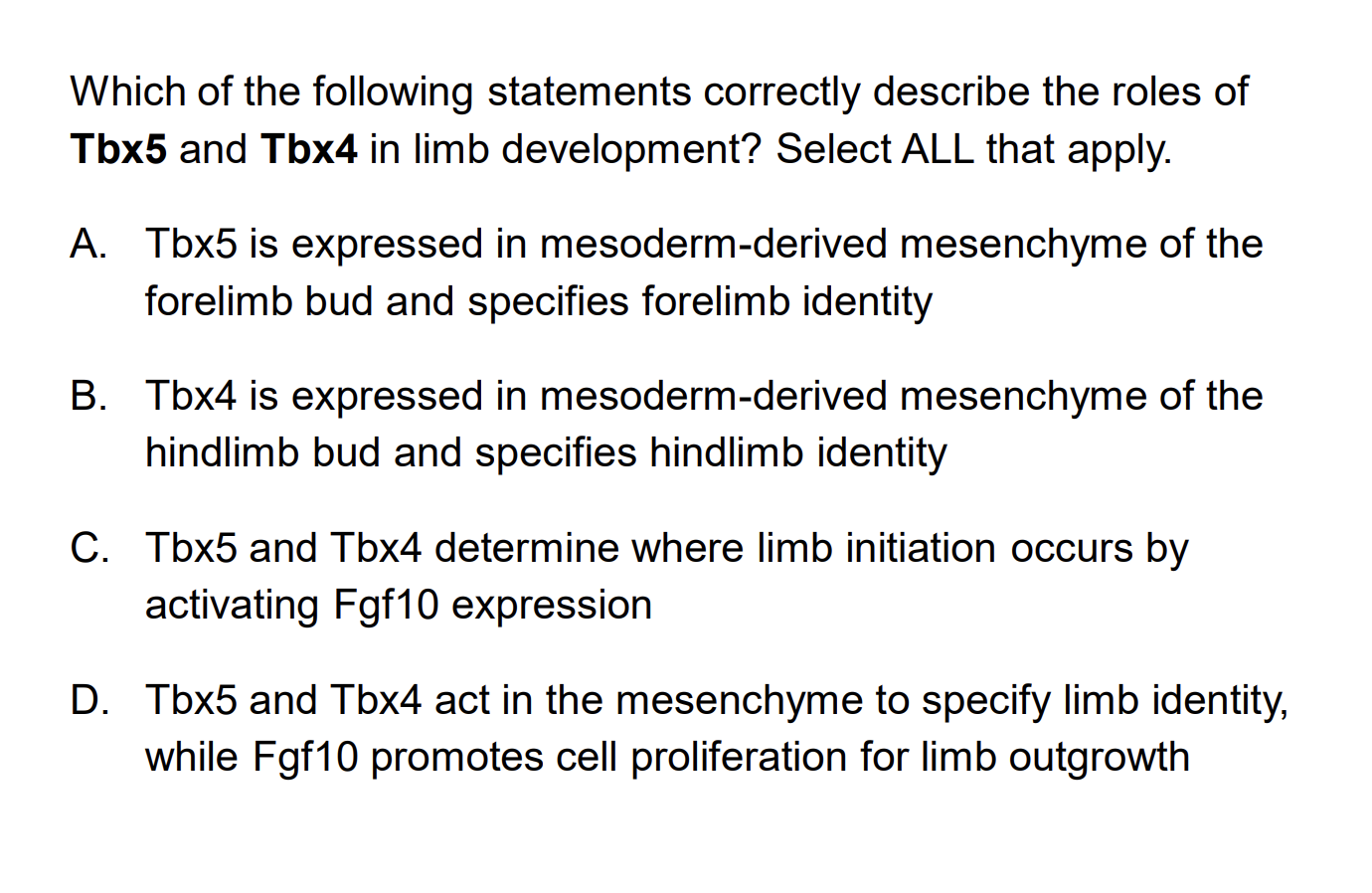
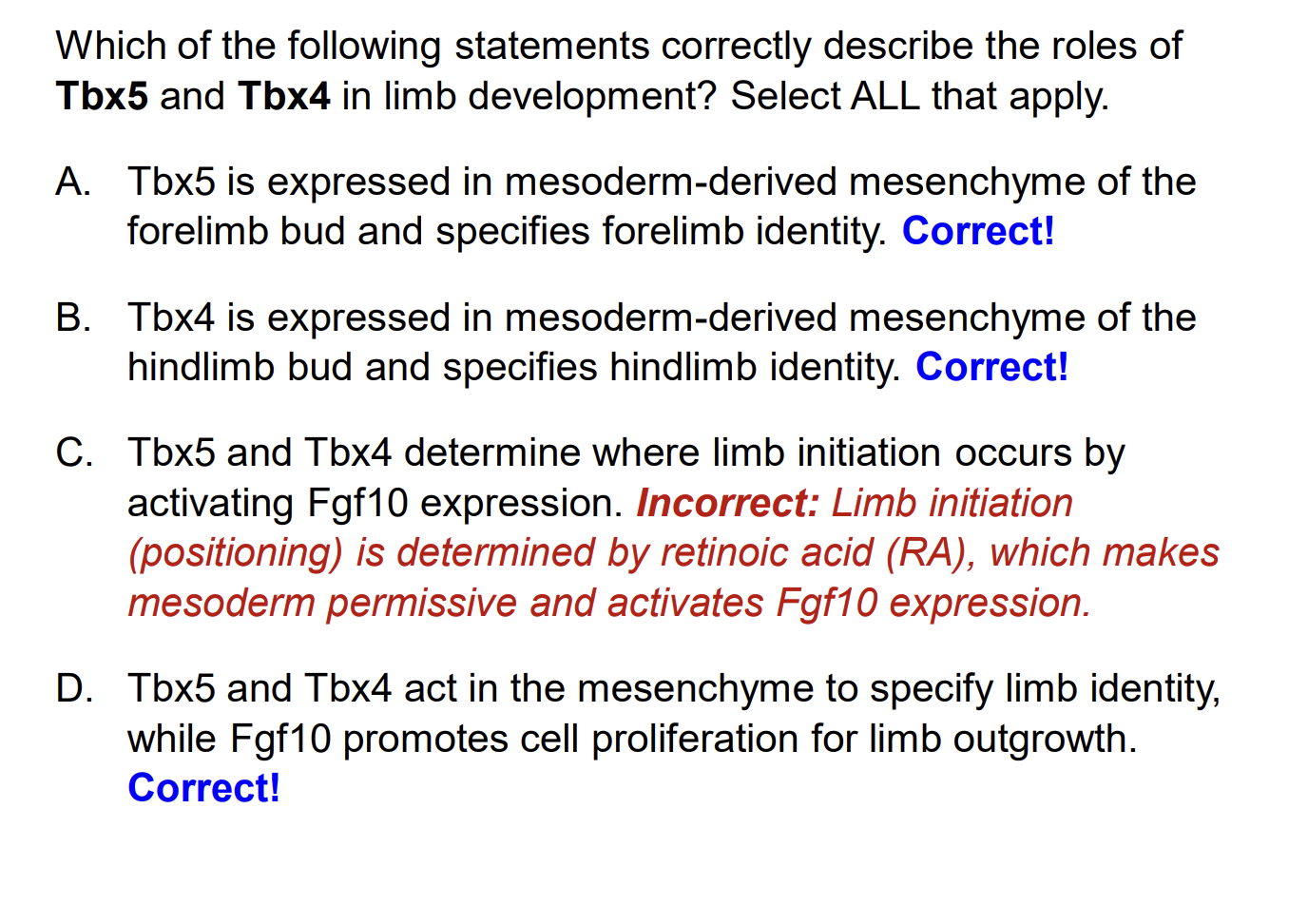
Which gene specifies forelimb identity?
A) Hox13 B) Fgf10 C) Tbx4 D) Tbx5
D
Which of the following accurately describe how limb identity and outgrowth are controlled? Select ALL that apply.
A) Tbx5 expression in mesoderm-derived mesenchyme specifies forelimb identity B) The AER determines whether the limb becomes a forelimb or hindlimb by expressing Fgf8 C) Fgf8 from the AER maintains limb outgrowth by promoting proliferation of mesenchymal cells D) All of the above
A and C
Why does a forelimb still form when the AER from a hindlimb is transplanted onto a forelimb bud?
A) Because Fgf8 from the AER replaces the need for identity signals B) Because the AER controls both identity and outgrowth C) Because the AER determines whether the limb will become a forelimb or hindlimb D) Because the mesoderm determines limb identity via Tbx5/Tbx4, and the AER only promotes outgrowth
D
Why does transplanting hindlimb mesenchyme into a forelimb bud result in a leg structure?
A) RA converts forelimb to hindlimb fate B) The mesenchyme expresses Tbx4, which specifies hindlimb fate C) Sonic hedgehog specifies forelimb vs hindlimb identity D) The AER determines limb identity
B
The mesenchyme of the limb bud is best described as?
A) The cells that express Fgf8 B) Tightly connected epithelial cells on the surface of the limb bud C) The cells that make up the AER D) Loosely packed cells located inside the limb bud that respond to signals from the AER
D
Which statement correctly distinguishes the roles of the AER and Fgf8 during limb outgrowth?
A) Both the AER and Fgf8 are signaling molecules that act broadly across the embryo to control limb identity B) The AER is a physical structure of ectodermal cells at the distal tip of the limb bud, and those cells express Fgf8, which signals to underlying mesenchyme to continue proliferating C) Fgf8 determines whether the limb will become a forelimb or hindlimb, while the AER specifies digit identities D) The AER is a gene expressed throughout the limb bud, and Fgf8 is a structural ridge that physically pushes the limb outward
B
Which pairing correctly describes a positive feedback loop in limb outgrowth?
A) BMP causes mesenchyme to express Fgf10 until digit formation is complete B) Shh activates RA to induce mesenchymal proliferation C) RA activates Tbx5, which turns off Fgf8 D) Fgf8 from the AER maintains Fgf10 in mesenchyme, which keeps Fgf8 expression in the AER
D
Which statement regarding the timing of Fgf8 function is correct?
A) Fgf8 has the same function throughout all stages of development B) Early Fgf8 blocks RA in heart and tail regions; later Fgf8 maintains outgrowth from the AER C) Fgf8 only controls digit patterning late in development D) None of the above
B
Which roles does Fgf8 perform late in limb development? Select ALL that apply.
A) Maintains proliferation of mesenchymal cells to support limb outgrowth B) Degrades retinoic acid to restrict where limbs form C) Participates in a positive feedback loop with Fgf10 to sustain limb outgrowth D) Determines forelimb vs hindlimb identity
A and C
What is the role of Hox genes in limb development?
A) They control whether the limb is a forelimb or hindlimb B) They determine how many limbs the embryo forms C) They separate digits by triggering apoptosis D) They pattern structures along the proximal-distal axis of the limb
D
What does Hox gene expression ensure? Select ALL that apply.
A) Limb structures form in the correct proximal-to-distal sequence B) Cells know whether they should become more proximal or more distal elements C) Forelimbs and hindlimbs have distinct identities D) More distal Hox genes are expressed later and in more distal regions of the limb
A, B, D
What outcomes would you expect from loss of one Hox paralog versus loss of all paralogs?
A) Loss of one paralog results in complete loss of the limb segment; loss of all paralogs results in a shorter segment B) Loss of one or more Hox genes affects only digit identity and does not affect proximal-distal patterning C) Loss of one paralog results in a shorter limb segment; loss of all paralogs results in complete loss of that segment D) None of the above
C
Which best describes how Sonic hedgehog (Shh) signaling influences digit identity?
A) Shh determines whether the limb becomes a forelimb or hindlimb B) Higher Shh levels and longer exposure specify more posterior digits, while low or no Shh specifies anterior digits C) Shh keeps the mesenchyme proliferating to extend the limb D) Shh causes the cells between digits to die
B
What does BMP do during digit separation?
A) Initiates limb outgrowth B) Patterns limb identity C) Triggers apoptosis between digits D) Determines digit number
C
Which of the following functions belong to retinoic acid? Select ALL that apply.
A) Helps define the forelimb field by creating a permissive region B) Keeps mesenchymal cells proliferating directly C) Activates Fgf10 expression in mesoderm D) Represses Fgf8 transcription, helping restrict limb initiation to the correct region E) Specifies forelimb vs hindlimb identity
A, C, and D
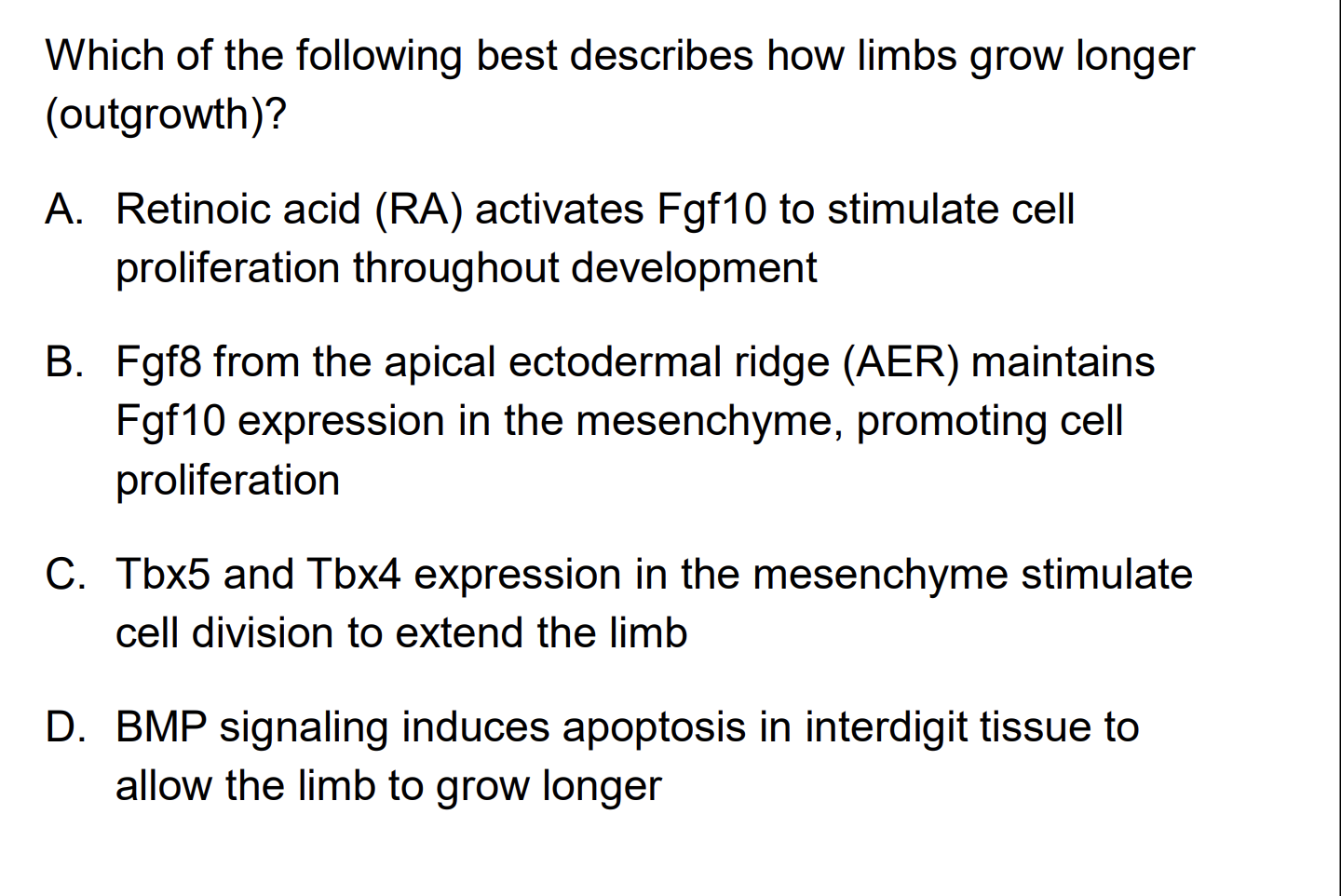
Which statement correctly explains how limb outgrowth continues during development?
A) Sonic hedgehog directly stimulates cell division throughout the limb bud B) The mesenchyme releases BMP, which causes ectodermal cells to proliferate C) Limb outgrowth stops once the AER forms because identity is already established D) The AER releases Fgf8, which keeps the underlying mesenchyme cells dividing
D
Which statements describe how RA and Fgf8 gradients work together to control forelimb position? Select ALL that apply.
A) RA is high near the future forelimb and allows Fgf10 expression B) Fgf8 is high near the heart and tail and prevents Fgf10 expression C) Forelimbs form in regions where RA activity remains high because it is not degraded by Fgf8-induced Cyp26 D) They form identical spatial gradients E) Their opposing gradients refine a narrow permissive zone for limb initiation
A, B, C, E
What is the correct sequence of events from limb initiation to outgrowth?
A) Fgf10 → RA → AER forms → Fgf8 expressed → limb grows outward B) Fgf8 → Fgf10 → AER forms → RA expressed → limb grows outward C) RA → Fgf10 → AER forms → Fgf8 expressed → limb grows outward D) RA → Fgf8 → AER forms → Fgf10 expressed → limb grows outward
C