Body Composition
 Call Kai
 Learn
Learn Practice Test
 Spaced Repetition
 Match
Match Flashcards
 Knowt Play
1/89

There's no tags or description
Looks like no tags are added yet.
Name | Mastery | Learn | Test | Matching | Spaced | Call with Kai |
|---|
No analytics yet
Send a link to your students to track their progress
90 Terms
What are the five major components of body weight?
extracellular water
intracellular water
minerals
protein
fat
Of the five components of our weight, what represents fat free mass (FFM)? What represents fat-mass (FM)?
FFM (4)
extracellular water
intracellular water
minerals
proteins
FM
fat
Of the five components of our weight, what gives us energy?
protein and fat
What are the BMI cutoffs?
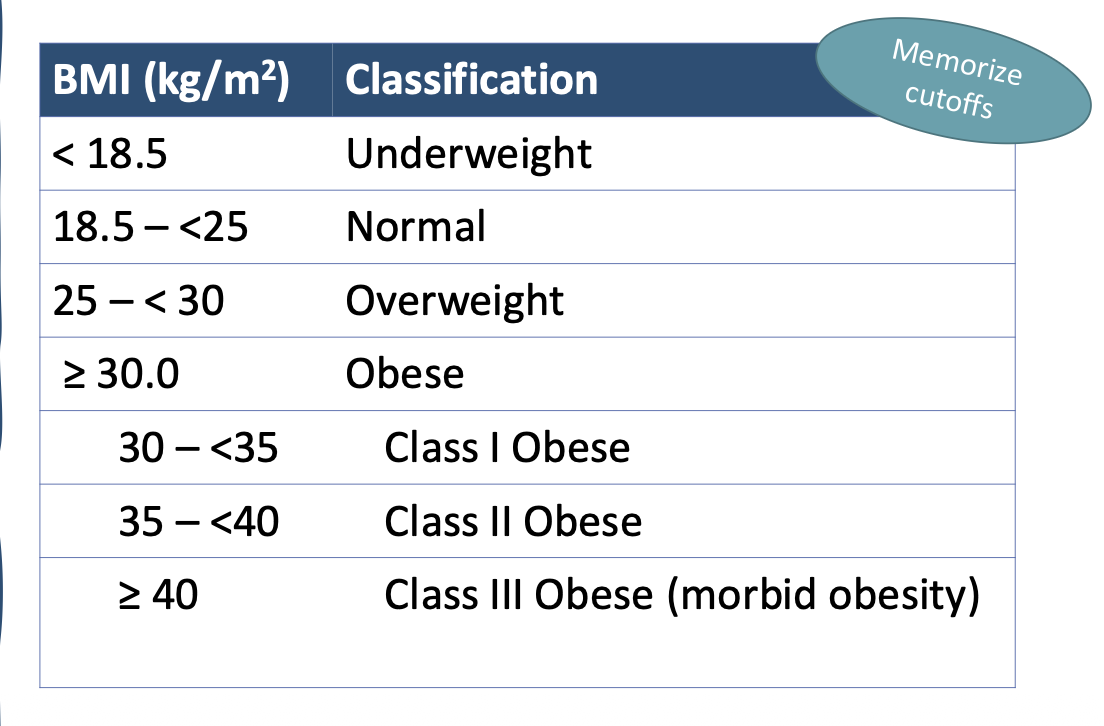
What does waist circumference/Waist:Hip Ratio (WHR) measure?
measures central obesity (WC) and distribution of intra- abdominal (visceral) to subcutaneous fat (WHR)
What is WC/WHR highly correlated with?
highly correlated to BMI. % body fat, subcutaneous and intra-abdominal fat in women and men
What is a better predictor of diabetes, WC or BMI?
WC
in general WC are better predictors of adverse effects of excess adipose such as CVD
What are the cutoffs for WC in terms of measuring central obesity for both men and women?
men = > 102 cm (40 in)
women = > 88 cm (35 in)
What is the difference between visceral and subcutaneous fat?
Subcutaneous fat is the pinchable "jiggly" fat located just beneath the skin, acting as energy storage and insulation.
Visceral fat is hidden fat surrounding and within internal organs (liver, intestines) deep within the abdominal cavity
What percent of our total fat is subcutaneous vs visceral?
subcutaneous = 90%
visceral = 10%
What is intramuscular fat?
adipose tissue that has accumulated within and between muscle tissue
What is fat-free mass?
all residual, lipid-free tissues and extracellular materials (water, muscle, bone, connective tissues, and internal organs
What are the cutoffs for waist-to-hip ratio for women and men?
men = > 1.0
women = > 0.8
What are three conditions that affect body composition?
sarcopenia
osteoporosis
cachexia
What is sarcopenia?
progressive loss of muscle mass (primarily losing protein)
typically associated with aging as it affects 10 - 50% of individuals > 65 years old
increases risk of falls by 5x (and falls result up to 9% of mortality rate amongst adults > 65 years)
What is sarcopenic obesity?
when sarcopenia (loss of muscle mass) co-exists with obesity
fat can infiltrate the muscle tissue
What is osteoporosis?
when bones become weak and brittle, this is typically characterized by loss of bone mineral density and low bone mass
increased risk of hip, spine, and wrist fracture
How many women vs men > 50 years re impacted by osteoporosis?
women: 19.6%
men: 4.4
tends to be higher amongst women just in general
What is cachexia?
weight loss (especially in FFM but also some FM) due to diseases, leading to severe wasting
What diseases can lead to cachexia?
cancers
advanced HIV/AIDS
tuberculosis
heart failure
chronic kidney disease
chronic obstructive pulmonary disease
What happens when we have too much extracellular water?
edema
What happens when we have too low mineral levels?
could result in osteoporosis, osteopenia, and rickets
What is the two compartment model?
assumes that body is compromised of fat mass + FFM
method is to measure one aspect of FFM and calculate the others based on assumptions of ratios and then determine the fat mass by taking the difference
What assumptions are made under the two compartment model?
subject has constant hydration
constant ratio of bone to muscle mass
What is the caveat of the two compartment model?
assumptions are likely to be incorrect for those who are ill, malnourished, or have metabolic disturbances
What is fat mass?
sum of all adipose tissue depots
What are five methods for estimating body composition?
anthropometric (skinfold)
bioelectrical impedance (BIA)
stable isotope dilution
radiologic methods
densitometry
What does skinfold thickness typically estimate?
subcutaneous fat
helps us to calculate density which then helps us to calculate % body fat
most widely used method to estimate subcutaneous adipose tissue as it is a good estimate compared to DXA
What are six assumptions made under the skinfold thickness measurements?
double thickness of skin and subcutaneous adipose tissue has a constant compressibility
thickness of skin is negligible/constant
thickness of subcutaneous adipose tissue is constant/predictable → in reality the thickness of subcutaneous adipose tissue varies among different sites within the same individual
fat content of adipose tissue is constant
proportion of internal to external fat is constant
body fat is normally distributed
What are the four different skin fold thickness measurements?
bicep
tricep
subscapular (back)
suprailiac (hip area)
What is the most common single-site skin fold measurement?
tricep
What is a single-site skin fold measurement good for?
can be used to estimate risk of wasting in combination with MUAC
cannot be used to estimate total percent body fat
What are the two equations that are relevant when we just have one skin fold site measurement?
arm fat area (AFA): correlates with total body fat
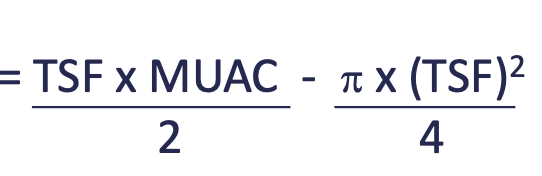
arm muscle area (AMA): index of muscle mass
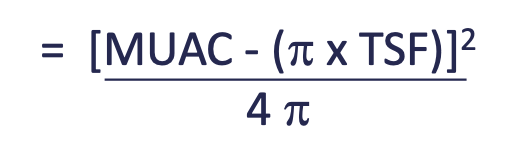
What measurement is accurate in assessing muscle wasting in the elderly?
mid-upper arm muscle area (MAMA)
A minimum of how many skin fold measurements are recommended when using skin fold thickness to assess body fat?
minimum of 3
When calculating the density and % body fat from skin fold measurements, what are some assumptions we make about the FFM?
constant density of 1.10g/cm3 (more than water)
constant hydration
constant proportion of bone mineral to muscle
When calculating the density and % body fat from skin fold measurements, what are some assumptions we make about the FM?
constant density of 0.9g/cm3 (less than water)
What is the Durnin-Womersley equation used for?
used to calculate body density given skin fold measurements
What are the percent body fat cutoffs for men and women?
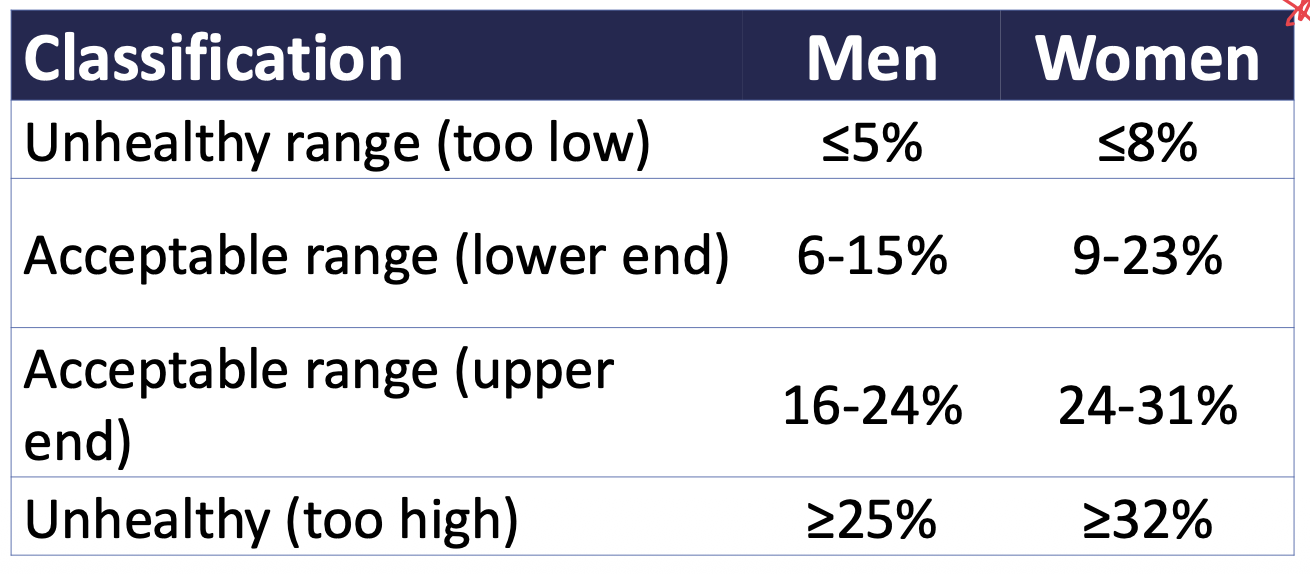
What are the advantages associated with the skin fold measures for body composition assessment? (4)
inexpensive
non-invasive
relatively quick and simple to take the measurements
can provide a more accurate estiamte of body fat compared to BMI
What are the limitations associated with the skin fold measures for body composition assessment? (2)
predictive equations may not be appropriate for all population groups
requires practice to take measurements accurately and precisely
What is Bioelectrical Impedance Analysis (BIA)?
an electrical current is passed through the body and the impedance to the current is measured
this impedance helps us to determine FM vs FFM as electrical conductivity differs in both
fat and cell membranes are relatively non-conducting whereas electrolytes in water (found in FFM) are more conductive
mainly estimates total body water (TBW) with high precisions which can then help us calculate FM and FFM
What are the two components found in BIA measures?
resistance
reactance
both allow for estimations of intra and extracellular water
What is resistance?
body fluids resist the electrical current at different rates
What is reactance?
cell membranes act as capacitors, storing electrical energy
What are some requirements/criteria that make a BIA test more accurate?
ideally performed after a fast
30 minutes after voiding
normal hydration
traditionally done with subjects in a supine position, some instruments allow standing position
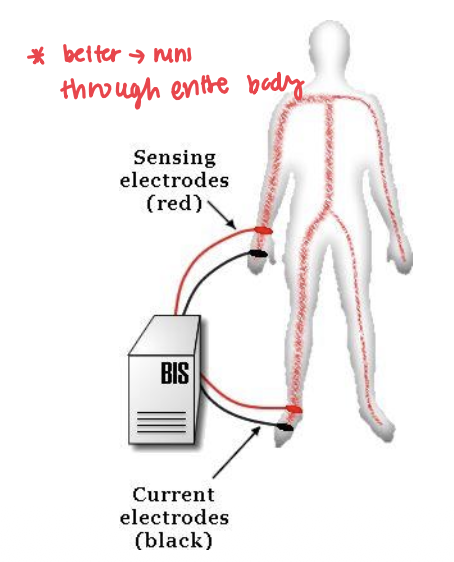
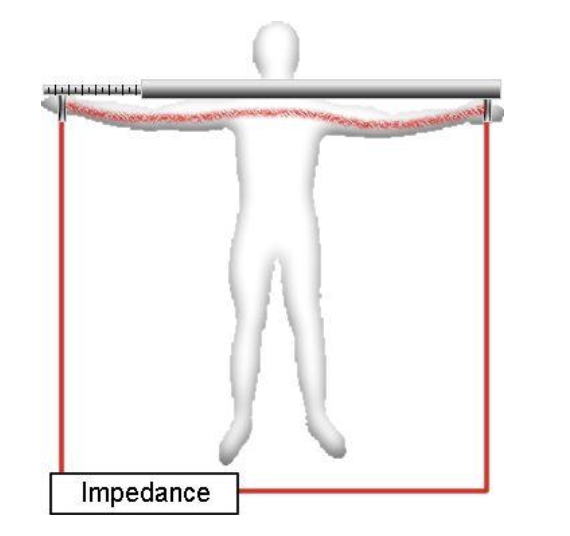
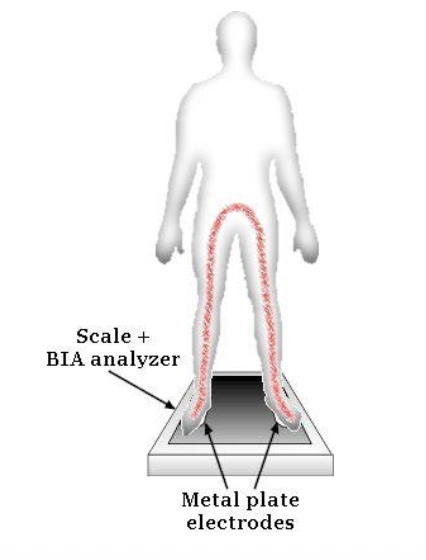
What are the three different segmental BIA measurements?
hand to foot
hand to hand
foot to foot
What percent of our TBW is FFM?
73.2%
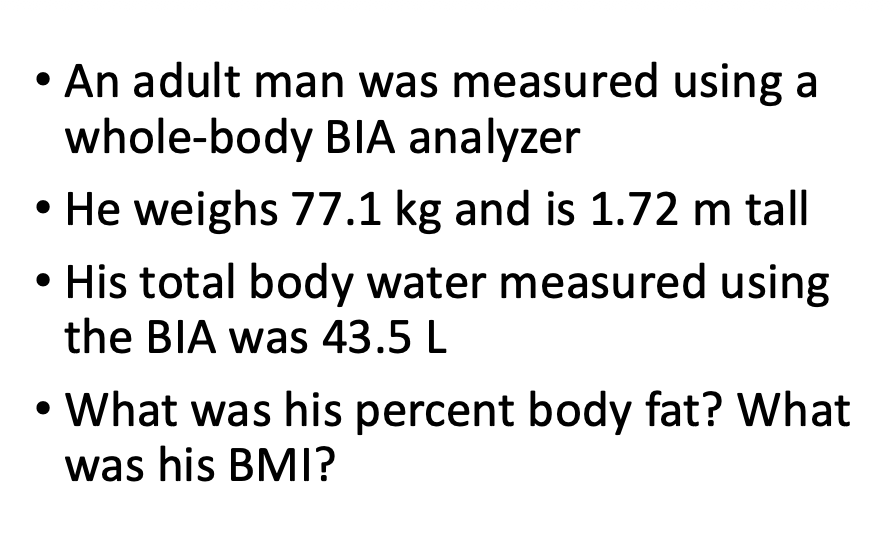
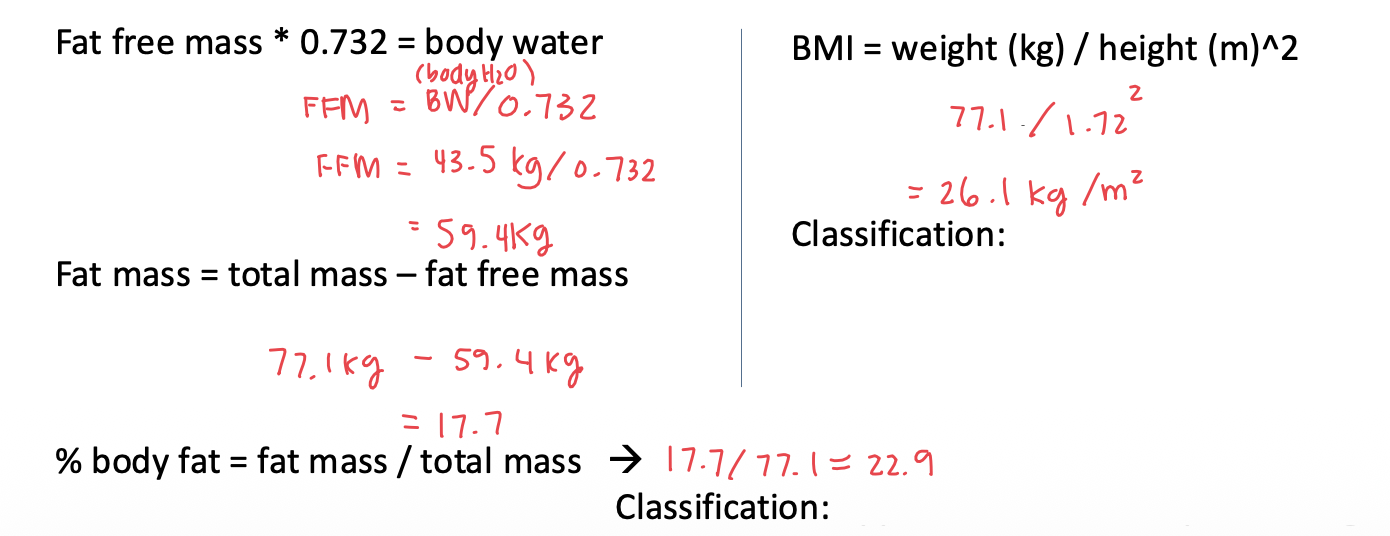
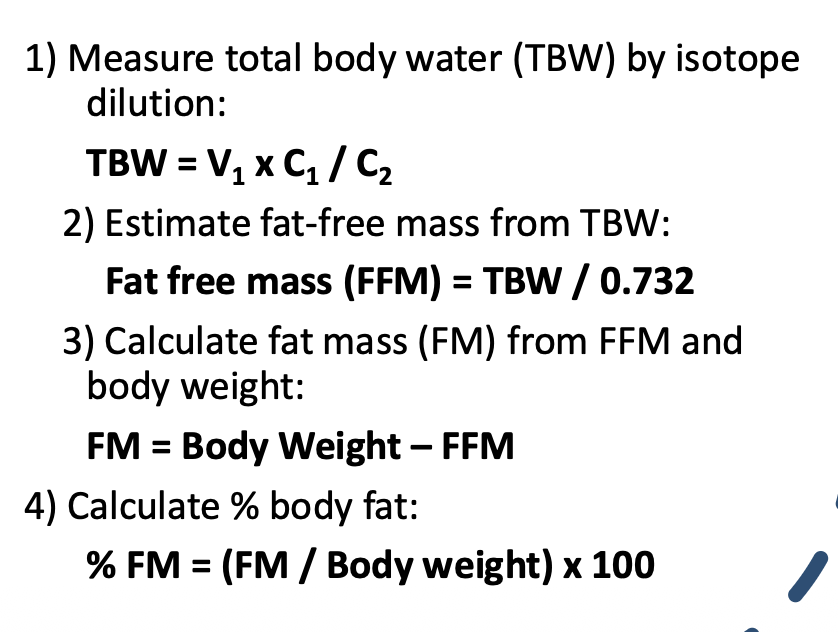
How do we determine body composition given BIA?
measure TBW from BIA
estimate FFM from TBW (FFM = TBW/0.732)
calculate the FM from FFM and body weight (FM = body weight - FFM)
calculate % body fat
What are the advantages of BIA?
simple and fast to perform
safe
relatively inexpensive
reliable in healthy populations
can be used in large studies
can be used easily in outpatient clinical settings
What are the disadvantages of BIA?
affected by the subject’s position, state of hydration, exercise, meals, alcohol and caffeine consumption
affected by electrode placement
predictive equations may not be applicable to certain populations
What are two different methods that fall under densitometry that is applicable to measuring body composition?
hydrostatic weighing (underwater weighing; this is typically the gold standard)
air displacement plethysomography (bod pod)
What is the methodology behind densitometry that helps it estimate one’s body composition?
attempt to assess body composition by measuring the density (mass/volume) of the entire body
What are some characteristics associated with hydrostatic weighing?
determines whole body volume based on Archimedes’ Principle (helps us to obtain volume of a person)
if the mass and volume of an object are known, density can be calculated which can then be used to calculate body fat percentage via the siri equation
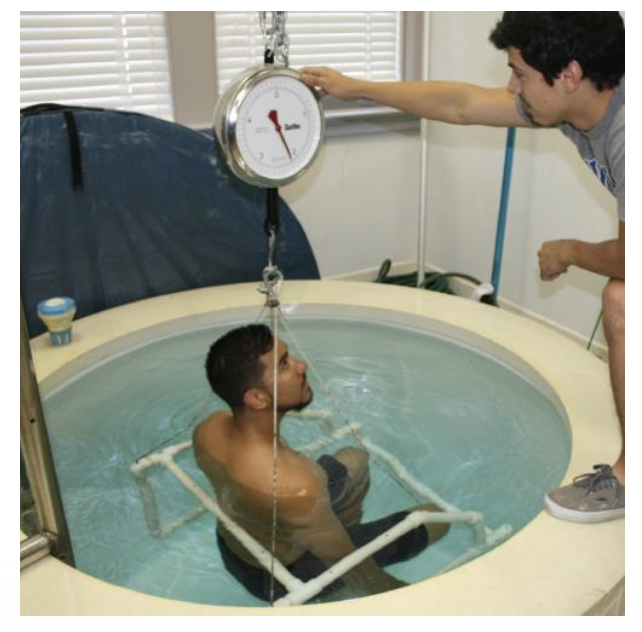
What is the Archimedes’ Principle?
states that the volume of an object submerged in water equals the volume of the water the object displaces
What are the assumptions made about FFM and FM when talking about hydrostatic weighing?
The same assumptions are made when considering skin folds
What are the different variables involved in the body density equation used for hydrostatic weighing?
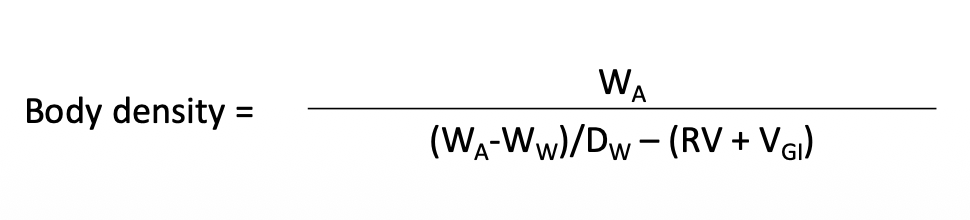
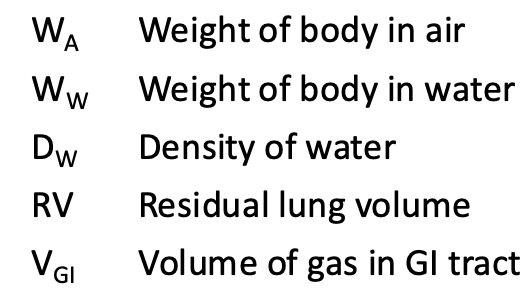
What are the different steps involved in hydrostatic weighing?
record body weight in air
subject expels all air from their lungs
submerge chair in the water (subject holds their breath for 10-15 seconds)
record body weight in water
measure residual lung volume (RV) or calculate using predictive equations
apply correction factor to the volume of air in the GI tract (assumed to be 100 mL)
What are the advantages of underwater weighing?
has historically been the method upon which other indirect measures of body composition were compared
What are the disadvantages of underwater weighing?
subject’s ability to cooperate
residual lung volume determination and GI gas assumption
not practical for large studies
underestimation of body fat in non-whites and athletes
overestimation of body fat in elderly
requires special facilities
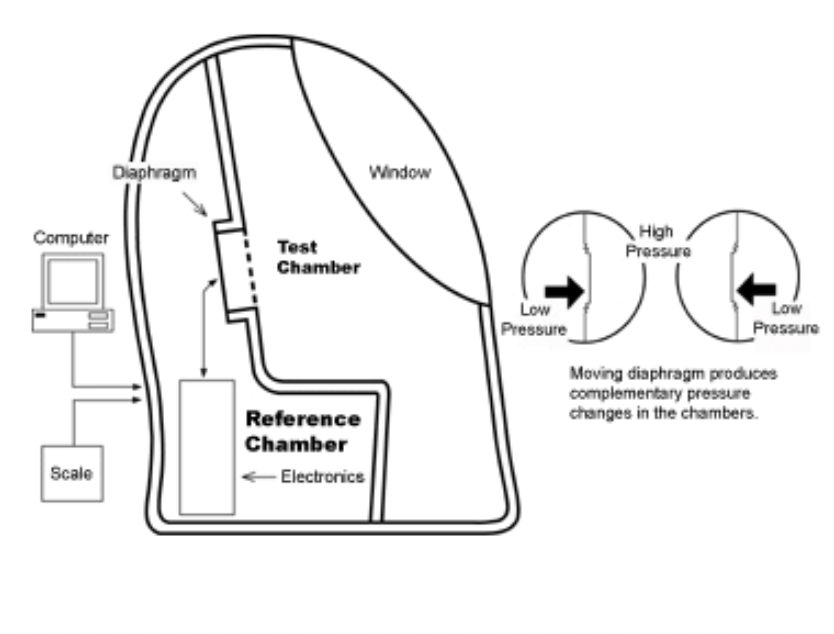
What are some characteristics of air displacement plethysmography (bod pod)?
used to measure volume in a similar sense compared to underwater weighing but instead of using water we use air
when a subject enters a chamber of a known volume, the subject’s body volume = the reduction in the chamber volume
What are the different steps involved air displacement plethysomography?
when the bod pod is empty measure the interior volume of the chamber
when the subject is seated inside measure the volume of the test chamber again
measure or apply a correction factor for residual lung volume
What is a pea pod?
a bod pod but for infants (1-8 kg)
same principles as the bod pod
accommodates most infant behaviors
What are the different assumptions about FFM and FM made in regard to air displacement plethysmography?
same as both skin fold and underwater weighing assumptions
What are the advantages of the bod pod in comparison to hydrostatic weighing?
more acceptable to most subjects
greater precision
residual lung volume is not as much of a factor
What are the disadvantages of the bod pod in comparison to hydrostatic weighing?
equipment cost ~$32 k
still assumes a constant density of FFM and FM
calibration can be challenging
What are two radiologic methods used to determine body composition?
dual-energy x-ray absorptiometry (DXA)
computed tomography (CT) scans
in general these are more accurate methods for calculating body composition
How does dual-energy x ray absorptiometry work?
have two low dose x ray beams of differing energy pass through the body that can differentiate between bone and soft tissue and thus determines the relative proportion of tissues
separate estimates of bone mineral, FM and lean, soft-tissue mass
tends to be the gold standard for assessing body composition
highly correlated with underwater weighing
takes less than 5 minutes for a very low dose of radiation
What was dual energy x ray absorption originally used for?
originally developed for bone density determinations (ex: osteoporosis/osteopenia screening)
later became a widely used method of body composition assessment
Besides body composition what can DXA also be used to identify?
used to identify sarcopenia based on the ASMM index
What is Appendicular skeletal muscle mass (ASMM)?
sum of the muscle mass of the arms and legs
How do you calculate the ASMM index? What do the cutoffs represent?
ASMM index = ASMM/height2
determine presence of sarcopenia via DXA
cutoff values defined in comparison to young adult populations
What are the advantages of DXA?
compares well with other techniques (ex: underwater weighing)
reproducible measurements
pediatric and adult references are available
is the gold standard measure of bone mineral content and bone density
quick
can measure body composition
What are the limitations of DXA?
variability of fat mass at different depths (there can be inaccuracies among obese patients are those who are losing or gaining weight)
calibration can be problematic
movement artifacts can cause uninterpretable measure
expensive
small radiation exposure
How does a CT scan work to measure body composition?
measures the transmission of an x-ray beam through the body tissues and typically produces a detailed cross sectional image of the body in which where we can measure regional muscle mass and adipose tissue
can distinguish between visceral and subcutaneous fat
gold standard to measuring visceral fat (aka intra-abdominal fat)
primarily used for research
What can a arm or leg CT scan tell us?
can identify muscle wasting or intramuscular adipose tissue accumulation
What are the advantages of CT scans?
can measure regional muscle mass and adipose tissue
can differentiate between types of lean body mass (muscle vs organs)
can assess distribution of subcutaneous and visceral fat
What are the limitations of CT scans?
high cost
limited availability
radiation makes multiple scans of same individual not desirable but multiple scans are needed to estimate total body fat (hence why it is rarely done)
What are the two isotope dilution methods that help us determine body composition?
deuterium dilution method
doubly-labeled water
What isotope is used in deuterium dilution? Which one is used in doubly-labeled water?
deuterium: 2H2O
doubly-labeled water: 2H218O
Describe the mechanism behind the isotope dilution method and how it helps to determine body composition?
assess total body water (TBW) in order to determine FM
after you take a baseline saliva sample you give a person a known amount/dose of the isotope (typically a water containing 2H) and you give it time to mix evenly throughout all the water in the body (~ 3 - 5 hours) equilibrating it
afterwards you measure how diluted the isotope is in a sample of saliva
the more water the body contains, the more diluted the isotope will be
once you have the total body water you can calculate the FFM (as TBW is typically 73.2% of our FFM)
What is the one caveat with the isotope dilution method?
have to take into account that the isotope not only mixes with body water but also with other hydrogen molecules in fats and proteins
saliva sample taken typically makes it look like the total body water volume is about 4.1% larger than it actually is
How do we take into account that the isotope dilution method doesn’t only mix in with one’s total body water?
to get the true TBW you have to divide the measured dilution space by 1.041 (to remove the 4.1% overestimation)
What is the equation used in isotope dilution?
C1V1=C2V2
C1V1 = dose of initial isotope given
measure the ending C2 level
solve for volume of water in the body as TBW = V2
Once we determine TBW from isotope dilution, how do we use it to calculate FM?
since we know that TBW makes up 73.2% of our FFM, we can use that to calculate our total FFM and use that FFM to calculate FM
What are some assumptions made from isotope dilution?
isotope is exchanged from the body as water
isotope does not alter normal physiologic process of homeostatic regulation
fat is free of water
fat free mass is assumed to be 73.2% water in healthy non-pregnant adults
What are three major sources of error while measuring total body water using isotope dilution?
failure to administer accurately measured isotope does
consumption of beverages during the equilibration period
sample contamination by atmospheric water before analysis
What are the advantages of isotope dilution?
accurate precise measure of TBW
isotopes are stable therefore no radiation exposure
safe for children and women
more affordable than mass spectrometry
What are the limitations of isotope dilution?
administering a precise amount of the tracer dose can be challenging
high cost and high level of expertise needed
collection of saliva from young children can be difficult
saliva samples must be stored properly until analyzed to prevent contamination from atmospheric water