OMIS 327 Exam 2
 Call Kai
 Learn
Learn Practice Test
 Spaced Repetition
 Match
Match Flashcards
 Knowt Play
1/42

There's no tags or description
Looks like no tags are added yet.
Name | Mastery | Learn | Test | Matching | Spaced | Call with Kai |
|---|
No analytics yet
Send a link to your students to track their progress
43 Terms
Integer programming (IP) model -
one where one or more of the decision variables has to take on an integer value in the final solution
3 types of integer programming problems
Pure integer programming - all variables have integer values
Mixed integer programming - some but not all of the variables have integer values
Zero-one integer programming - special cases in which all of the decision variables must have integer solution values of 0 or 1
An integer solution..
Can never be better than the LP solution and is usually a lesser value.
Binary variables (aka 0-1 variable)
decision variable that must be equal to 0 or 1
Corresponds to yes/ no or taken or not taken activity
1 = activity is undertaken
0 = activity not undertaken
Integer solution
not just rounded number of the non integer solution
Fix charge problem
charge is incurred if an activity is undertaken at any positive level
Independent of the level of the activity and is known as a fixed charge (or fixed cost)
A fixed charge is incurred if an activity is undertaken at any positive level
No fixed charge is incurred i the activity is not undertaken at all
Use 0-1 variables
In an integer problem you cannot
round the non-integer solution to an integer
Node
indicated by a circle, generally represents a geographical location
Arc
indicated by an arrow, generally represents a route for getting a product from one node to another
Flows
decision variables, denoted by xij, they represent the amounts shipped on the various arcs
Assignment models
used to determine the most efficient assignment of people or equipment to particular tasks
Objective is to minimize total cost or total task time
need to = supply of workers (vertical) and = demand for workers (horizontal)
Why we distinguish between network models from other LP models -
structure of these models allows them to be represented graphically in a way that is intuitive to users. This graphical representation can then be used as an aid in the spreadsheet model development.
Transportation problem
deals with distribution of goods from several points of supply (origins or sources) to a number of points of demand (destinations)
need to be < supply to minimize costs (vertical) and equal to demand (horizontal)
Linear program for transportation problem includes:
Minimize transportation cost (objective)
Not exceed supply (constraint)
Meet demand (constraint)
Xij
number of units shipped from source i to destination j
Ex: where:
i = 1,2,3 (1= des moines, 2 = evansville, 3= fort lauderdale)
j = 1,2,3( 1= albuquerque, 2 = boston, 3 = cleveland
Ex: X23 represents the amount shipped from evansville to cleveland (x 2 -3 not 23)
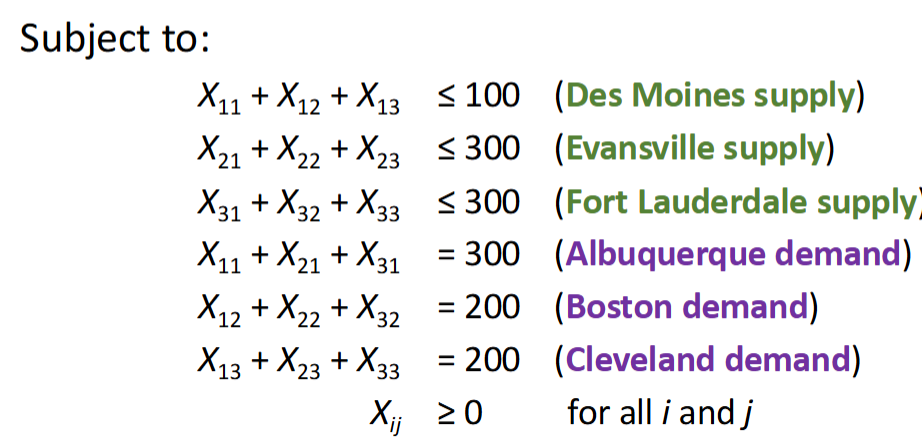
Examples of supply and demand constraints for the following variables
i = 1,2,3 (1= des moines, 2 = evansville, 3= fort lauderdale)
j = 1,2,3( 1= albuquerque, 2 = boston, 3 = cleveland
Transshipment point
physical location in between source(s) and destination(s)
A location where goods simply pass through
node with new outflow (or net inflow) equal to 0
start point flow - end point flow
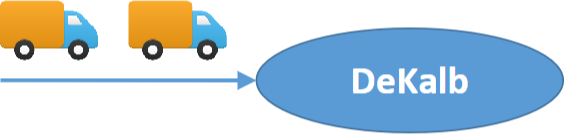
Inflow
arc pointed into a node
Outflow
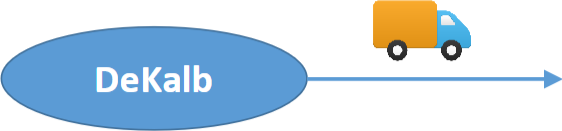
an arrow pointed out of a node
Net inflow
for any node is defined as total inflow minus total outflow for that node (i.e. total inflow - total outflow)
Net inflow equation
total inflow - total outflow
Net outflow equation
total outflow - total inflow
Origin
node with positive net outflow
sumif(startpoint only)
Destination
node with positive net inflow
sumif(end point only)
Framework for network design decisions
Maximize the overall profitability of the supply chain network while providing customers with the appropriate responsiveness
Many trade offs during network design
Network design models used:
To decide on locations and capacities
To assign current demand to facilities and identify transportation lanes
Shortest route problem
find the shortest distance from one location to another
Can be modeled as
linear programming problem with 0-1 variables
Special type of transshipment problem
Using specialized algorithm
How to use Xij variable
Xij = 1, then choose
Xij = 0, then cannot select
How to find total distance
multiplying the binary decision for each route (flow) with its distance, then adding up all the distances across all the routes
∑(Flow * distance)
Ex: 100X12 + 200x13 + 50X23 etc
Rules for shortest route constraints
Origin location (node 1) = total outflow should = 1
All intermediate nodes = total outflow should = 0
Calculated by total inflow - total outflow OR total outflow - total inflow
Destination location (last node) = total outflow should = 1
Minimal spanning tree problem
connect all points of a network together while minimizing the total distance of the connections.
Linear programming can be used but is complex
Minimal spanning tree technique is easy
A spanning tree
for an n-node network is a set of n-1 arcs that connects every node to every other node
Steps for the minimal spanning tree technique
Select any node in the network
Connect this node to the nearest node that minimizes the total distance
Considering all of the nodes that are now connected, find and connect the nearest node that is not connected. If there is a tie for the nearest node, select one arbitrarily. A tie suggests there may be more than one optimal solution.
Repeat the third step until all nodes are connected.
How many distances to add up =
n-1
So if you have 5 nodes, you are gonna have 4 distances to add up (between 2 houses 1 road)
How to solve minimizing spanning tree method -
Start by picking the min distance for each
Going chronologically for each node
Once you start to branch out to ones that are too far away, you can look at which ones you have already “unlocked”/ accessed via a connecting branch
You can use these to connect to the node instead
Start looking at the node you need to get to, look at what branches are leading to it and if you’ve unlocked the starting nodes for them
If you have unlocked the node then you pick the shortest one
Keep going in chronological order until you have reached all nodes and have n-1 branches done. (so say 7 nodes and 6 branches)
transshipment problem
optimization model that determines the lowest-cost routing of goods from origins through transshipment points to final destinations
minimal-spanning tree
All the nodes must be connected in this technique
The objective of a transportation problem
to minimize the total transportation (shipping) cost from sources to destinations.
non integer solution: (1)
integer solution: (2)
ex: 3.75, 2.49
3,4,5,
integer = whole number
non-integer = not whole number
In the minimal-spanning tree technique, if there is a tie for the nearest node, that suggests
there may be more than one optimal solution.
[Binary Variable Scenario]: Limiting the number of alternatives selected
involves limiting the number of projects or items that are selected from a group
ex: Quemo chemical required to select no more than 2 projects
constraint = X1 + X2 + X3 < 2
Saying all of the projects (value of 1 or 0) must be < 2
[Binary Variable Scenario]: Dependent selections
the selection of one project depends on the selection of another
ex: Quemo’s catalytic converter could only be purchased if the software was purchased
constraint → X1 < X2 or X1 - X2 < 0
If we wished for the catalytic converter and software
projects to either both be selected or both not be
selected, the constraint would be
- X1 = X2 or X1 − X2 = 0
Linear program for assignment example
Xij = 1 if person i is assigned to project j 0 otherwise
where i = 1,2,3 (1 = Adams, 2 = brown, 3 = cooper)
j = 1,2,3 (1 = project 1, 2 = project 2, 3 = project 3
solving an employee scheduling thing
define the decision variables as the number of employees starting work on each day of the week
by knowing the values of these decision variables, the other output variables can be calculated