Equine Parasitology
 Call Kai
 Learn
Learn Practice Test
 Spaced Repetition
 Match
Match Flashcards
 Knowt Play
1/14

There's no tags or description
Looks like no tags are added yet.
Name | Mastery | Learn | Test | Matching | Spaced | Call with Kai |
|---|
No analytics yet
Send a link to your students to track their progress
15 Terms
What are the Cyathostomin species?
Considered the equine parasite of most epidemiological and clinical significance.
Over 50 different species identified.
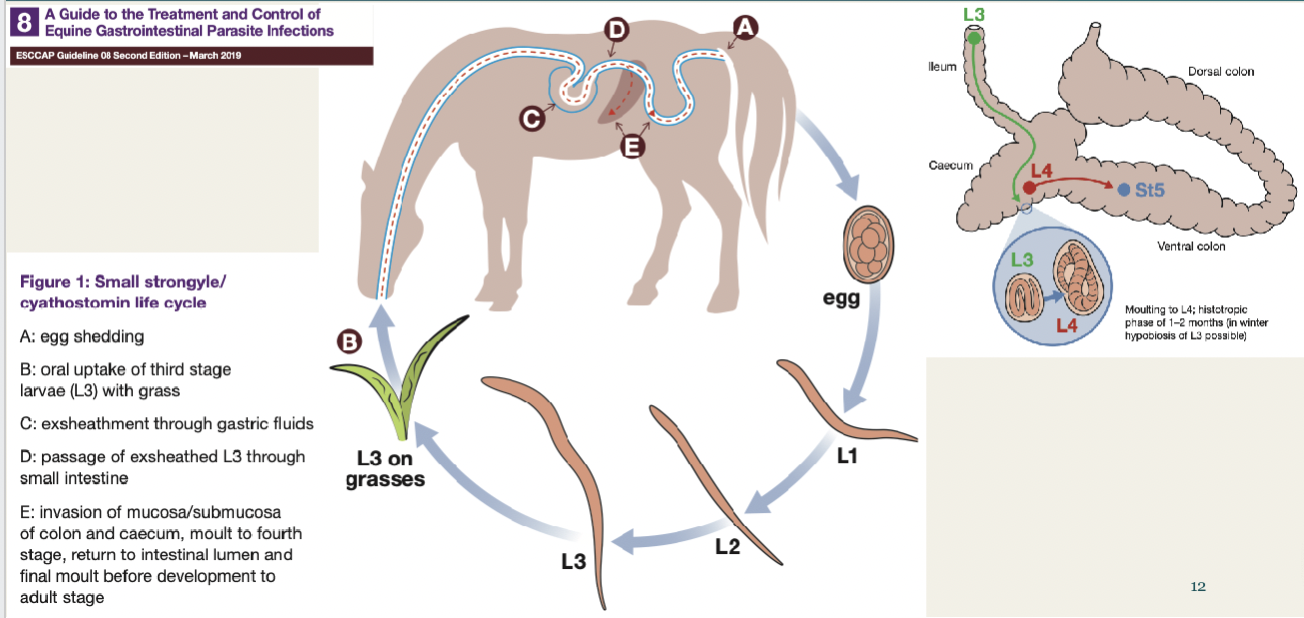
Direct, non-migratory life cycle
Ingested larvae develop (L3→L4) within mucosal crypts of the large colon
Early L3 larvae can arrest their life cycle when conditions outside the host are suboptimal for development.
Mass eruption of the EL3 larvae can result in clinical disease – Larval
Cyathostominosis
What is Larval Cyathostominosis?
Emergence of larvae from mucosal crypts causes localised mucosal inflammation.
Mass emergence will lead to widespread disruption of mucosal barrier and loss mucosal function.
Acute disease:
Colitis and systemic inflammatory response syndrome (SIRS)
Diarrhoea, colic, pyrexia, tachycardia, cardiovascular compromise
Chronic disease:
Low grade colitis, altered digestive function, loss of protein from GIT
Clinical signs- low grade or recurrent colic, weight loss
What are the main methods of parasite prevention?
Remove/Reduce exposure
Eradicate disease in population
Isolation
Vaccination
Prophylactic therapy
Prevent development of clinical disease
Prevent infection/infestation in an individual
What is interval dosing?
A blanket, indiscriminate approach to prevention of equine parasites
E.g treat every horse for roundworms every 8-13 weeks during the grazing season
What are the benefits of interval dosing?
Very effective in reducing some parasite burdens
Non-discriminatory, non-selective pattern allows for control of different parasites with the same regimen.
Simple for owners to follow
What is the problem with interval dosing?
There is no evidence to say that prophylactic therapy will prevent the onset of clinical disease.
It may in some cases hasten the onset of clinical disease.
Development of anthelmintic resistance.
What is a “wormer”?
Worming, Deworming, Drenching
Large number of products on the market
But only three classes of anthelmintics:
Benzimidazoles- Fenbendazole
Macrocyclic Lactones- Avermectins
Tetrahydropyrimidines- Pyrantel
How is anthelmintic resistance in the equine industry?
Anthelmintic Resistance (AR) is considered one of the greatest threats
facing the equine industry
Widespread, indiscriminate use of anthelmintics has created a positive
selection pressure for the development of AR
• Selective pressures for AR include;
• Under-dosing - Very Common Problem
• Prolonged use of single agent
• Regular rotation of products – Selecting for resistance genes in parasites
• Removal of parasite refugia
Worldwide resistance to BENZIMIDAZOLES reported
Resistance to the macrocyclic lactones is rapidly developing
Parascaris equorum- Resistance to ivermectin reported
There are no new classes of anthelmintic in development Anthelmintic Resistance
What are some simple control methods that can be utilised to prevent parasites?
Removing faeces from a paddock
Individual grazing paddocks
Rotating paddock grazing with livestock or resting over-grazed paddocks
What are the aims of strategic targeted dosing?
To reduce exposure by targeting high shedders
To preserve anthelmintic efficacy by actively discouraging the development of anthelmintic resistance.
What are the methods of strategic targeted dosing?
Establish drug effectivity
Target the high shedders- those requiring treatment
Monitor the efficacy of the treatment prescribed
Maintain parasite refugia
What do faecal egg counts tell us?
Provide an estimation of the level of egg excretion?
What are the limitations of faecal egg counts?
Don’t differentiate between large and small strongyles
No information on the number of larval stages present
Sensitivity is generally poor for individuals
Not suitable for detecting:
Tapeworm (A.perfoliata), Lungworm, Bots, Pinworm, Fluke
How should cyathostomin larvae be controlled?
Treat high shedders
Reduce infective ‘load’ which susceptible individuals will be exposed to should be reduced.
Strategic Treatment
• Moxidectin is only recommended treatment effective in killing the larval stages of cyathostomin spp
• Some advocate treatment of high risk horses in late-Autumn or winter
• Potential concern though about inducing re-emergence
• Is likely contributing to resistance to moxidectin
ELISA has now been developed and is reaching commercial application
• Detects IgG to three antigens, including the encysted larvae
How is tapeworm diagnosed and controlled?
Diagnosis- faecal egg count is not a useful diagnostic tool, ELISA is available, confirms exposure not infection
Control- Strategic evidence based dosing, single annual treatment at the end of risk period