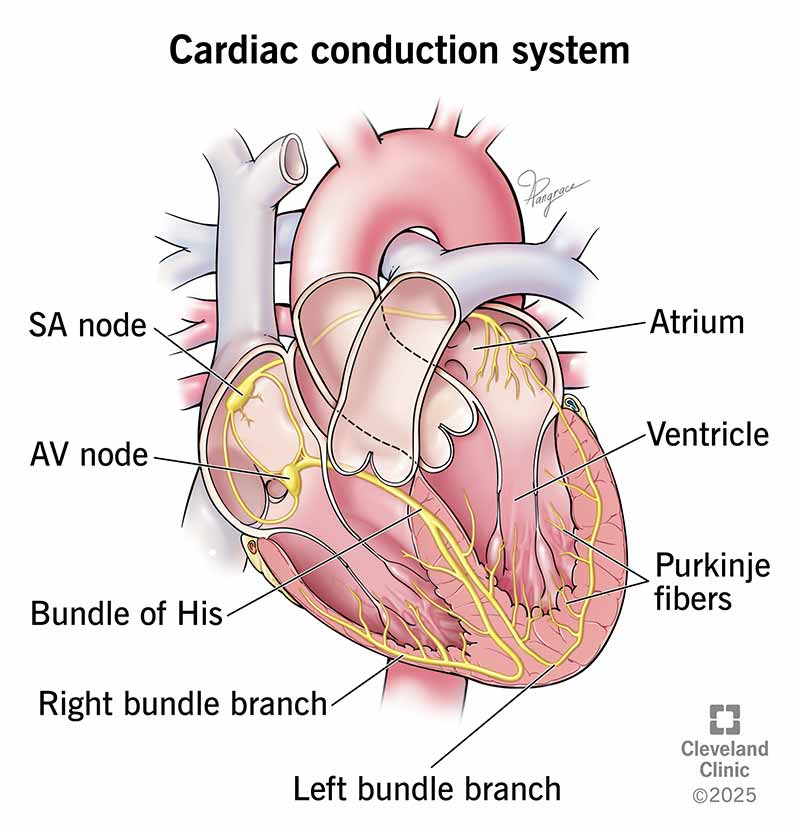
Cardiac conduction system
 Call Kai
 Learn
Learn Practice Test
 Spaced Repetition
 Match
Match Flashcards
 Knowt Play
1/6

There's no tags or description
Looks like no tags are added yet.
Name | Mastery | Learn | Test | Matching | Spaced | Call with Kai |
|---|
No analytics yet
Send a link to your students to track their progress
7 Terms
Describe how the cardiac conduction system causes the heart to contract
Sinoatrial node sends an electrical impulse through the atria.
This spreads as a wave of excitation.
This causes the atria to contract, causing atrial systole.
The impulse passes to the atrioventricular node, which delays the impulse by 0.1 seconds to allow the atria to fully empty.
The impulse then travels down the septum via the bundle of his and into the bundle branches and then the purkinje fibres.
The purkinje fibres distribute the impulse throughout the ventricular walls and the stimulation causes them to contract and pump blood out.
What is the sinoatrial node known as?
The pacemaker of the heart.
Label the cardiac conduction system
What is the difference between a normal resting heart rate and a trained athletes heart rate? How does this hapen?
Normal resting heart rate is between 60-90 bpm.
Trained athletes will have a lower heart rate below 60bpm due to bradycardia.
This is called athletes heart and is developed due to training causing the cardiac muscle in the left ventricle to increase in size (cardiac hypertrophy).
What type of training causes heart hypertrophy?
Endurance training causes heart hypertrophy. Training causes the stroke volume to increase.
What happens for a trained heart in regards to oxygen?
A trained heart does not need to work as hard so less oxygen is needed by it. This means more oxygen can go to the working muscles.
What does myogenic mean?
The heart can generate its own electrical impulse.