H&M CH 8: Internal Forced Convection
 Call Kai
 Learn
Learn Practice Test
 Spaced Repetition
 Match
Match Flashcards
 Knowt Play
1/41

There's no tags or description
Looks like no tags are added yet.
Name | Mastery | Learn | Test | Matching | Spaced | Call with Kai |
|---|
No analytics yet
Send a link to your students to track their progress
42 Terms
Q: Why are circular tubes preferred in internal forced convection?
A: They provide the most heat transfer for the least pressure drop for a fixed surface area.
Q: What is average velocity in a pipe?
A: The mean velocity across a cross-section used to simplify flow analysis.
Q: What is mean temperature (Tm) in fluid flow?
A: The average temperature of the fluid at a cross-section.
Q: How does mean temperature change along a tube?
A: It changes in the flow direction when the fluid is heated or cooled.
Q: What are the Reynolds number for pipe flow?
A: Laminar: Re < 2300, Transitional: 2300–10,000, Turbulent: Re > 10,000.
Q: What is hydraulic diameter?

A: A characteristic length used for noncircular tubes defined as
Q: What is the thermal entrance region?
A: The region where the thermal boundary layer develops.
Q: What is thermal entry length?
A: The distance required for the thermal boundary layer to fully develop.
Q: What is thermally fully developed flow?
A: Flow where the temperature profile shape no longer changes.
Q: What is fully developed flow?
A: Flow that is both hydrodynamically and thermally developed.
Q: How does the convection coefficient behave in the fully developed region?
A: It remains constant along the tube.
Q: How do entrance regions affect heat transfer and friction?
A: They increase both the average heat transfer coefficient and friction factor.
Q: What are the two common thermal boundary conditions in tubes?
A: Constant surface temperature and constant surface heat flux.
Q: When does constant surface temperature occur? Ts= const
A: During phase change processes like boiling or condensation.
Q: When does constant surface heat flux occur?
When heating is applied uniformly, such as electrical resistance heating.

Can a tube have both constant surface temperature and constant heat flux simultaneously?
No.
Q: What is the relationship between heat transfer and fluid energy change?
Heat transfer equals the increase in fluid energy.
Q: How does mean fluid temperature vary for constant heat flux?
It increases linearly along the tube.
Q: What happens to the temperature profile in fully developed flow with constant heat flux?
Its shape remains constant.
Q: What is arithmetic mean temperature difference?
A simple average of temperature differences assuming linear variation.
Q: What does NTU represent?
Number of transfer units, indicating heat exchanger effectiveness.
Q: What happens when NTU > 5?
The fluid temperature approaches the surface temperature at the exit.
What happens when NTU = 5?
The fluid temperature at the exit equals the fluid temperature at the surface, and the limit for heat transfer is reached.
Q: What does a small NTU indicate?
Greater potential for heat transfer.
What is the velocity relationship in fully developed laminar flow?
Average velocity is half the maximum velocity.
Q: What is the velocity relationship in fully developed laminar flow?
Average velocity is half the maximum velocity.
What is pressure drop directly proportional to?
length and viscosity
What is pressure drop inversely proportional to?
diameter4
Q: What determines pumping power in pipe flow?
The pressure drop.
Q: What is the Nusselt number behavior in fully developed laminar flow with constant heat flux?
A: It is constant and independent of Reynolds and Prandtl numbers
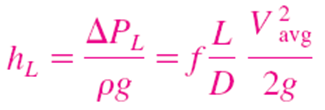
What is head loss?
The additional height that the fluid needs to be raised by a pump in order to overcome the frictional losses in the pipe. It is caused by viscosity and is directly related to the wall shear stress.
Q: How does surface roughness affect laminar flow?
It has negligible effect.
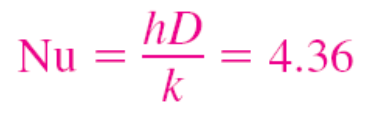
Q: How is heat transfer coefficient calculated once Nusselt number is known?
Q: How does Nusselt number behave in the entrance region?
It is higher and decreases toward the fully developed value.
Q: What happens to Nusselt number as tube length increases?
It approaches a constant value (e.g., 3.66 for laminar flow).

Q: Where are properties evaluated in turbulent flow?
At bulk temperature, except viscosity at surface temperature.
Q: What equations are commonly used for turbulent flow heat transfer?
Dittus–Boelter, Gnielinski, and Petukhov equations.
Q: How does surface roughness affect turbulent flow?
It increases heat transfer coefficient significantly.
Q: What is used to determine friction factor in turbulent flow?
Moody chart or Colebrook equation.
Q: What is a tube annulus?
The space between two concentric tubes.
Q: How is hydraulic diameter for annulus defined?
Dh = Do - Di
Q: How do convection coefficients compare in turbulent annulus flow?
Inner and outer coefficients are approximately equal.