Concepts chapter 4, 9, 10, 11
 Call Kai
 Learn
Learn Practice Test
 Spaced Repetition
 Match
Match Flashcards
 Knowt Play
1/7

There's no tags or description
Looks like no tags are added yet.
Name | Mastery | Learn | Test | Matching | Spaced | Call with Kai |
|---|
No analytics yet
Send a link to your students to track their progress
8 Terms
Introversion vs extraversion
introversion
= a person may be quiet and reserved, or you may be social, but your energy is derived from your inner activity
extroversion
= A person is energized by being outgoing and socially oriented. you get energy from being around others
Internal vs external locus of control
internal locus of control
= Belief that outcomes are the direct result of efforts
external locus of control
=beliefs that outcomes are outside of your control
1. Internal Locus of Control
People with an internal locus of control believe that their own efforts, decisions, and hard work determine their outcomes.
Perspective: "I am the master of my fate."
Behavior: They tend to be more achievement-oriented, take responsibility for their failures, and are more likely to take action to change their situation.
Example: "I got an A because I studied hard for the economics exam."
2. External Locus of Control
People with an external locus of control believe that their outcomes are determined by outside forces—such as luck, fate, other people, or the complexity of the situation.
Perspective: "Life happens to me."
Behavior: They may feel like victims of circumstance, experience more stress or helplessness, and believe that trying hard won't necessarily change the result.
Example: "The teacher made the test too hard; that’s why I failed."
motivation
Motivation is defined as the wants or needs that direct behavior toward a goal. It is the driving force that initiates and maintains goal-oriented actions.
The textbook categorizes motivation into two primary types:
1. Intrinsic vs. Extrinsic Motivation
Intrinsic Motivation: Arises from internal factors. You perform a task because it is inherently rewarding, satisfying, or challenging to you (e.g., studying economics because you find the theories fascinating).
Extrinsic Motivation: Arises from external factors. You perform a task to receive a reward or avoid a punishment from others (e.g., studying to get a high GPA or a better salary).
2. Major Theories of Motivation
The textbook details several foundational theories explaining why we are motivated:
Instinct Theory: Proposed by William James; asserts that behavior is driven by a set of unlearned, species-specific biological instincts (e.g., a mother's protection of her baby).
Drive Theory: Suggests that deviations from homeostasis (a state of physiological balance) create physiological needs. These needs result in psychological drive states that direct behavior to meet the need and bring the system back to homeostasis (e.g., hunger creating a drive to eat).
Self-Efficacy and Social Motivation: Albert Bandura argued that motivation is rooted in our self-efficacy—our belief in our own capability to complete a task.
Maslow’s Hierarchy of Needs: A pyramid-shaped model stating that basic physiological needs must be met before higher-level safety, social, and esteem needs can be addressed, culminating in self-actualization.
Over justification effect
intrinsic motivation is diminished when extrinsic motivation is given. This can lead to extinguishing the intrinsic motivation and creating a dependence on extrinsic rewards for continued performance
1. The "Professional Hobbies" Trap
Imagine you love taking photos and post them on Instagram just for fun (Intrinsic). You then get hired as a professional photographer.
The Shift: Now, you have to take photos to pay your rent (Extrinsic).
The Result: On your days off, you might find that you no longer want to pick up your camera for fun. The joy of the hobby has been "crowded out" by the necessity of the paycheck.
stage 1 and 2 (NREM)
Stage 1
=Phase between wakefulness and sleep
Stage 2
=A light sleep, heart rate slows and body temparature drops
theta waves の方がamplitudeでかい
Stage 1 NREM (N1)
The Transition: This is the "theta wave" phase. It’s the brief period where you are drifting off.
Key Features: * Alpha waves (relaxed wakefulness) transition into theta waves (lower frequency, higher amplitude).
It is very easy to wake someone up from this stage.
People often experience hypnic jerks (that feeling of falling) or vivid sensory hallucinations
Stage 2 NREM (N2)
The "True" Light Sleep: Your body officially enters a sleep state, and you spend about 50% of your total sleep time here.
Key Features:
Physical changes: Heart rate slows, and body temperature drops significantly.
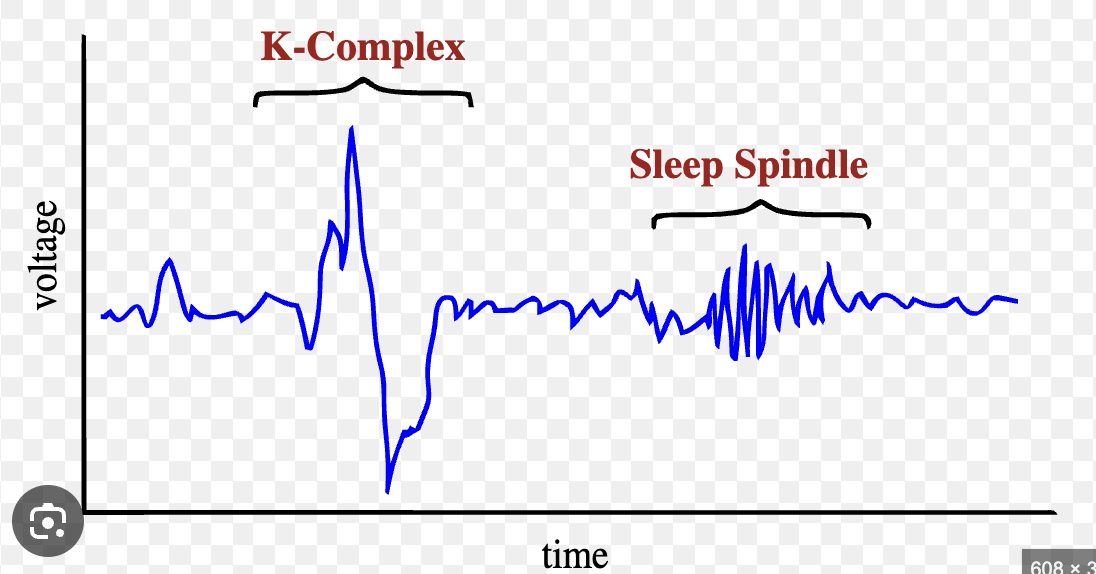
Brain activity: This is the most important part for exams! Look for Sleep Spindles (rapid bursts of high-frequency brain waves) and K-complexes (very high amplitude pattern of brain activity).
Function: Scientists believe sleep spindles are related to processing memories.
Carl Jung (+ famous for)
he is famous for analytical psychology
= the balance of your conscious and unconscious thoughts
1. The Collective Unconscious
This is perhaps his most famous (and controversial) contribution. While Freud focused on the personal unconscious (repressed memories), Jung believed in a Collective Unconscious.
Definition: A universal version of the personal unconscious, containing mental patterns or memory traces which are common to all of us.
Source: He argued these are ancestral memories passed down through human evolution, explaining why similar symbols appear in myths and religions across totally different cultures.
2. Archetypes
Within the collective unconscious are Archetypes.
Definition: Universal, archaic patterns and images that derive from the collective unconscious.
Famous Examples:
The Persona: The "mask" we wear in public to hide our true self.
The Shadow: The dark, hidden, or repressed part of our personality.
3. Introversion vs. Extraversion
As we discussed earlier, Jung was the one who coined these terms. He believed that our personality is defined by whether our psychic energy is directed inward (Introversion) or outward (Extraversion). This laid the foundation for almost all modern personality tests, including the MBTI.
ユングの最重要ポイント
分析心理学の創始者: 元々はフロイトの弟子やったけど、フロイトが「何でもかんでも性のせい」にするのに反対して独立した。
集合的無意識 (Collective Unconscious): 全人類に共通する「心の奥底の記憶」があると考えた。君とブラジルの人が同じような「神話」や「シンボル」を思いつくのは、この遺伝的な記憶のせいやってことや。
型(Archetypes): 集合的無意識の中にある共通のイメージ。
ペルソナ (Persona): 社会で見せる「仮面」。
シャドウ (Shadow): 自分が認めたくない「影」の部分。
内向型・外向型: 心理的エネルギーが「内(自分)」に向くか「外(他人)」に向くか。MBTIの元ネタやな。