sani retake
 Call Kai
 Learn
Learn Practice Test
 Spaced Repetition
 Match
Match Flashcards
 Knowt Play
1/52

There's no tags or description
Looks like no tags are added yet.
Name | Mastery | Learn | Test | Matching | Spaced | Call with Kai |
|---|
No analytics yet
Send a link to your students to track their progress
53 Terms
definition of disinfection?
process of removal, inactivation, or killing of all microorganisms that may cause a disease or affect the health of animals and humans.
Main tool for prevention of disease spread.
What does sanitation include?
anitation is a complex of measures aimed at the removal, inactivation or killing of the infectious agents in the external environment. It aims to reduce the nuimber of microorganisms on objects to a level acceptable for public health standards. It includes:
Disinfection
Rodent control
Insect control
Safe disposal of cadavers and wastes/harmless removal
Environmental hygiene
Hydroxides: Preparations, mechanism of action, properties, using in %
Hydroxide: Alkaline disinfectact.
Preparations:
Sodium hydroxide (NaOH) - caustic soda
Potassium hydroxide (KOH) - component of cleaning preps + soap
Ca hydroxide (CaOH)2 - by adding water to Ca oxide (lime)
Mechanism of action: strong alkaline effect, pH change, destruction of cell structures, protein denaturation, lipid saponification (destroys cell membranes), hydrolysis of nucleic acids/enzymes
Properties: Bactericidal, virudical, fungicidal, corrosive, irritating to skin/tissue, slow action but increased by higher temperature. Stable.
Concentration:
2-4% virus, 1% bacteria, 5-10% for spores - NaOH
2-5% - KOH
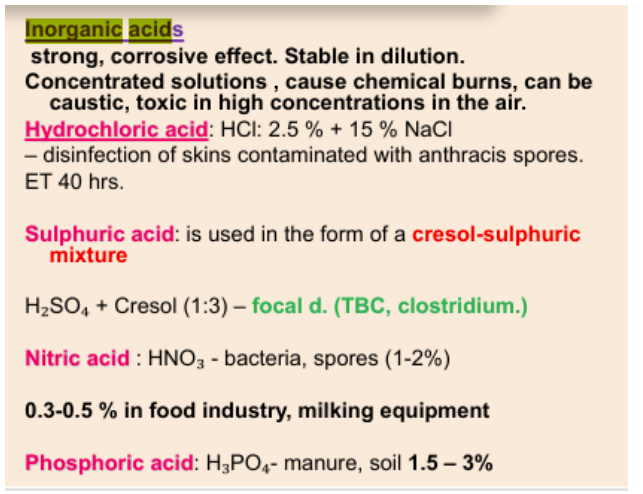
Inorganic acids: Preparations, mechanism of action, properties, using in %
Preparations: Hydrochloric acid, Sulfuric acid, Phosphoric acid
Mechanism of action: Lower pH, disruption of cell wall permeability, denaturation of proteins
Properties: Strong, corrosive effect, stable in dilution
Concentration: Usually 1–5% solutions depending on application
Chlorine-releasing compounds: Preparations, mechanism of action, properties, using in %
Preparations:
hypochlorites (inorganic, sodium hypochlorite, chlorinated lime)
chloramines (organic), chloramin T, dikonyt
Mechanism: Oxidation → releaseactive chlorine, oxidize cellular component, destroys proteins + enzymes, damages cell structures.
Properties: Bactericidal, virucidal, sporecidal (at higher conc.), Used as surface spray, water disinfection, diary industry + farm
Concentrations:
2-3% → Preventive
up to 10% → for spores
iodine compounds: Preparations, mechanism of action, properties, using in %
Preparations: Iodonal A B M other bedadine
Mechanism of action: protein denaturation, interfere with the enzymatic systems of microorganisms
Properties: bactericidal (broad-spectrum), virucidal, fungicidal, effective against mycobacteria. Used as a skin disinfectant, often made with soap, relatively safe
Concentrations - for A
Preventive disinfection: 2– 4%
Focal disinfection: 5–6%
Food applications: 0.5–2%
M: 2-4% for udder, 20 for teat dipping
Formaldehyde: Preparations, mechanism of action, properties, using in %
Preparations: Formalin
Mechanism of action: protein + nucleic acid denaturation, crosslinking of cellular proteins → microbial cell death
Properties: effective against bacteria, fungi, viruses, mycobacteria, spores. unstable, highly toxic. Used as liquid, aerosol, or gas
Concentration:
1-2% solution for spraying, preventive
1-3% → surface disinfection
Up to 10% for spores
Describe bait and bait boxes.
Bait: food materials similar to rats feed (meat, fish, cereals). Contains rodenticide, sometimes includes sugar, contains bitter taste (additive) → vomiting (rats cannot vomit), should be placed where rodents are active
Bait boxes: protective stations containing the bait. Usually has two openings (6-7cm), protecting the bait from weather and non-target animals. Placed along walls or rodent paths.
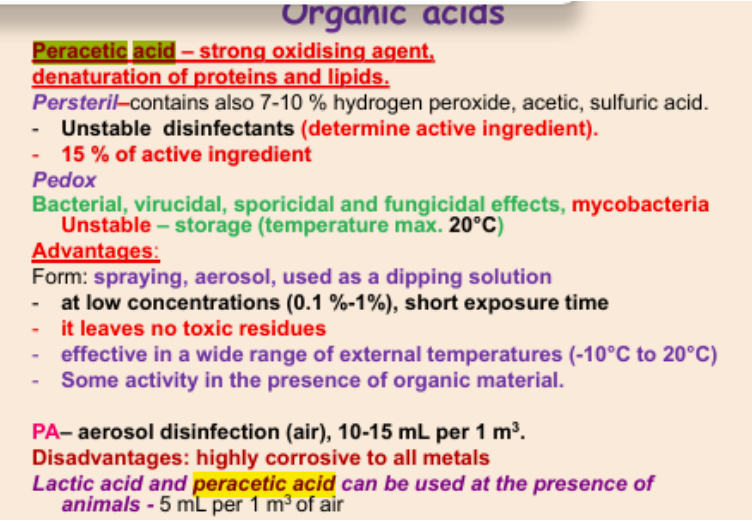
Peracetic acids: preparations, mechanism of action, properties, and usage percentage %
most used organic acid
Preparations: Persteril, pedox
Mechanism of action: Strong oxidizing disinfectant, denaturation of proteins + enzymes, destruction of nucleic acids
Properties: very broad antimicrobial spectrum: bactericidal, virucidal, fungicidal, sporicidial, decomposes into nontoxic products (water, O2)
Concentrations: Usually 0.1–0.5% solutions depending on application. 0.1-1% - effective at low doses
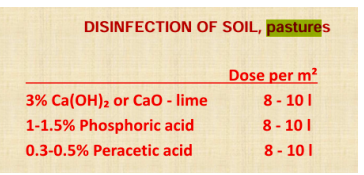
Disinfection of excrement, pasture and soil
4
Chemical disinfection (Lime, NaOH, formaldehyde)
3% CaOH/lime, 1-1.5% phosphoric acid, 0.3- 0.5% peracetic acid excrement: formalin (1%)
Burial or composting of contaminated materials.
Ploughing and sunlight exposure of soil
Restricting access of animals until pathogens are destroyed
Microbiological control of disinfection, procedures, control and results
Most objective way to evaluate disinfection effectiveness using microbial swabs. Used for preventive + focal disinfection, determines total microbial load/presence of indicator germs. Can show the resistance to disinfectants.
Procedure
1. Collect >30 sterile swabs from surfaces (10 cm² area).
2. samples are collected before + after disinfection, if needed → dilute samples
3. Culture on agar media (e.g., nutritive agar, Endo agar).
4. Calculate colonyforming units (CFU).
Evaluation
Preventive disinfection: max. 10% positive indicator microorganisms, so > 90% swabs must be negative.
Focal disinfection: 100% swabs must be negative
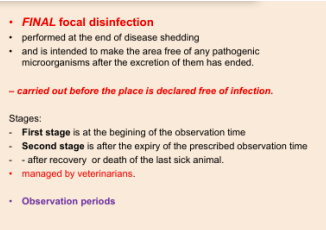
What are the stages of focal disinfection?
Preparatory stage Determine area and disinfectant Prepare solution and equipment
Mechanical cleaning Removal of organic material (dust, feces, bedding).
Disinfection Application of chemical disinfectant
Final evaluation and repeated application if necessary
What methods are used for rodent control?
1. Mechanical methods - physical devices that capture/kill rodents. ex. snap traps, cage traps, glue traps, electronic traps. Usually by using bait + placed in areas with rodent activity (along walls, near holes
2. Physical methods - using environmental or physical factors. Ex. water flooding of burrows, sound or ultrasonic devices. Usually used with other methods. Elimination of food, or entrances.
3. Biological methods: Involve nautral predators, like cats and dogs.
4. Chemical methods - Using rodenticides (poison). Usually mixed with bait (meat, fish, cereals) Acute: death within 6-24h subacute: death within 3-6days chronic (anticoagulants): death after 6-10d.
What are the chemical properties of drinking water, their limits, and impact on organisms?
Typical limits:
pH: 6.5–9.5
Nitrates: ≤ 50 mg/L
Nitrites: ≤ 0.5 mg/L
Ammonia: ≤ 0.5 mg/L
Iron: ≤ 0.2 mg/L
Phosphates: max. 1mg/L
Active chlorine: 0.05-0.3mg/L (residual of chlorine) - disinfection of water.
chlorides: ≤ 250 mg/L
DO: dissolved
O2: 50% hardness: 1.1- 5mmol/L (Ca > 30mg/L, Mg 10- 30mg/L)
methemoglobinemia - 500mg to adults, 1-10mg
Impact on organisms: If these substances exceed limits, they can cause toxicity, oxygen transport disorders (methemoglobinemia from nitrates/nitrites), organ damage, nervous system effects, digestive problems, and unpleasant taste or odor of water.
What is eutrophication, its meaning, causes, and consequences?
Eutrophication = excessive enrichment of water with nutrients, mainly nitrogen and phosphorus → rapid growth of algae + aquatic plants
Causes: Agricultural fertilizers + manure runoff, wastewater + sewage discharge, industrial pollution, detergents containing phosphates
Consequences: massive multiplication of algae, fish and aquatic organisms dies, water quality reduces and ecosystem in imbalance, change in O2
What are chemical rodenticides, their division, characteristics, and usage?
chemical rodenticides: Poisonous chemicals used to kill rodents
Division:
acute: death within 6-24h, needs prebaiting, ex. zinc phosphide, aluminidium phospde, red squill
Subacute: death with 3-6d, ex. vitamin D compounds
Chronic (anticoagulants): death after several days (6-10d) due to repeated feeding
Characteristics: mixed with bait in forms such as dry, wet, powder, or paraffin blocks. Acute act quick, are more toxic and less selective. Chronic are more safer, and act slower.
Use: control in farms, food facilities, buildings. Placed in areas with rodent activity
What are acute rodenticides?
Cause death within 12-42h, needs pre-baiting, ex.
zinc phosphide,
aluminidium phospde,
red squill.
What methods are used for disinfection of drinking water?
Drinking water is disinfected mainly by:'
chlorination (Chlorine gas, hypochlorites, chloramine-T))
chlorine dioxide treatment
UV radiation disinfection
These methods destroy pathogenic microorganisms and ensure safety
What is secondary poisoning in rodent control and how can it be prevented?
Secondary poisoning is when non-target animals (ex. pets) eat rodents that have been poisoned with rodenticides, and then become poisoned too.
Prevention: Use bait boxes, place bait in rodent-active areas only, remove and dispose of dead rodents regularly, use selective or less toxic rodenticides when possible, monitor bait placement and quantities carefully.
development of resistance in rodent control
Development of resistance in rodent control is when rodents become less sensitive to rodenticides after repeated use, and the resistant ones survive and reproduce.
Prevention: rotate different rodenticides, use integrated control methods, and apply the correct dose and bait placement.
What are unstable disinfectants and what percentage of active ingredient do they contain?
Unstable disinfectants are disinfectants whose conc. of the active ingredient changes with time, temp., storage conditions, so they must be prepared acc. to the concentration of the active ingredient.
Chlorinated Lime (33-34% active chlorine)
Persteril (32-36% peracetic acid)
Formalin (38-40% formaldehyde)
Pyrethroids: preparations, use and advantages
Preparations: Permethrin, cypermethrin, deltamethrin
Use: Control of insects and ectoparasites (flies, mosquitoes, fleas, lice) in animal houses + on animals.
Advantages: High effectiveness, fast action, low toxicity to mammals, effective at low conc.
indicator of hazards in water: MOs in drinking water, methods, limits, impact
microorganisms = an indicator of hazards in water
Microorganisms (indicators): total coliform bacteria (esp. E.Coli) used as indicators of fecal contamination.
Enterobacteriaceae family
fecal enterococci (fam. enterococcaceae)
Methods of detection: Microbiological analysis of water samples, cultivation on selective media + counting colony-forming units (CFU). Membrane filtration methods, lactose exam.
Limits: E.Coli and coliform bacteria: 0 per 100ml of drinking water
Impact on organisms: Presence indicates fecal contamination, possible pathogens, can lead to waterborne diseases such as diarrhea, gastroenteritis, cholera or typhoid.
What is the aim of preventative disinfection in different animal housing?
Eliminate pathogens and reduce the number of microorganisms in the environment, prevent growth-depressing + production-depressing factors in animals, and to improve hygiene, maintain animal health.
Routine sanitary measure performed regularly in animal hoysing systems (ex. after animals are removed in an all in/all out system or periodically in continuous housing.
Differences between preventive and focal disinfection? (MCQ)
preventive: Routine, done regularly, preventive
Focal: emergency disinfection used during or after an outbreak to eliminate pathogens at the infection source.
Which factors affect the effectiveness of disinfection?
resistance of microorganisms (ex. spores are more resistant)
effect of the disinfectant - type + action
environmental conditions
concentration of the disinfectant, amount used, exposure time, number of application of the disinfectant
What does physical disinfection include? (MCQ
Physical disinfection removes or kills microorganisms using physical methods.
1. heat: 1. dry heat: kills by oxidation used for surface/equipment 2. moist heat: kills by proteicoagulation ex. boiling, steam
2. Cold: for preservation rather than killing MOs. slows down, prevents growth.
3. dessication (drying): removal of moisture, dehydration of microbial cells, stops metabolism.
4. radiation: ionizing radiation (ex. x-ray), non-ionizing (UV light) - damage to DNA + cell structure.
5. Ozonisation: use of zone gas as disinfection, strong oxidation, damage to membrane, protein + nucleic acids
When must continuous disinfection be performed? (MCQ)
Continuous (preventive) disinfection must be done during the period when sick animals are shedding pathogens into the environment, to continuously destroy MO and prevent their spread.
What methods are included in mechanical disinfection? (MCQ)
hot water under pressure, detergent, up to 90% MO removed.
Mechanical disinfection - methods that physically remove MO + organic material from surfaces.
Methods: Dry cleaning - brushing, scraping, sweeping etc., washing with water + detergents, high pressure water spraying
Specify the limit for nitrites (NO2) in drinking water and potential consequences of their increased levels
Nitrites (NO2) in drinking water: <0.5mg/L. Consequences of increased levels are: cause methemoglobinemia (red. O2 transport in blood), esp. dangerous for infants (blue baby syndrome), can lead to O2 deficiency in tissues and health problems
Nitrates (NO3): <50mg/L. Consequences of incr. levels: nitrates → nitrites in body
Which indicator micro–organisms are used to assess safety of drinking water and what is their acceptable level?
Indicator MO used to assess drinking water safety:
E. Coli Coliform bacteria sometimes enterococci
Acceptable level: 0 microorganisms in 100ml of drinking water (E.Coli + coliforms must not be present)
Hygiene of air, components, characterisation
Air hygiene - studies quality + cleanliness of air and its impact on the health of humans and animals.
Components of air: Nitrogen (~78%) Oxygen (~21%) Argon (~0.9%) Carbon dioxide (~0.04%) Small amounts of gases, dust, microorganisms, and pollutants.
haracterization of air quality: chemical composition (gas, pollutant), physical properties (temp. humidity, air movement, dustiness), biological content (MO such as bacteria, fungi, spores).
Too much CO2 → poor ventilation, red. O2 availability, resp. stress, decr. productivity. Too much ammonia: irritation, damage to MM, reduced immunity, risk of resp. disease. H2S: highly toxic gas, cause resp. paralysis, NS damage, death.
Microorganisms in air, airborne diseases, transmission
Air is not a natural environment for MOs, but it can contain them temporarily.
Sources of MOs in air: animals (resp., skin, secretions), manure, feces, bedding, feed, dust and aerosols in animal hourses
Types: Bacteria, virus, fungal spores, parasites (egg, cysts).
MOs are usually attached to dust particles/droplets (aerosols) and their survival depends on humidity, temp., UV, and ventilation
Airborne diseases: transmitted through air by droplets, droplet nuclei, dust particles with MOs. Ex. respiratory diseases, viral diseases, TBC type. Transmission by inhalation of contaminated air - coughing, sneezing, aerosols, dusts
what is pulsation method in rodent control and why is it used?
Pulsation method in rodent control is a technique where rodenticides are applied in repeated short periods (pulses) with breaks between treatments. Placed in low amounts, repeated after 6-7d. 20-80g for rat, 5-25g for mice
Why it is used: reduce risk of secondary poisoning, prevent development of resistance in rodents, incr. effectiveness, prevent acc. of excessive dose of coagulant in rodent body.
Chronic rodenticides, division, mechanism of action, properties, using
Slow acting, death in 4-10d
Based on anticoagulants → change in blood coagulation, cumulative poisons.
Division:
1st gen: warfarin, coumatetralyl, chlorophacinone
2nd gen: bromadiolone, brodifacoum, difenacoum
3rd gen: difethialon, baraki
Mechanism of action: Inhibit vit K metabolism, prevent blood clotting, cause internal bleeding → death after several days.
Properties: delayed action, do not cause bait shyness, effective even when rodents eat small repeated doses.
Use: mixed with food bait, used for rodent control.
Rodent control, importance?
1. Prevent spread of diseases
2. protect food and animal production
3. reduce economic damage cuased by rodents to buildings, crops + stored products.
what is pre-baiting in rodent-control and when is it used?
This is the placement of non-poisoned bait first so that rodents get used to eating it before poison is added.
Mainly with acute rodenticides, used to increase bait acceptance, avoid bait shyness. After 2-3d rodents will have learned to feed at these locations.
Specify mechanism of effect of the synthetic pyrethroids on insects ,properties, using
Mechnanism of effect: Affect NS of insects by blocking voltage-gated sodium channels in nerve cells. Cause continuous nerve stimulation → paralysis (knock-down effect) → death.
Properties: Highly effective at low dose, rapid action, low toxicity to mammals, relatively stable, can cause resistance in insects with repeated use
Use: control of flies, mosquito, fleas, lice etc. Used in animal housing, farms, on animals. Apllied as spray, aerosol, powders or on material.
Insect control: methods, aim, classification and using of pyrethroids
1. Mechanical methods – traps, sticky papers, screens, removing breeding sites.
2. Physical methods – temperature (heat/cold), light traps, electric insect killers.
3. Biological methods – natural predators or parasites of insects.
4. Chemical methods – use of insecticides (e.g., pyrethroids, sprays, aerosols).
5. Preventive measures – hygiene, proper waste disposal, and preventing insect entry
aim: elimination/reduction of insects, prevention of disease transmission, protection.
classification: acc. to life stage affected, acc. to mode of action, acc. to entry into organism, acc. to origin.
Pyrethroids: from pyrethrum but made chemically, sodium channel modulators, cause continuous nerve impulses → tremors, paralysis + death of insects. Knock-down + killing effect. low toxicitiy to mammals + bird. ex. allethrins, permethrin.
Damage caused by insects are related to economic losses & health of animals
Economic losses: reducing animal production + incr. costs for control and medical treatment. They can decrease weight gain, milk and egg production and incr. mortality while also causing pain, irritation and allergies.
Insects also affect hygiene and health by spreading viral, bacterial and parasitic diseases (inc. zoonoses). They are classified as poisonous insects (ex. bees - little importance for prod:), parasitic and disease-transmitting insects.
Specify mechanism of effect of organophosphates and carbamates insecticides (biodegrability, effect residual).
Organophosphates: broad-spectrum insecticides acting as contact,
stomach, and respiratory poisons.
inhibit acetylcholinesterase, -, paralysis, and death; short residual effect.
Carbamates: similar insecticides that act as contact and stomach poisons and also inhibit cholinesterase; some have longer residual effect
Resistance management: prevent resistance by moderating use, rotating insecticides, maintaining sanitation, and using multiple control methods
Classification of insecticides according to
1. According to the effect on LC: ovicides, larvicides, adulticides
2. According to mode of action: systemic, residual effect
3. according to entry into organism: contact, stomach or respiratory poisons
4. Acc. to origin: plant derived, synthetic
group of synthetic insecticides?
1. SYNTHETIC PYRETHROIDS
2. ORGANOPHOSPHATES
3. CARBAMATE INSECTICIDES
4. NEONICOTINOID INSECTICIDES
5. INORGANIC SYNTHETIC INSECTICIDES
6. CHLORINATED HYDROCARBONS
7. FUMIGANTS
life cycle of insects?
Insects undergo metamorphosis (body change), which can be either
1. Complete (insect changes a lot during growth): egg → larva (molts 3x) → pupa → adult (process takes 4-10d). The female sticks the eggs to hair or feathers using a special sticky liquid.
2. Incomplete (insect does not change shape much): egg (inside capsule, called ootheca) → nymph (molts several times) → adult. ex. cockroach.
insect control, the importance?
insects in animal facilities → economic loss + health issue by red. weight gain, milk and egg production, incr. costs for control and treatment
Transmits also diseases. Imp. insects include: coackroach, houseflies, mosquito, fleas, lice and ticks.
Aldehydes: preparations, mechanism of action, properties,using (%
Preparations: Formaldehyde (formalin), Gluteraldehyde (1-2%)
Mechanism of action: protein denaturation, damage of nucleic acids, affects enzymatic systems
Properties: broad antimicrobial spectrum - bactericidal, virucidal, fungicidal, mycobactericidal, sporicidal, influenced by temperature + humidity.
Concentrations: spray: 2% formaldehyde, for spores: 10% alkaline formadehyde: 3% formaldehyde + 3% NaOH for focal disinfection
NaOH, mechanism of action, properties, usage
Sodium hydroxide (NaOH)
Mechanism of action: Raises pH strongly, destroying microbial cells Causes hydrolysis of proteins and saponification of lipids → damage of cell structure
Properties:
Strong alkaline disinfectant
Broad microbicidal effect (bacteria, viruses, spores)
Highly corrosive to metals and tissues
Activity increases with higher temperature
Usage:
1–2% for Gramnegative bacteria
3–5% for Grampositive bacteria
2–4% for viruses
5–10% for spores
Used mainly for disinfection of animal houses and equipment.
sanitation, defintiion, aim, using, measures
Sanitation is a set of hygienic measures used to remove or destroy pathogens in the environment to prevent the spread of infectious diseases among animals and humans.
Aim: Prevent transmission of infections, Protect health and welfare of animals and humans, Maintain hygienic conditions in animal housing and the environment
Using: Applied in animal production facilities, farms, food industry, and public health environments
Measures:
Disinfection (chemical or physical)
Insect control (disinsection)
Rodent control (deratization)
Cleaning and waste disposal
General hygiene and preventive measures
Types: preventive sanitation, focal sanitation
Define the term sanitation
Sanitation is removal, inactivation or killing of agents of infections in the external environment. The aim is to reduce the number of microorganisms
Acids: preparations, mechanism of action, properties, using in %
Preparations:
Inorganic: hydrochloric acid (HCl) - used 2.5% with 15% NaCl solution, sulphuric acid (H2SO4)
Organic: lactic acid, peracetic acid (0.1% on meat, 0.5-1% for preventive) Hydrochloric acid (HCl
Mechanism of action: oxidation, dehydration, destruction of enzyme system, damaging microbial cells
Properties: bactericidal, virucidal, fungicidal, strong and corrosive, stable in dilution
Stages of disinfection?
1. Preparatory works – determine the area to disinfect, select disinfectant, prepare solution, equipment, and protective clothing.
2. Mechanical cleaning – remove organic material (dust, feces, bedding, feed, dirt) by brushing, scraping, and washing.
3. Disinfection – application of the disinfectant (e.g., spraying or aerosol).
4. Deactivation (neutralization) – removal or neutralization of disinfectant residues.
5. Control of effectiveness – checking efficiency by microbiological tests or swabs.
6. Finishing works – documentation and final inspection.
mechanical cleaning, importance, differences in the 2 types of disinfection?
Preventive (protective) disinfection aims to reduce microorganisms and maintain hygiene in animal housing to improve animal health and productivity. It is performed regularly, e.g., after animals are removed in an all-in/all-out system or at least twice a year in continuous housing.
Focal disinfection is used during disease outbreaks to eliminate pathogens at the infection source and stop disease transmission. It includes continuous disinfection (during pathogen shedding) and final disinfection (after recovery or death of the last infected animal).
List methods of controlling disinfection?
control of disinfection - process for verifying whether disinfection is done correctly and if it is effective.
Types
1. Direct control - evaluation of mechanical cleaning quality, environment conditions, temp., and correct use of disinfectants
2. indirect control: checking the disinfection protocol and procedure documentation.
3. Chemical control - checking conc. of the disinfectant active ingredient
4. microbio control - swab tests to detect MOs and confirm disinfection effectiveness
Results: after focal: all swabs must be negative, after preventive- min. 90% of swabs must be negative.