human personality weeks 3-6
 Call Kai
 Learn
Learn Practice Test
 Spaced Repetition
 Match
Match Flashcards
 Knowt Play
1/83

There's no tags or description
Looks like no tags are added yet.
Name | Mastery | Learn | Test | Matching | Spaced | Call with Kai |
|---|
No analytics yet
Send a link to your students to track their progress
84 Terms
why is personality science uniquely positioned to predict real-life ouctomes?
life outcomes are complex and multidetermined → many small causes
personality science provides many variables (traits, facets, ABCDSs)
measures capture real-world behaviour (high ecological validty_
ABCDS cover broad psychological processes
can combine many small effects to predict ouctomes
eval
correlations usually small
stronger for self-report ouctomes due to method overlap
what is the explanatory approach in psychology?
goal: explain why someting happens
uses:
simple (parisomnious) models
few variables
controlled/lab experiments
what are the problems with explanatory models?
focuses on in-sample explanation, not prediction
often overfit to specific samples and methods
low ecological validity
do not generalise well to real life
what is the predictive approach in psychology?
Goal: accurately predict outcomes
uses:
many predictors
real world relevant measures
focus on out of sample generalization
can predict out of the sample it was built on
what is the key tension between explanatory and predictive approaches?
explanatory models:
simple and elegant
poor prediction
predictive models
complex, many variables
better real-world prediction
trade-off between parsimony vs accuracy
what are the main kinds of outcomes linked to personality traits?
education
SES
relationships
political, socially responsible behaviour
health and mortality
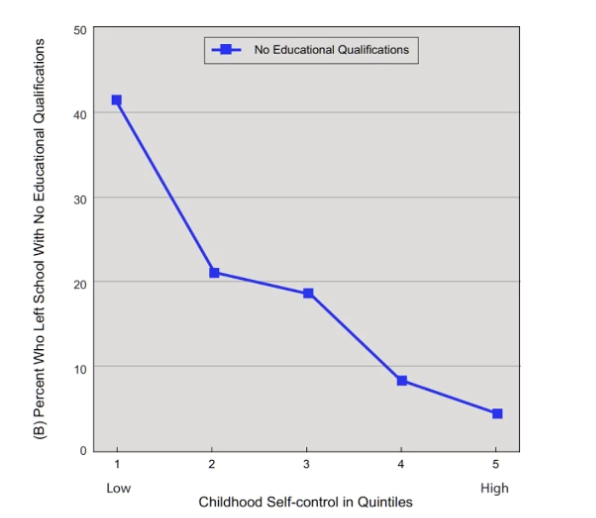
relationship between dropping out of school and low self control? moffit et al. 2011
children with low self control were substantially more likely to drop out of school
big five and GPA? poropat et al., 2011
three of big five
openness .12
agreeableness .07
conscientiousness .22
main finding : children with higher conscientiousness are more likely to do well in school. Most associations pertain to self reported conscientiousness.
what are the effect sizes and how do we meaninfgully interpret them?
they appear to not be particularly strong or weak
to intrepret menaingfully we would comapre to something we know to be a ribsut association with meaninfgul effect sizes
such as IQ
how does IQ effect sizes and big five relate?
intelligence is .25
conscientiousness is .22
pretty much the same, not far off
how do the associations maintain throughout stages for big five and GPA?
associations are generally stronger in primary school
what are the associations between methods of gpa and big five?
associations are there and stronger so they do generalise w
conscientiousness .43
openness .37
why could self reports be smaller?
parents perceptions are tainted with school performance
kids self reports are unreliable
grades reflect how kids appear to others
how do you students self select ito academic majors? what traits with what degres? vedel, 2016
neuroticism highest for arts and humanities, psychology
extraversion highest for economics, law and medicine
openness highest for arts, humanities, psychology, polities
agreeableness lowest for law, business and economics
conscientiousness lowest for arts and humanities
job performance and big five? salgado & de fruyt, 2005
Neuroticism | -.21 |
Extraversion | .10 |
Openness | .09 |
Agreeableness | .19 |
Conscientiousness | .33 |
high c seems to be highets prefictor for job performance
job satisfaction and big five? salgado & de fruyt, 2005
N-.29
E - .25
O- .02
A - .17
C - .26
low N high E and C seem to be more satifies with jobs on averga e
socioeconomic success and big five? judge et al., (1999)
children measured in childhood and in adulthood
higher income?
Income | Income | |
Adult | Child | |
N | -.32 | -.26 |
E | .24 | .25 |
O | -.01 | .10 |
A | -.11 | -.01 |
C | .34 | .16 |
relationship quality and big five?
personality traits linked with relationship quality (meta-nalaysies)
N
-.22
E
.06
O
.03
A
.15
C
.12
personality traits predict likelihood of divorce (Roberts et al., 2007)
antisocial behaviour and big five?
antisocial behaviour
Low A and Low C, high N.
agreesiveness
high N
low E, O, A and C

political converservtaism and big five?
when times are hard, less open people are likley to be politically conservative,
however not strong associations
N | -.03 |
E | -.01 |
O | -.18 |
A | -0.2 |
C | .10 |
environmentalism and HEXACO
Pro environmental behaviour | Pro environmental attitudes | |
N | -.02 | .02 |
E | .10 | .09 |
O | .21 | .22 |
A | .10 | .15 |
C | .11 | .12 |
H | .26 | .21 |
big five and longevity? graham et al., 2017
low C more likely to die in certain period of time
N | 1.05 |
E | 0.94 |
O | 0.97 |
A | 0.95 |
C | 0.89 |
how are big five traits related ro a variety of self-rpeorted helath issues?
most consistently conscientiousness
alzhiemer’s and the big five?
high N seems to be predictive of future of Alzhemier’s
Low C seems to be predictive
effects comparable to established risks (low education, diabtees)
AD (OR) | |
N | 1.33 |
E | 0.95 |
O | 0.86 |
A | 0.88 |
c | 0.76 |
what can explain the associations?
personality traits are linked to SES whihc might have some helath relvane
health related behaviours
adherence ro doctors advice and medical treatment
higher C linked
stress
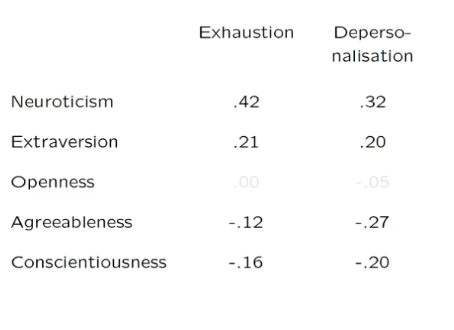
employee burnout
accidents
low C and high N are more likely
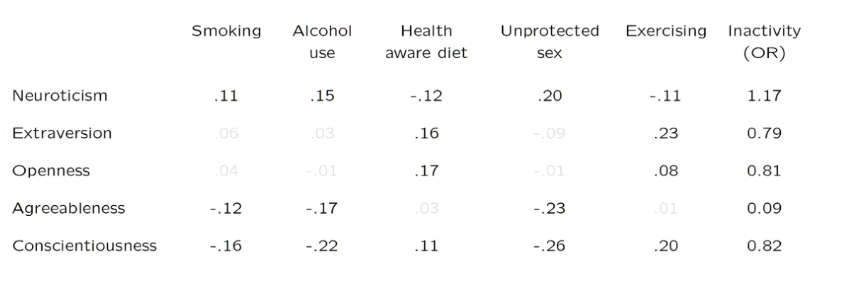
general conscientiousness patterns?
High C
better education
higher income and job performance
better relationships
better health and longevity
healtheir behaviour
better adhernece to medical illness
fewer chronic ilness
Low C
more antisocial behahviour
worse health
risky behaviours (smoking alcohol)
more accidents
higher mortality risk
high C is consistently positive across most ouctomes
general neuroticism patterns?
High N
worse education and work ouctoes
poorer relationship quality
worse health
higher stress and anxiety
mor emental health problems
increased risk of physical illness
linked to alzhimers’s risk
more agression and antisical behvaiour
lowee socioeconomic stress
Low N
better eductaion and job ouctomes
higher SES
better relationships
better health
extraversion general patterns
High E
better job performance and satisfation
better SES
better relationships
Pro environmental behaviour and attitudes
better longevity of life
Low E
higher aggressiveness
agreeableness general patterns?
HIgh A
better relationships
less antisicoal behvaiour
health:
better cooopertaion with doctors
less stress
Low A
more agreesion
worse health via hoistility
openness general patterns
High O
better education
pro environmental behaviour and attitudes
Low O
more agressiveness
political conservative views
not strong associations
what are the typical effect sizes across all outcomes?
generally small to moderate
however the are similar in size to other important predictors
what explains the associations between personality and these ouctomes?
health behaviours
e.g - high c → better diet, exercise and adherence
stress and emotional processes
e.g - high N → more stress, burnout
indirect pathways
personality → education/income → health
risk behaviours
low c / high N → more accidents, poor decisons
what happens when you aggregate trait outcome association?
when you move from individual associations → aggregate patterns:
effects become substantially stronger
small correlations accumulate across traits and outcomes
examples:
combined trait predictions = r = .28-.43
do personality traits still predict outcomes when controlling for SES and cognitive ability?
personality traits still predict life outcomes even when controlling for factors like SES and cognitive ability, effects typically modest but not too different
many cases, evidence supports the conclusion that personlaity traits predict these ouctomes better than SES
perosnlaity addes incremental preictive validty beyond traditonla predictors
what is the personlaity coefficient and why could it be unhelpdul?
the personality coefficient refers to the idea that personality traits typically show small effect sizes (low correlations) with outcomes
it is unhelpful as it can mislead people into thinking personality doesnt matter
focuses only on single correlations, ignoring broader patterns
how replicable are personality trait-ocutome associations?
soto (2019)
most trait outcome associations successfully replicate
replication rates are higher than in many psychological fields
how does the replication compare to other fields?
many areas of psychology have poor replication rates
classic findings often fail to replicate
personality research shows greater robustness and more consistent patterns across studies
personality is considered methodologically stronger and more stanle than otehr subfields
which level of trait hierarchy tends to be most strongly linked with outcomes ?
associations are quite facet specific
for aggression
angry hostility facets of N seems to predict more aggressiveness whereas self consciousness predicts none
for prediction of BMI in independent samples (vainik et al., 2019)
facets based predictions were 4x more accurate
single items (nuances) explained ~30% more variance
what is the overall pattern (“architecture”) of personlaity-outcome associations?
associations are pervasive (traits linked to many life outcomes)
at a broad level:
good traits → good outcomes
bad traits → worse outcomes
at specific levlels:
associations are facet or nuance specific
broad general pattern + specific underlying detail
what is the correlation/causation point?
correlation does not inevitably imply causation
just becase traits and ouctomes are linked
does not mean one causes the other
traits → outcomes
outcomes → traits
something esle cause both
example - genetic s
how does trait hierarchy relate to bandwith-fidelity dimenna?
facets improve prediction but increase complexity and interpretation difficulty
trade-off between simplicity and predictive accuracy
why should associations be independent of how traits are measure?
if a trait is real and meaningful, then its association with outcomes should be stable regardless of how it is measures
example
neurotisicms should predict ouctomes regradless of what facets are used
what is associations depend on measurement? what should we do ?
associations change on depending on which facets/items are included
implications
effects may reflect specific components, not whole trait
we should:
interpret results at the facet level or nuance level
avoid overgeneralizing to broad traits
what are reflective personality traits?
traits that summarise patterns of behaviour, thoughts and feelings
they are not distinct causes, but descriptions of consistent tendencies
how could traits and outcomes overlap?
two ways
conceptyal overlap
trait and outcome describe similar things
e.g. conscientiousness and academic success
measurement overlap
same behaviours appear in trai questionnaires
outcome measures
why is personality science unqiuely positioned to map demographic variations?
personality science is uniquely suited because it uses standardised trait models (e.g., Big Five) that allow direct comparison across individuals, groups and cultures (Costa & McCrae, 1992).
traits are quantitative, enabling calculation of effect sizes, correlations, and variance explained
what else does personality science use to position it as suited approach for mapping demographic variation?
also uses multiple methods (self + informant ratings) → helps separate real differences from bia (Vazire, 2010)
large cross-cultural datasets → allows testing universality (McCrae et al., 2005)
what are the main patterns of gender differences? who is source?
costa et al., (2001)
across cultures
women are higher in
Neuroticism (d ≈ .48)
Agreeableness (d ≈ .45)
Slightly higher Conscientiousness (d ≈ .11)
men higher in
assertiveness (facet of extraverison)
risk taking
some aspects of openness
do gender differences match intuitions?
match common stereotypes
they also replicate across observers
same pattern is observed for big 5 facets and overall big five
differences between genders are small to medium
are gender differences large?
for individual traits
gender differences are small to moderate
for example Neuroticism d ~=.40
schmitt et al., 2008
when traits are combined
differences become larger
overall differences = 1.07 SDs (large)
what happens when you compound gender differences across a range of traits?
helps more intuitive interpretations
random man vs woman:
77% chnace difference is in epxpected direction
men vs women differ
~30% more than two people of same gender
is big five the best level?
big five is too broad
as facet level rveals clearer differnces betwen men and women
women are higher in warmth on extraversion
whereas men are higher on assertivness
same trait but differenct facets
are gender differences similar in self - and informant ratings? source?
McCrae et al., (2005)
yes broadly consistent
evidence
self report
neuroticism = d =.48
informant
neuroticism, = d.43
same directions and similar magnitude
BUT
informant effects sometimes smaller (e.g aggreeableness .45 → .25)
suggets some inflation in self reports
but differences are real
how do gender differences vary across cultures? source
there is cross-cultural universality of gender differences - universality
however gender differences are larger in more developed, egalitarian countries
poorer or less equal countries → smaller differences
does this match intutions?
not really because you would expect that as men and women became more equal, they should become more similar however data showed that more equality resulted in more personality differences
what might explain the size of these differences?
from Schmitt et al., 2008
social role theory (eagly, 1987) would have been a reaosn if match intuitions but it is not supported
social role theory says gender differences come from social roles
if roles became equal → differences should shrink
but reuslts showed the opposite
study challenges social role explanations as the main cause
evolutionary explanations (Buss, 1997)
in freer sociaties, people can express natural tendencies more
in wealthy countries people have more freedom, less survival pressure and more oppurtunity to express personlaity
this might allow innate differences to show more strongly
measurement/artifcat explanations
richer countries just measure personality better
better data quality in developed countries
but they found little support for measurement errors
age : what forms of stability and change in personality traits can you distinugsih and what are they?
rank-order stability
peoples relative position compared to others
person A B C - high medium low at age 20
person A B C - high medium low ar age 40n
the order stays the same
this = high rank-order stability
even if te numbers change but order remians
mean level change
average score of a group
is everyone chnaging overall ?
how do they relate to each other?
personlaity is
stable in rank -order
and chnaging in mean-level
what are the main patterns of age differences? stable? unstable?
rank order stability - personality traits show high stability across many years and even decades
long tems correlations of personality across years can be around ~.60 over 15 years
even higher when measurement error is controlled
not completely fixed but not also constantly changing
mean - level change
even though individuals sty relatively consistent compared to others, the average level of traits in the populations chnages with age
typical life-span pattern
⬇Neuroticism
Decreases with age (people become emotionally stable)
⬆Agreeableness
Increases (more cooperative/kind)
⬆Conscientiousness
Increases (more responsible, organised)
⬇extraversion
Often decline slightly in later adulthood
what kind of changes are they?
gradual
small
most noticebale from teens → adulthood
what is cumulative continuity?
personlaity becomes more stable with age, especially from adolescence to adulthood
why does stability increase with age ?
life become more consistent
people choose environments that fit their triats
roles stabilise
personlaity maturation
what age does personlaity become stable overall ?
about age 30
are age differences large?
overall, age differences in personality traits are small in magnitude, especially compared to gender differences
evidence:
changes are roughly ~1 T-score point per decase
terraciono et al., 2005
changes with age are also small, e.g.:
Neuroticism: r ≈ −.14
Agreeableness: r ≈ +.08
Conscientiousness: r ≈ +.03
Chopik & Kitayama, 2017
changes are gradual, supports the idea of gradual maturation
are age differences similar across methods?
broad patterns are consistent across methods
self-reports
informnat reports
magnitude differences as some effects are stronger in self and weaker in informant
timing differences as changes may appear earlier in one method and later than another
what level of the trait hierarchy captures age differences best?
facet-level is better than big five level
some facets openness to feelings increases but opennens to values decreases
studies have shown that different facets within the same trait follow different developmental patterns, this creates inconsistency across measures
how large are cohort effects?
very small
evidence for this includes
cross cultural simialrty
longitudinal vs cross sectionla agreement
most differences reflect development, not generation
why is personality stable?
genetics
twin studies show:
genes explain about half of personality stability
genetic influence becomes fully stable by audlthood
environment
life experiences can affect personality
but many life events show little long-term personality change amd effects are often small otr temporray
challenges the idea that personlaity constantly responds to life events
rubber band (stretaches from life events) but snap backs
why could personality change?
social invetsment theory
people chang because they take on adult roles
become workers, partners, parents
adapt to social expectations
what are the main findings of cross cultural differences?
country differences are: small
rankings:
moderately reliable (r ≈ .50–.70)
do traits