OEB 130 Lecture 9-10 (Respiration + Swimbladder)
 Call Kai
 Learn
Learn Practice Test
 Spaced Repetition
 Match
Match Flashcards
 Knowt Play
1/57

Earn XP
Description and Tags
Midterm 2
Name | Mastery | Learn | Test | Matching | Spaced | Call with Kai |
|---|
No analytics yet
Send a link to your students to track their progress
58 Terms
Air vs water as a media to breathe
Air is much easier to access O2 supply
Enables high metabolic rates of mammals and birds
Oxygen solubility trend with temperature
O2 solubility decerases with increased temperature & salinity
freshwater likely more O2 available
Why is efficient uptake vital to fish?
because of low O2 water solubility
Gills are the site of
oxygen uptake and carbon dioxide release
Blood enters the gills directly after leaving the heart
Gill tissue also contains
specialized cell types, including chloride cells which help maintain fish blood osmotic balance
What do chloride cells?
help maintain fish blood osmotic balance
similar to kidney function
How can fish remove 80 - 90% of O2 available from water?
Short diffusion distance at gill site
Large surface area for diffusion at gill site
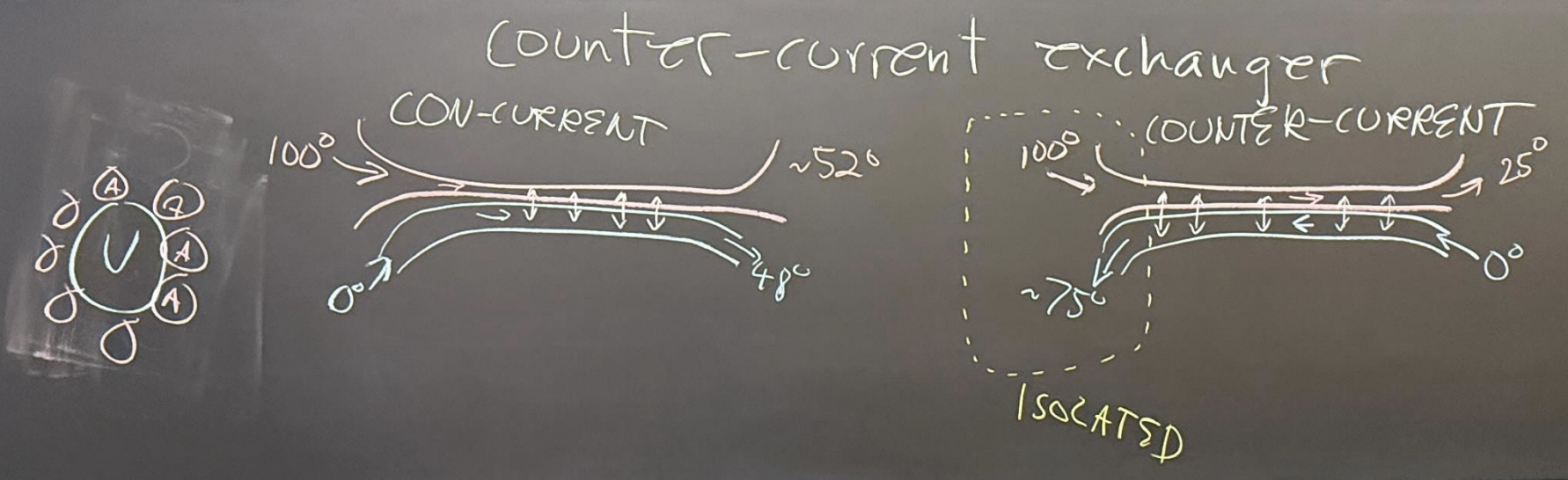
Counter current exchange of gases at gill site
Large volume of water passes over gills
% of O2 that fish remove from water vs humans from air
Fish remove 80-90% of O2 passing through gills
Humans remove ~25% of O2 from air before exhalation
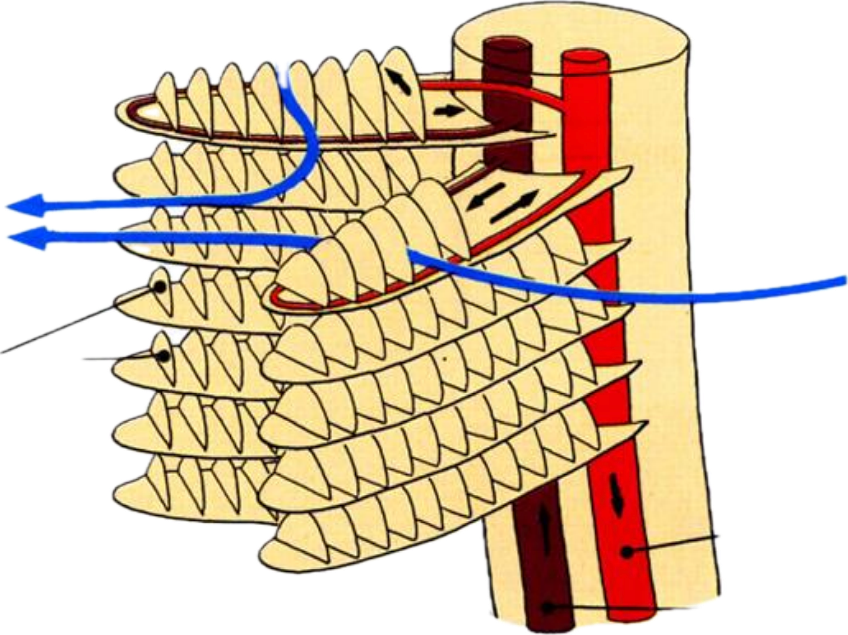
diagram of Actinopterygii gills
Gill surface area trends
Fast swimming fish have large gill surface areas (up to 50x more than sedantary “goosefish”)
Inactive fish have low gill surface ares
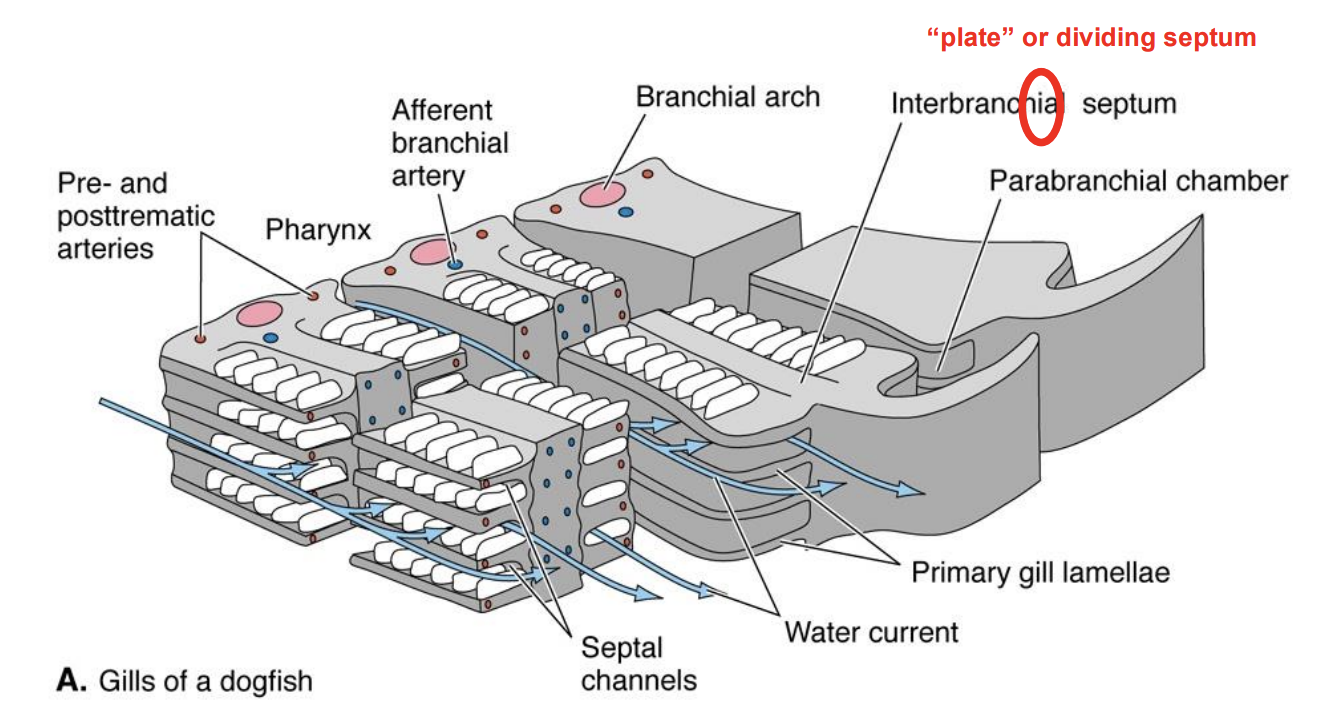
diagram of shark gills
How do fish move water over the gills? Using what pumps?
Use 1) a buccal pump and 2) an opercular pump
Fill mouth cavity (open mouth, expand volume of mouth, expand volume of gill chamber with operculum closed)
Fill gill cavity (close mouth, squeeze mouth cavity, expand gill cavity, with operculum closed
Expel water from gill cavity (squeeze mouth and gill cavities, open operculum)
4. Reset for next cycl
obligate air breathers and why?
Requires gulps of air to survive
Water near the surface is more highly oxygenated, and aquatic respiration here could have led to air breathing
eg. arapima
Anatomical Air Respiration Structure
Air bubbles in the intestine of a catfish
Vascularized gut in some catfish absorbs oxygen when air is swallowed
Physostomous swimbladders
modified respiratory organs into swim bladders (ie. Holostei in gar and bowfin)
“walking catfish” have developed
Suprabranchial organ support air breathing
“Labyrinth” fishes have
an accessory labyrinth-like air-breathing organ above the gills
labyrinth organ
ie. climbing perch
Labyrinth fish belongs to ___ group
percomorph anabantoid
anabantoid fishes
Air respiration in anabantoid fishes with a labyrinth accessory respiratory organ
Air respiration in lungfishes
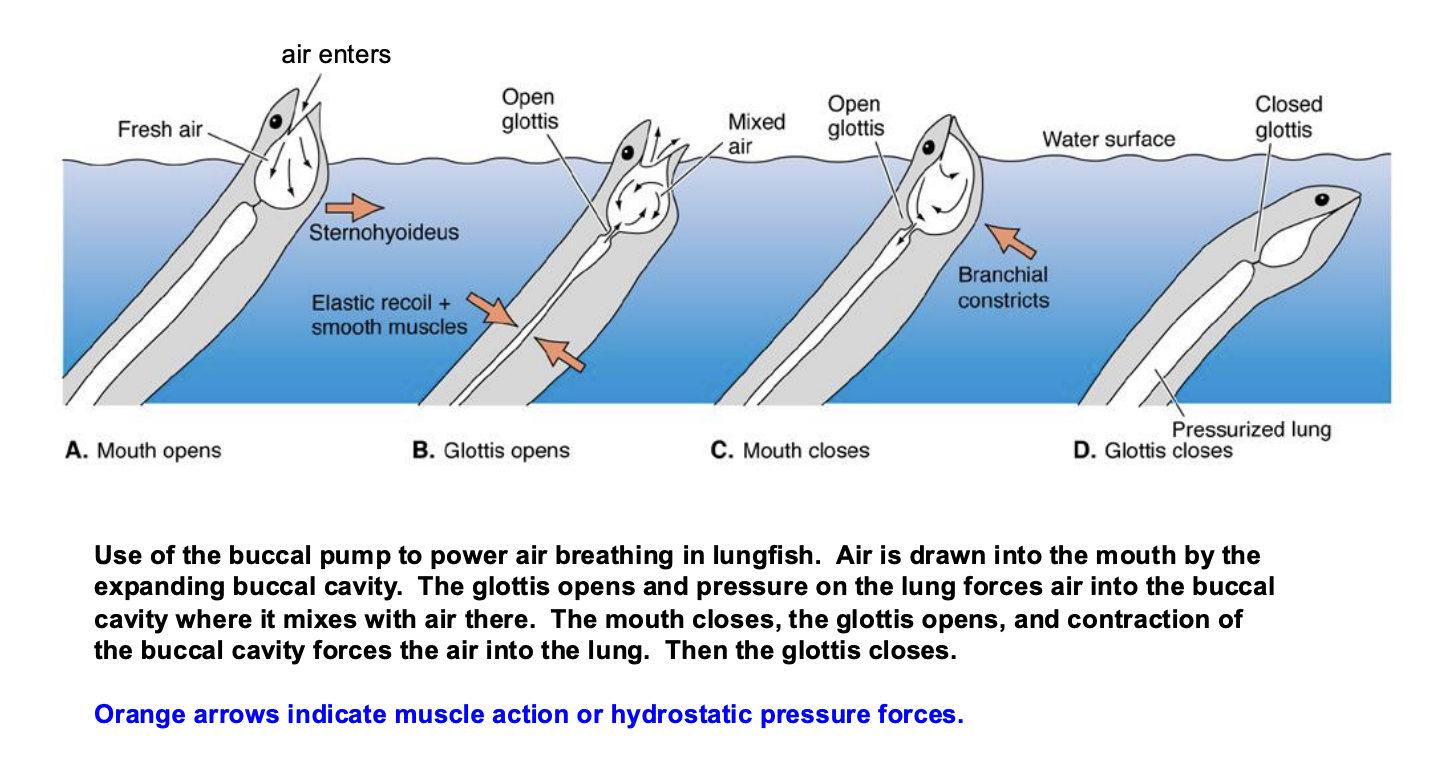
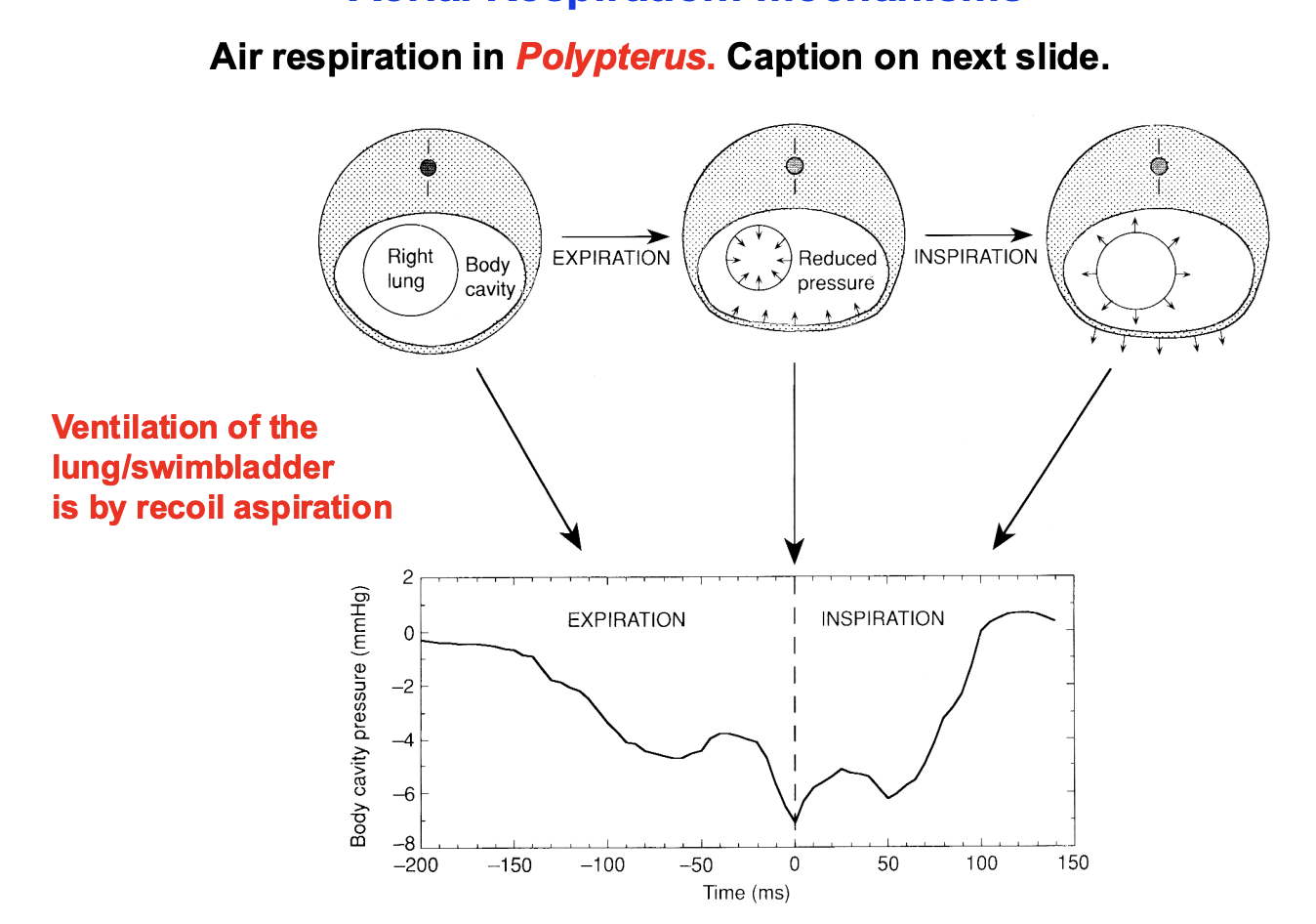
Air respiration in Polypterus
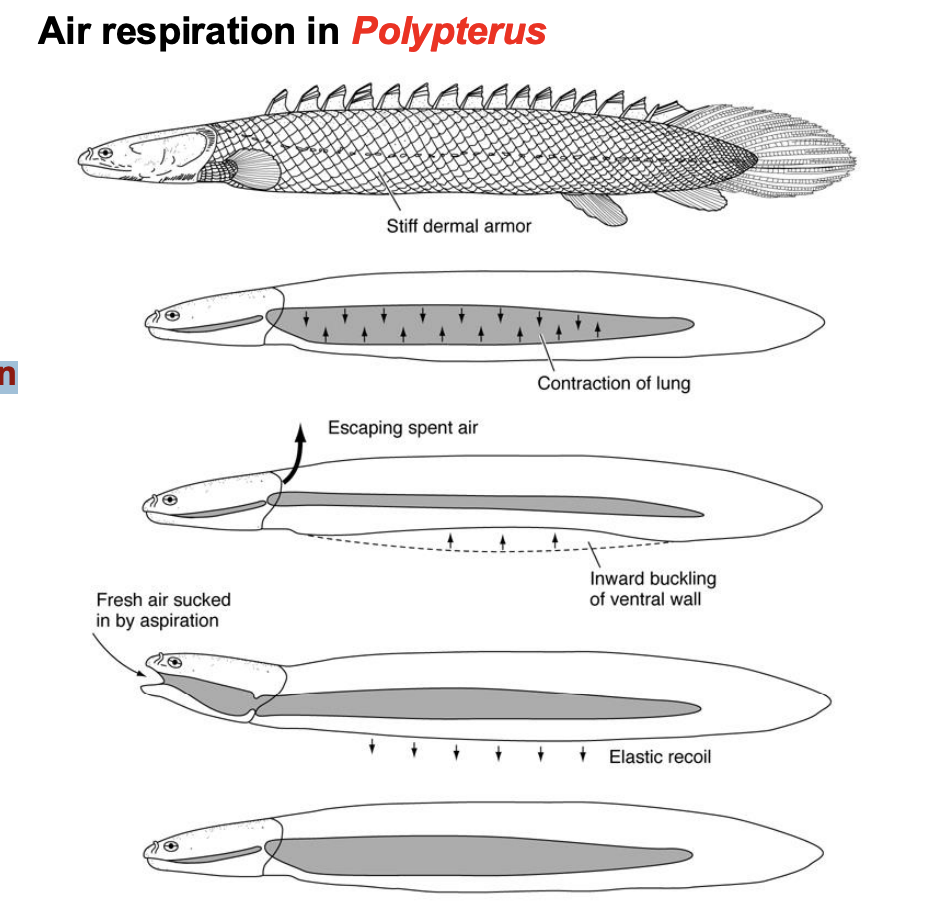
recoil aspiration
Two basic physiological principles that you need to understand the swimbladder:
Countercurrent exchange
The effect of lactic acid on Hemoglobin
Why are fish denser than water?
Because they are made of Bone (2.0 as dense), Muscle (1.05), Cartilage (1.1)
Relative density aka
specific gravity
Relative density / specific gravity is…
the ratio of the density (mass of a unit volume) of a substance to the density of a given reference material
Problem of fish density
Most fish are denser than water, and tend to sink unless they have some way of compensation
How can fish fight their density problem?
Fish can compensate by:
1. Reducing overall body density
2. Generating lift forces when swimming (like an airplane, covered in the locomotion lectures)
How do sharks fight density issue?
Reduce tissue density with special oils like squalene
How do deep-sea fish fight density issue
Reduce tissue density with thin and light bones; watery tissues.
What is squalene?
Oil with very low density that is present in shark livers
Broad phylogenetic patterns of Cyclostomes/Agnatha density
no gas bladder or lung:
individuals are negatively buoyant, and no way to avoid this problem
Broad phylogenetic patterns of Chondrichthyes density
no gas bladder or lung
calcified cartilaginous skeleton
lots of low density oils in the liver
use fins and body to generate lift during locomotion
Broad phylogenetic patterns of Ray-finned fishes (+Sarcopterygii) density
gas bladder (=swimbladder) or lung
living on the bottom – no need for weight reduction
reduced ossification in many deep-sea fishes
and increased water content in body tissues
Also use fins and body to generate lift during locomotion
What is the swimbladder? What is it also called?
aka gas bladder
a gas inclusion in the body cavity important for buoyancy
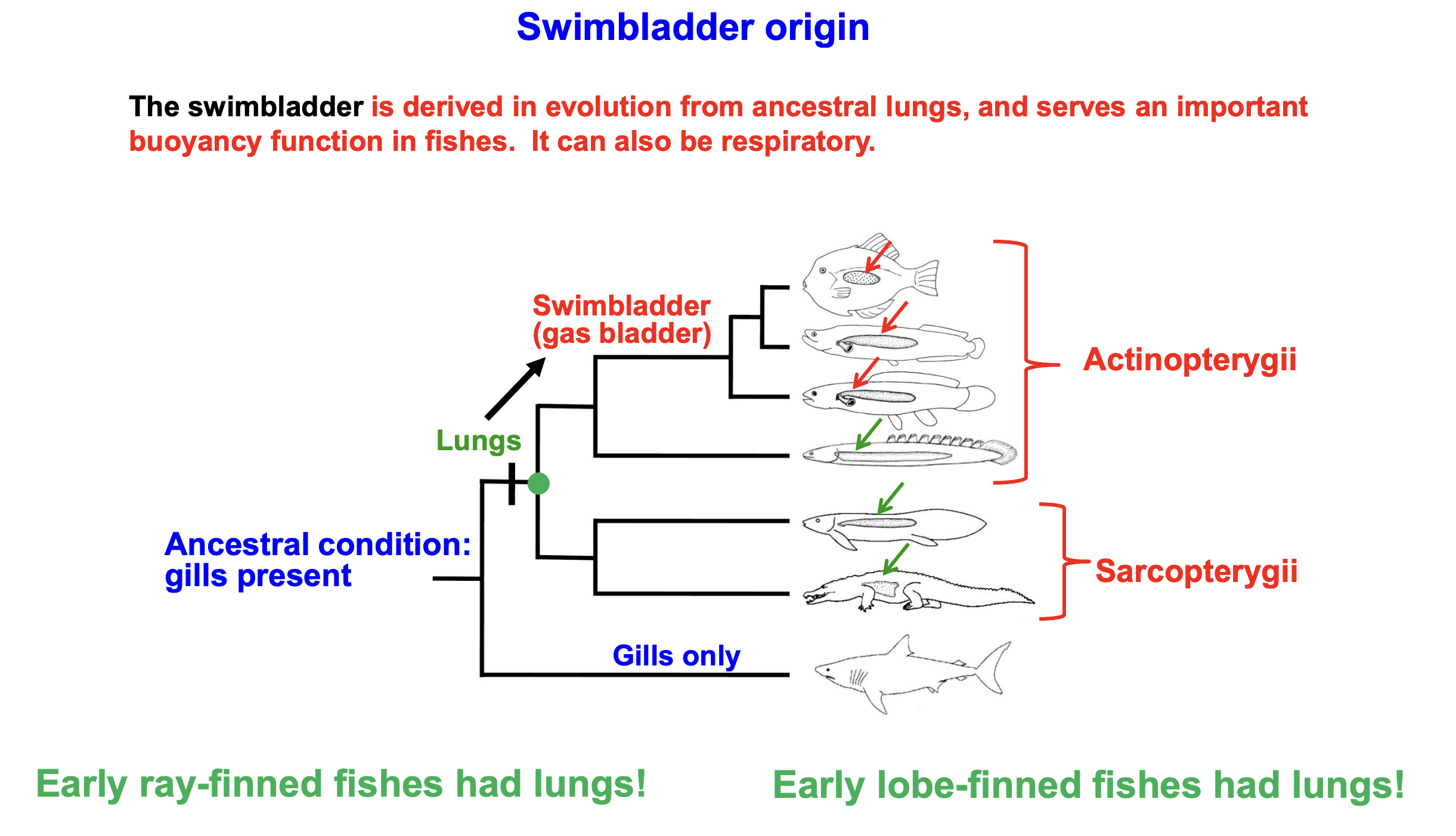
Sacropterygii have duct to the lungs on what side?
Ventral duct from the esophagus into the lungs
Ray-finned fishes have duct to the lungs on what side?
Dorsal duct from the esophagus into the lungs
Swimbladder evolution
derived in evolution from ancestral lungs, and serves an important buoyancy function in fishes. It can also be respiratory.
How many chambers do swimbladders have?
commonly between 1-2
What is the swimbladder covered in? Why?
often covered by a thick fibrous coating of connective tissue, and can have a layer of guanine crystals that make it relatively impervious to gas leakage
Facts bout the swimbladder
Swimbladders have many different shapes and sizes in fishes
Swimbladders can have muscles attached to them too which can be used to make sounds
Swimbladder can have air-filled connections to the ear which improves hearing
The swimbladder can be secondarily vascularized and used as a respiratory organ also (remember air-breathing fishes!)
What is the gas in the swimbladder composed of?
~70+ % oxygen, although this varies quite a bit , ~ 20% nitrogen, and a little CO2
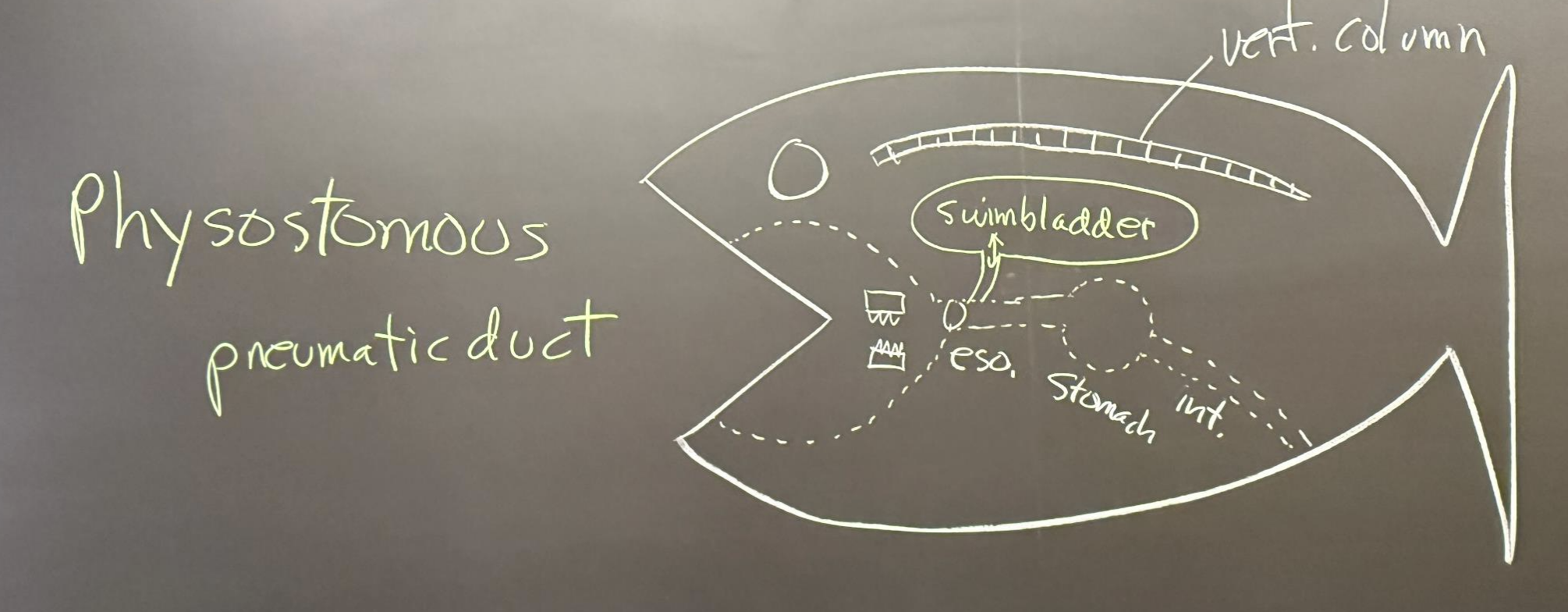
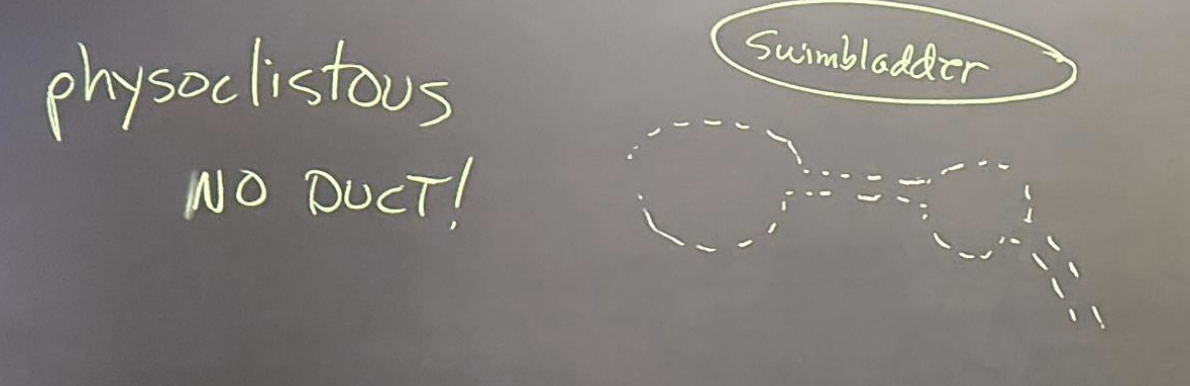
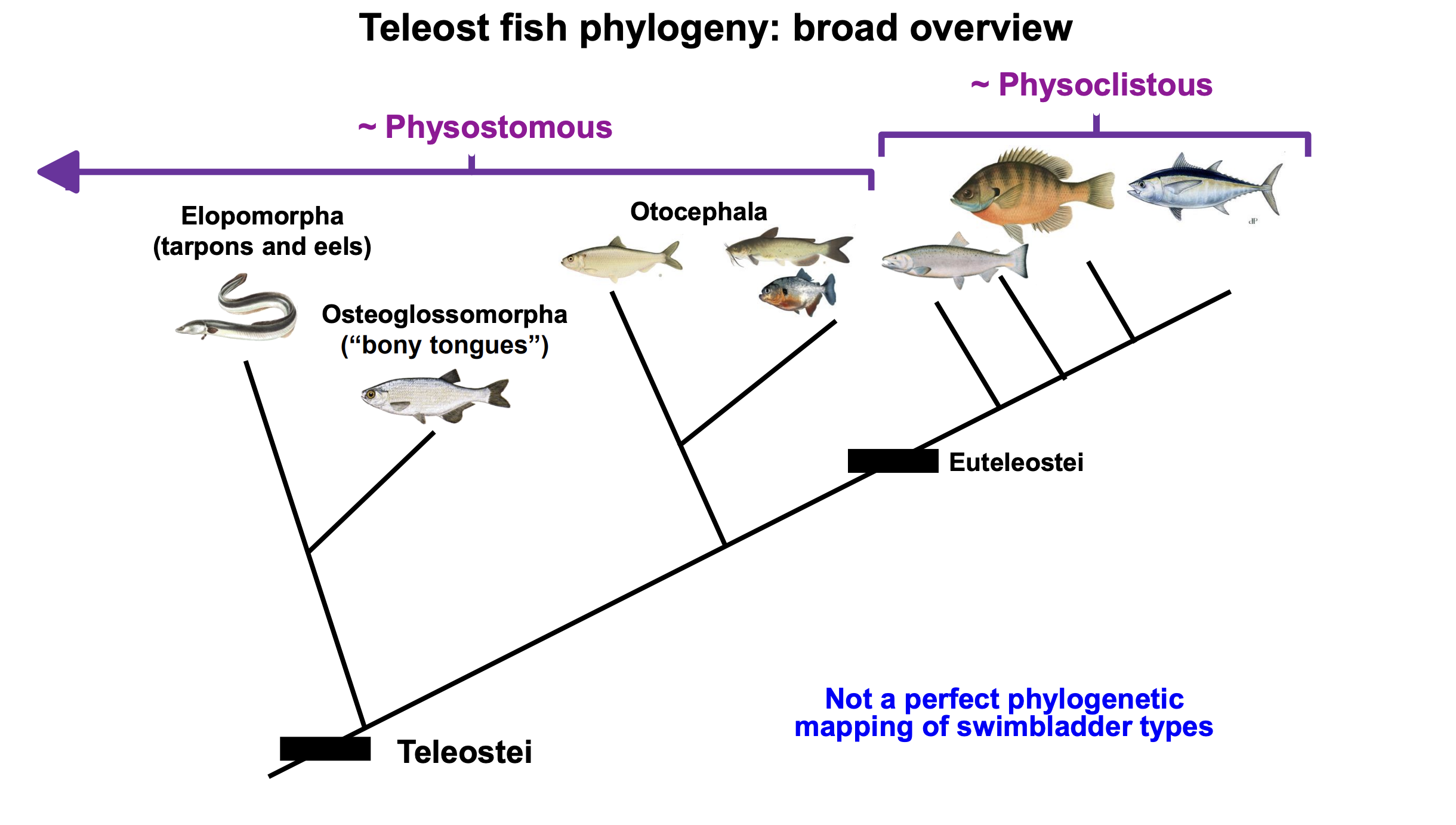
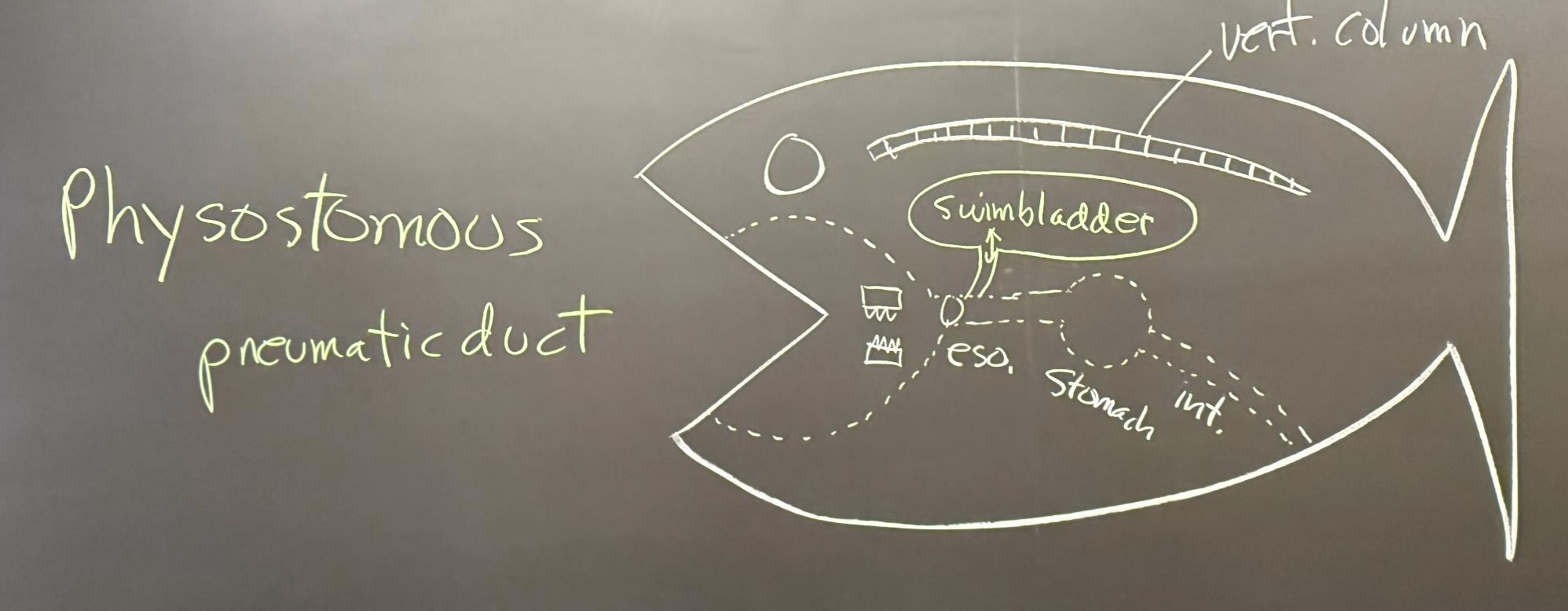
Physostomous means what? What fish? What does it look like?
“stomous” = having a “mouth” or opening of some kind
Filled with gas using the pneumatic duct (has an opening into the esophagus)
ie. soft-rayed teleosts--herrings, salmonids, catfishes, cyprinids, eels, (Otocephala, Elopomorpha), etc.
Physoclistous means what? What fish?
Filled with gas from the blood/circulatory system
ie. spiny-rayed teleosts—Neoteleost fishes: Acanthopterygii, sunfishes, perch, most marine fishes
Phylogeny of physostomous and physoclistous
What do you know about benthic fishes and swimbladders
No swimbladder at all, would be physoclistous
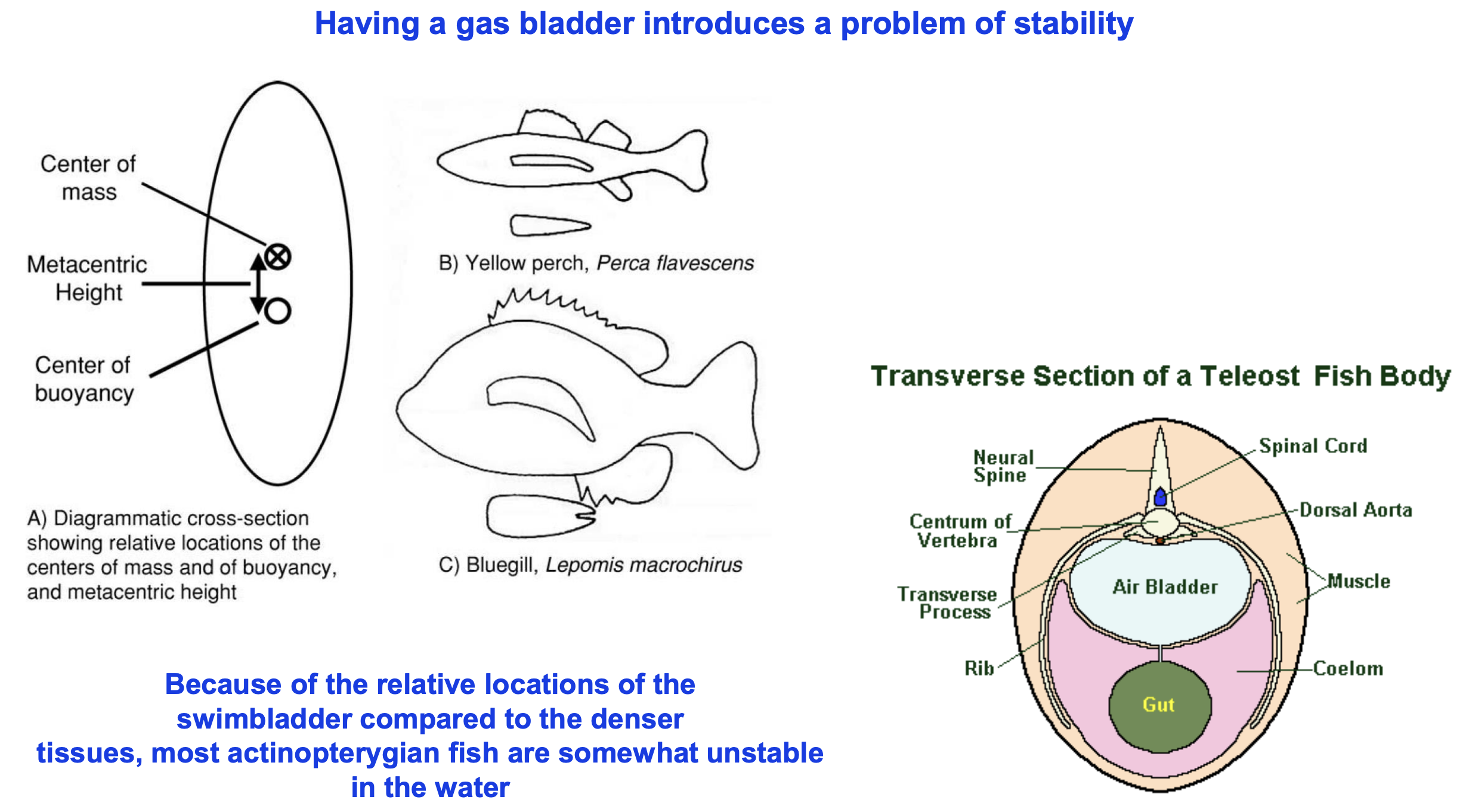
What problems does having a gas bladder introduce?
stability
how to adjust the volume (esp. changing depth)
volume should decrease as they go down
stability-maneuverability tradeoff
Need constant fin action to maintain posture
Negatively buoyant; CB below CM
Very effective at maneuvering and controlling position
Swim bladder and noises
Swimbladders can make noises
The posterior duct is used to expel gas from the swimbladder
Why is there a stability problem? What is it the tradeoff called?
Because of the relative locations of the swimbladder compared to the denser issues, most actinopterygian fish are somewhat unstable in the water
stability-maneuverability tradeoff
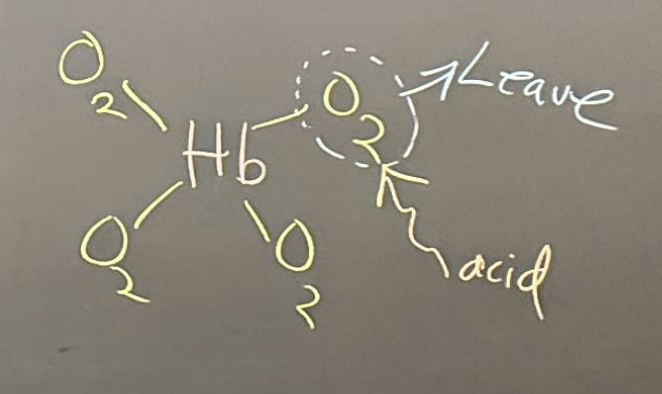
What do you know about hemoglobin?
can bind 4 oxygen
BUT in presence of acid, hemoglobin changes shape and oxygens will leave
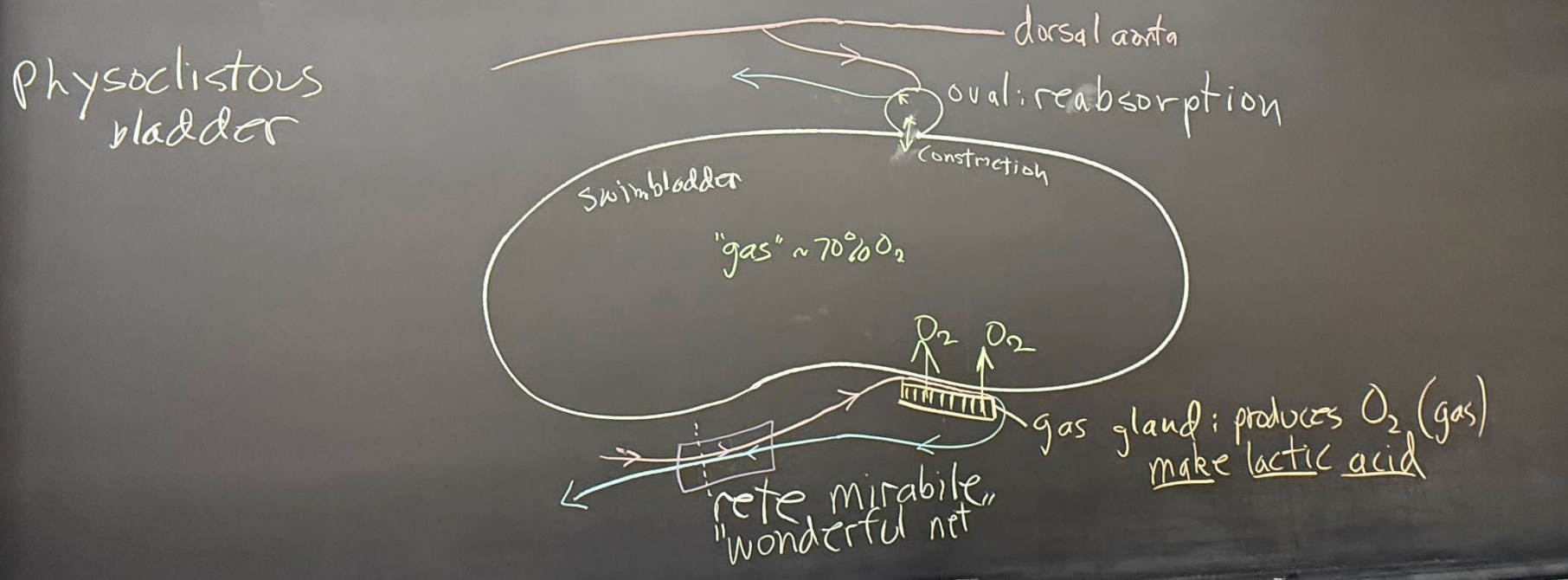
What is the oval used for?
Gas Reabsorption region taking O2 from dorsal aorta
What is the Rete Mirabale? What does it mean?
“wonderful net”
Counter current exchange allows gas in the swimbladder to stay there and not diffuse out
makes the leaving blood acid which causes O2 to dissociate and diffuse down its concentration gradient into the swimbladder
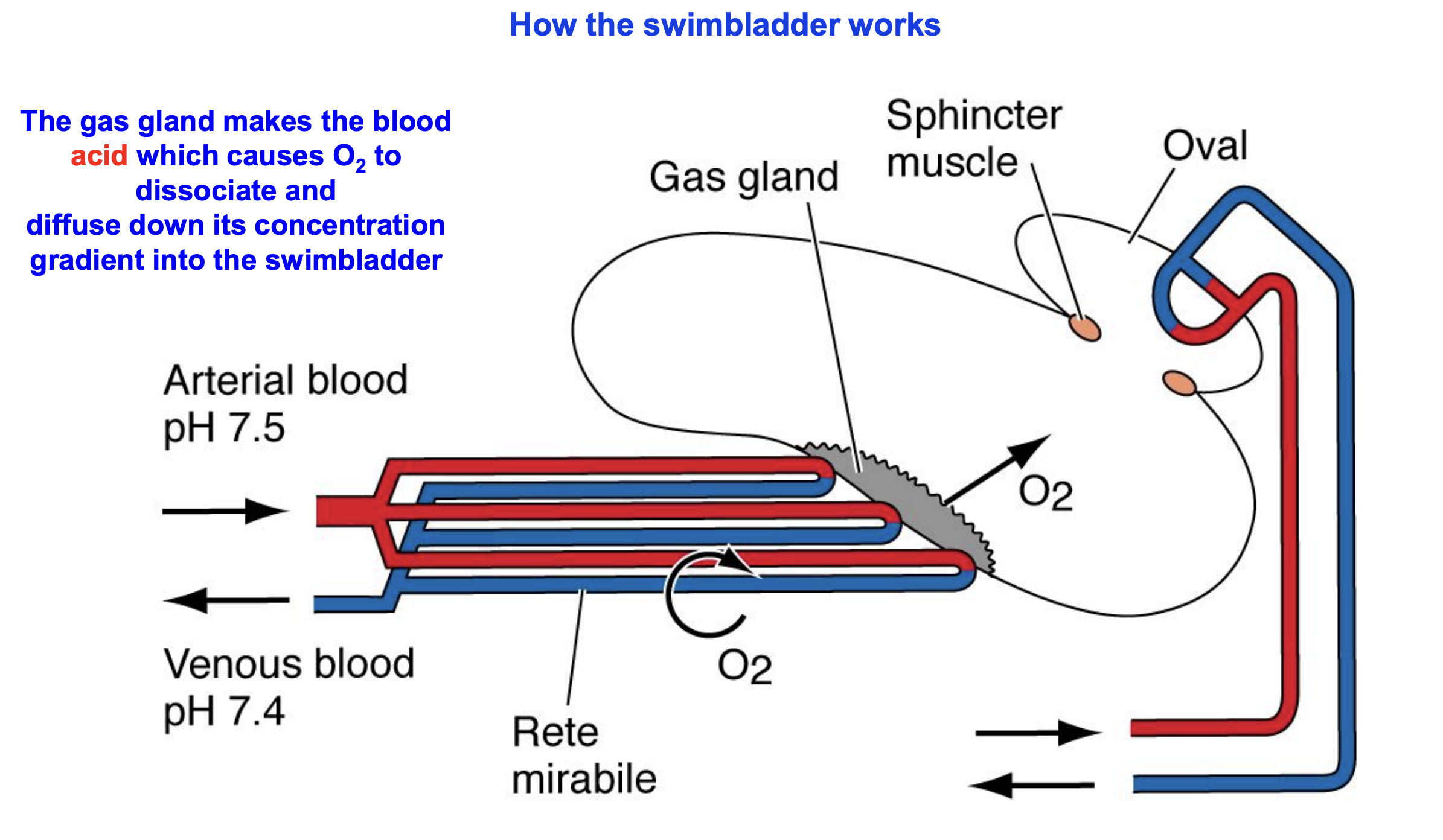
Counter-current exchange allows
“isolation” of a region
Enhanced exchange of ions, thermal energy, etc. by maintaining an exchange gradient
What does changing the acidity of blood alter?
alters Hb subunit conformation and hence alters the binding properties of oxygen
Increasing acidity of blood reduces the affinity for Oxygen
Hb usually binds 4O2
Physoclistous diagram
Physostomous diagram
Counter current exchange diagram