Visual Field Testing Patterns and Strategies - Ocular Neurology Spring 2026
 Call Kai
 Learn
Learn Practice Test
 Spaced Repetition
 Match
Match Flashcards
 Knowt Play
1/59

There's no tags or description
Looks like no tags are added yet.
Name | Mastery | Learn | Test | Matching | Spaced | Call with Kai |
|---|
No analytics yet
Send a link to your students to track their progress
60 Terms
outlines field or defect shape
What is the function of kinetic perimetry?
either!
Kinetic perimetry is performed (manually/automated)
isopters
Kinetic perimetry results are displayed as ______
Yes
Are there many parameter options for kinetic perimetry?
-tangent screen
-arc perimeter
-Goldmann perimeter
-Octopus 900 Pro
-Humphrey Field Analyzer 3
What are the typical instruments for kinetic perimetry?
provide visual sensitivity thresholds that allow mapping the hill of vision of a patient
Both kinetic and static perimeters are designed to do what?
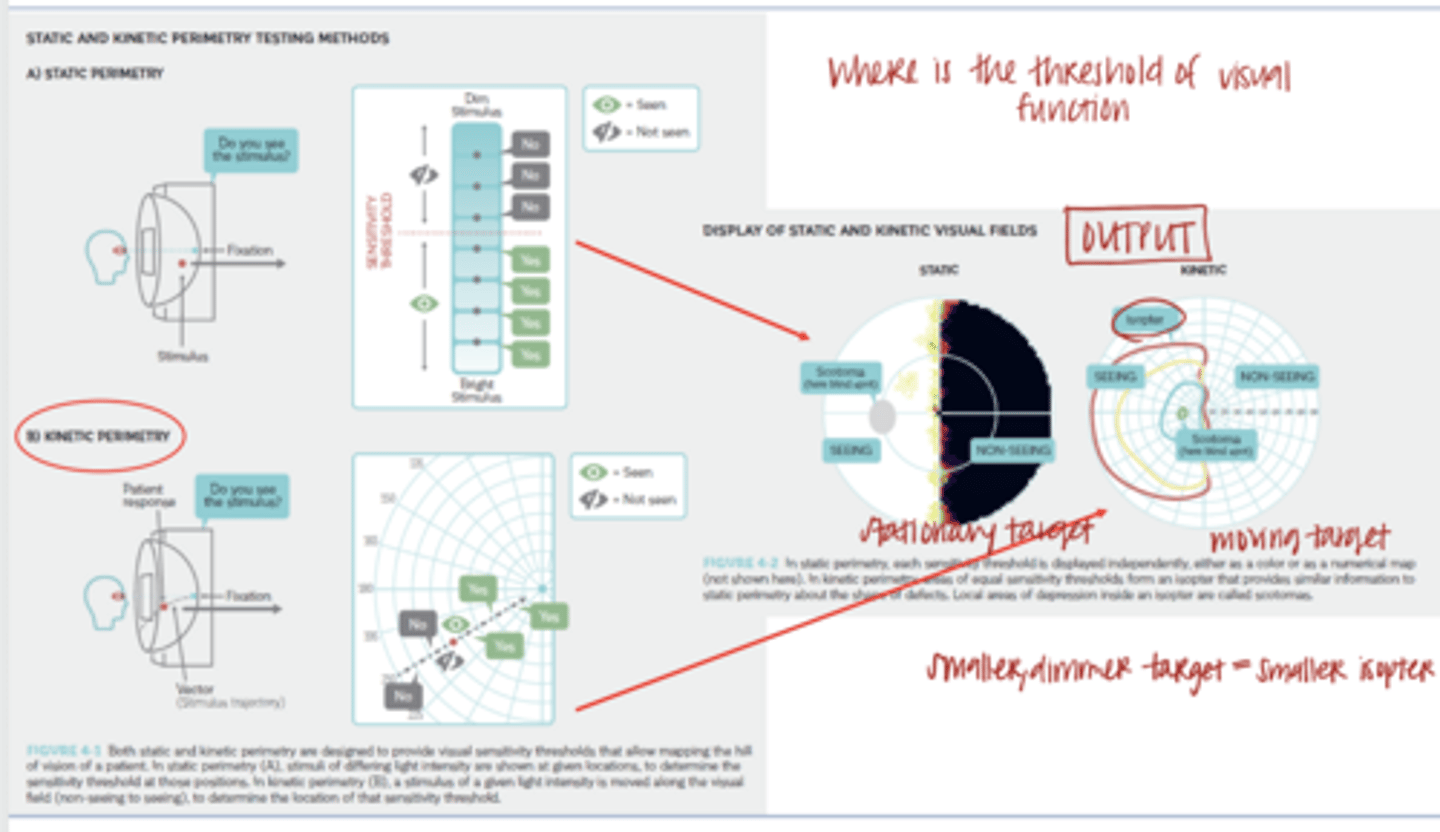
stimuli of differing light intensities are shown at given locations, to determine the sensitivity thresholds at those positions
How is static perimetry performed? Why is it performed?
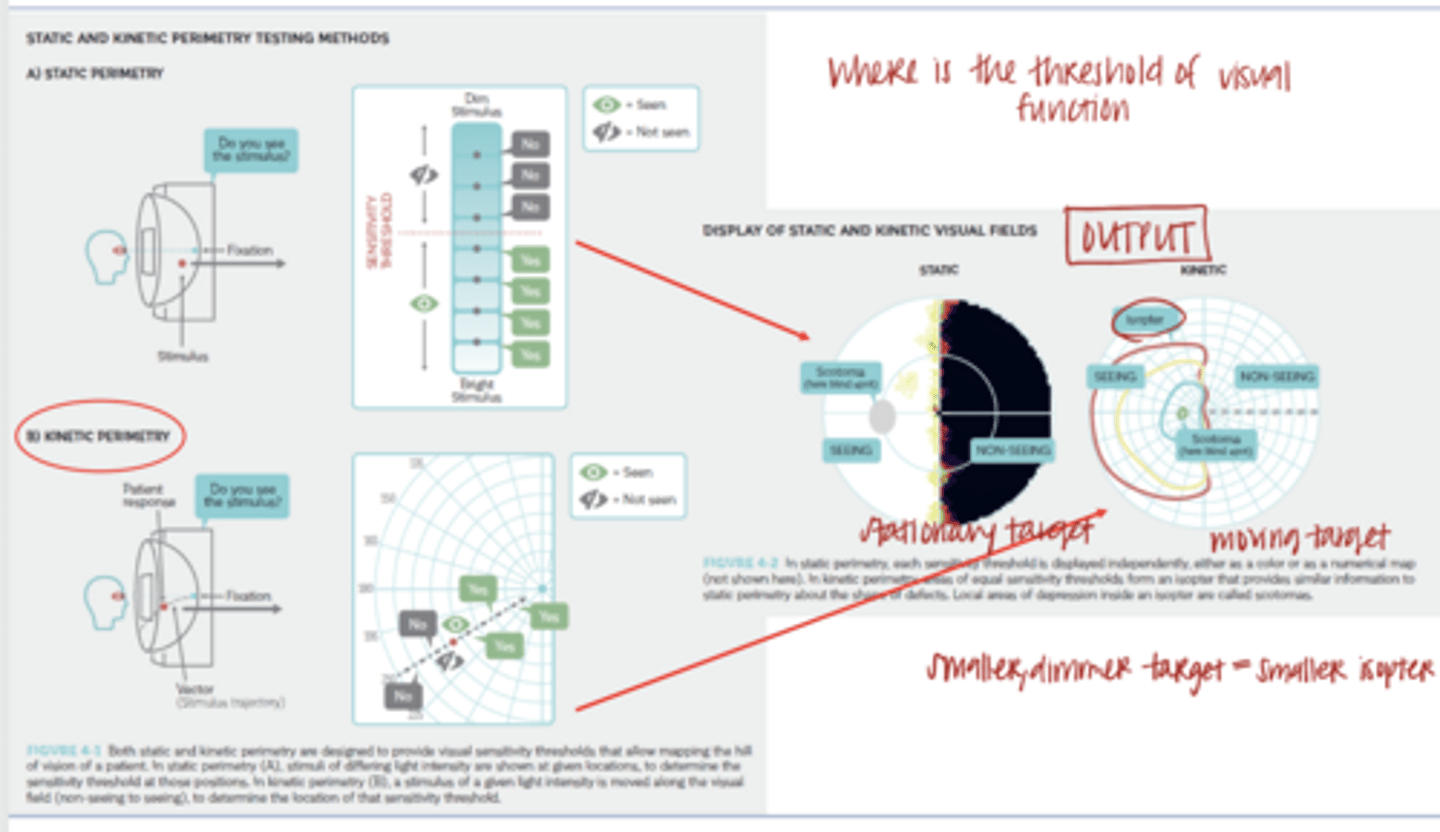
A stimulus of a given light intensity is moved along the visual field (from non-seeing to seeing) in order to determine the location of that sensitivity threshold
How is kinetic perimetry performed? Why is it performed?
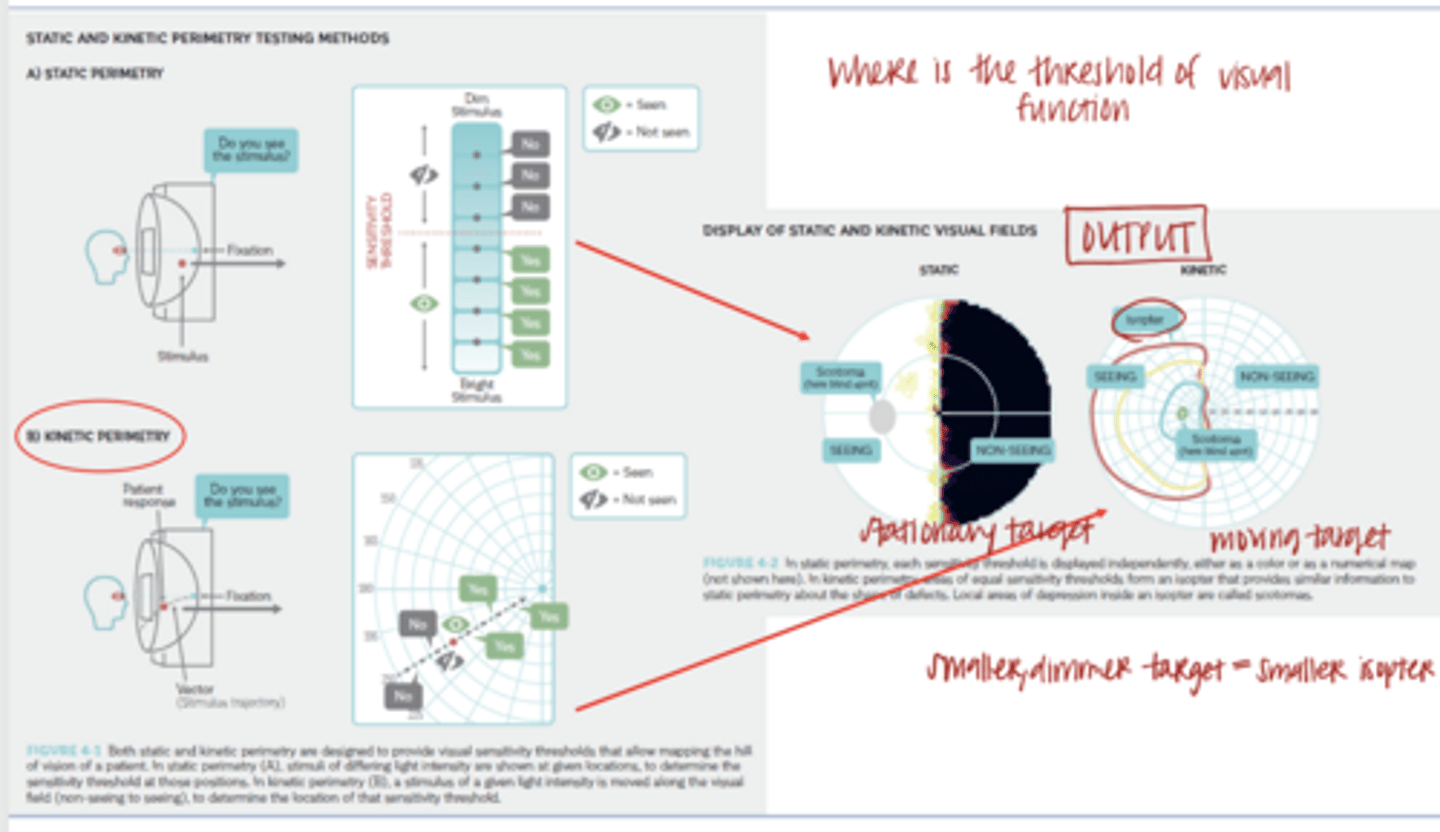
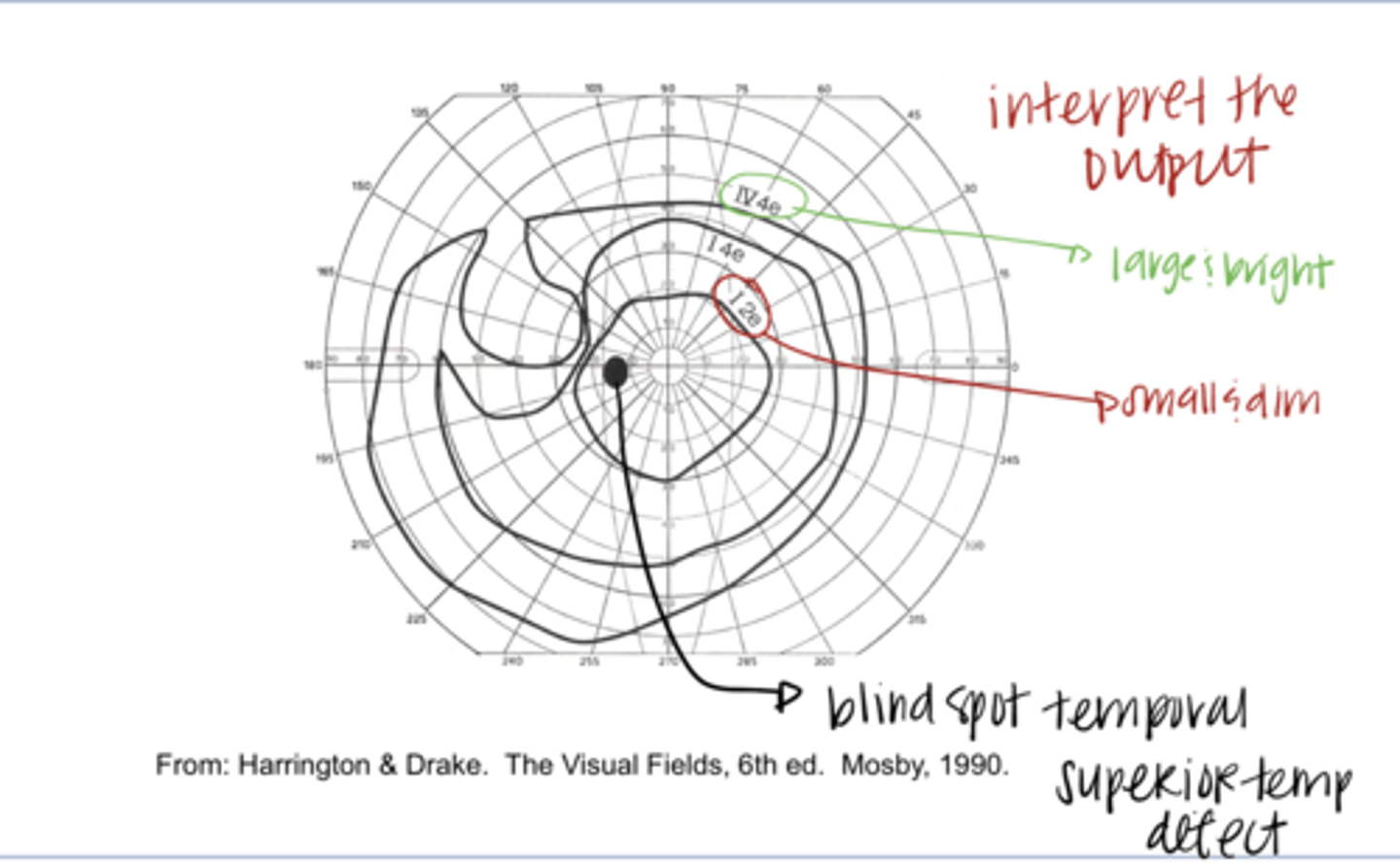
smaller
A smaller & dimmer light will most likely have a (smaller/larger) isopter around the macula
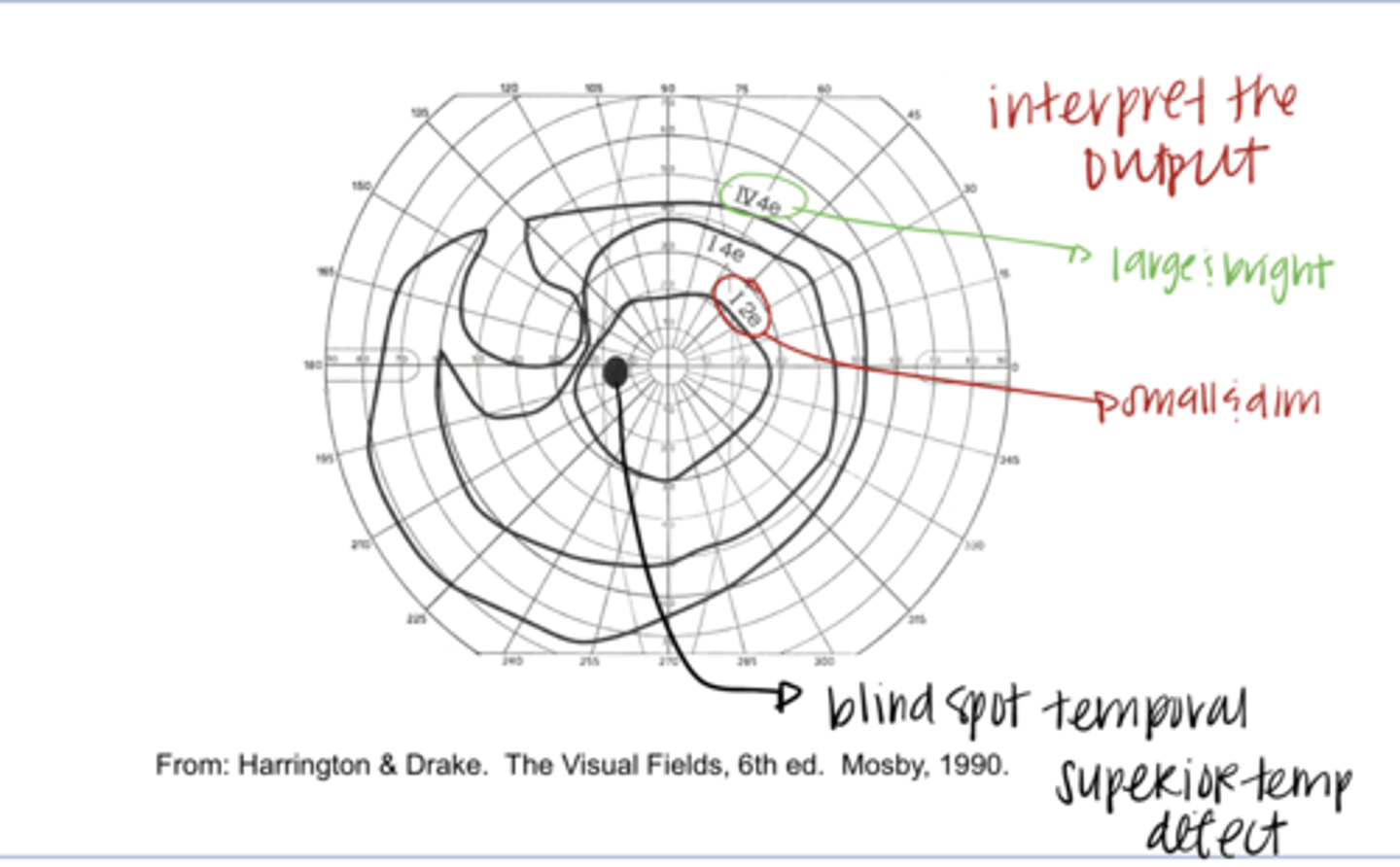
larger
A larger & brighter light will most likely have a (smaller/larger) isopter around the macula
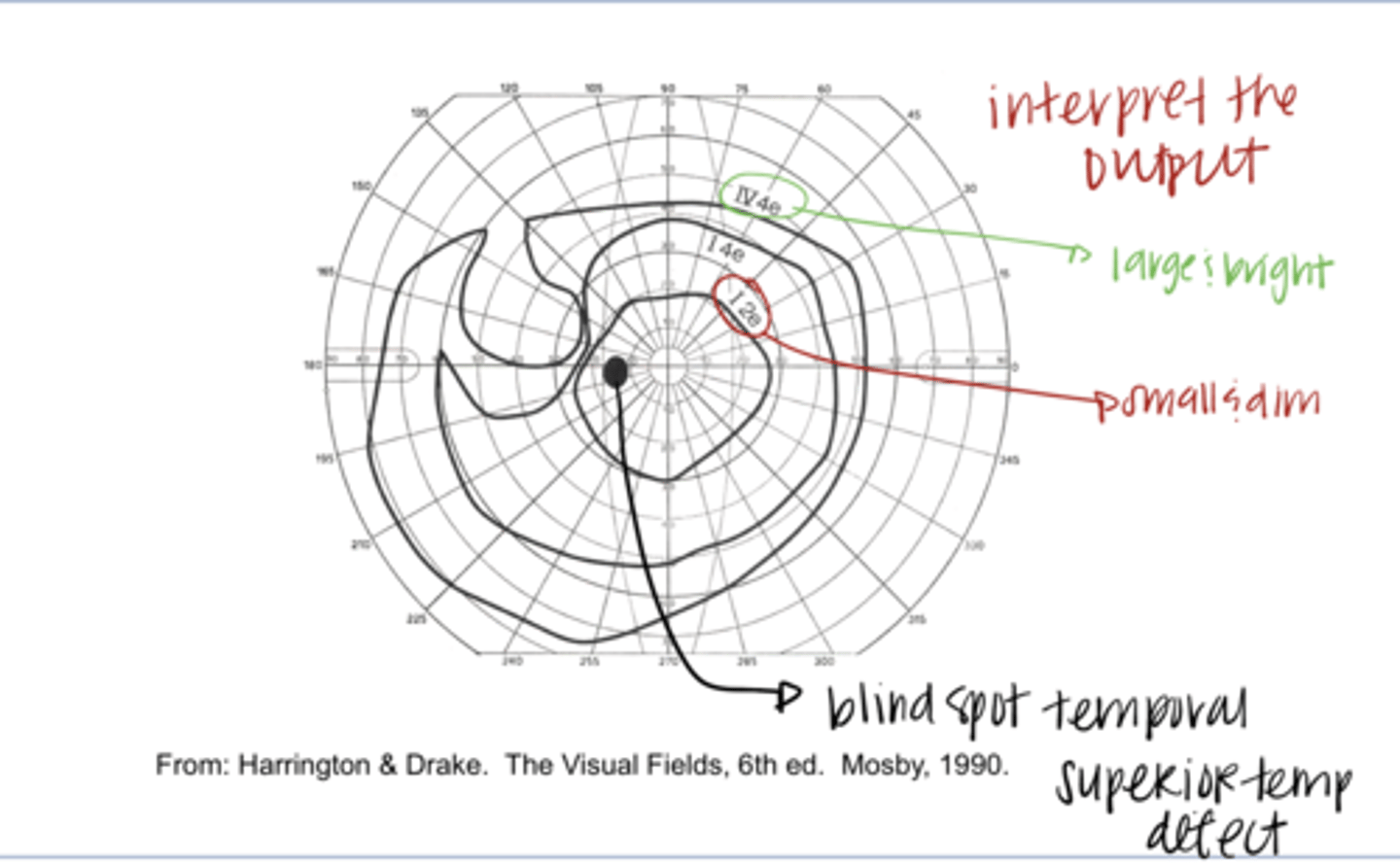
temporal
The blind spot will the (nasal/temporal) in the VF
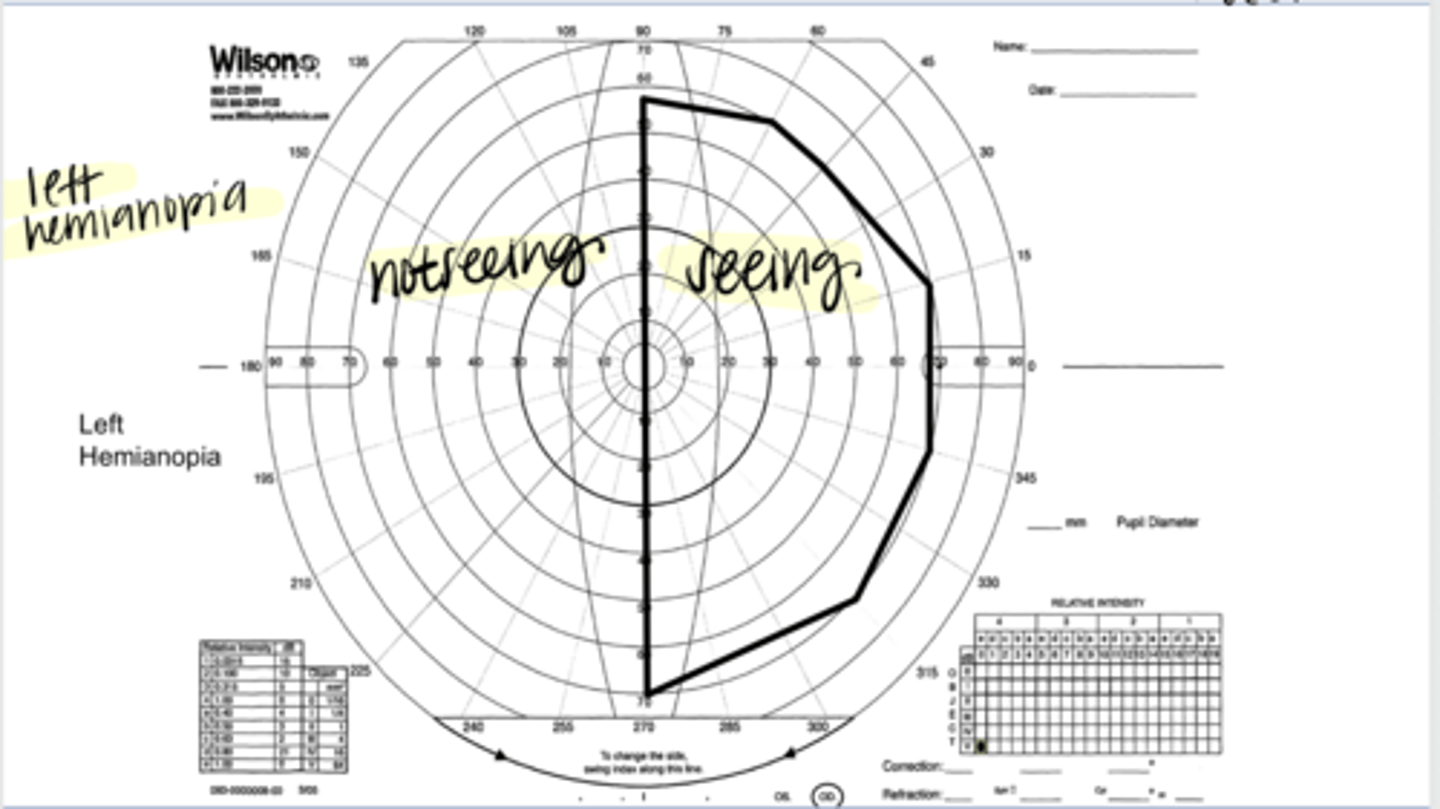
left hemianopia
What is the name of this type of defect?
-Rarely
-Testing the peripheral visual field quickly and characterizing its spatial extent
-Driving testing
-Post-stroke testing
-Disability determination
-Patients with substantial visual field loss, like from RP
-Patients with difficulty completing threshold static testing or kids
When do we use kinetic testing?
presents stimuli at a single, predetermined brightness level to see if a patient can detect them
What is single intensity strategy for automated static VF?
-program will only record "hit" or "miss"
-does not quantify defect depth
-measures the exact minimum luminance a patient can detect at specific retinal locations
Describe a Threshold-Related Strategy for automated static VF
-a rapid screening test that categorizes retinal sensitivity into three specific outcomes: Normal, Relative Defect, or Absolute Defect
-Different symbols used for no defect, absolute defect, or relative defect
Describe a 3 Zone Strategy for automated static VF
missed screening stimuli are thresholded
Describe a Quantify Defects Strategy for automated static VF
-Each point starts 6dB brighter than expected threshold or at a db level that 95% of the population would be expected to see
-If seen on 1st try, recorded as seen and not tested again
-If missed on 1st try -- point is tested again (or several times)
-If seen on repeat testing, the point will be recorded as seen
-If missed on repeat testing, the point will be recorded as missed
How the automated perimeter will perform a Threshold-Related Strategy VF?
an area of reduced vision where the eye can still detect bright or large light targets, but cannot perceive dimmer or smaller ones
What is a relative VF defect?
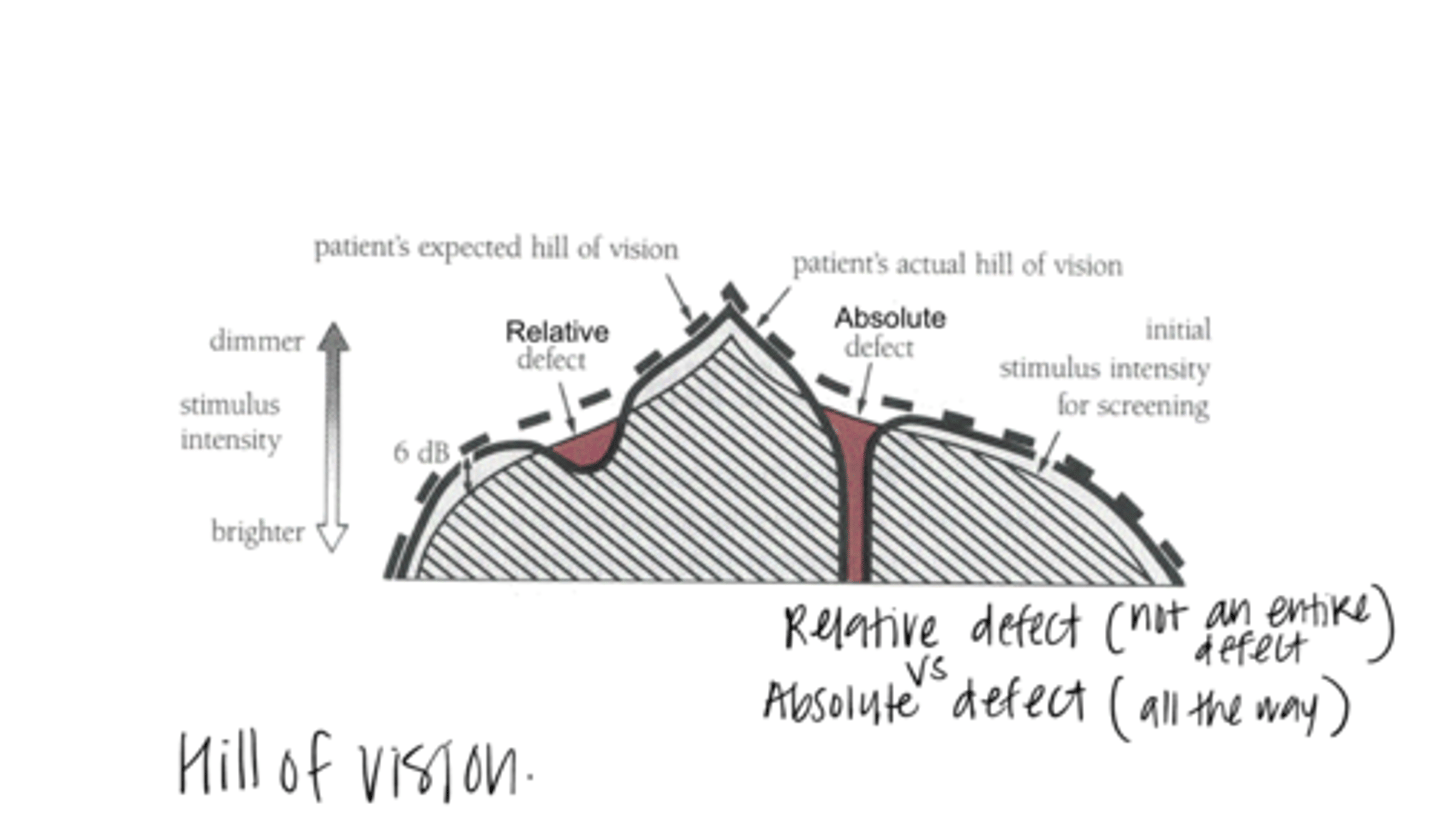
there is an area of complete blindness
What is an absolute VF defect?
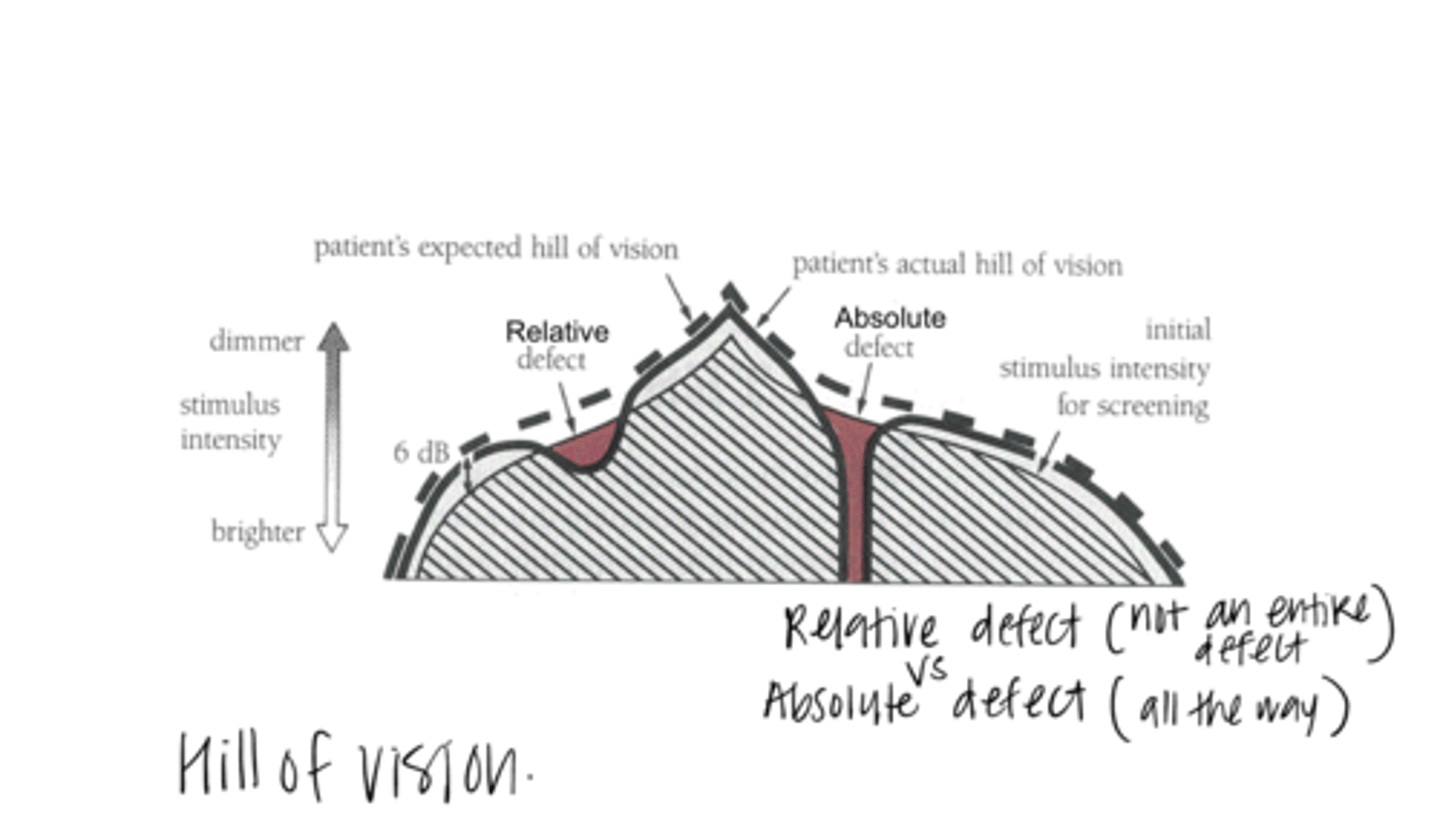
-Do not repeat screening test
-Proceed to a threshold strategy VF
When defects are found on a screening test, what should be done?
-2 or more adjacent missed points
-1 or more misses within 20 deg of fixation
-central reference level of 26dB or less
Concerning VF Defects on a Screening Test that may prompt a Threshold Strategy test?
Threshold Detection Diagram -- Seeing v Non-Seeing to Plot the Hill of Vision (Pic)
Threshold Detection Diagram -- Seeing v Non-Seeing to Plot the Hill of Vision (Pic)
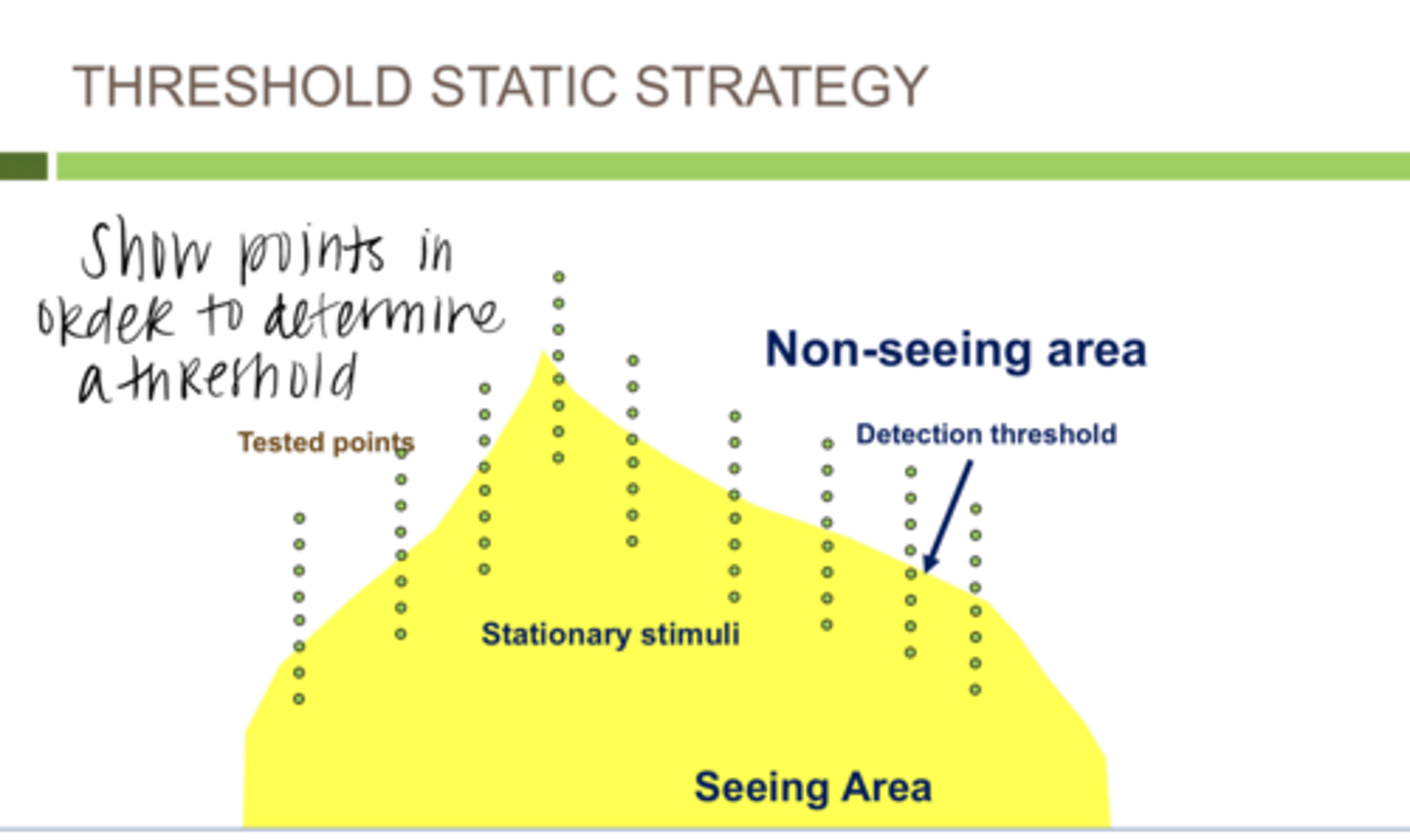
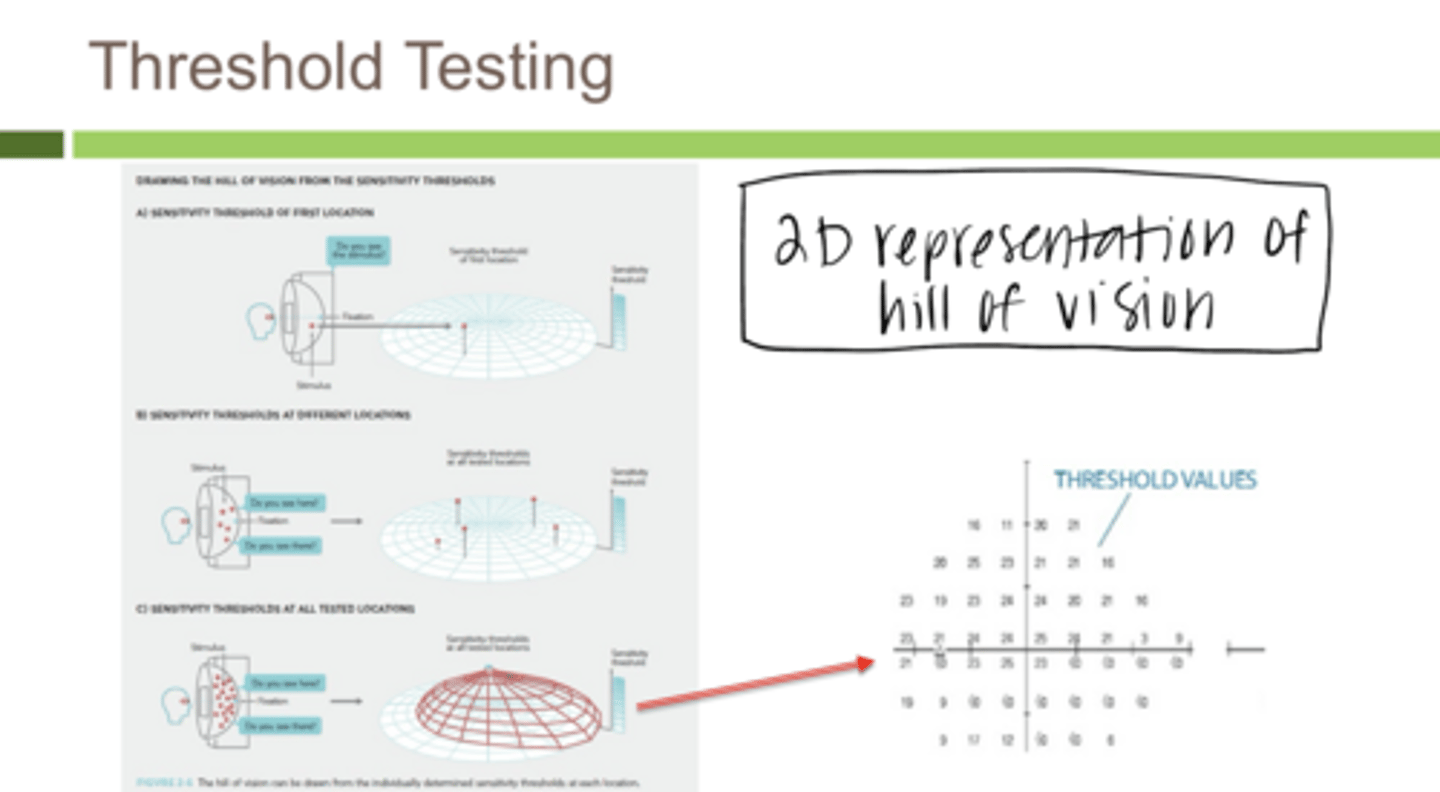
the hill of vision
Threshold Values on VF Analysis is a 2D representation of what?
200 milliseconds (1/5 sec)
What is the stimulus duration on a Humphrey Threshold Test?
Yes
Is Humphrey VF capable of presenting any of the Goldmann I-V stimulus sizes?
III
What is the most commonly (and almost exclusively) used Goldmann stimulus size used in Humphrey VF machines?
constant
The stimulus size is (varied/constant) throughout Threshold Test in a Humphrey VF?
varied
The stimulus intensity is (varied/constant) throughout Threshold Test in a Humphrey VF
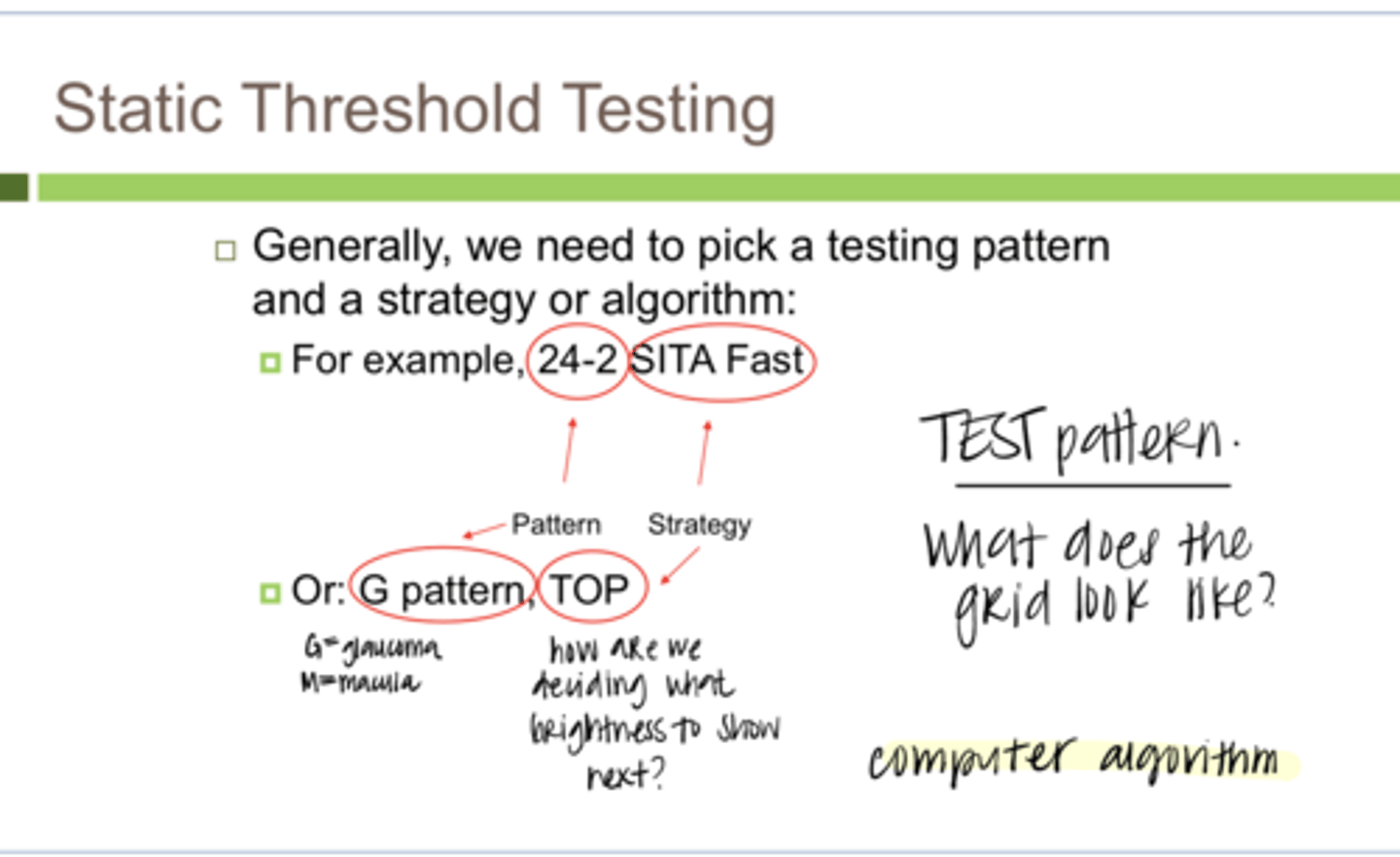
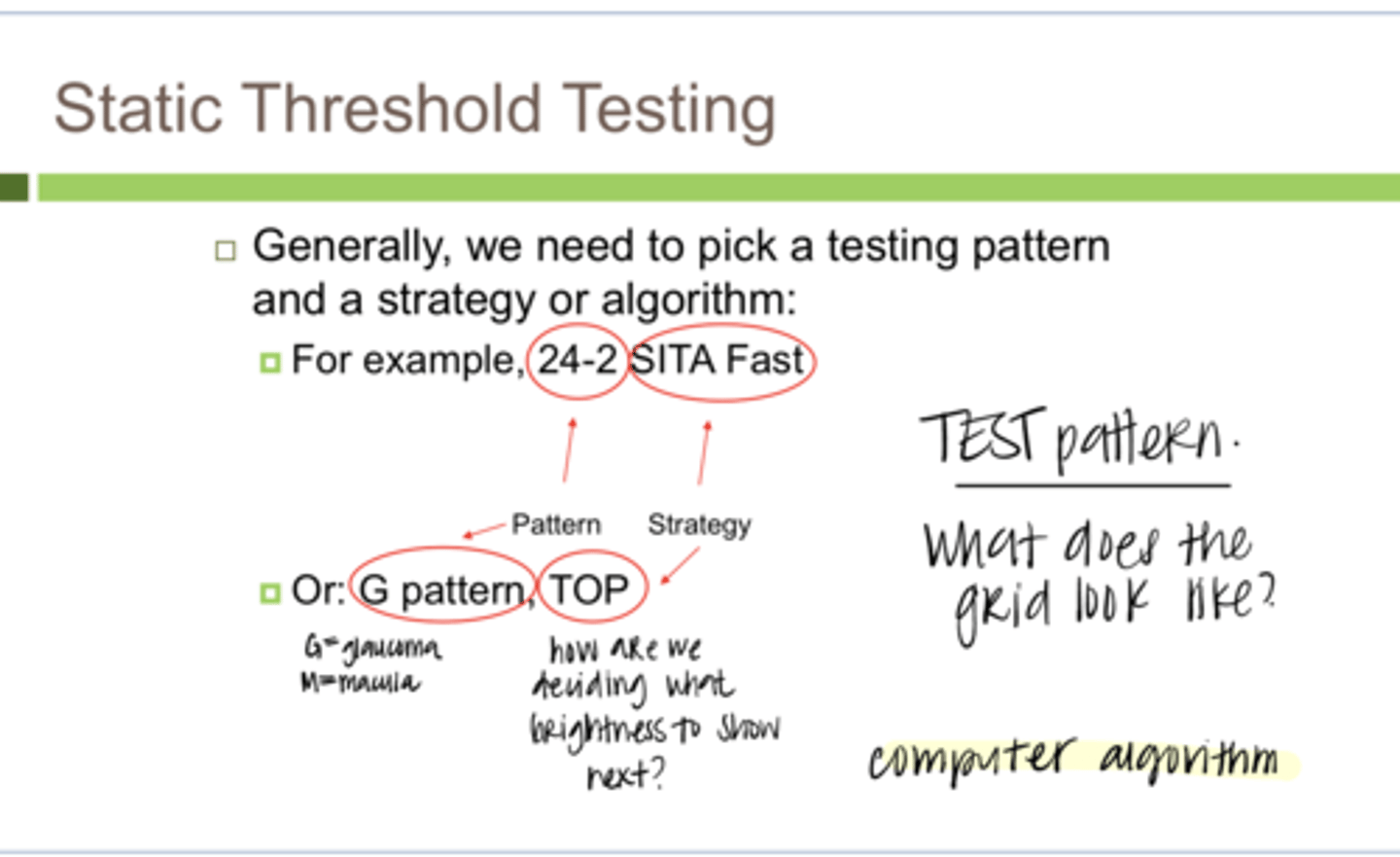
-24-2
-30-2
-10-2
Humphrey Testing Pattens
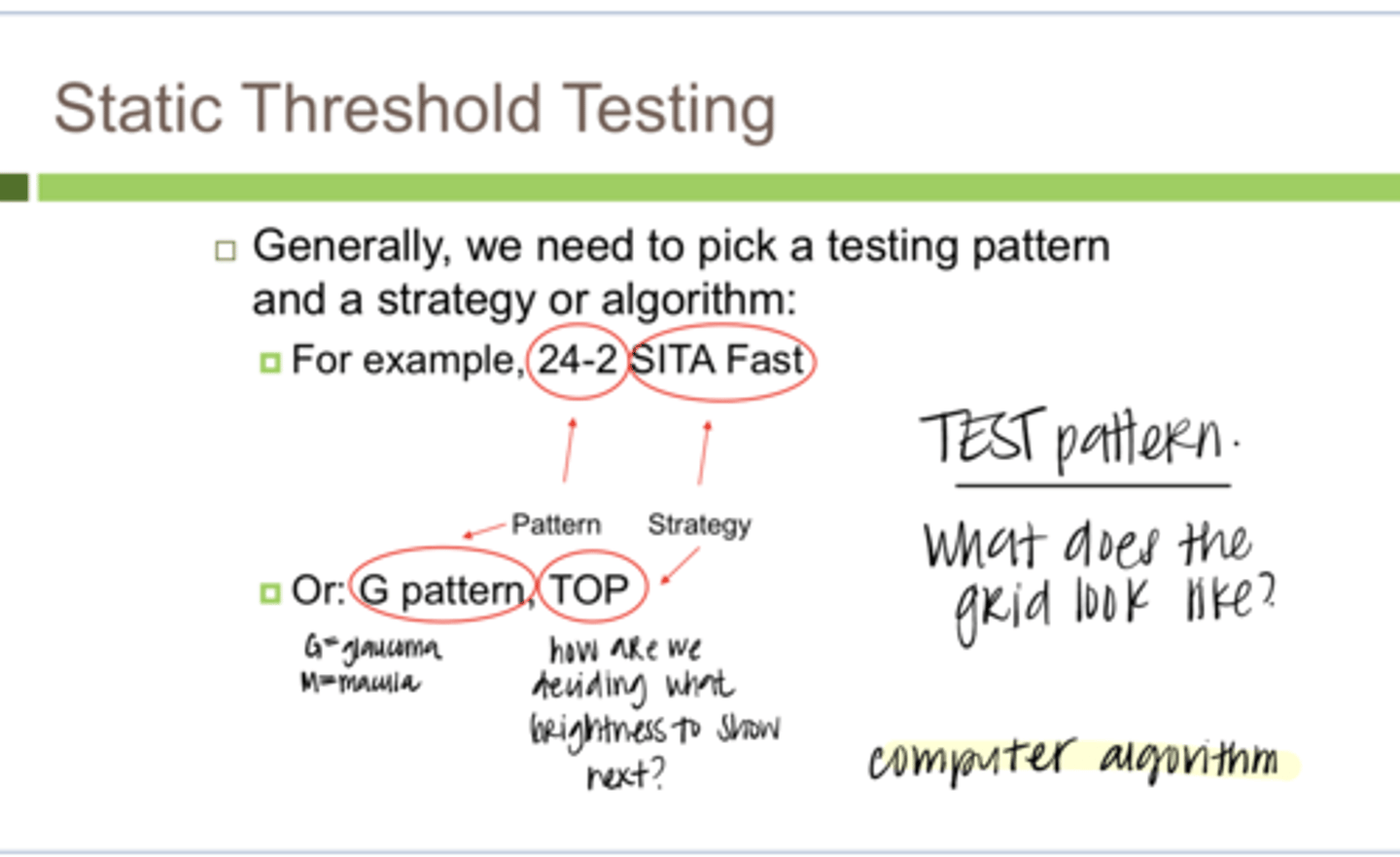
-G pattern
-M pattern
Octopus Testing Pattens
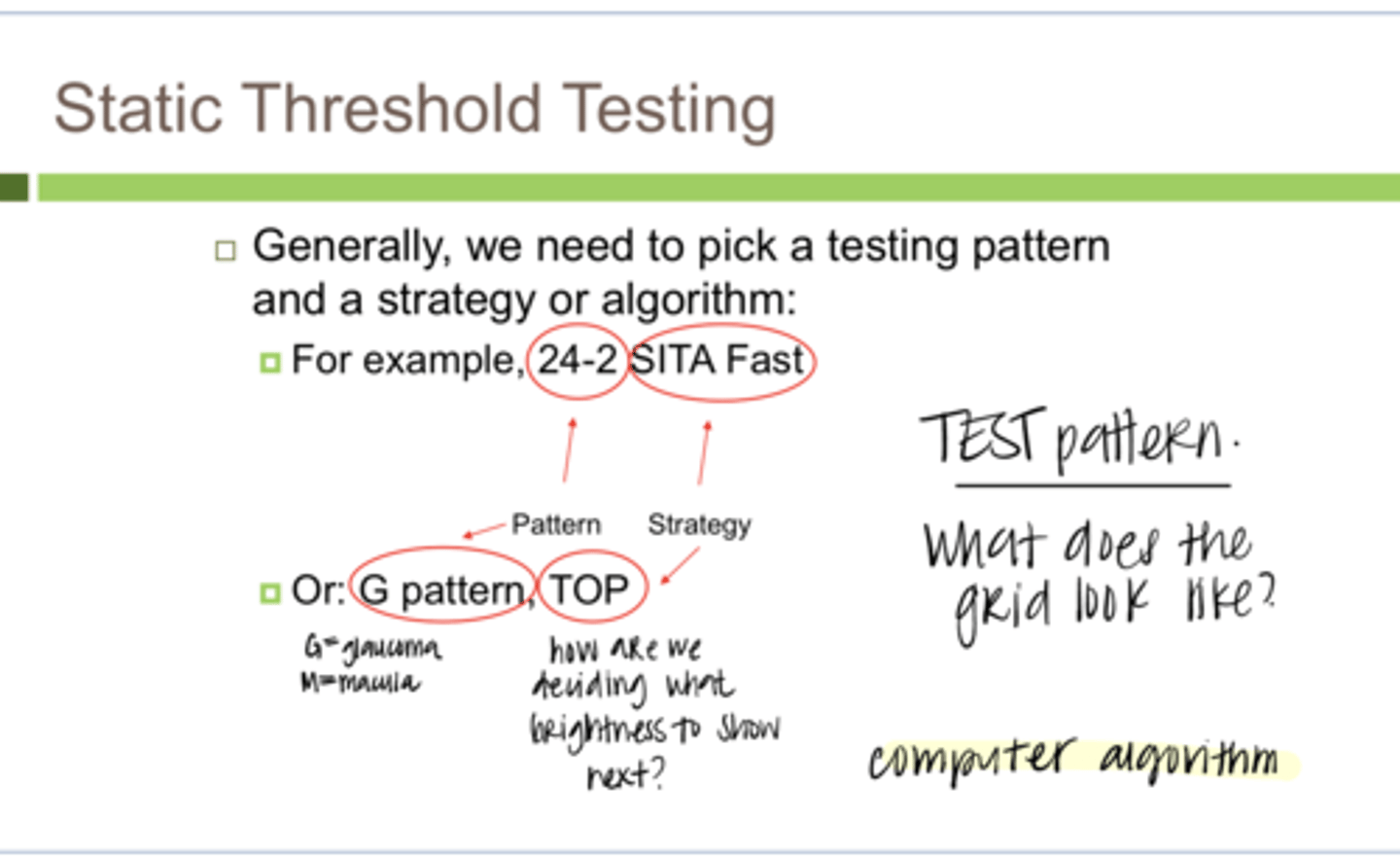
-SITA Fast
-SITA Faster
Humphrey Testing Strategies
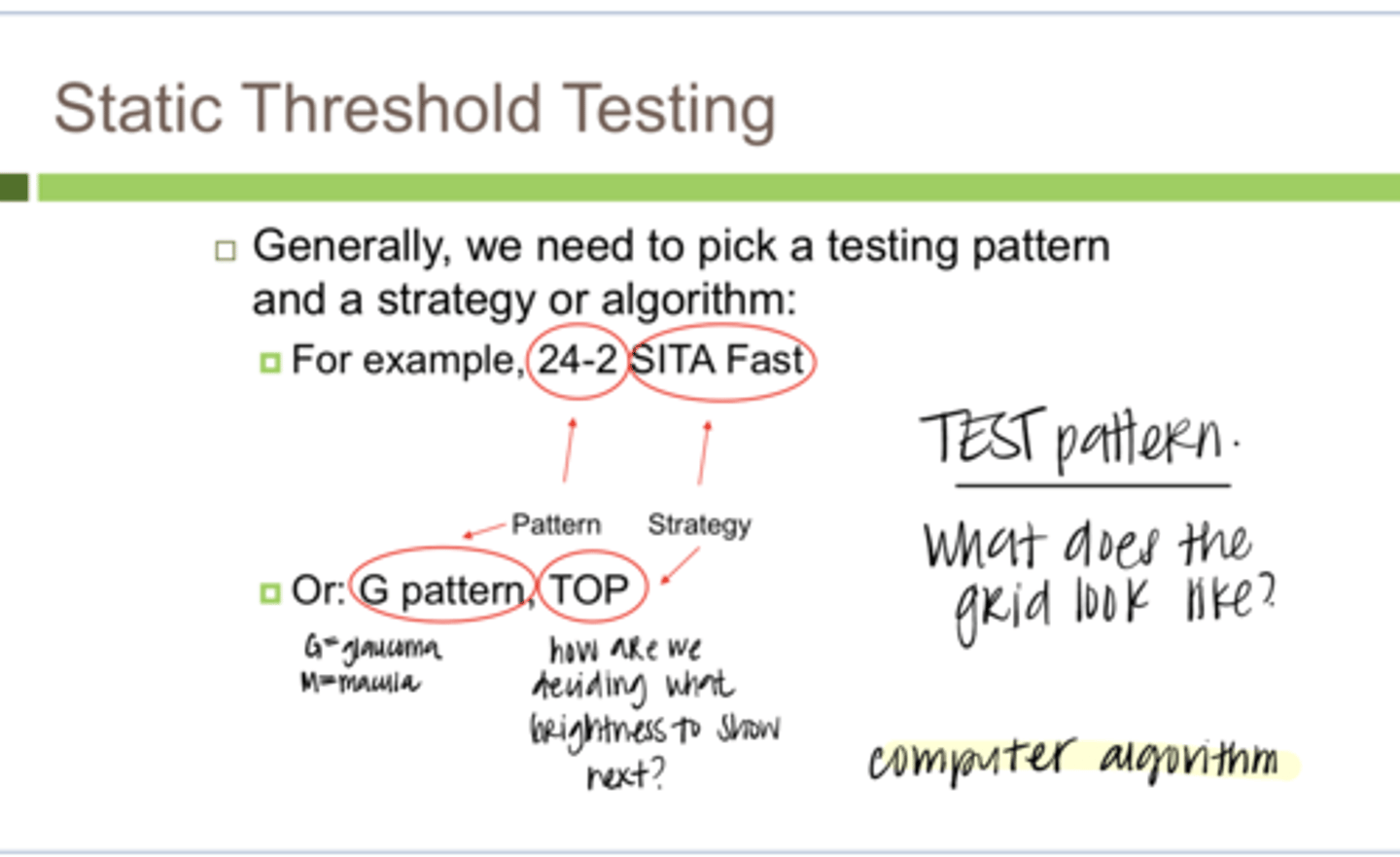
TOP
Octopus Testing Strategies
24-2 and 30-2
What are the most common testing patterns?
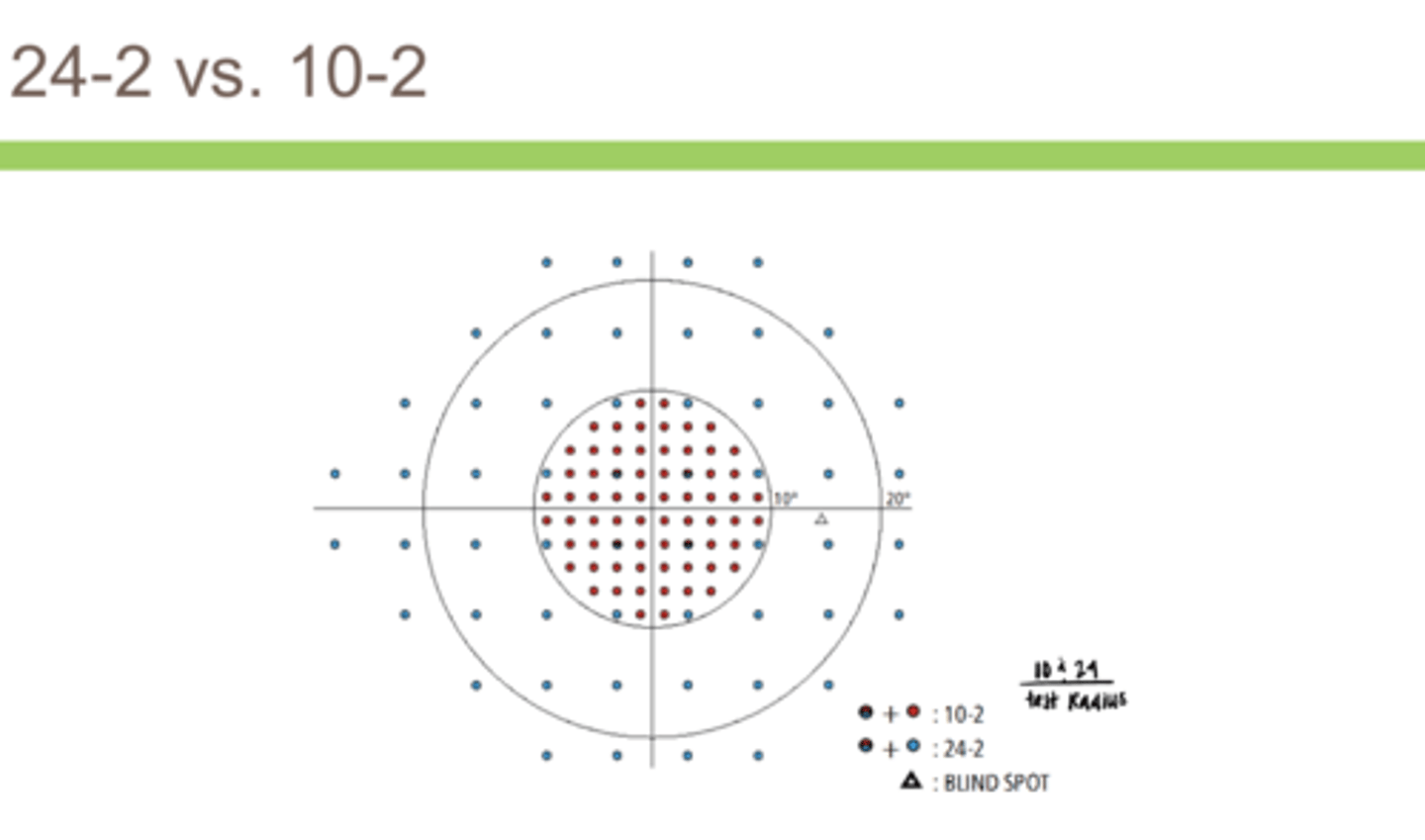
Tests less points and a smaller area than 30-2, but captures most of the same info
Describe a 24-2 Threshold VF
Can be useful in cases where a small central scotoma is suspected or where specific macular testing is desired
Describe what a 10-2 Threshold VF can be useful for
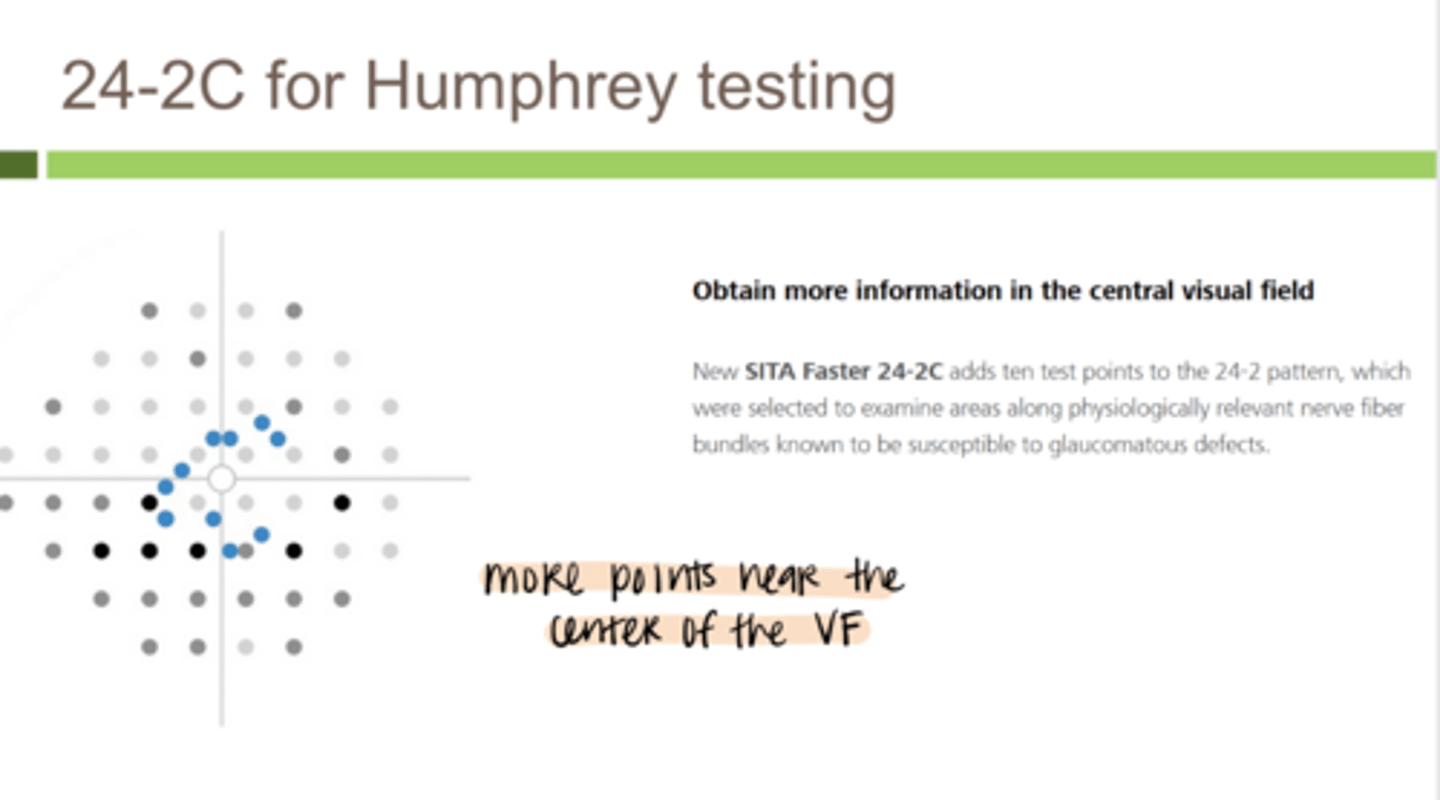
includes more macular points
What is 24-2C useful for?
-10-2, 30-2, 24-2 equivalent
-Tests central 30 degree based on nerve fiber physiology
-Closest to the 24-2C
What is a G pattern on Octopus VF?
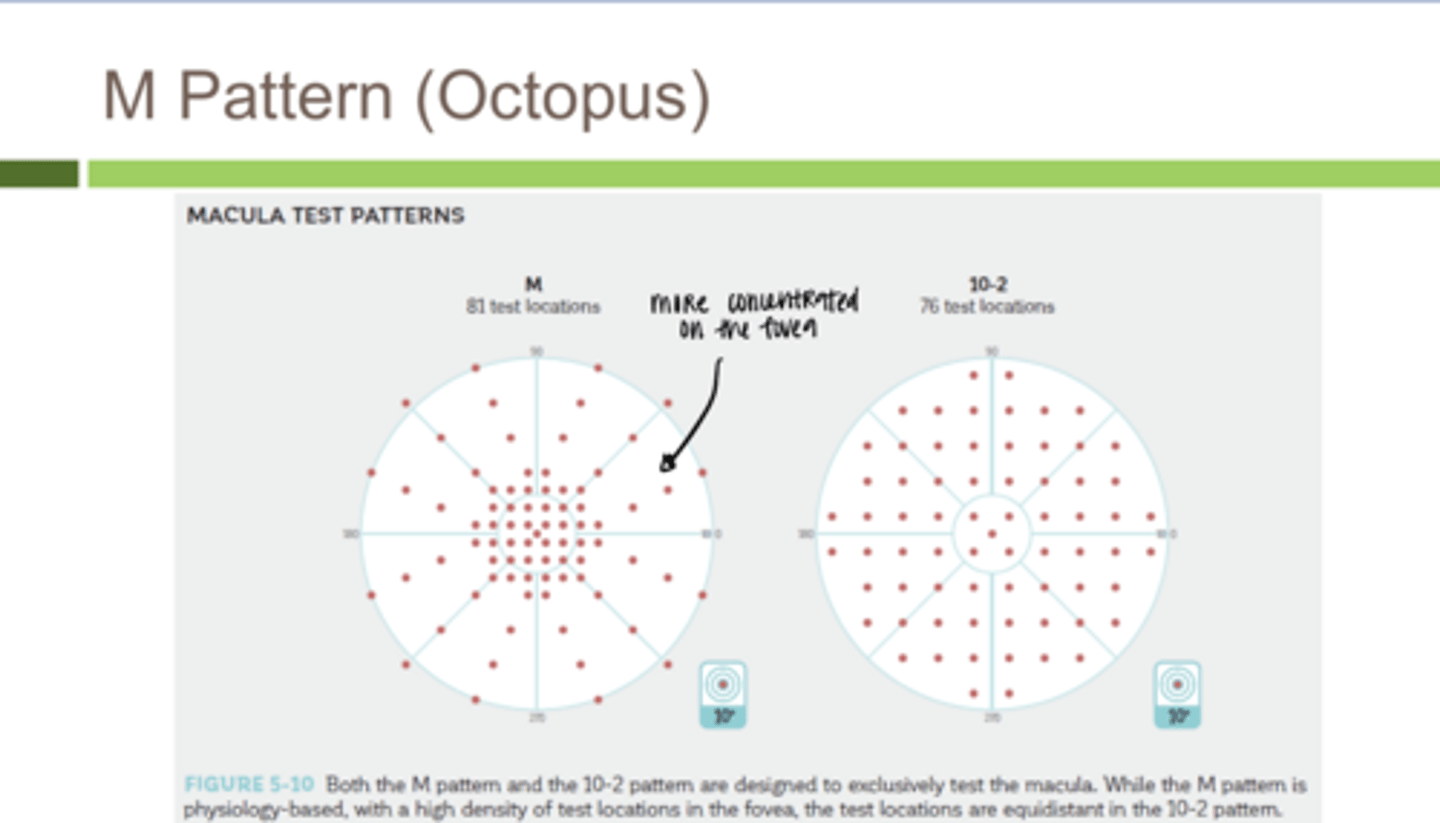
Like a 10-2 but with more emphasis near the fovea
What is a M pattern on Octopus VF?
24-2 vs 10-2 on Humphrey VF (Pic)
24-2 vs 10-2 on Humphrey VF (Pic)
M Pattern on Octopus (Pic)
M Pattern on Octopus (Pic)
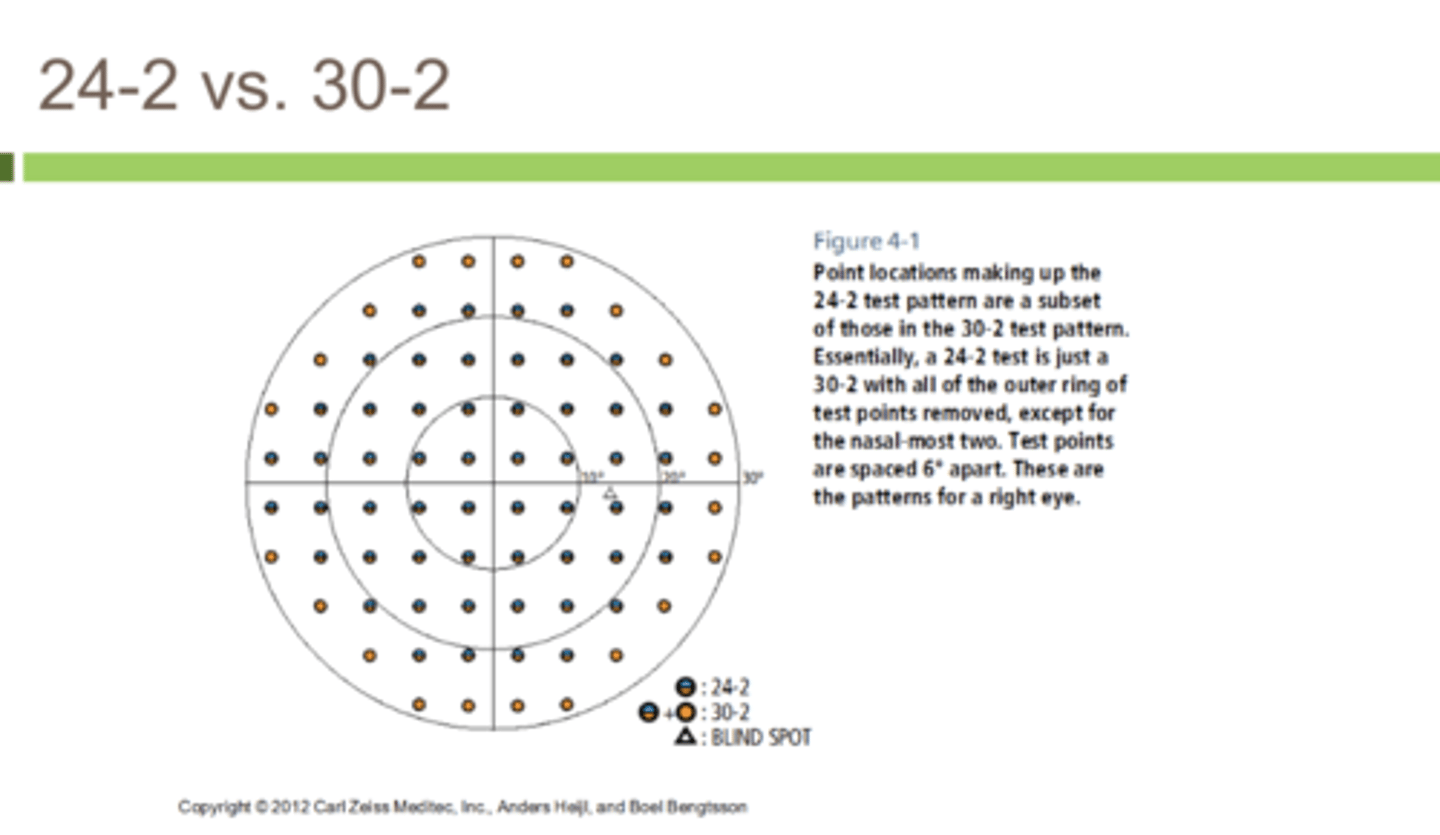
24-2 v 30-2 on Humphrey VF (Pic)
24-2 v 30-2 on Humphrey VF (Pic)
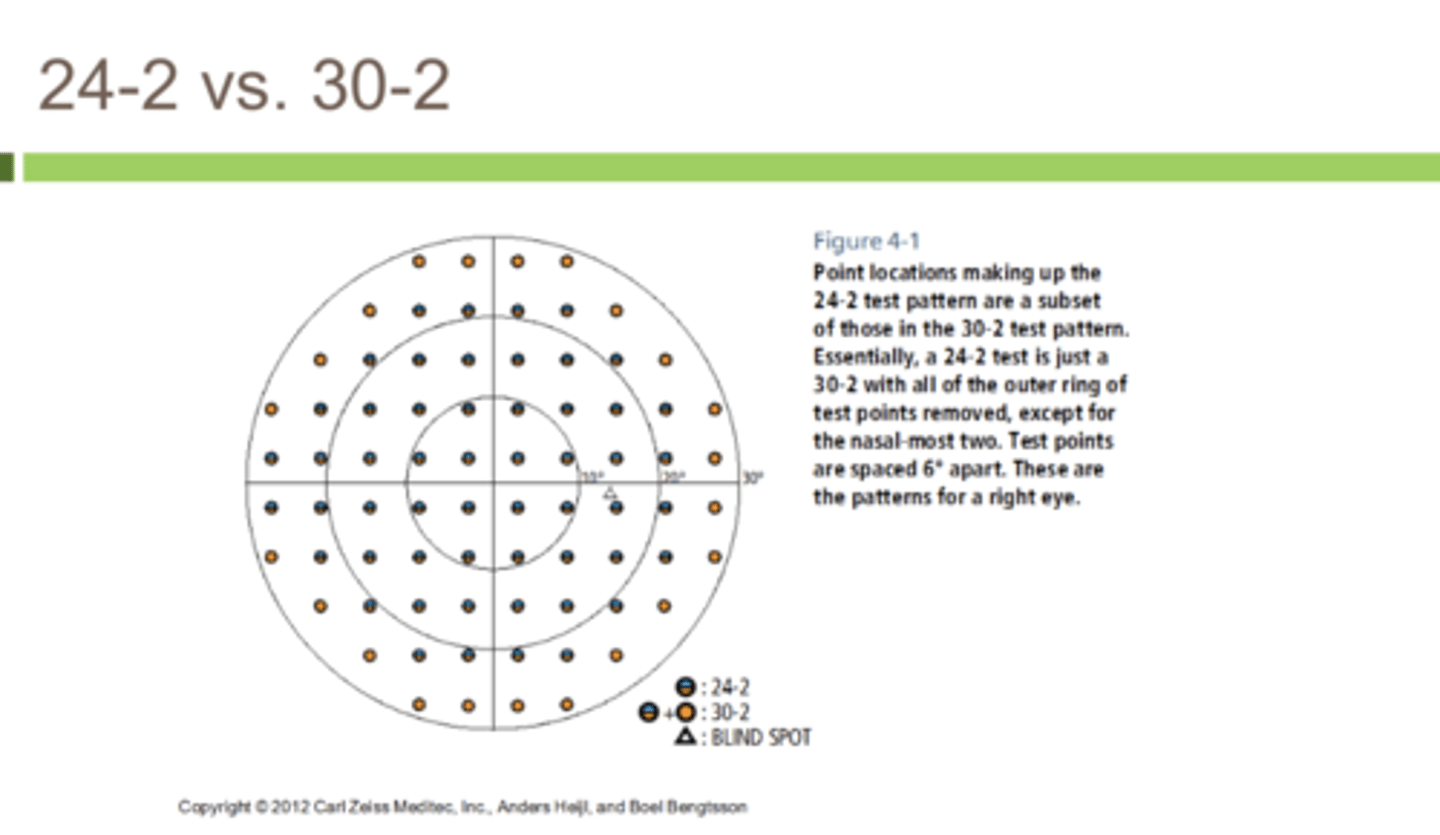
30-2
Point locations making up the 24-2 test pattern are a subset of those in the _____ pattern
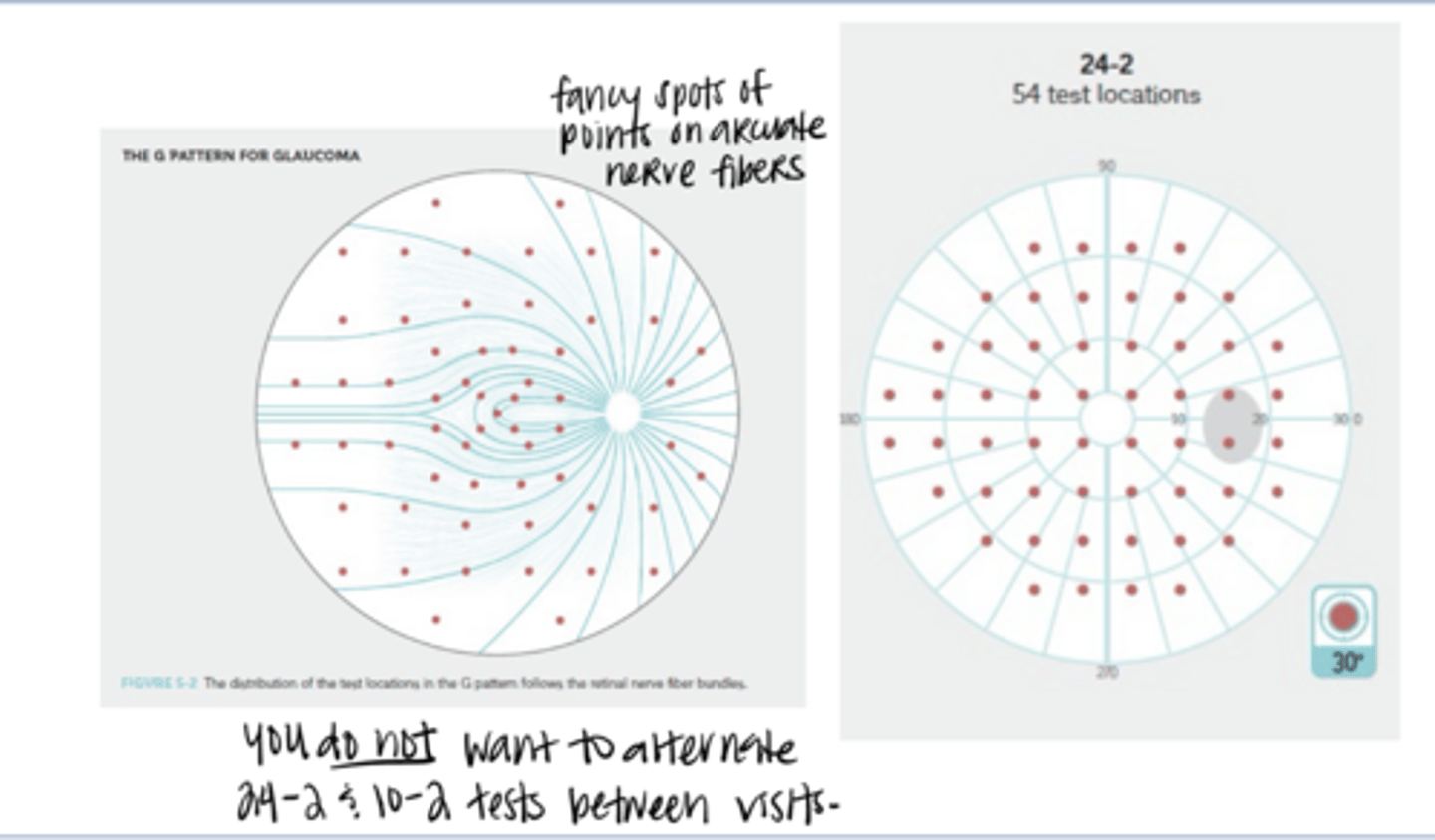
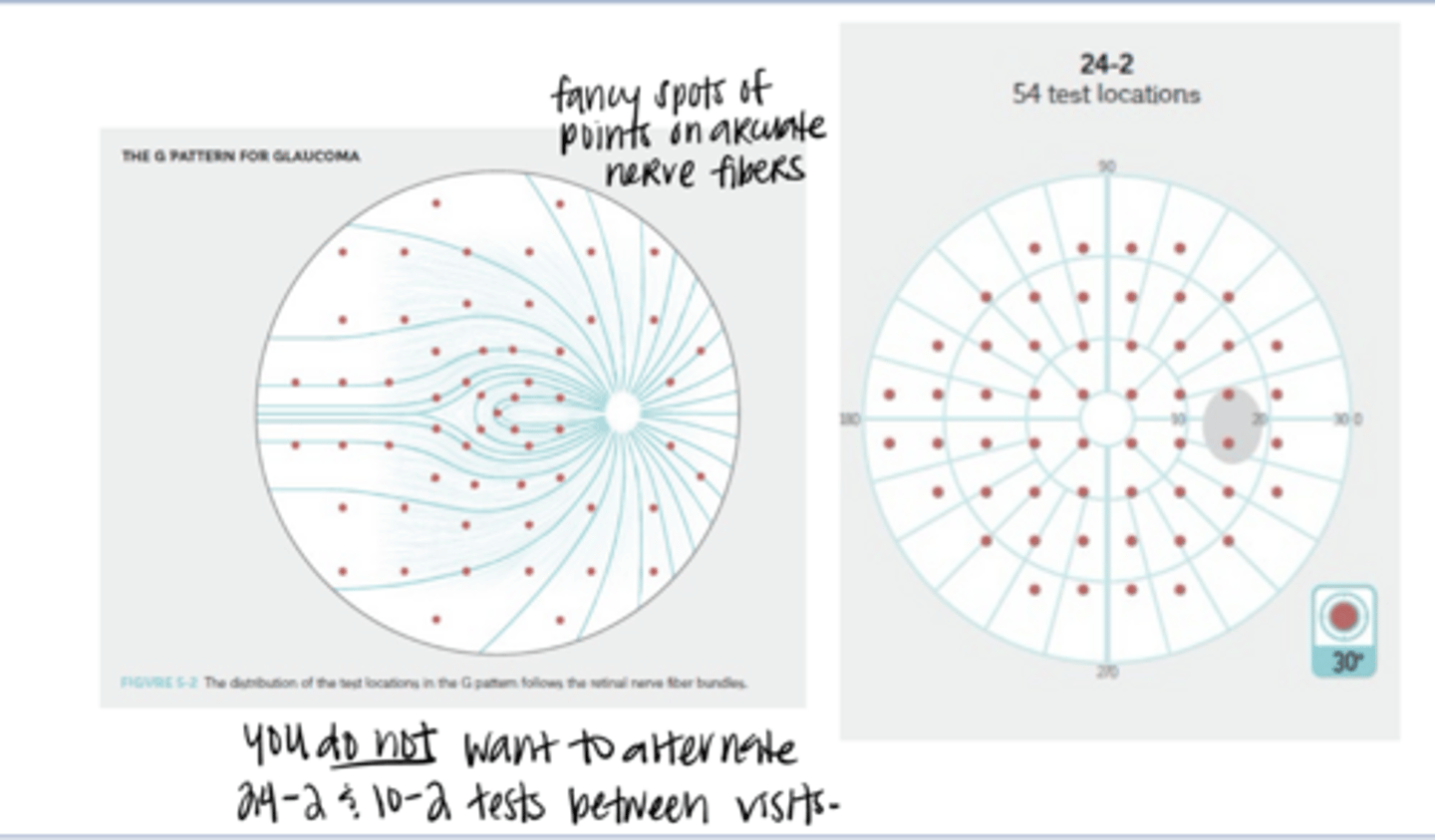
G Pattern on Octopus v 24-2 on Humphrey (Pic)
G Pattern on Octopus v 24-2 on Humphrey (Pic)
**Tests central 30 degree based on nerve fiber physiology
No -- stick to the same test to accurately compare
Do you want to alternate 24-2 with 10-2 tests in between visits for patients?
Obtain more info in the central VF
What is the benefit of the 24-2C VF?
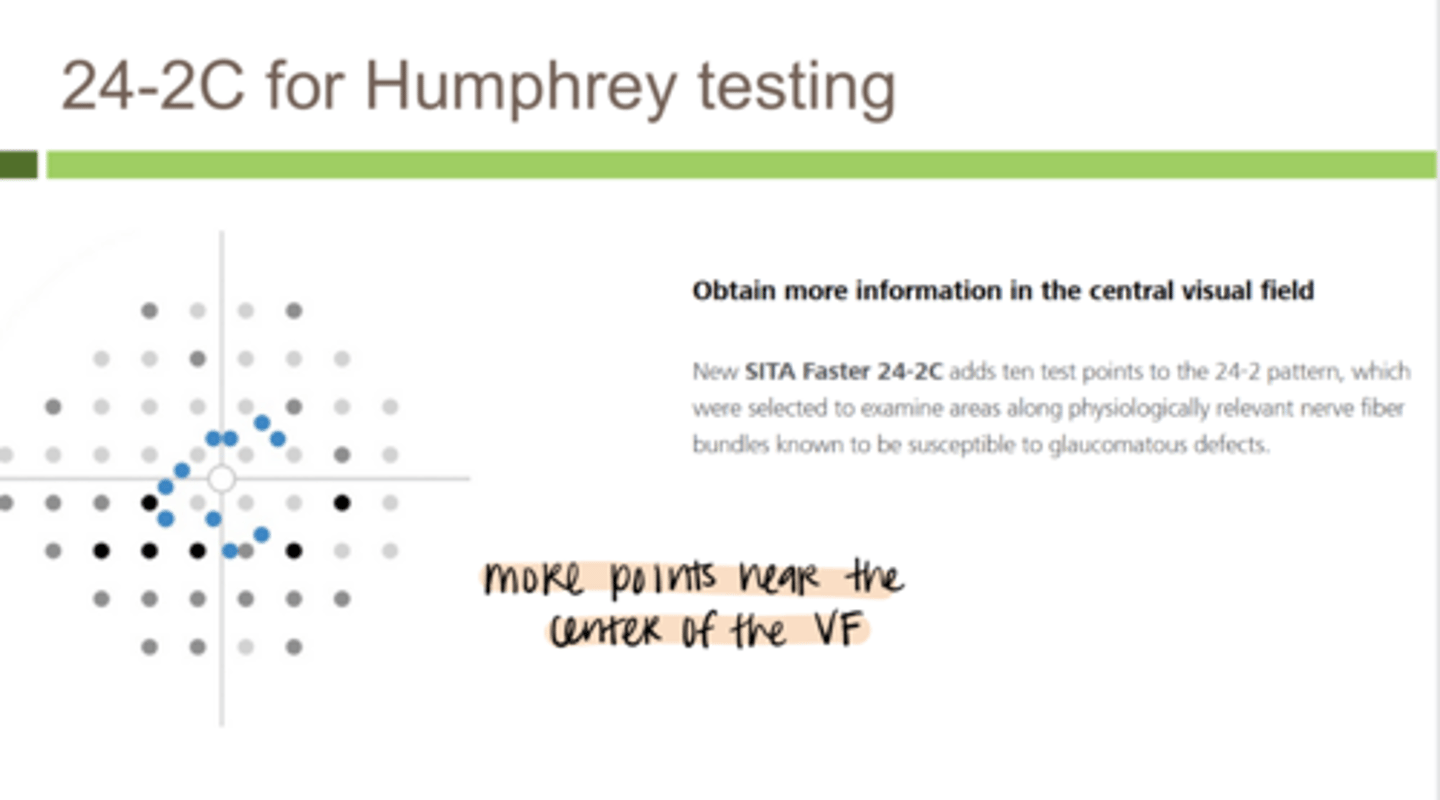
SITA FASTER 24-2C
This test adds 10 points to the 24-2 pattern, which were selected to examine areas along physiologically relevant nerve fiber bundles known to be suspectible to glaucomatous damage
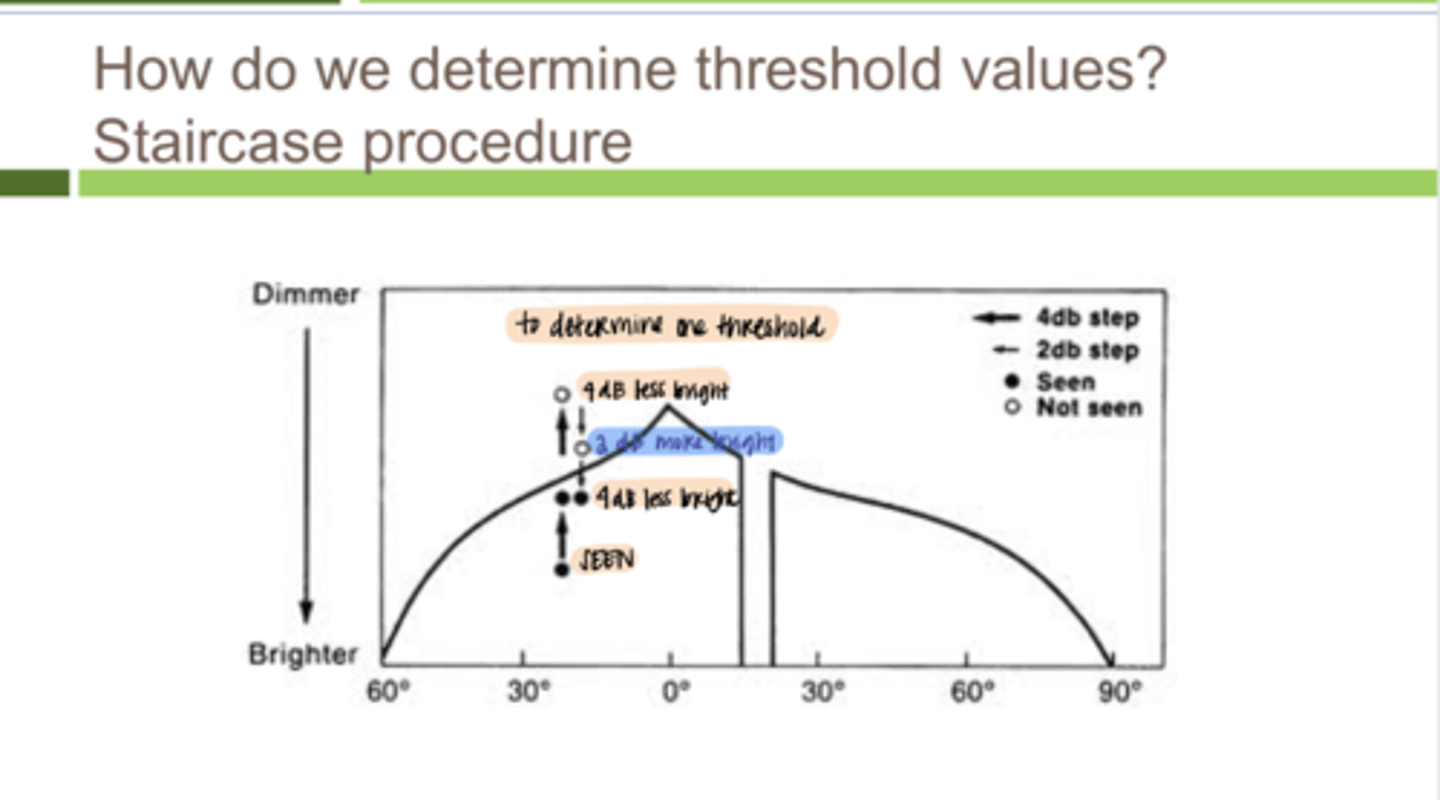
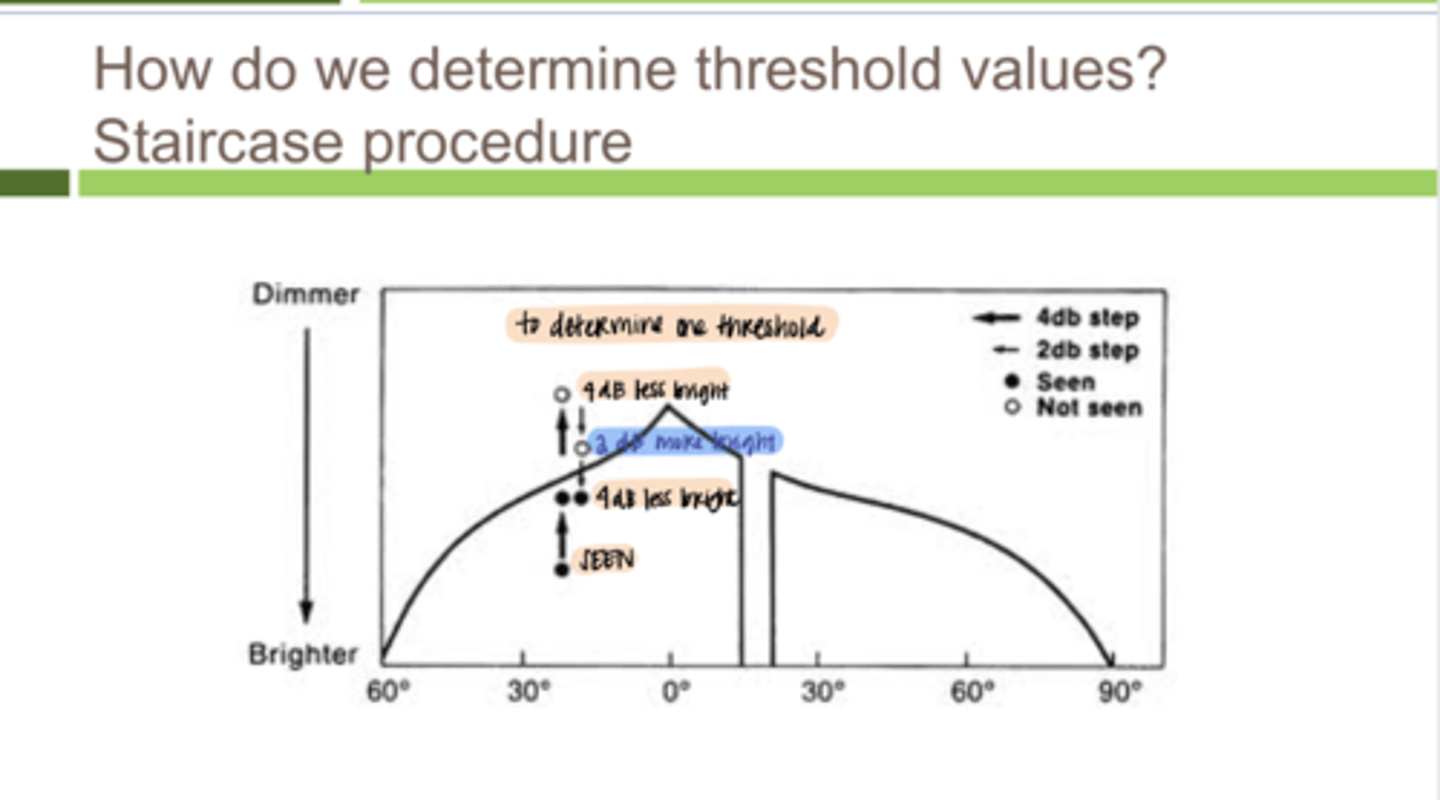
Staircase procedure
**Start 6dB higher than expected, 4dB less bright still seen, 4dB less bright not seen, 2dB more bright is not seen, 2dB more bright is seen
How do we determine the threshold values during Threshold VF Strategy?
4; 2
Humphrey Field Analyzer originally used a "Humphrey Full Threshold" algorithm and used a ______dB staircase followed by a _____dB staircase
-Swedish Interactive Testing Algorithm
-Developed in 1990s and reduced the number of points shown without reduction in data quality
-Compared to Dynamic strategy with Octopus
What is SITA?
TOP strategy
What is SITA-Fast compared to w/ Octopus?
-Asks smart questions
-Starts testing near the threshold, and uses all prior information, such as age-corrected normal threshold values
-Uses a "maximum likelihood" procedure combined with staircase
-Adjusts pace according to reaction time
-Stops when uncertainty decreases to a given level
-Recalculates all threshold values following testing
-Uses reaction times to decide what are false positive responses
-Uses consistency of answers at each point in calculating the threshold
What is the benefit of SITA Strategy in Threshold VF Testing?
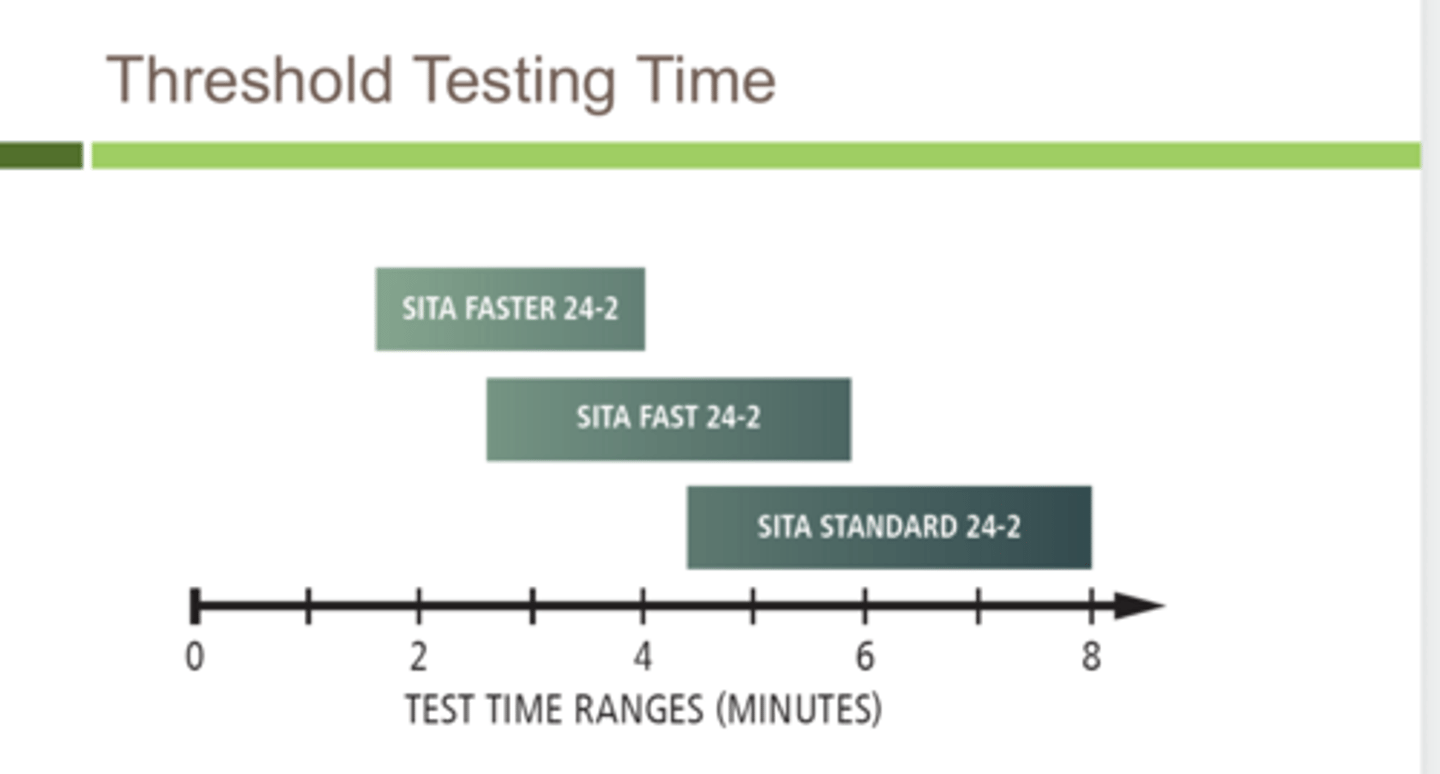
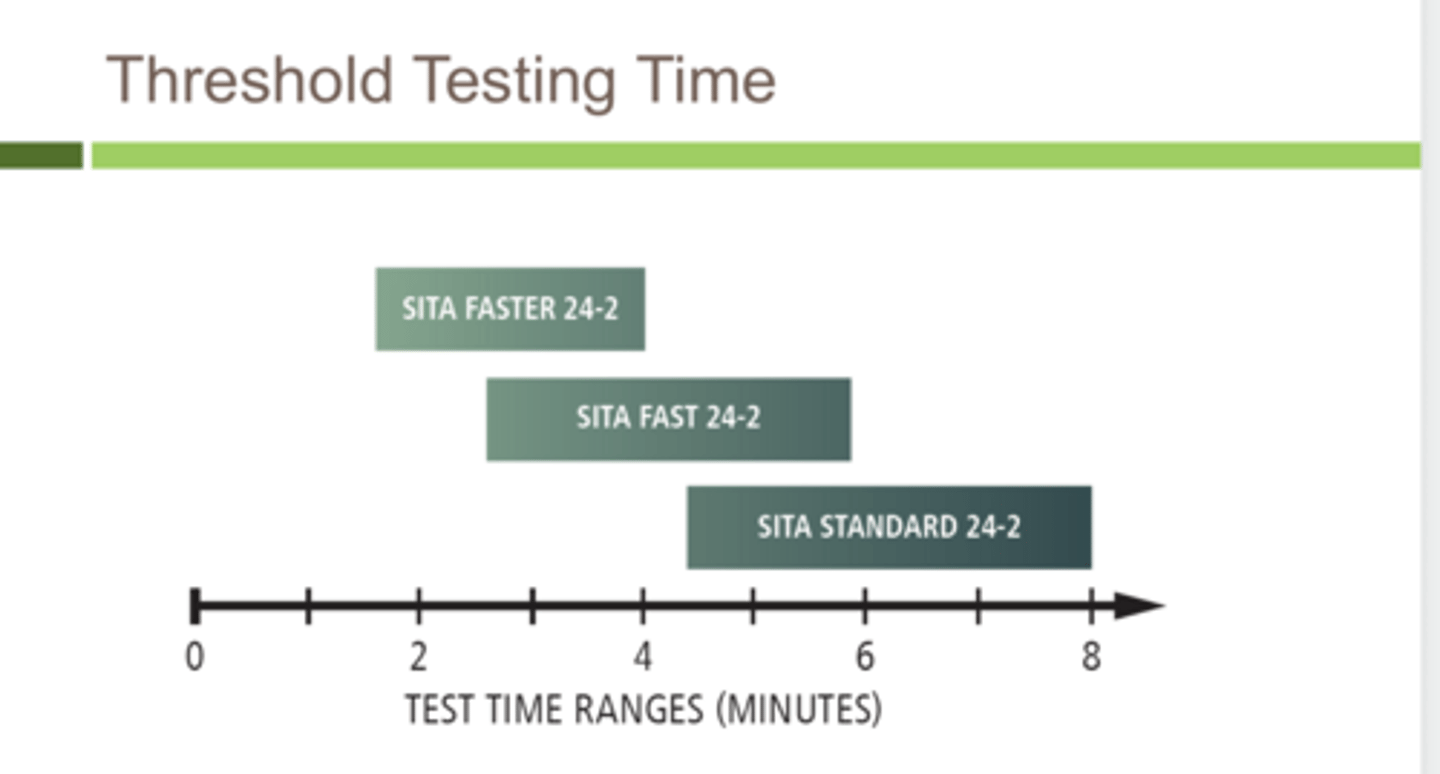
-accelerated thresholding procedure
-"maximum likelihood" procedure. Uses all of previous responses to determine the most likely threshold at that point
-Uses a 4dB staircase, then 2dB
What is SITA-Standard?
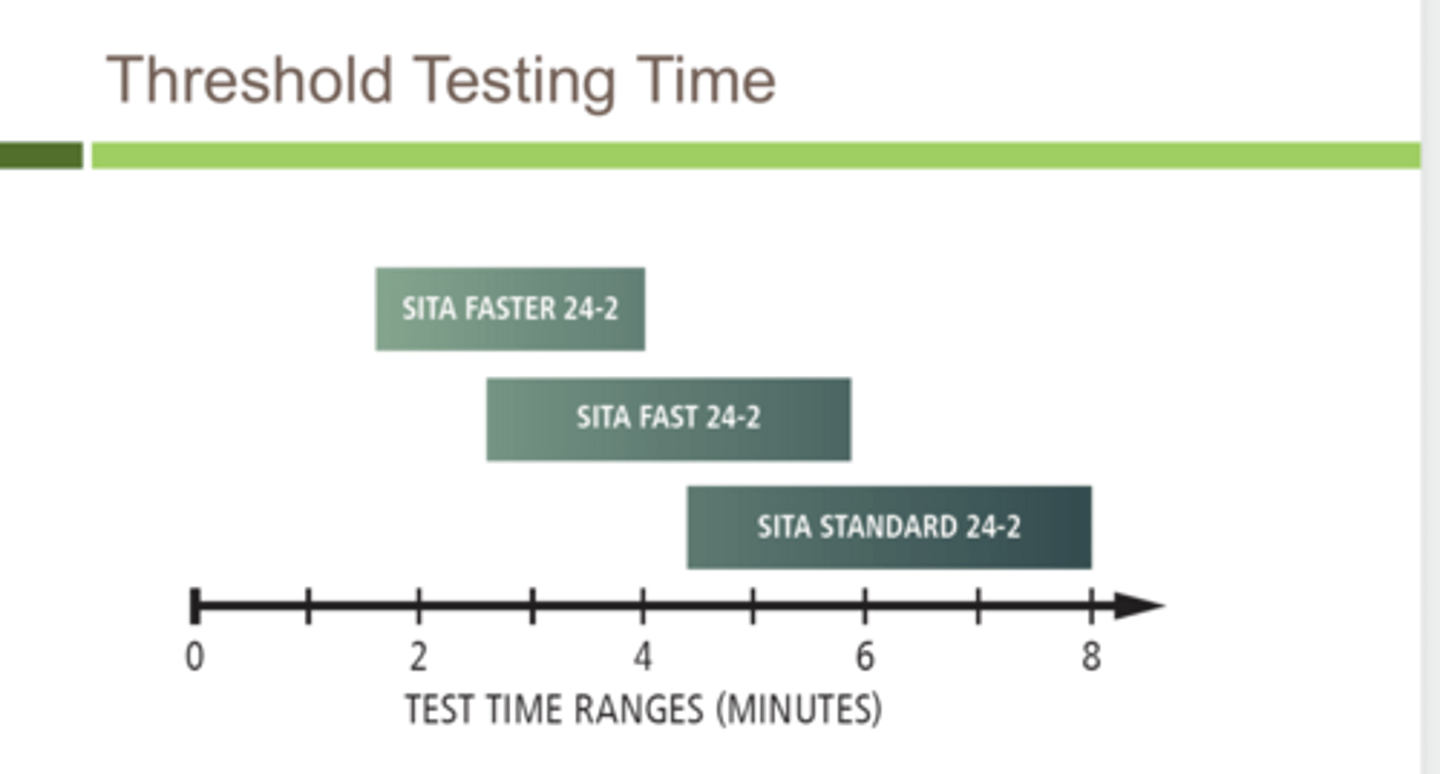
-Also uses "maximum likelihood" procedure.
-Uses only a 4dB staircase at most points
-Takes 2/3 of the time of SITA standard
-Test reliability is a bit worse than SITA standard
What is SITA Fast & Faster?
24-2C
SITA Faster is to be used with what testing pattern?
Test Time Ranges -- SITA Standard, Fast, Faster (Pic)
Test Time Ranges -- SITA Standard, Fast, Faster (Pic)
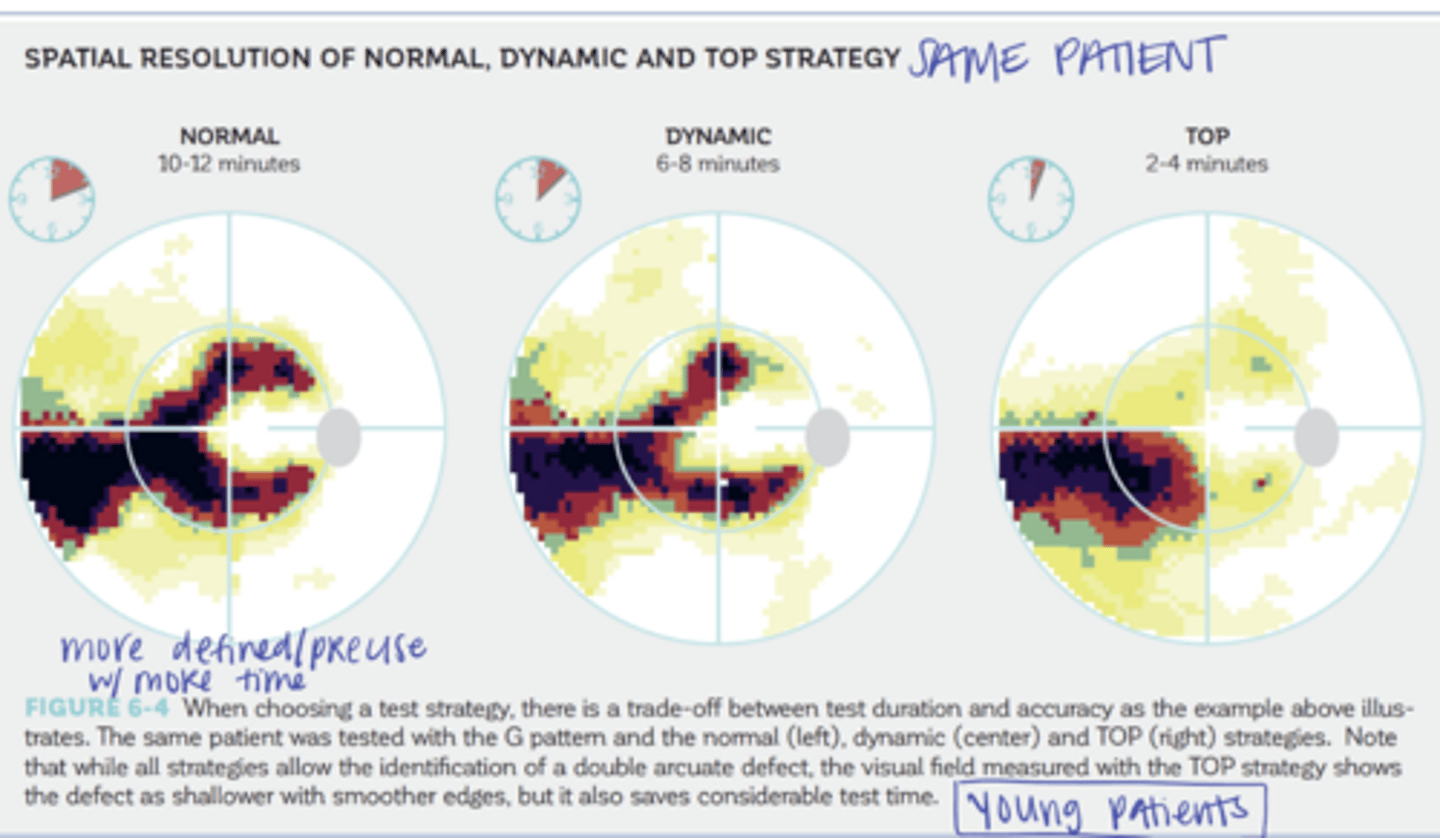
Spatial Resolution -- SITA Standard, Fast, Faster (Pic)
Spatial Resolution -- SITA Standard, Fast, Faster (Pic)
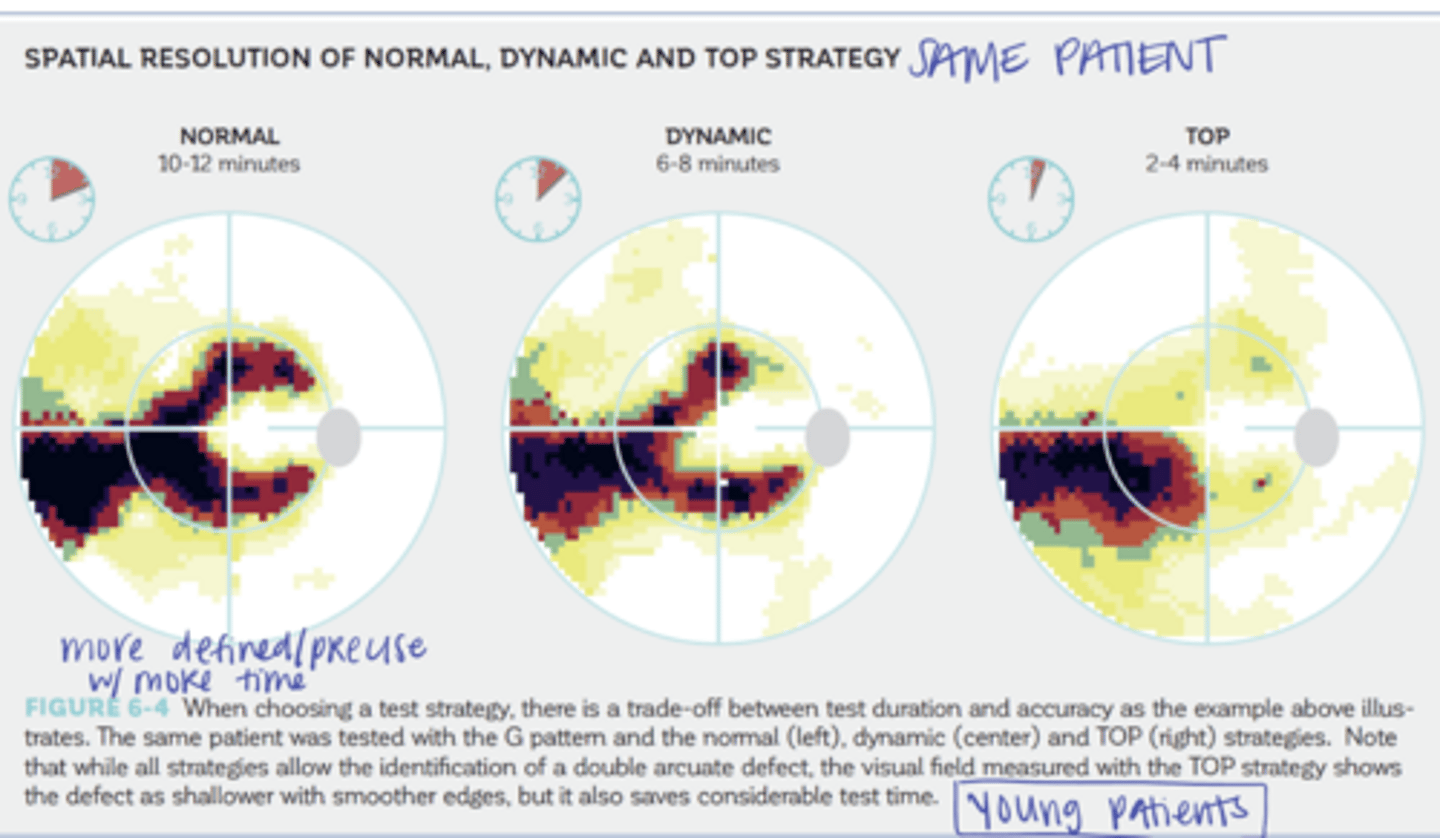
-young patients
-good test takers
-cases of fatigue
SITA Fast (TOP) can be a particularly useful alternative in what patients?
Recently this is the case, but historically no
Is SITA FAST typically recommended over SITA Standard or Dynamic Stategies?
Yes
Is there some loss in the ability to characterize isolated defects and recognize small changes in threshold sensitivity with Fast and Faster strategies?