Biology 2201- Unit 2 Test 2
 Call Kai
 Learn
Learn Practice Test
 Spaced Repetition
 Match
Match Flashcards
 Knowt Play
1/99

There's no tags or description
Looks like no tags are added yet.
Name | Mastery | Learn | Test | Matching | Spaced | Call with Kai |
|---|
No analytics yet
Send a link to your students to track their progress
100 Terms
Biochemistry
the study of the activity and properties of molecules that are important to living systems
Carbon
Hydrogen
Oxygen
Nitrogen
Living things are composed almost entirely (96%) of just 4 chemical elements:
- A medium for most chemical reactions
- Transports dissolved substances
- A reactant or product in many of life's chemical reactions
- Made up of polar molecules
The role of water in Living Systems:
Hydrophilic
Substances that dissolve in water (water loving)
`Hydrophilic
Made of polar or charged molecules or ions that are attracted to water
Hydrophobic
Substances that do not dissolve in, or form hydrogen bonds with, water (water-fearing)
Hydrophobic
made of non-polar or uncharged molecules that are not attracted to water
Glucose (C6H12O6)
a simple sugar that is used by cells for energy. It is produced by plants in photosynthesis
ATP (adensine triphosphae)
an energy - carrying molecule within our cells that releases energy when it loses a phosphate
Hydrolysis
a chemical process where a molecule of water is added to break a chemical bond
1. Carbohydrates
2. Lipids
3.Proteins
4. Nucleus Acids
Major biological Marcomolecules:
Carbohydrate function
- provide structure in plants (cell wall)
- source of energy for animals (simple and commplex sugars)
Carbohydrate structure
Made of carbon, hydrogen, and oxygen
Carbohydrate examples
Monosaccharides, disaccharides, polysaccharides (glucose, sucrose, starch)
Lipids function
- serve as structural components of cell membranes
energy source
Lipids structure
- hydrophobic and nonpolar (do not interact with water)
Lipid examples
- waxes, phopholipids (lipid bilayer of cell membrane), steroids and cholesterol
Proteins function
- Raw materials for making hormones, muscles, and other essential biological molecules
- Embedded in cell membrane to help transport materials in and out of the cell
Protein structure
- Composed of amino acids
Proteins examples
Keratin (fingernails and toenails)
Actin (muscles)
Collagen (connective tissue in skin)
Enzymes (lactose, catalose, amylose ec.)
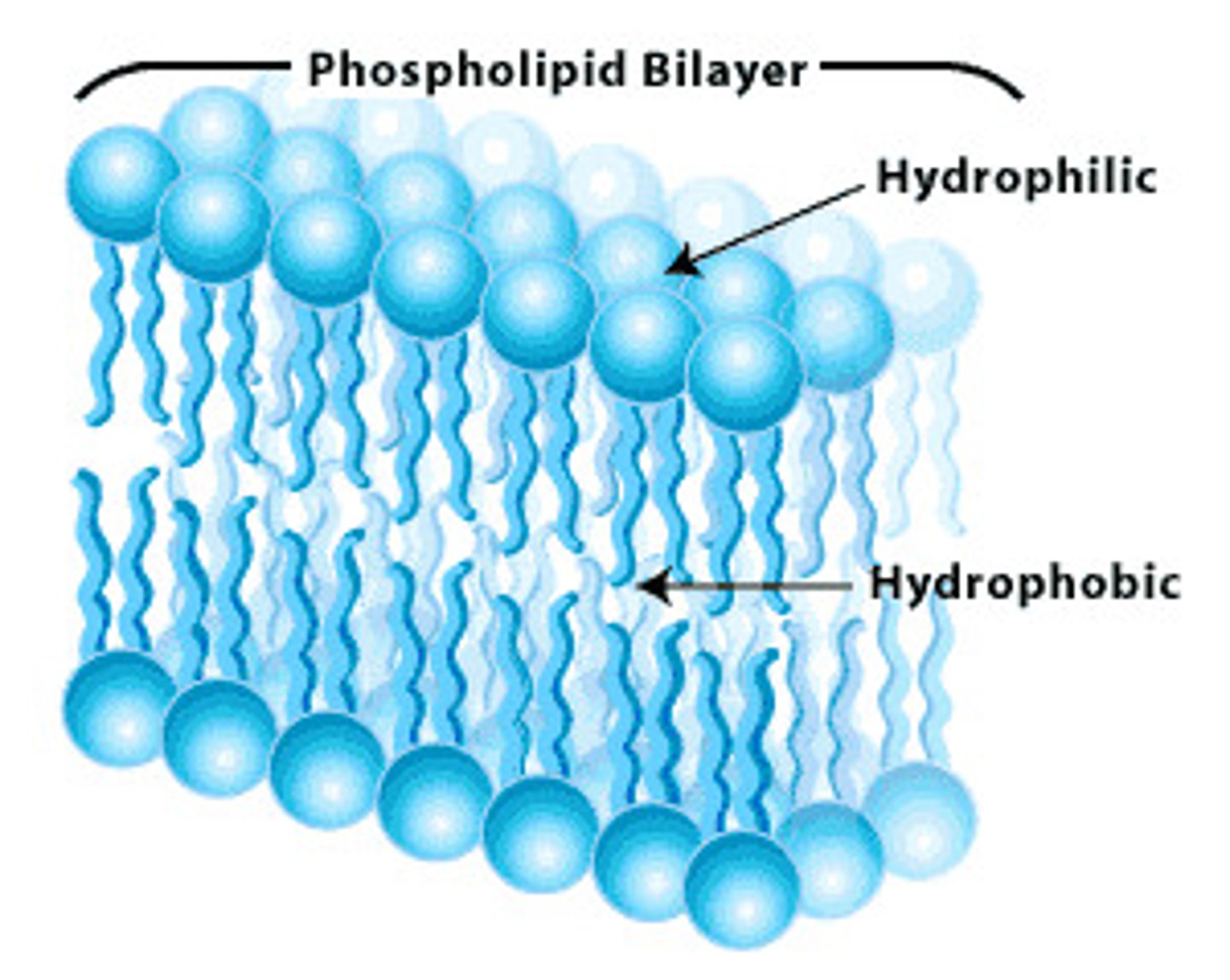
Phospholipids
Arranged in two layers (bilayer)
Phospholipids
Provides structure for the cell membrane
Phospholipids
Have two fatty acids (lipids) bonded to glycerol "backbone" and phosphate group
Phospholipids
The "head" is hydrophillic (water-loving) because it is polar while fatty acid "tails" are hydrophobc (water-fearing)
Phospholipids
Cholesterol
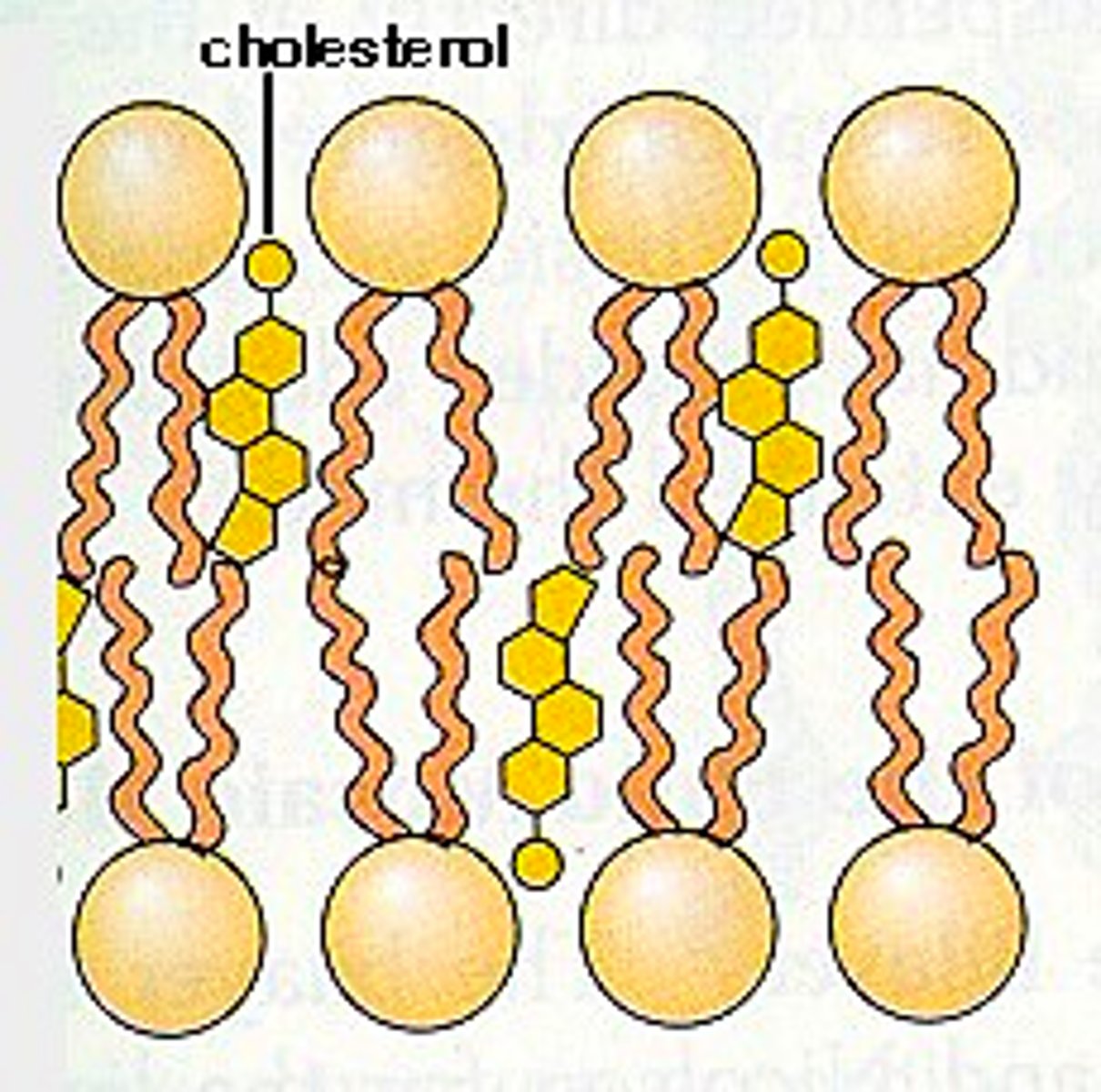
Found in the phospholipid bilayer
Cholesterol
Helps to keep fluidity of membrane consistent
Cholesterol
Allows the cell membrane to function at a wide range of temperatures
Cholesterol
At low temps, it keeps the membrane fluid and flexible
Cholesterol
At high temps, it reduces the fluidity of the membrane
Cholesterol
Makes the membrane less permeable to biological molecules
Cholesterol
Proteins
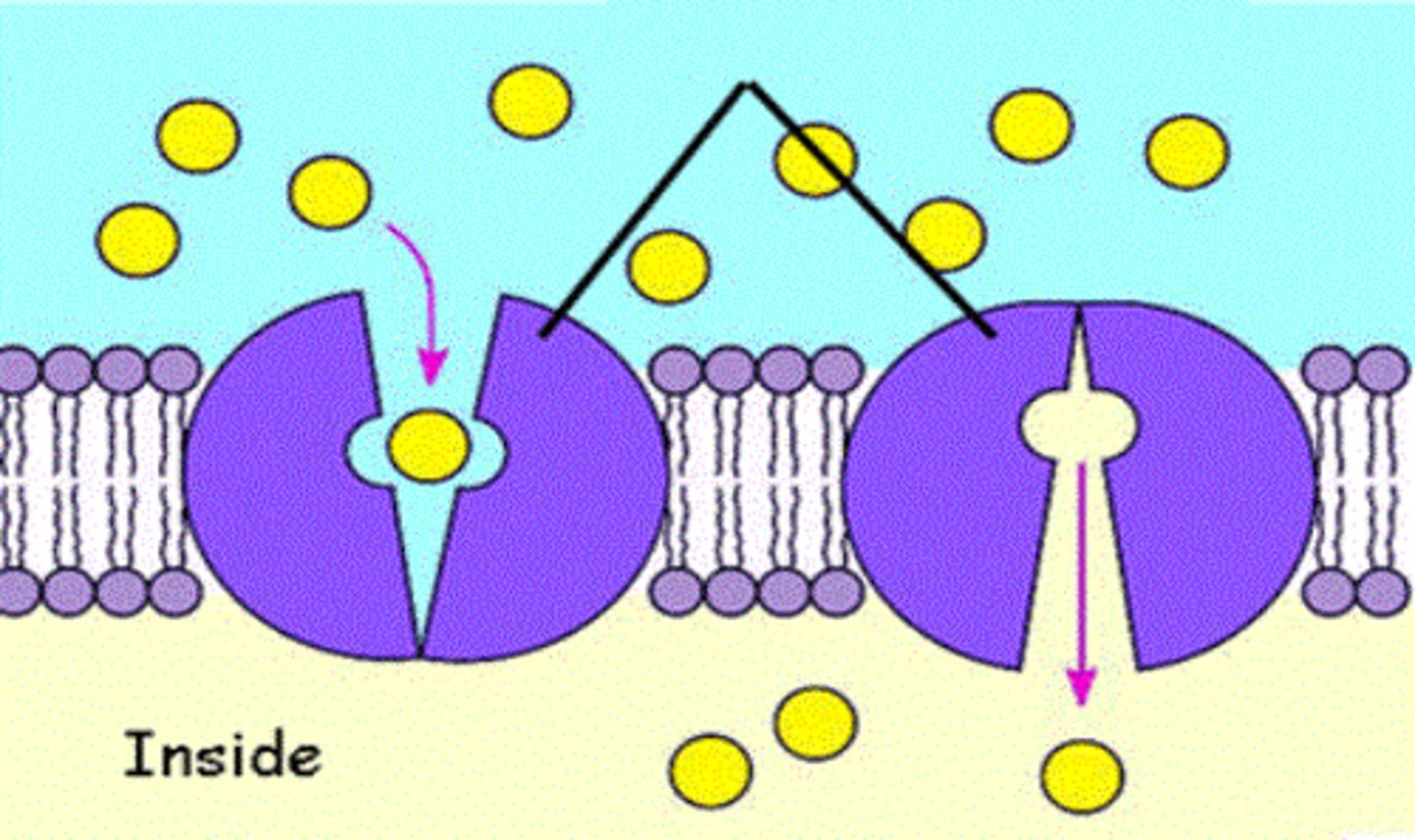
Most are embedded in the phospholipid bilayer
Proteins
Some transport specific substances across the membrane (channel or carrier)
Proteins
Some are enzymes
Proteins
some transmit signals from other cells (receptor proteins)
Proteins
Some bind the membrane to neighboring cells or to structural elements in the cytoplasm of the cell
Proteins
Carbohydrates
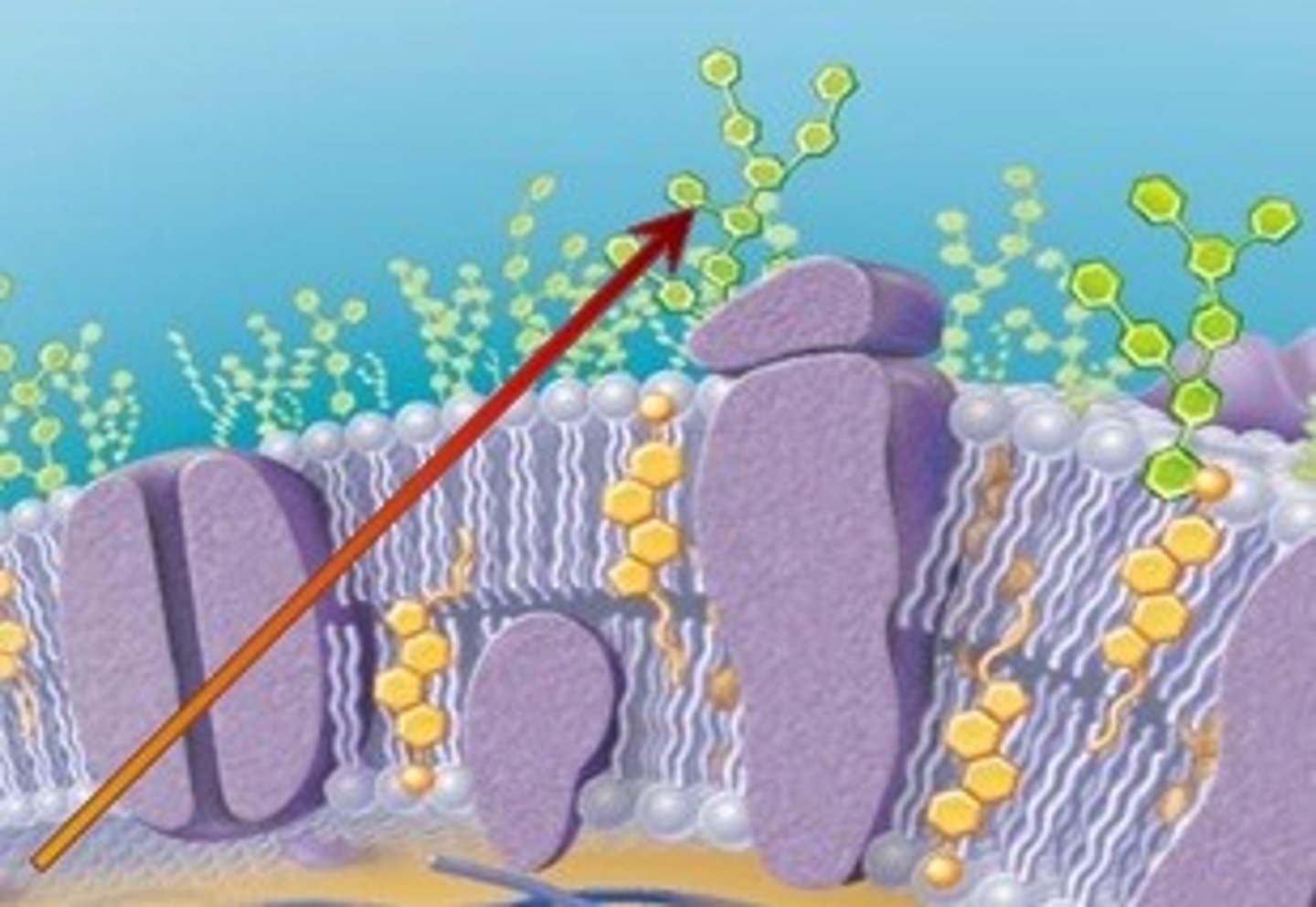
Extend from the phopholipids and proteins on the external edge of the membrane; known as glcoproteins or glycolipids
Carbohydrates
Allow other cells the "recognize" the cell as belonging to the organism and not an intruder
Carbohydrates
selectively permeable
the cell membrane selects or controls what substances may enter or leave the cell
Passive Transport
The movement of material across the cell membrane without the use of cellular energy (ATP)
1. Passive transport
2. Active Transport
3. Bulk membrane transport
3 Categories that involve transport of materials across the cell membrane
Passive Transport
Causes solutes to move from an area of high concentration to an area of low concentration across a centration gradient
Simple Diffusion
Movement of small, uncharged molecules from a region where they are more concentrated, to a region where they are less concentrated (along a concentration gradient) with NO energy
Simple Diffusion
Results in equiibrium (an equal distribution of molecules on the inside of a cell and on the outside of the cell)
Simple Diffusion example
the exchange of oxygen into the capillaries of the lungs
Simple Diffusion example
the movement of nutrients of the bloodstream into the body cells
Osmosis
the diffusion of water along a concentration gradient (water moving from an area of high concentration, to an area of low concentration)
Osmosis
the net movement of water tends to be in the direction that makes the concentration on both sides equal
Osmosis
moves water
Isotonic Condition
this occurs when the conentration of water inside the cell equals the concentration otside the cell. there is an equal amount of water entering as there is leaving the cell. In this condition there is no change in the cell.
Hypotonic condition
when the concentration of water outside the cell is greater than that inside the cell causing it to swell. Animal cells may burst and plant cells will become rigid
Hypertonic
when the concentration of water is greater inside the cell than outside. More will migrate out of the cell than enter it. In both animals plant ceells the cytoplasm shrinks
Facilitated diffusion
Passive transport of material along a concentration gradient using a transport protein
Facilitated diffusion
Occurs when molecules are too large or insoluble in lipids
Facilitated diffusion
Protein is specific to the shape, size and charge of the molecule or ion it is transporting
Transport proteins
Carrier proteins
Channel proteins
Carrier proteins
Lets molecules pass through the membrane based on shape
Channel proteins
Lets molecules through based on charge
Active transport
the process of moving material across a cells membrane AGAINST the concentration gradient (low concentration to high concentration) using ATP (energy)
Membrane-assisted transport
Transport of large molecules across the cell membrane. This requires ENERGY
Membrane-assisted transport
A vesicle is needed to transport
Exocytosis
Vesicles inside the cell membrane where they empty their contents outside the cell
Endocytosis
the process where the membrane folds into itself and pinches off forming a vesicle
Pinocytosis
this process involves the cell taking a small droplets of extracellular fluid along with dissolved materials
Phagocytosis
encircling bigger and more specific paticles (ex:cell fragments or bacteria) and then pinching off inside the cell
1. ADD (adenosine diphosphate)
2. A free phosphate group
3. A burst of energy that cells can use immediately
ATP hydrolysis produces?
broken down and regenerated
ATP is ______ ____ and ___________ constantly in cells
2 billiion, minute
An adult human converts about _ _______ atp to ADP + P each ______ to get enough energy to stay alive
aerobic respiration
uses oxygen to release energy as ATP from glucose
aerobic respiration
this process is carried out by cells of all living organisms
glucose (from our food) + oxygen = energy (ATP) + carbon dioxide + water
Aerobic respiration equation?
Anaerobic respiration
happens without oxygen
Anaerobic respiration
It makes 2 ATP from a single molecule of glucose
Anaerobic respiration
Leads to lactic acid build up in muscles
Aerobic
Is Aerobic or Anaerobic respiration more efficient?
Glycolysis
In the cytosol, enzyemes split glucose into 2 phosphate molecules
Glycolysis
the result is 2 molecules of ATP formed (1st)
Glycolysis
this step does not require oxygen
Glycolysis
Pyruvate moves into the mitochondria
Kreb's cycle
Within the mitochondria, a series of reactions occur
Kreb's cycle
Pyruvate joins other molecules and forms high energy carrying molecules (electrons are gained)
Kreb's cycle
this step requires oxygen
Kreb's cycle
Crabon dioxide is released as waste
Kreb's cycle
Makes 2 ATP (2nd)
oxidative phosphorylation
within the mitochondria membrane, energy- carrying molecules pass electrons to an electron transport chain
oxidative phosphorylation
Oxygen is the last electron acceptor in the chain (water is produced)
oxidative phosphorylation
As electrons are passed along, energy is released
oxidative phosphorylation
As energy is released it is used to add a phosphate to ADP to make ATP
oxidative phosphorylation
This generates about 34 ATP molecules
Photosynthesis
a process carried out by green plants where energy rich glucose molecules are produced
Photosynthesis
is carried out in the organelles called chloroplasts
photosnthesis equation
CO2 + H2O + SUNLIGHT = O2 + C6H12O6
Light-dependent reactions
Chlorophyll pigments absorb light energy
Light-dependent reactions
Pigments then transfer this energy to 2 energy- carrying molecules, ATP and NADPH
Light-dependent reactions
A molecule of water is used and a molecule of oxygen is produced
Calvin cycle
Uses products of light-dependent reactions to convert CO2 into glucose
Calvin Cycle
These reactions occur in the stroma of the chloroplast