E+M Key Equations
 Call Kai
 Learn
Learn Practice Test
 Spaced Repetition
 Match
Match Flashcards
 Knowt Play
1/38

There's no tags or description
Looks like no tags are added yet.
Name | Mastery | Learn | Test | Matching | Spaced | Call with Kai |
|---|
No analytics yet
Send a link to your students to track their progress
39 Terms
Gauss’ Law for electric fields (M1)
∫E⋅dA=ϵ0Qenc
Gauss’ Law for magnetic fields (M2)
∫B⋅dA=0
Ampere’s Law
∫B⋅dl=μ0Ienc
Maxwell’s correction to Ampere’s Law (M3)
\int B\cdot dl=\mu_0\int\left(\imaginaryJ+\epsilon_0\frac{\partial E}{\partial t}\right)\cdot dA
Where j is the current density. (not the unit vector)
Faraday’s Law of Induction (M4)
∫E⋅dl=−dtd∫SB⋅dA
Coulumb’s Law
F=4πϵ0r2q1q2r
Key Gauss Law solutions: Point charge
E=4πϵ0r2qr
Key Gauss Law solutions: Line charge
E=2πrϵ0λr
λ is charge density (per unit distance)
Key Gauss Law solutions: Plane of charge (including parallel plate capacitors)
E=2ϵ0σr
σ is charge density (per unit area)
Scalar electric potential
ϕ(r)=−∫∞rE⋅dl
Electric field from potential
E=−∇ϕ=−dxdϕ (if 1D)
Equation of current from current density (recall both current density and area are vectors…)
I=∫sj⋅dA
Electric field energy density
uE=2ϵ0E2
True for all electric fields, easy to solve for parallel plate capacitor.
To get electric field potential energy, just multiply by volume (i.e for parallel plate capacitor example will be area of one plate times distance to other plate)
Total energy stored in a capacitor
U=21CV2
Recall C=VQ
Electric dipole moment and torque on electric dipole
p=qd
p is the electric diplole moment, note both this and distance are vectors
τ=p×E
Electric dipole potential
ϕ(θ)=4πϵ0r2Qdcosθ
Electric dipole electric field
E=4πϵ0Qd(2cosθr+sinθθ)
Electric dipole energy
U=−p⋅E
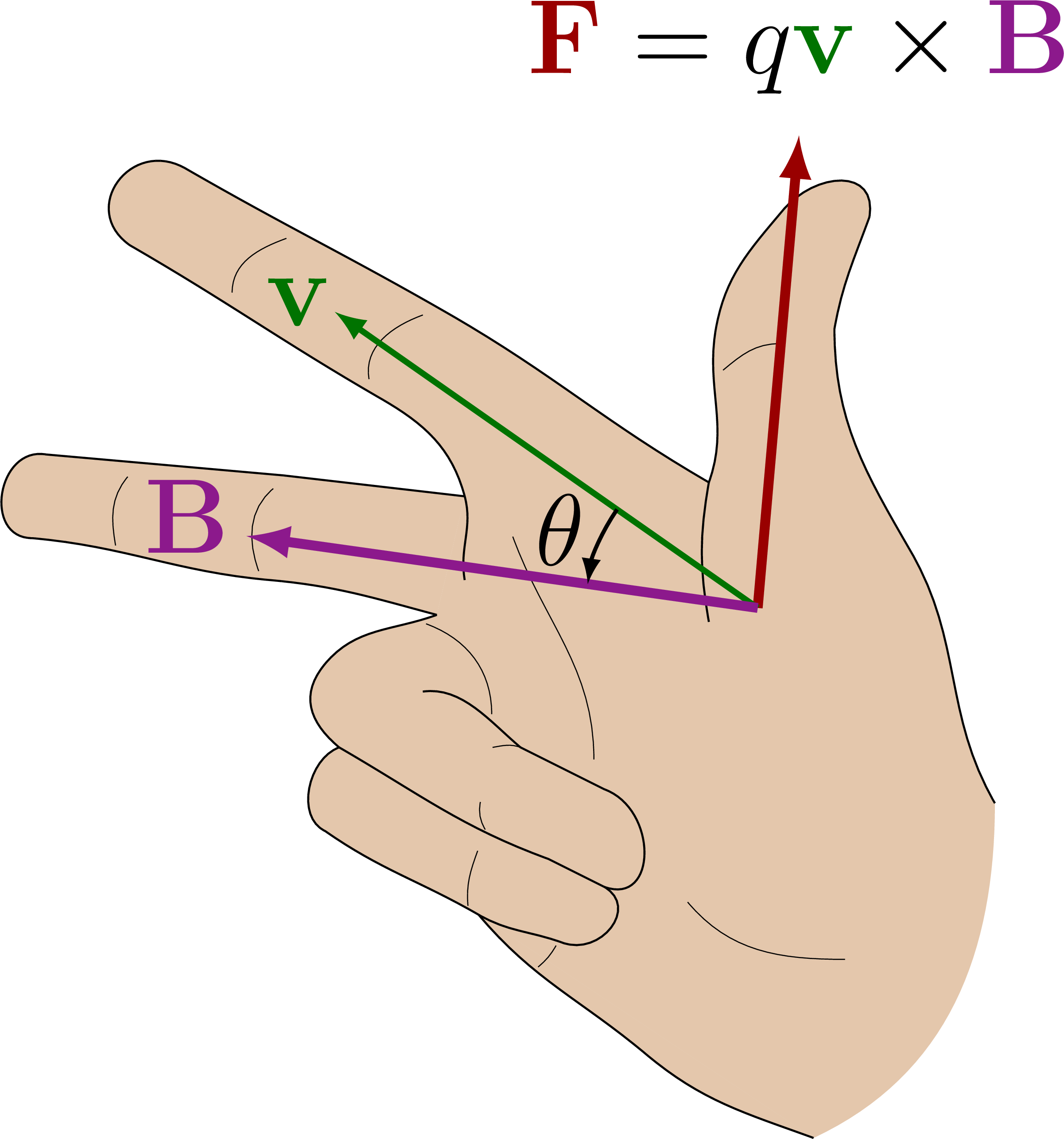
Magnetic force (on moving charged thing)
F=q(v×B)
note this rule works for all equations c=a×b
Lorentz force
F=q(E+v×B)
simply combination of magnetic force (F=q(v×B)) and electric force (F=qE)
Magnetic force on a charged wire
F=l(I×B)
Equation relating electric current to individual charge carriers
I=nAqv
where n is the charge carrier density (number of charge carriers per unit length). Note that this is how the magnetic force on a current carrying wire equation is derived (put this into force on moving charge equation)
The Biot-Savart Law
dB=4πr2μ0Idl×r
note that as r is a unit vector, the magnitude of this equation simplifies to ∣dB∣=4πr2μ0Idl
Key Biot-Savart Law solutions: Magnetic field from loop of current
At centre:
B(z=0)=2aμoIz
Just z component at any z value:
Bz=2(a2+z2)23μoIa2z
Key Biot-Savart Law solutions: Magnetic field from an infinite wire
B(s)=2πsμ0Iθ
Force experienced by parallel currents
lF=2πsμ0I1I2
Magnetic flux
Φ=∫sB⋅dA
Note, different from Gauss’ Law for magnetic fields as that law is the complete circulation over a gaussian surface, whereas this is an integral over part of a given surface
Induced EMF by a magnetic field
Expressed by Faraday’s law, but this time in terms of EMF:
\char"0190 =-\int E\cdot dl=-\frac{d\Phi}{\differentialD t}
Recall magnetic flux defined as Φ=∫sB⋅dA. This shows where the version of Faraday’s law used as M4 comes from.
Magnetic field produced in a solenoid
Bin=μ0nI
Note that Bin is specifically magnetic field inside solenoid (= 0 outside… kind of)
n is coil density (number of coils per unit length)
Moment on magnetic dipole
μ=IA
Torque on magnetic dipole
τ=μ×B
Magnetic dipole energy
U=−μ⋅B
magnetic field energy density
uB=2μ0B2
Multiply by volume to find magnetic potential energy
Self inductance and back voltage
Φ=LI
note that from equation for EMF we see that \char"0190 =-\frac{d\Phi}{\differentialD t}=-L\frac{dI}{\differentialD t}
Back voltage defined as negative of this EMF: ϕL=−Ɛ
Self inductance of a solenoid
L=μ0n2lA
n is number of coils per unit distance, and l is the total length of the coil
Total energy stored in an inductor
U=21LI2
Mutual inductance (between two solenoids)
Φ21=M21I1
I1 is the current in the first coil (which induces an emf in the second one), Φ12 is the flux linkage between the coils (magnetic flux in both coils), and M21 is the mutual inductance - the coupling coefficient between coils, which can also be written as:
M21=lμ0N1N2A
N1 and N2 is the total number of coils in each solenoid
Transformer EMF
Ɛ1=N2N1Ɛ2
N1 and N2 is the total number of coils in each solenoid
Transformer power
Power in transformers is conserved:
Ɛ1I1=Ɛ2I2