ECON 322: Final Units
 Call Kai
 Learn
Learn Practice Test
 Spaced Repetition
 Match
Match Flashcards
 Knowt Play
1/18

There's no tags or description
Looks like no tags are added yet.
Name | Mastery | Learn | Test | Matching | Spaced | Call with Kai |
|---|
No analytics yet
Send a link to your students to track their progress
19 Terms
What we know and don’t know about the science behind climate change:
CO2 concentration levels are on a rapid rise upward
Accumulation of CO2 and other GHG reduce the Earth’s ability to reflect energy outwards (→ increasing heat in atmosphere).
What Science we don’t know:
Full carbon budget (all sources of inputs and sinks): all GHG inputs, full functioning of GHG sinks (we know about 75%).
How GHG output from human choices will change in the future
What are some of our predicted outcomes due to the rise of CO2 & other GHG?
Our best estimate is that warming will continue and accelerate into the next century.
A number of estimated side effects:
Sea level rise
Migration of tropical disease
Desertification
Increase in strength and severity of storms
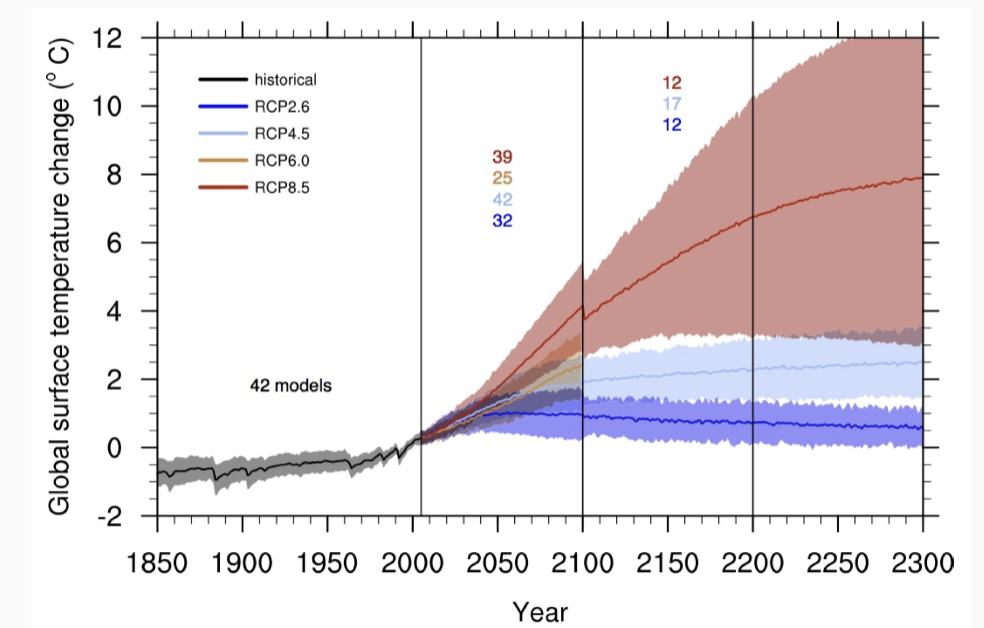
What is this graph telling us? What are the goals of the UN IPCC Report?
We want to avoid being in the red (dark blue would be ideal), but we’re on a trajectory to be in the dangerous section.
UN IPCC Report: limiting temperature increase to +1.5C instead of +2C would be beneficial to lower global sea level rise, decrease extreme weather, etc.
Bottom line: Need to react in next decade to avoid the +2C (or worse trajectory).
Why is climate change considered a market failure?
GHG free (or low GHG) atmosphere is a common-property open access resource that is rival and non-excludable.
One country’s emissions affects everyone else’s climate.
Location of GHG emissions irrelevant: it uniformly affects everyone.
What was the overall consensus of the Stern Review?
The Stern Review conducted an in-depth CBA for climate change mitigation and adaptation for the British Government.
Calculated CBA for reducing a lot, a little, or nothing.
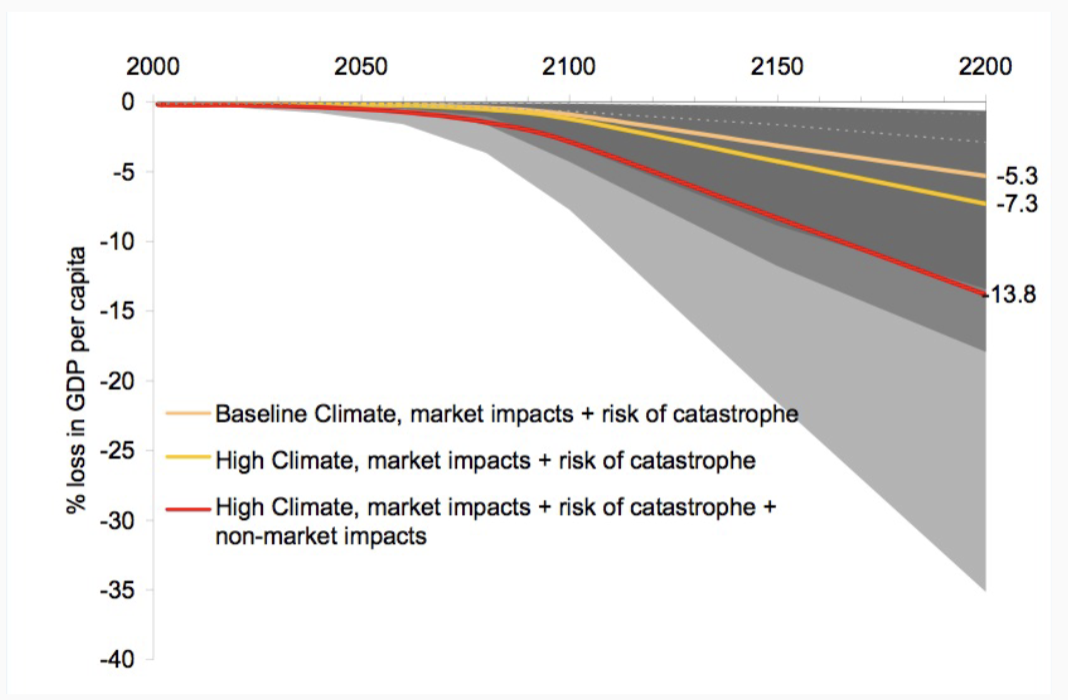
Tried to downweight impacts and add high discount (overestimate bad outlook) and even THEN, the benefits of reducing CC outweighed the costs.
What is the Paris Agreement’s central aim?
Central aim is to strengthen the global response to the threat of climate change by:
keeping global temp rise this century well below 2C [mitigation].
strengthen the ability of countries to deal with the impacts of climate change [adaptation].
What are some of the mitigation and adaptation provisions under the Paris Agreement?
Builds on Kyoto Framework by establishing these mitigation provisions:
Establish Nationally Determined Contributions (NDC’s) of GHG reductions.
Allows for a system of carbon accounting and trading.
Sustainable Development Mechanism.
Adaptation Provisions (more important for some countries, esp smaller ones):
Ensure financial adaptation ($100 billion per year in increased development assistance).
Compensation for loss and damage that occurs even with adaptation.
No enforcement mechanism.
What are the two biggest differences between the Kyoto Framework and the Paris Agreement? What is the biggest issue?
Who is cutting: developed countries (Kyoto), everybody (Paris)
Specific Targets: yes (Kyoto), NDC’s (Paris)
*Enforcement: no (both)
(+ both include Tradable Permits and Technical Exchange)
What’s the idea behind Carbon Taxes?
Most of the reductions in carbon emissions over the next 20 years will occur because of a shift away from high intensity (high carbon content) fossil fuels.
Idea: Charge per unit tax on energy based on carbon content.
Review of regulator setting fee (tax) on polluters:
Regulator wants Q to go back to 0.
Sets fee across all firms (not knowing individual MCC curves) → not sure how much pollution reduction will occur.
What happens if regulator increases fee? they will play around with fee until overall Q meets expectation.
What is the British Colombia Carbon Tax and Dividend Program?
Design features:
Covers 75% of all GHG emissions.
Charges per unit tax on energy use based on carbon content (e.g., coal has high content so it’s taxed a lot more).
Has some exemptions (fossils fuels exported from BC, planes & ships, land emissions from agriculture and development, methane leaks).
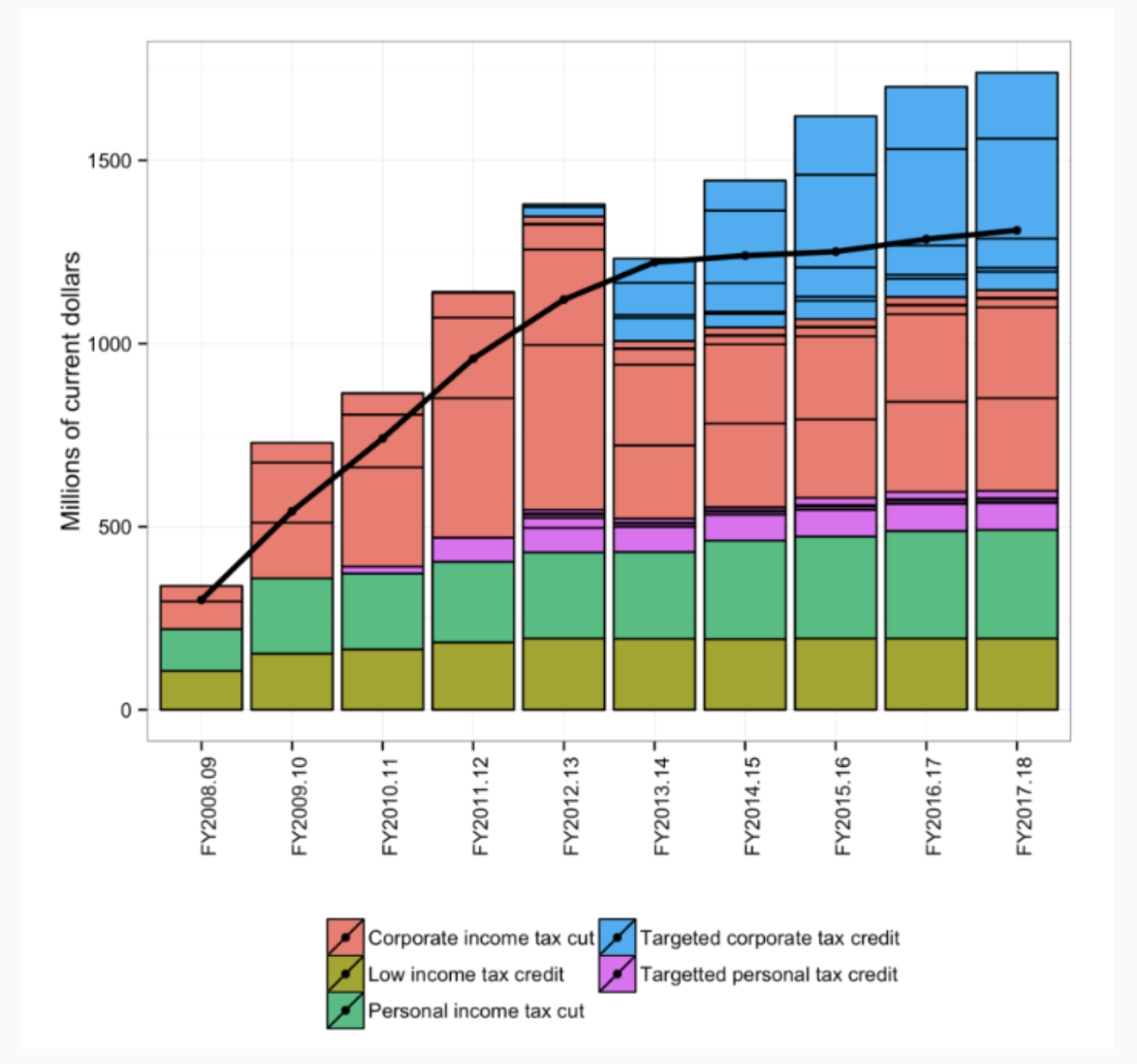
Revenues are redistributed back to households (in the form of tax reductions or directed transfers).
Achieved 10-15% reduction in GHG from cutting fuel consumption.
Policies: Carbon Taxes: Carbon Taxes, Summary of BC Program
Benefits and Costs:
Benefits:
Led to reductions
Had disproportionate impact on carbon intensive industries (heavy manufacturing industry hit hardest on employment/ transportation, mining, forestry, healthcare see most positive change).
Some of the tax revenues went directly back to citizens (about 1/3)
Costs:
Trade is mostly ignored.
Dividends went mostly to industry and certain sectors were omitted.
From the simulation exercise we did in class, what did we learn about regulators setting fees? What is the main concern with this policy?
We had to set a fee across 3 different MCC configurations (linear, non-linear, discontinuous). Firms will most realistically have non-linear/discontinuous MCC curves.
The issue comes from the fact that regulators cannot set Q directly; they have to set t blind and wait to see what happens.
There’s a chance that t could put firms at Q=0 and drive them out.
With discontinuous MCC’s a firm can become indifferent to cutting Q further once a certain Q has been met with t.
Pollution Permit Trading: Advantages vs. Taxes
Avoids the uncertainties of pollution amounts under taxes and the need for experimentation by setting up a pollution permit market.
Equity better under permits → poorer countries can buy/sell permits as they want
What are the key design decisions the regulator has to make for Pollution Permit Trading policy (AKA Cap and Trade):
Initial Allocation of Pollution Rights (permits) based on what? historic pollution patterns, randomly assigned, or auctioned off? (once trade happens, equimarginal Q will be met no matter what the initial allocation is)
Banking: can you carry over permits from one year to the next?
Limits to Trading: to avoid hotspots and market power in the pollution market, how much do we limit trade? Should countries be able to sell all permits, or be forced to keep some?
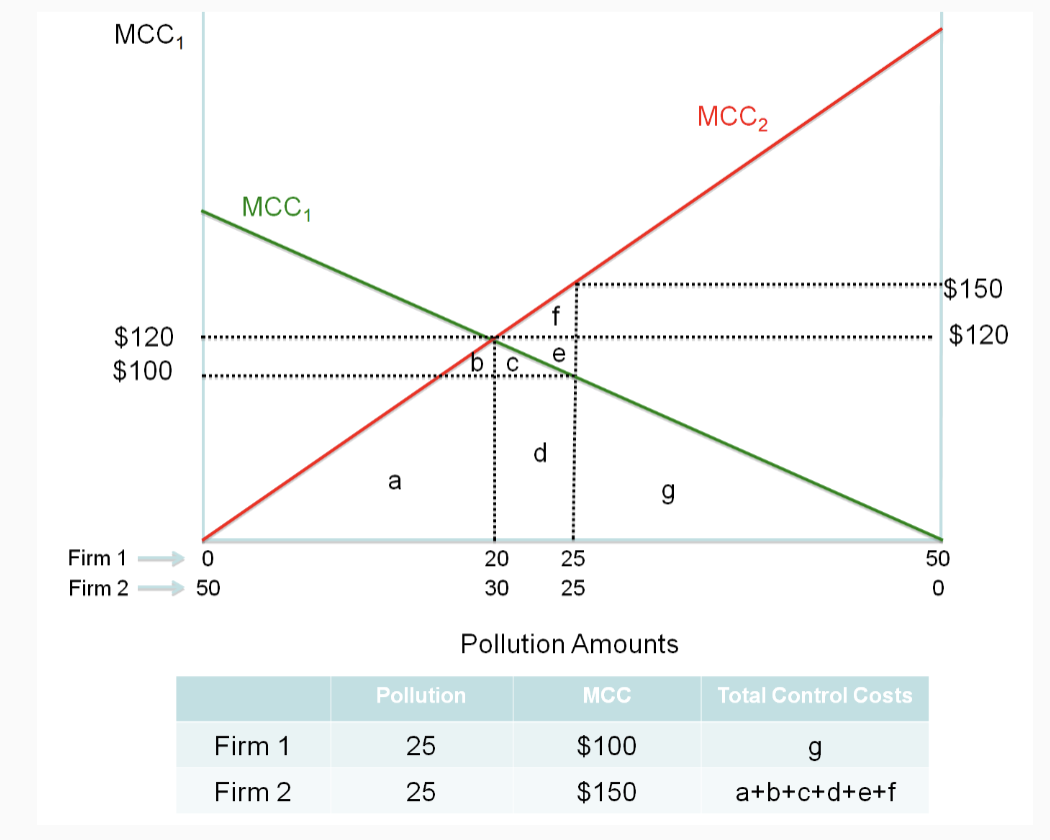
How do firms act under Pollution Permit Trading with NO trade?
(*Graph is important here)
No regulation: Total pollution = 100
If firm 1 pollutes 0, firm 2 can pollute 50 and vice versa.
Same setup as bubble policy.
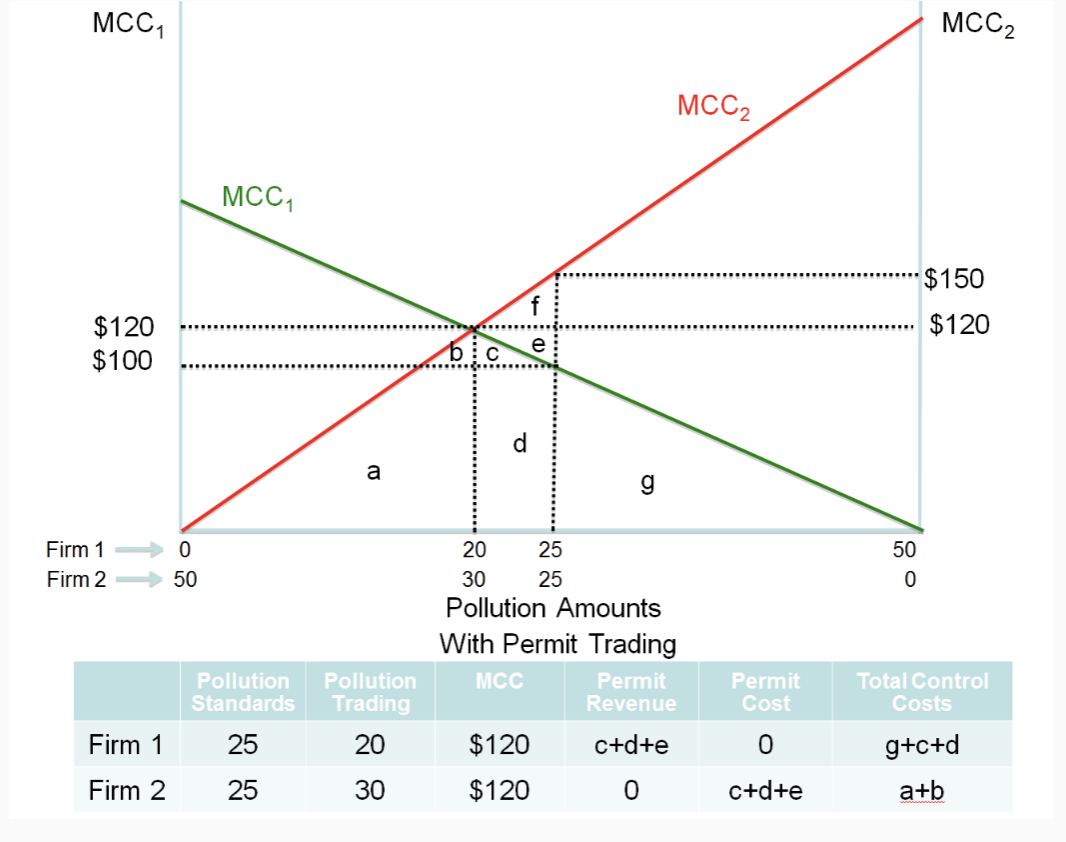
How do firms behave under Pollution Permit Trading WITH Permit Trading?
(*Need to know what each area on the graph represents)
Firm 1 (lower cost firm) will sell 5 permits to Firm 2 and make revenue (c+d+e).
Firm 2 will buy 5 permits, allowed to pollute 5 more.
Reach equimarginal principle (both firms MCC’s = 120)
f+e represent DWL
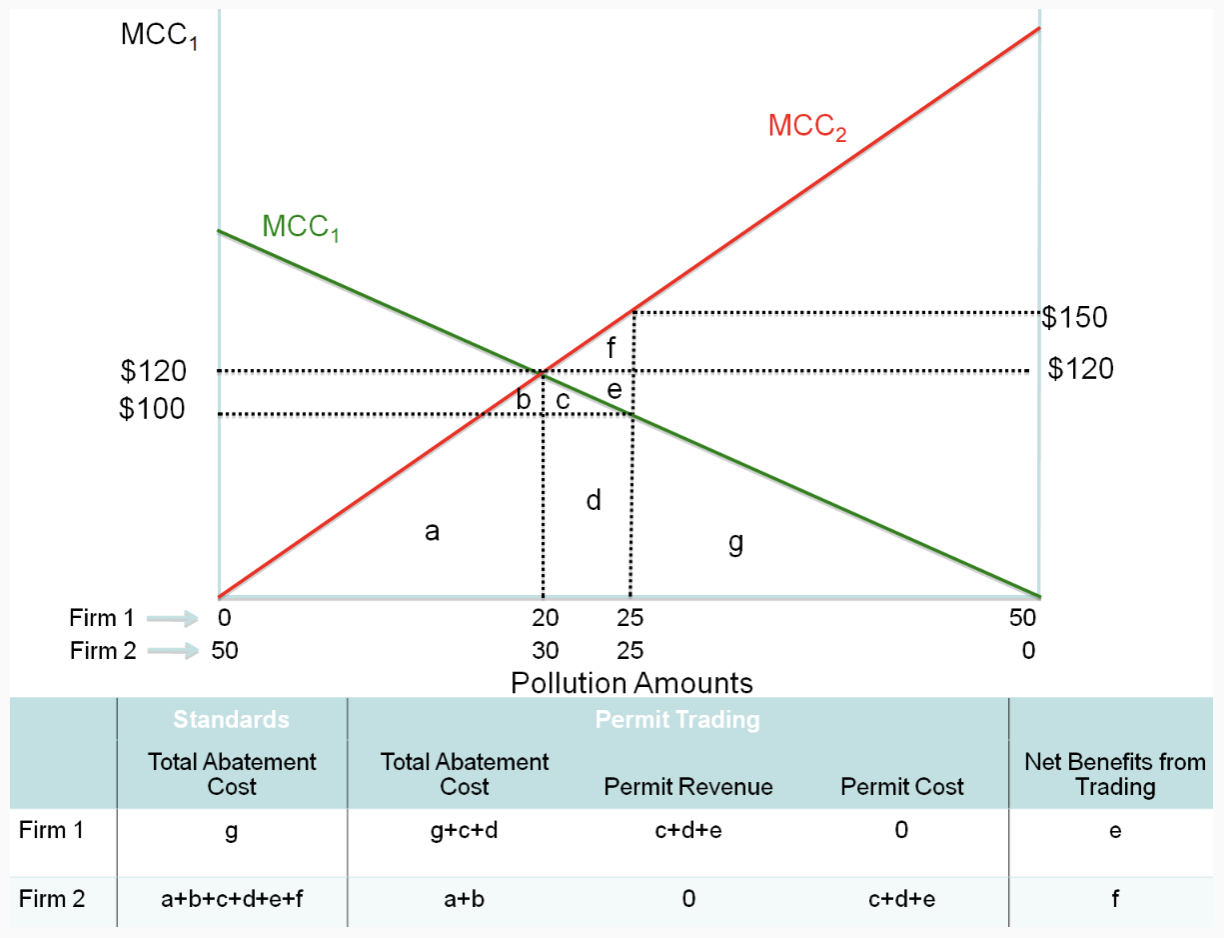
Comparing costs and benefits from operating under Standards vs. Pollution Permit Trading:
(*Know each area on graph)
Under standards, higher cost firm has to pay much more in abatement cost to the regulator.
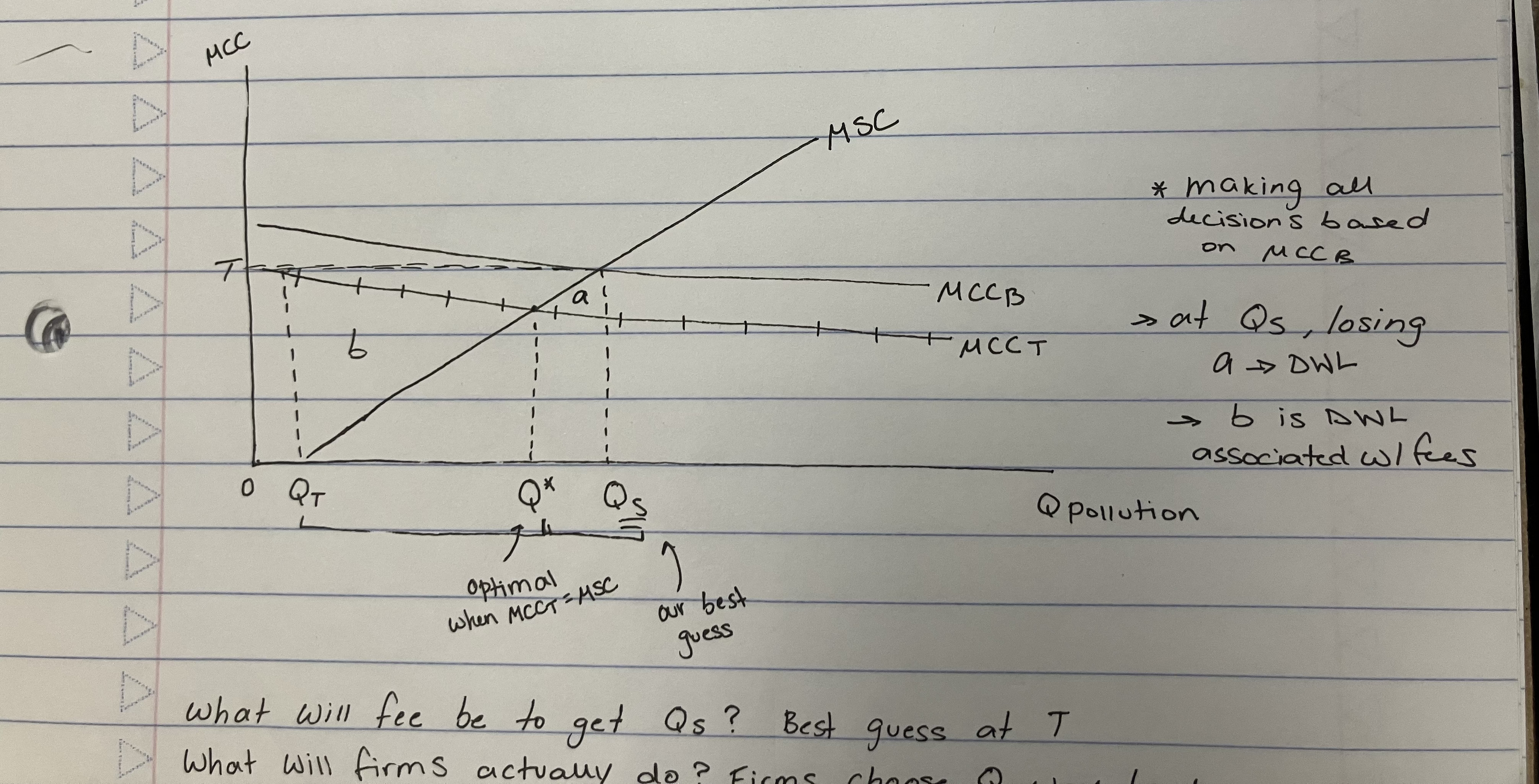
What does industry-wide MCC’s look like when regulators try their best guess at T?
MCCb = Regulator’s belief about industry MCC Curve
MCCT = True industry MCC
MSC = Society’s Marginal Social Cost Curve
Regulators can only make decisions based on MCCB
Findings:
Much bigger deviation from Q* with fees.
DWL with fees (b) > standards (a).
Less pollution with fees.