Chapter 4 and 5 Machines
 Call Kai
 Learn
Learn Practice Test
 Spaced Repetition
 Match
Match Flashcards
 Knowt Play
1/72

There's no tags or description
Looks like no tags are added yet.
Name | Mastery | Learn | Test | Matching | Spaced | Call with Kai |
|---|
No analytics yet
Send a link to your students to track their progress
73 Terms
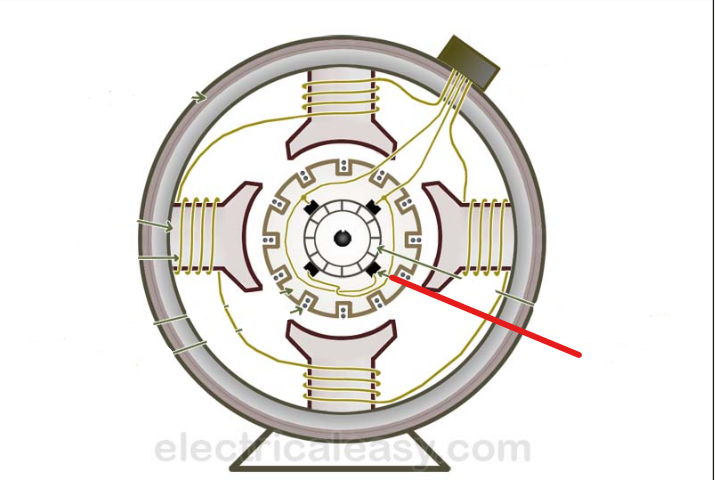
What is this arrow pointing at?
Brushes
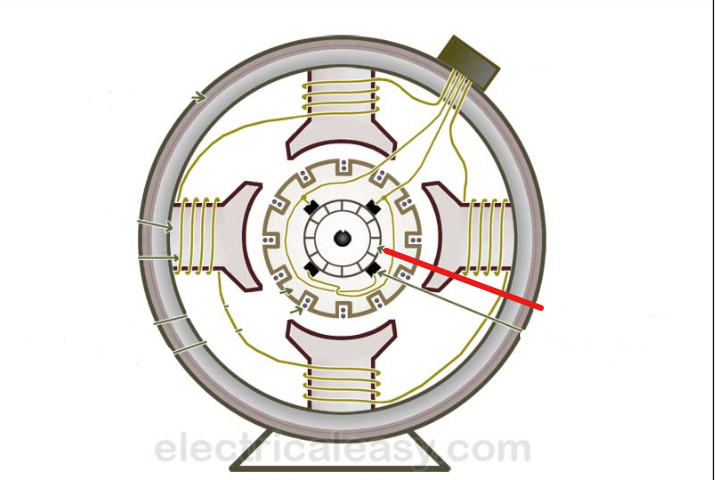
What is this arrow pointing at?
Commutator
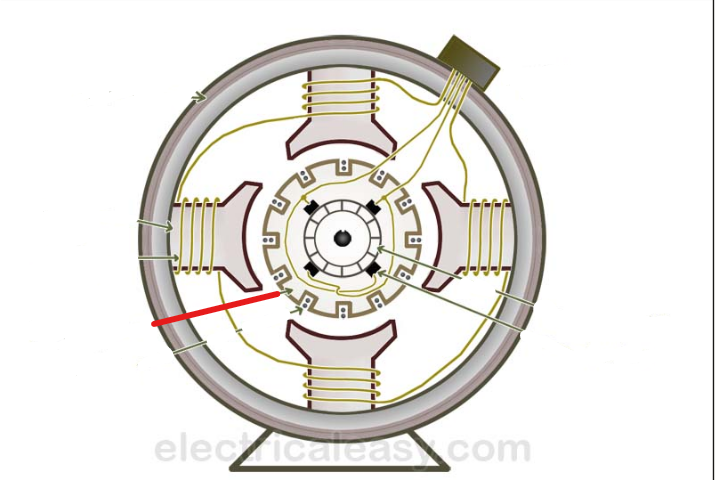
What is this arrow pointing at?
Armature
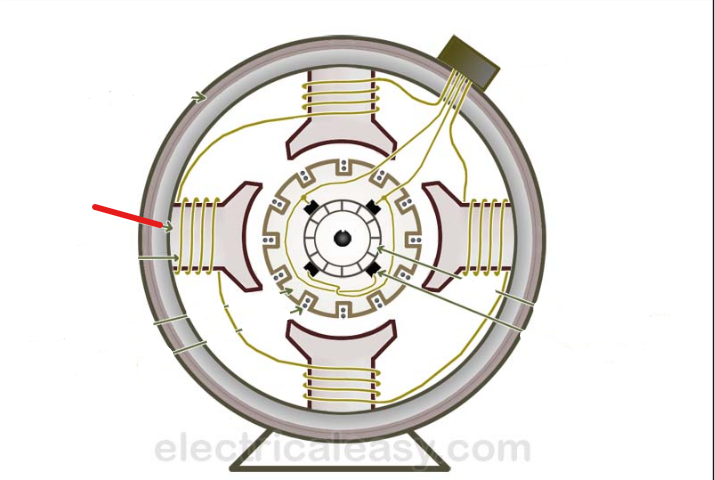
What is this arrow pointing at?
Poles
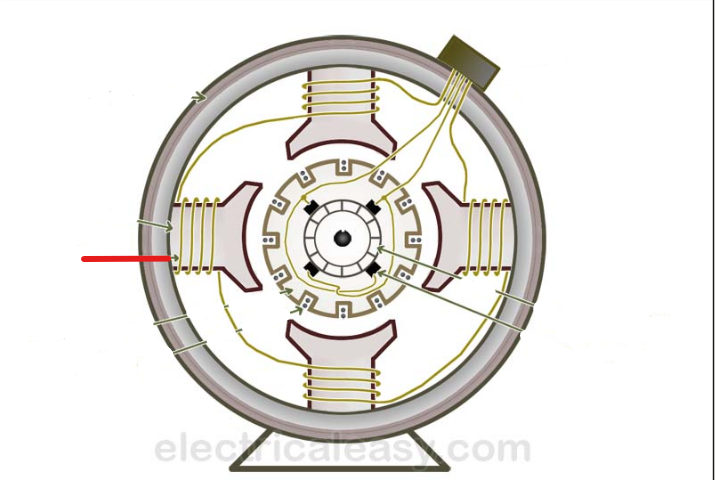
What is this pointing at?
Field windings
Why are the brushes of a dc machine always placed at the neutral points?
To maximize the output voltage and prevent sparking by short-circuiting coils that have zero induced voltage
Describe the construction of a commutator.
An assembly of tapered copper segments, insulated from each other by mica sheets and mounted on the machine's shaft.
If the prime mover of a separately excited dc generator increases the armature speed from 1200 r/min to 1800 r/min while the exciting current remains constant, what happens to the induced voltage (Eo)?
The induced voltage increasing in direct proportion to the speed, becoming 1.5 times its original value.
What is the result of reducing the exciting current (Ix) in a separately excited dc generator while maintaining a constant operating speed?
The induced voltage decreases because the magnetic flux per pole (Φ) is reduced.
How do we adjust the voltage of a shunt generator?
By varying the resistance of a field rheostat connected in series with the shunt field.
The terminal voltage of a shunt generator decreases with increasing load. Explain.
Because the armature resistance drop and armature reaction lower the terminal voltage, which in turn reduces the exciting current and the resulting magnetic flux.
Why does the output voltage of an over-compound generator increase as the load current increases?
Because the extra turns in the series field produce an additional magnetic flux that overcompensates for internal voltage drops and feeder line losses.
Which of the following describes the typical construction of the field winding in a shunt generator?
Several hundred turns of fine wire connected in parallel with the armature terminals.
What is a defining electrical characteristic of a self-excited shunt generator under load?
The terminal voltage drops progressively, because the falling terminal voltage also reduces the exciting current.
How is a compound generator constructed to distinguish it from a standard shunt generator?
It includes additional field coils made of a few turns of heavy wire connected in series with the armature.
What happens to the terminal voltage of an over-compound generator as the load increases?
It increases to compensate for the armature voltage drop and feeder line losses.
How is the differential compound generator physically configured compared to a cumulative compound machine?
The series field is reversed so that its magnetomotive force (mmf) acts opposite to the shunt field.
Which application is best suited for the electrical properties of a differential compound generator, and why?
DC arc welders, because its terminal voltage falls drastically with increasing load to stabilize the arc.
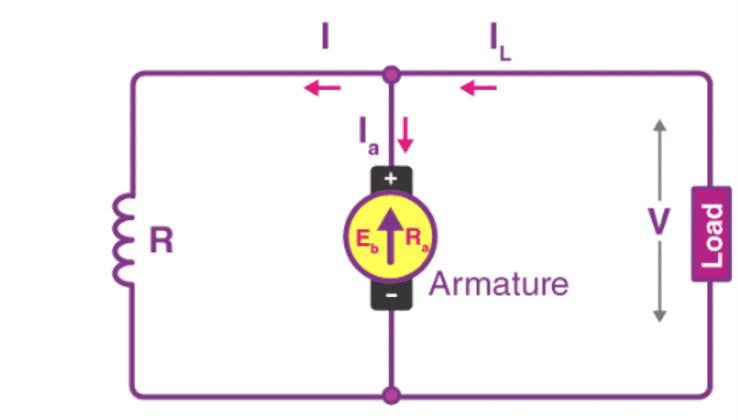
What configuration is this
Shunt
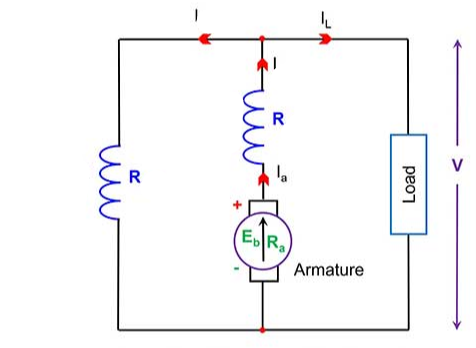
What configuration is this?
Compound
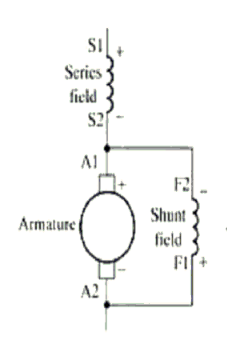
What configuration is this?
Differential Compound
Which of the following best describes the operating characteristic of a DC shunt motor?
It maintains a relatively constant speed from no-load to full-load because the field flux remains stable.
Which characteristic makes a DC series motor ideal for driving electric trains and heavy cranes, but dangerous to operate at no-load?
It produces exceptionally high starting torque, but at no-load, the flux becomes so weak that the speed can rise to destructive levels.
What is the primary operational advantage of a cumulative compound motor over a standard series motor?
It provides the high starting torque of a series motor but uses its shunt field to remain stable and safe at no-load.
What is the generator effect in a dc motor, and how does it influence the motor's operation as it accelerates?
it is the phenomenon where rotating armature conductors cut magnetic flux and induce a counter-electromotive force that opposes the supply voltage,
Which set of factors directly determines the magnitude of the counter-emf (Eo) induced in a dc motor?
The number of armature conductors (Z), the speed of rotation (n), and the magnetic flux per pole (Φ).
What determines the polarity of the counter-emf in a dc motor?
It is determined by the direction of rotation and the field polarity, and it always acts to oppose the supply voltage.
Why is the counter-emf (Eo) of a dc motor always slightly lower than the applied armature voltage (Es), even when the motor is running at no-load?
Because a net voltage is required to drive the armature current necessary to produce the torque needed to overcome mechanical drag and friction.
Which of the following correctly identifies the two primary methods for controlling the speed of a DC motor and their respective relationships to the speed of rotation (n)?
Armature speed control and Field speed control; speed is directly proportional to armature voltage and inversely proportional to field flux.
Why does the armature current of a shunt motor decrease progressively as the machine accelerates from a standstill to its maximum speed?
Because the rising speed increases the counter-electromotive force (cemf), which reduces the net voltage available to drive current through the armature.
Why is a starting resistor needed to bring a motor up to speed?
To limit the initial armature current, which can be 20 to 30 times higher than the rated current because the counter-emf is zero when the motor is at rest.
Show one way to reverse the direction of rotation of a compound motor.
Reverse the connections of the armature OR reverse the connections of both the shunt and series fields simultaneously.
What type of voltage is inherently generated within the armature coils of a DC generator?
Alternating current voltage.
Which component acts as a mechanical reversing switch to rectify the AC in the coils to DC at the brushes?
The commutator.
What is the primary physical difference in construction between an AC and a DC generator?
AC generators use slip rings, while DC generators use a commutator.
How do modern DC generators achieve a smooth output voltage with very little ripple?
By using a large number of coils and commutator segments.
The brushes are positioned to short-circuit coils at the moment their induced voltage.
Momentarily zero.
What is a "neutral zone" on the surface of a DC machine armature?
An area where the magnetic flux density is zero.
Value of the Induced Voltage According to the equation Eo=ZnΦ/60, if you double the speed (n) and keep the flux (Φ) constant, the induced voltage (Eo) will:
Double.
When a generator delivers current to a load, the armature conductors experience a force that produces a torque.
Opposite to the direction of rotation.
How does "armature reaction" affect the magnetic field produced by the main poles?
It distorts and weakens the main field flux.
Shifting the Brushes In a DC generator, where should the brushes be shifted to reduce sparking caused by armature reaction?
In the direction of rotation.
What is the primary function of commutating poles placed between the main poles?
To neutralize the armature mmf in the brush zone and prevent sparking.
In a separately excited generator, the field current is supplied by:
An independent DC source like a battery or another generator
The "knee" of a saturation curve indicates the point where:
The iron in the machine begins to saturate.
How does a shunt generator start to build up voltage without an external power source?
By using remanent magnetism in the poles to induce a small initial voltage.
In the equivalent circuit of a DC generator, the internal resistance (Ro) includes the resistance of the armature winding and:
The resistance of the commutating poles.
Why does the terminal voltage of a separately excited generator decrease as the load current increases?
Because of the internal armature resistance (Ro) drop and pole-tip saturation.
Why does the terminal voltage of a shunt generator drop more sharply under load than a separately excited generator?
Because the falling terminal voltage also causes the exciting current to drop.
A compound generator uses a series field in addition to a shunt field to:
Prevent the terminal voltage from dropping as the load increases.
In a differential compound generator, the series field mmf:
Acts opposite to the shunt field mmf, causing a drastic voltage drop.
Which type of generator is designed so that its terminal voltage increases as the load current rises?
Over-compound generator.
The frame of a DC machine is usually made of solid cast steel, while the pole pieces are made of:
Stacked iron laminations.
Armature cores are made of stacked, insulated iron laminations primarily to:
Reduce eddy-current losses.
What is the primary reason carbon is used as the material for brushes?
It has good conductivity and its softness prevents scoring the commutator.
A 12-pole lap-wound generator will generally have:
12 brush sets.
In the ideal commutation process, current reversal in a coil is forced by:
The contact resistance between the brush and the commutator.
What is the main obstacle to perfect, sparkless commutation in practical machines?
The self-inductance of the armature coils.
What is "residual magnetism"?
The small amount of flux remaining in the poles after the current is removed.
At the "zero points" (neutral zones), do the brushes induce a voltage in the short-circuited coils?
No; they are stationary contacts that pick up the voltage induced in the coils.
How does a commutator "rectify" voltage?
By switching brush contacts to ensure the polarity at the terminals is constant.
In a DC motor, what is the role of the counter-emf (Eo)?
It acts against the source voltage, effectively limiting the armature current as speed increases
Why does the armature current of a DC motor decrease progressively as it accelerates from a standstill?
The rising speed increases the counter-emf, which reduces the net voltage available to drive current.
The electrical power that is successfully converted into mechanical power in a DC motor is equal to:
The product of the counter-emf and the armature current
When using field control to increase a motor’s speed above its base speed, what is the primary risk of a "field failure"?
The motor may reach dangerously high speeds (runaway) while attempting to induce its counter-emf
Why is a DC shunt motor considered a "constant-speed machine"?
Its field flux remains stable, leading to relatively constant speed from no-load to full-load
What happens to a series motor if it is operated at "no-load" (no mechanical resistance)?
The flux becomes so weak that the speed rises to destructive, dangerously high levels.
How can the speed of a series motor be increased while it is carrying a load?
By placing a diverter resistor in parallel with the series field to reduce the field current
In a manual face-plate starter, what is the purpose of the small electromagnet (4) that holds the contact arm?
To release the arm and stop the motor if the supply voltage is interrupted or field excitation is lost
In a dynamic braking circuit, what happens to the energy of the rotating armature?
It is dissipated as heat in an external braking resistor.
What is "armature reaction" in the context of a DC motor?
The magnetic field created by the armature current that distorts and weakens the main field flux
How does armature reaction affect the "neutral zone" of a DC motor?
It shifts the neutral zone against the direction of rotation
What is a major advantage of a Permanent Magnet (PM) motor compared to a wound-field shunt motor?
Higher efficiency and smaller size, as it requires no energy for field excitation