EECS 3461 - Week 8A: Expert Evaluation
 Call Kai
 Learn
Learn Practice Test
 Spaced Repetition
 Match
Match Flashcards
 Knowt Play
1/30

Earn XP
Description and Tags
Week 8A
Name | Mastery | Learn | Test | Matching | Spaced | Call with Kai |
|---|
No analytics yet
Send a link to your students to track their progress
31 Terms
What are the steps for the interaction design process (DraPE)?
Discovering Requirements
Designing Alternatives
Prototyping
Evaluating
What are the 3 Evaluation methods? (SUE)
Stand-Alone Critiques - designers evaluate their own work
Usability Tests - real users test the system
Expert Reviews - usability experts evaluate the system
What is the definition of Expert Evaluation?
An inspection method where usability experts evaluate a system using usability principles or heuristics
What are the benefits of Expert Evaluation?
Cost-effective
Independent
Early detection
Saving of time and money
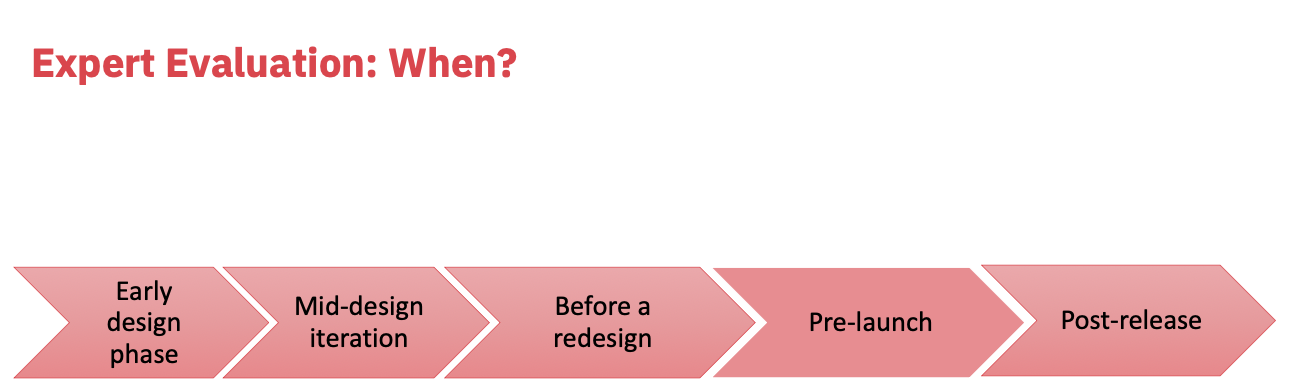
List the purpose of expert evaluation at each stage
To identify potential usability issues
To assess the effectiveness of the design changes
To identify areas for improvement
To conduct a final assessment
For future product updates
What are the two expert evaluation types?
Heuristics and Cognitive Walkthrough
When can a Heuristic Evaluation be done in the design process?
At any stage
Who developed the Heuristic Evaluation?
Jacob Nielson and Rolf Molich
What is the Heuristic Evaluation used and not used for?
Used for identifying usability problems in prototypes/designs
Not used for coming up with new design solutions
What are the disadvantages of Heuristic Evaluation?
It may reinforce existing design assumptions and it is not always consistent between evaluators
What are the steps in Heuristic Evaluation?
Select 3–5 evaluators, brief them with context and process, independent evaluation, consolidation
Which step in the heuristic evaluation produces a list of justified, rated problems and involves going through the interface at least twice?
Independent Evaluation
Which step in the heuristic evaluation sets the scene for the evaluation by explaining the target users, what users are expected to know, the context, and what tasks are most interested?
Briefing session
What are the Heuristic Evaluation (Interface-Based) Steps? (Hint: SIR)
Select a set of principles or guidelines, inspect design against each principle, and record where design violates each principle
What are the 10 of Neilsen’s Heuristics?
Visibility of system status
Match Between the System and the Real World
User Control and Freedom
Consistency and Standards
Error Prevention
Recognition Rather than Recall
Flexibility and Efficiency of Use
Aesthetic and Minimalist Design
Help Users Recognize, Diagnose, and Recover from Errors
Help and Documentation
Which of the 10 of Neilsen’s heuristics explains that the system should always keep users informed about what’s going on through appropriate feedback?
Visibility of system status
Which of the 10 of Neilsen’s heuristics explains that the system should speak the users’ language, with words, phrases, and concepts familiar to the user?
Match between the system and the real world
Which of the 10 of Neilsen’s heuristics explains that error messages should be expressed in plain language (no codes), precisely indicating the problem, while suggesting a solution?
Help users recognize, diagnose, and recover from error
Which of the 10 of Neilsen’s heuristics suggests making objects, actions, and options visible, while explaining that the user should not have to remember information from one part of the dialogue to another?
Recognition rather than recall
Which of the 10 of Neilsen’s heuristics explains that the system should allow users to tailer frequent actions with alternative interaction styles such as function keys?
Flexibility and efficiency of use
What is a Cognitive Walkthrough?
An evaluation where experts step through a prototype simulating user problem-solving at each step
What is a Cognitive Walkthrough used and not used for?
Used for assessing ease of learning for new users by identifying detailed problems; not used for evaluating performance of highly skilled or frequently performed tasks
At what phase can a Cognitive Walkthrough be done, and what is the evaluation group?
It can be done at any phase after detailed UI specifications exist, and the evaluation group is usually design or development team members acting as evaluators
What are the four roles in a Cognitive Walkthrough? (FPUS)
Facilitator
Presenter
User
Scribe
What are the components in a Cognitive Walkthrough? (PETSQ)
Prototype, Evaluators (Users), Tasks, Scenario, Questions
What are the Scenario Components for CW/Usability Testing? (GOATS)
Goal, Outcomes, Actions, Tasks
What are the steps for Cognitive Walkthrough (Interaction-Based)? (Hint: De CAR)
Define a task, Convert task into a process, Ask a set of questions per step, Record issues found
Between Heuristic Evaluation and Cognitive Walkthrough, which of the two is provides a flexible and informal assessment?
Heuristic Evaluation
Between Heuristic Evaluation and Cognitive Walkthrough, which is best suited for interaction design?
Cognitive Walkthrough
What is the aim of a Heuristic Evaluation and Cognitive Walkthrough?
The aim for a HE is to see whether the system interface design meets a set of principles, while the aim for a CW is to determine whether a new user can carry out specified tasks