Identification of unexpected antibodies
 Call Kai
 Learn
Learn Practice Test
 Spaced Repetition
 Match
Match Flashcards
 Knowt Play
1/13

There's no tags or description
Looks like no tags are added yet.
Name | Mastery | Learn | Test | Matching | Spaced | Call with Kai |
|---|
No analytics yet
Send a link to your students to track their progress
14 Terms
State the purpose and method of the autocontrol when performing an antibody screen
Mix pateint’s serum and RBCs together to test for autoagglutination
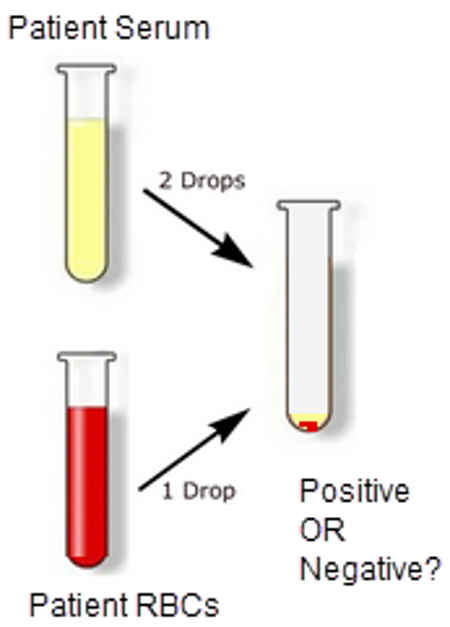
When your autocontrol is positive what is the next step?
To perform a DAT to determine if autoantibody or alloantibody is present
Differentiate alloantibodies and autoantibodies based on autocontrol and DAT test results
An autoantibody may be present if the autocontrol and DAT is positive.
An alloantibody will not cause positive autocontrol. Panreactivity with all cells (except autocontrol may suggest alloantibody to a high-frequency antigen)
Describe the impact of dosage on antibody identification
Dosage is when an antibodies react differently with cells that have homozygous versus heterozygous antigen expression
Weaker reaction- heterozygous cells
Stronger reaction- homozygous cells
Describe the purpose of the p-value
The p value helps determine the likelihood that the correct antibody has been identified using an antibody panel
p-value should be less than ___?
0.05
What is the p-Value formula?

Anti-Fya identified:
4 positive cells
6 negative cells
10 total cells
Calculate the p-Value
4! X 6! 24 x 720
-------- = ---------------- = 0.0048
10! 3,628,800
How are enzyme treated cells used in antibody identification?
Cell panels that come pre-treated with ficin or papain
Adds evidence/clarifies reaction patterns, especially in patients with multiple Ab’s
What is neutralization and how is it used in antibody identification?
Neutralization: Inactivation of antibody by combining it with soluble form of corresponding antigen
Helps uncover underlying antibodies by uncovering the neutralized one was ‘hiding’
What is Elution and how is it used in antibody identification?
Elution: Chemically frees antibodies bound to red blood cells while maintaining structure
Uses:
Helps ID antibody(ies) from Positive DAT
Concentrate antibody to help identify weakly reactive antibodies/antigens
Prepare DAT negative cells for more tests
Combine with adsorption to remove one antibody when multiple are present
Can be used to detect a weakly reactive antigen, such as an ABO subgroup
What is Adsorption, and how is it used in antibody identification?
Adsorption- To remove antibodies from plasma
What is Titration and how is it used in antibody identification?
Titration: Measure the strength (concentration) of antibody
Used in determining antibody activity and potential severity of HDFN in alloimmunized pregnant women
State the four most likely causes of all or most cells reacting in an antibody identification procedure
Potential Causes:
Multiple antibodies
Antibodies to high-incidence antigens
Warm autoantibodies
Cold agglutinins