Chem001A - Unit 6: Reactions and Stoichiometry
 Call Kai
 Learn
Learn Practice Test
 Spaced Repetition
 Match
Match Flashcards
 Knowt Play
1/56

There's no tags or description
Looks like no tags are added yet.
Name | Mastery | Learn | Test | Matching | Spaced | Call with Kai |
|---|
No analytics yet
Send a link to your students to track their progress
57 Terms
A _ is a process in which one or more substances called reactant(s) are converted into one or more different substances called product(s)
Chemical reaction
Chemical reactions are represented using _ which provide a symbolic representation of a chemical reaction using molecular formulas and formulae
Chemical reaction equations

How to Write Chemical Reaction Equations
Reactants (the substances undergoing reaction) are placed on the left side of the equation
Products (the substances generated by the reaction) are placed on the right side of the equation
Plus signs are used to separate the chemical formulas for individual reactants and products
An arrow is used to separate the reactant and product sides of the equation
The physical state of each reactant and product is indicated by a letter in
parentheses following the chemical formula:
Solid: s
Gas: g
Liquid: l
Dissolved in Water: aq
To provide an accurate quantitative description of our chemical reaction equations we use _
Stoichiometric coefficients
_ are coefficients placed in front of the chemical formula for each reactant and product. They indicate the relative numbers of reactant and product molecules involved in the chemical reaction. A coefficient of ’1’ is assumed if no stoichiometric coefficient is present. By convention we use the smallest whole-number coefficients in a chemical reaction equation
Stoichiometric coefficients
A chemical reaction equation is _ if there are equal numbers of each atom type on the reactant and product side
Balanced
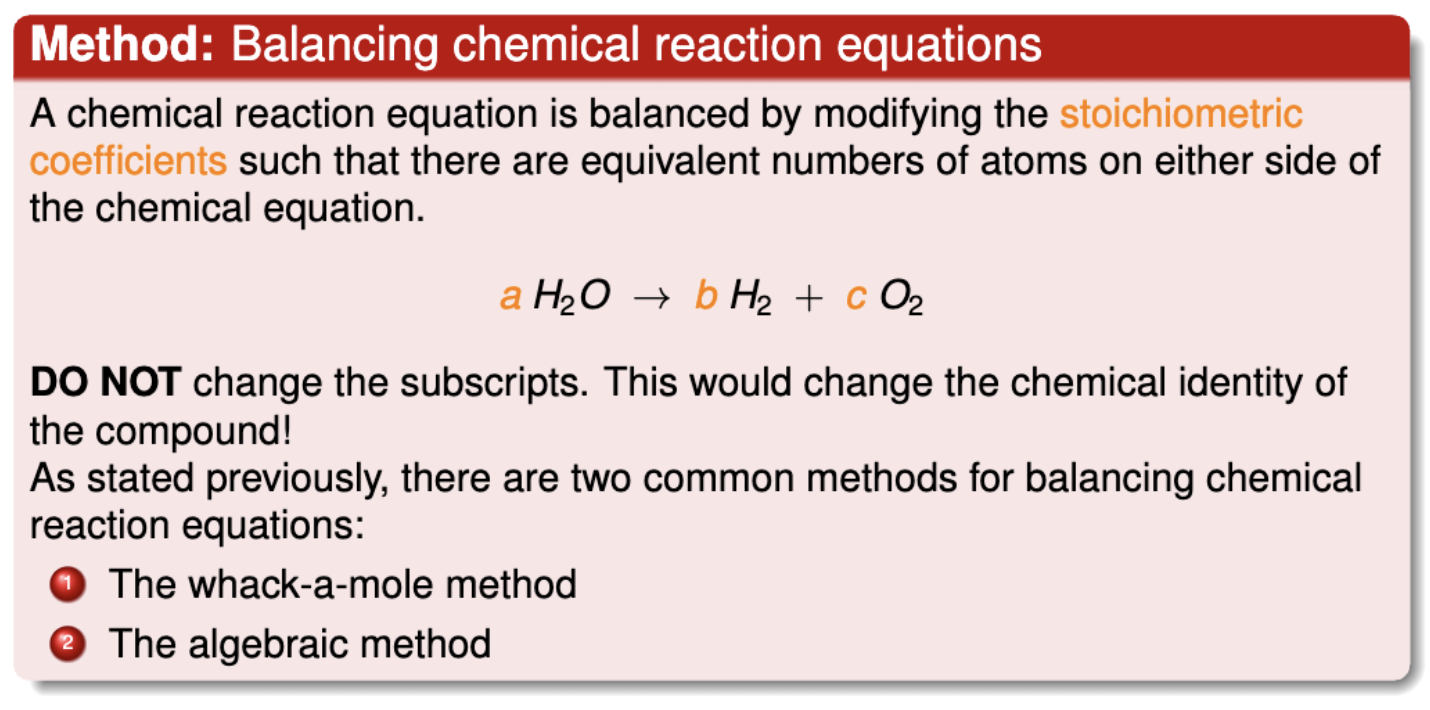
Methods for Balancing Chemical Reactions
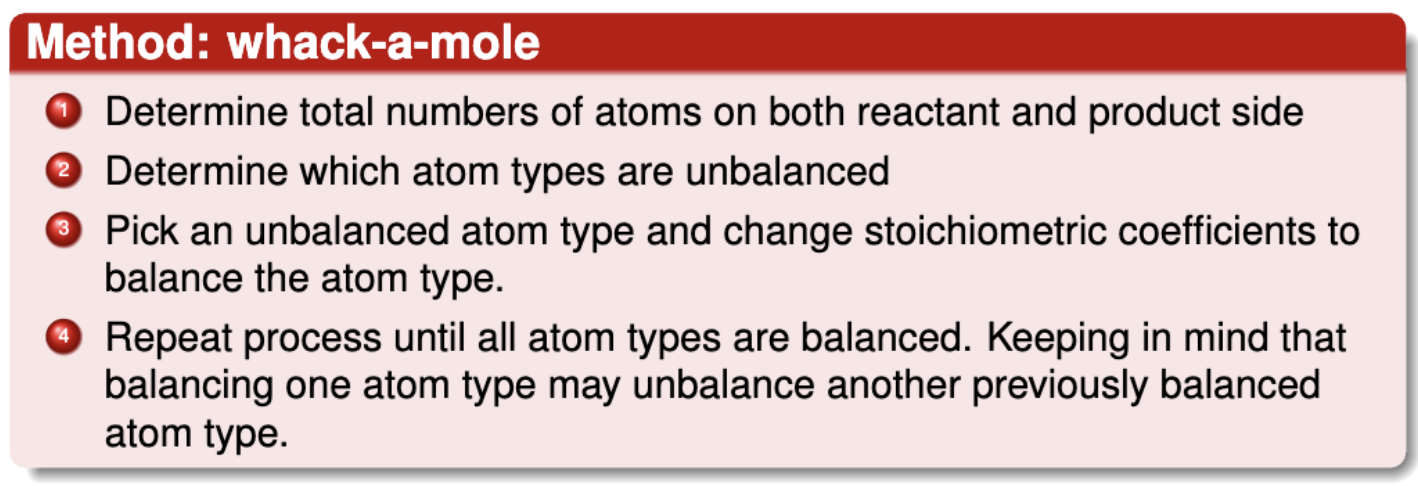
The whack-a-mole method
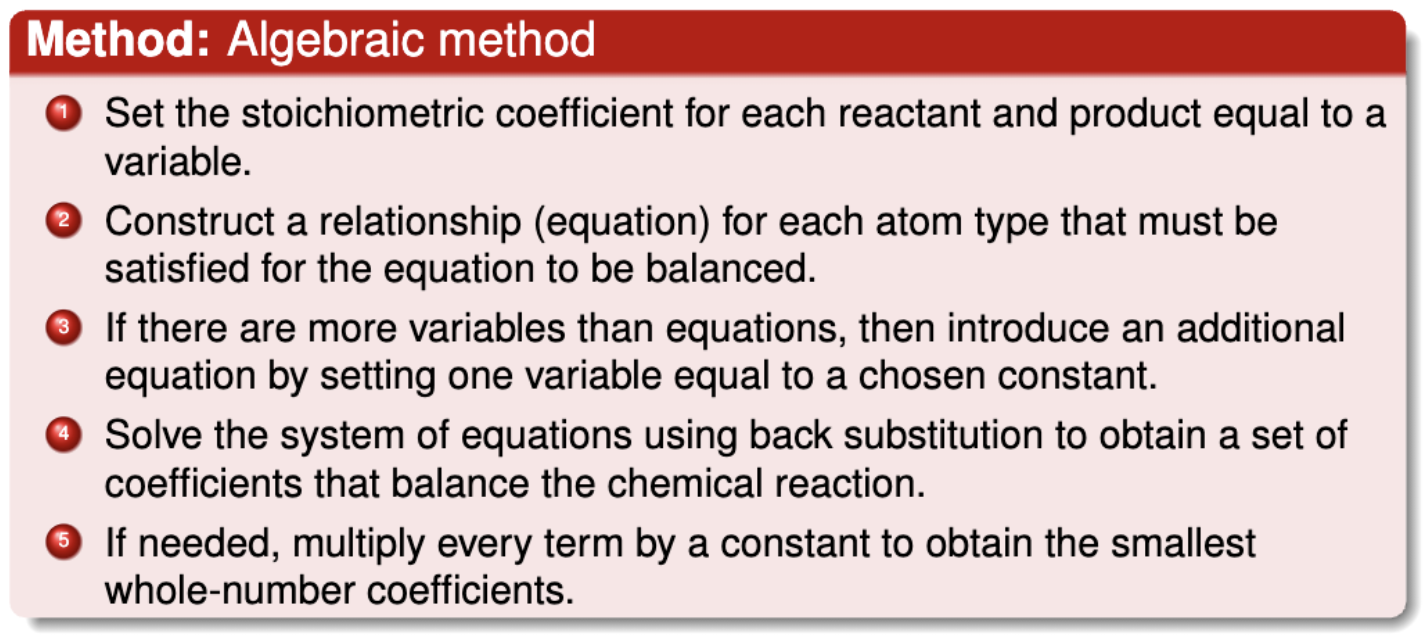
The algebraic method
_ are chemical reactions in which dissolved substances react to form one or more solid products
Precipitation reactions

_ are chemical reactions in which a gaseous product is formed that bubbles out of solution
Gas-evolving reactions

_ are chemical reactions in which a hydrogen ion (H+) is transferred from one chemical species to another
Acid-base reactions

_ are chemical reactions in which electrons are transferred from one reactant to another
Oxidation-reduction (redox) reactions

_ are chemical reactions in which a substance reacts with oxygen gas (O2) to form one or more oxygen-containing compounds, often including water (H2O)
Combustion reactions

The _ states that mass in a an isolated system is neither created nor destroyed by chemical or physical transformations
Law of conservation of mass
More on Balancing Chemical Reaction Equations
The Whack-a-mole Method for Balancing Chemical Reaction Equations
The Algebraic Method for Balancing Chemical Reaction Equations
The solid product of precipitation reactions are called _
Precipitate
Examples of Precipitation Reactions
Coral reef formation
Kidney stone formation
Certain types of double “displacement reactions”
_ are reactions involving the exchange of ions between ionic compounds in aqueous solution
AB + CD → AD + CB
Double displacement reactions
Examples of Double Displacement Reaction
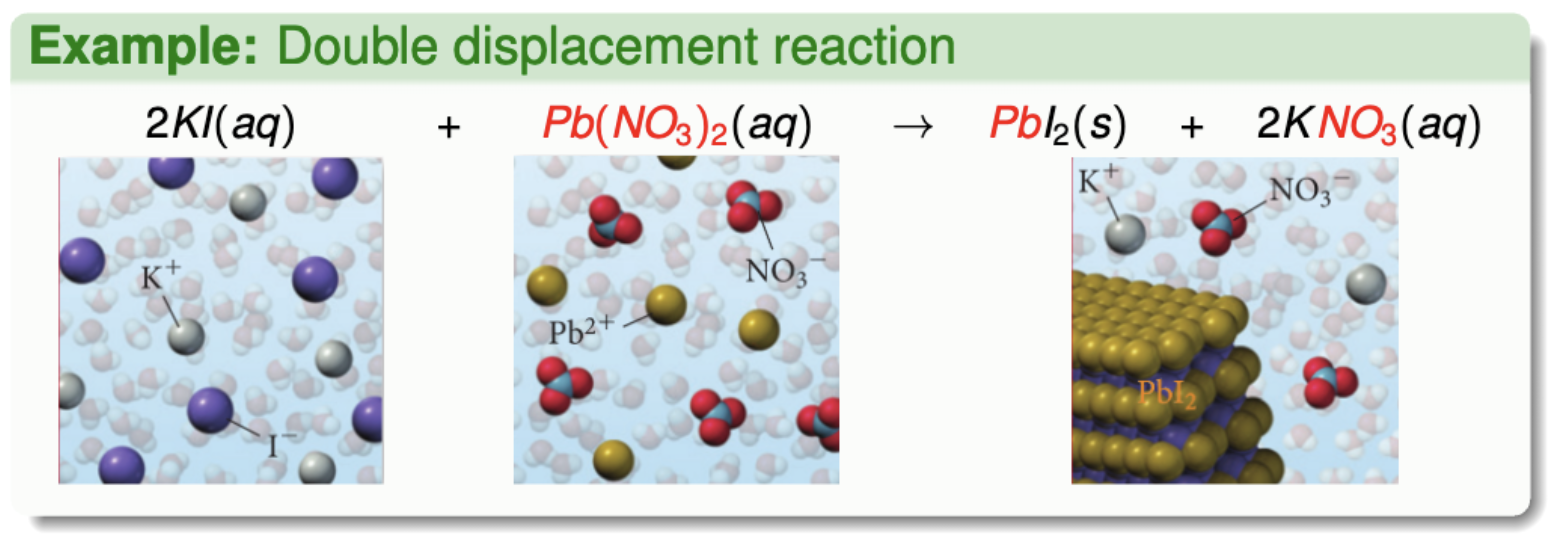
_ provides a quantitative description of the extent to which a substance will dissolve in a solvent. For our purposes the solvent will be water
Solubility
Substances with relatively low solubilities are said to be _
Insoluble
Substances with relatively large solubilities are said to be _
Soluble
When the concentration of a solute in solution exceeds its solubility the substance will _
Precipitate
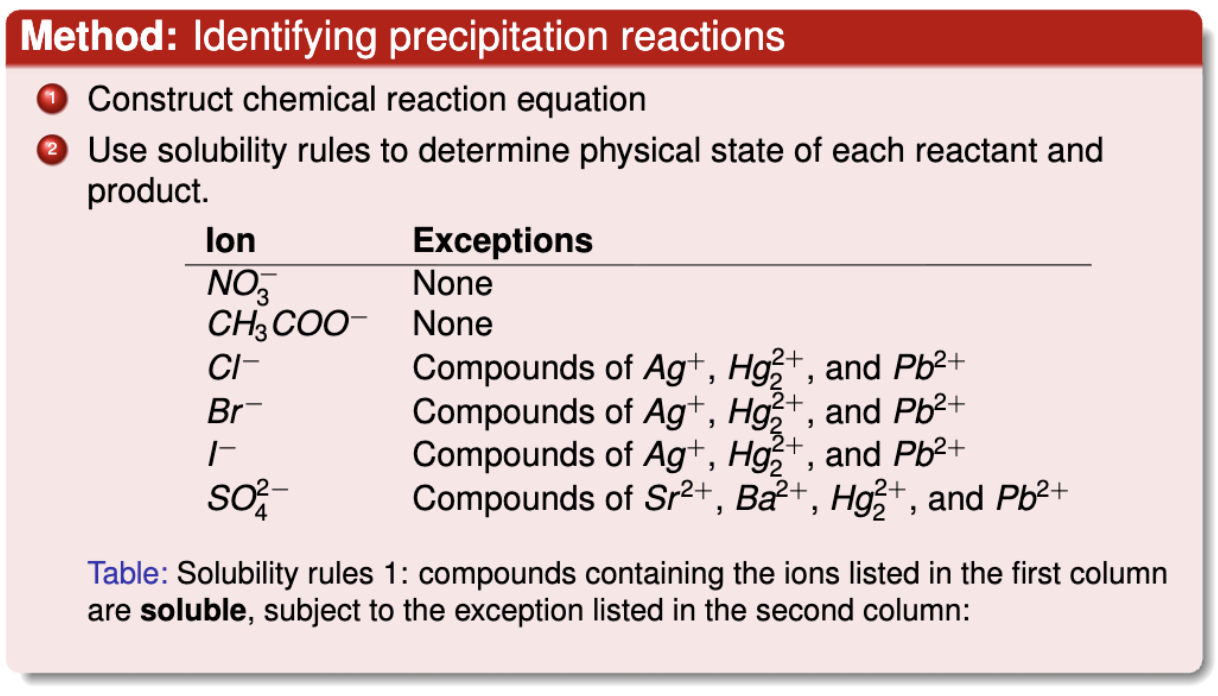
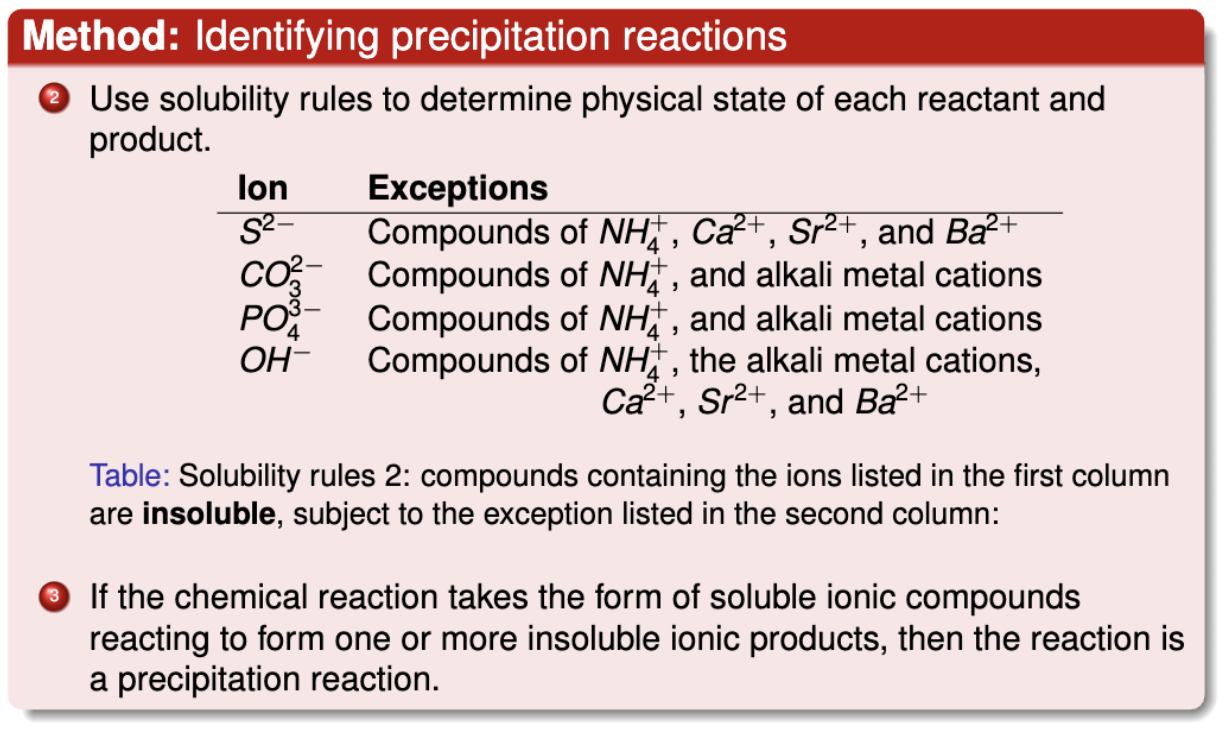
How to Identify Precipitation Reactions
The _ provides the complete neutral formulas for each compound in the reaction as if they existed as molecules
Molecular equation

In actual solutions of soluble ionic compounds, dissolved substances are present as _
Ions
_ list all of the ions present as they are found in
solution
Complete ionic equations

Ions that appear unchanged on both sides of the equation are called _
Spectator ions

_ only show the species that actually change during the reaction
Net ionic equations

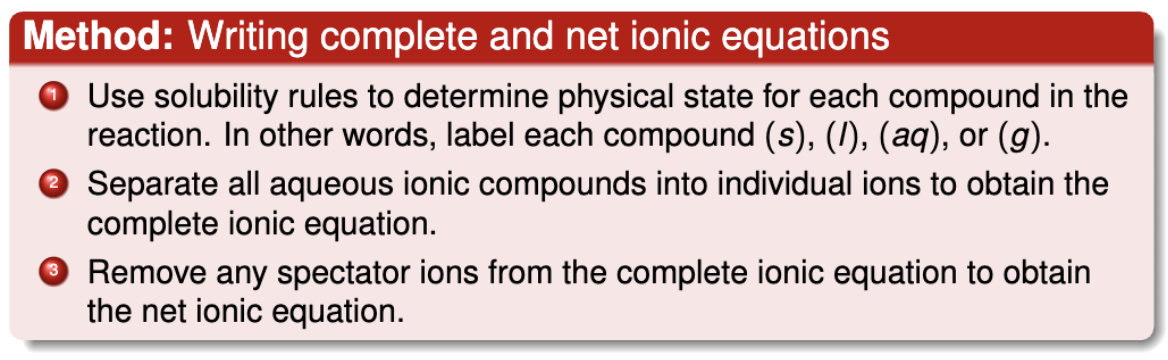
How to Write Complete and Net Ionic Equations
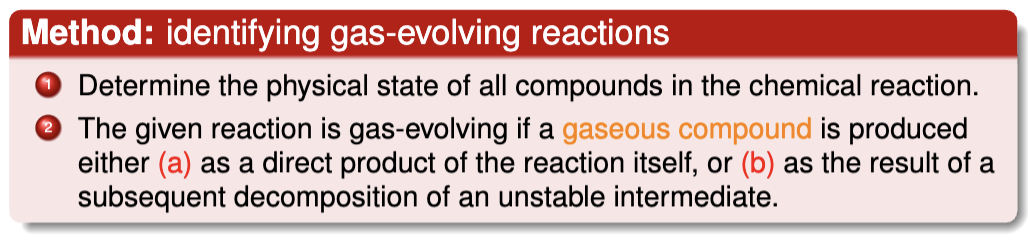
A _ is a type of chemical reaction that results in the formation of a gaseous product that bubbles out of solution
Gas-evolution reaction
A _ is a type of chemical reaction in which one reactant yields two or more products. The general form is:
AB → A + B
Decomposition reaction
How to Identify Gas-Evolving Reactions
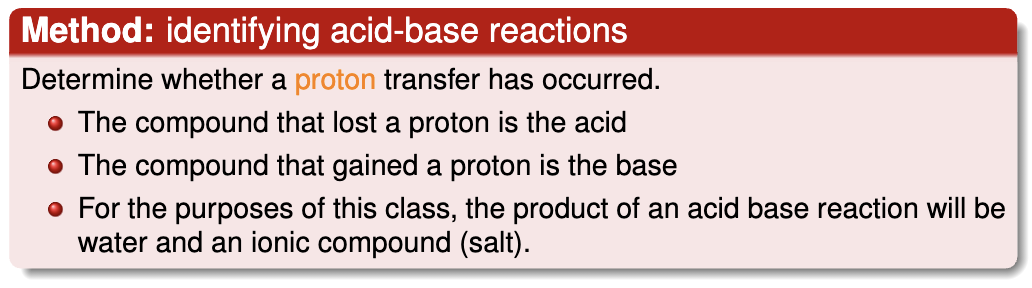
An _ is one in which a hydrogen ion (H+) is transferred from one chemical species to another
Acid-base reaction
An _ is a substance that produces H+ (or H3O+) ions in solution
Acid
A _ is a substance that produces OH− ions in aqueous solution
Base
A _ occurs when an acid is added to a base (or vice versa). In a neutralization reaction the H+ produced by the acid reacts with the OH− produced by the base to form H2O
Neutralization reaction

How to Identify Acid-Base Reactions
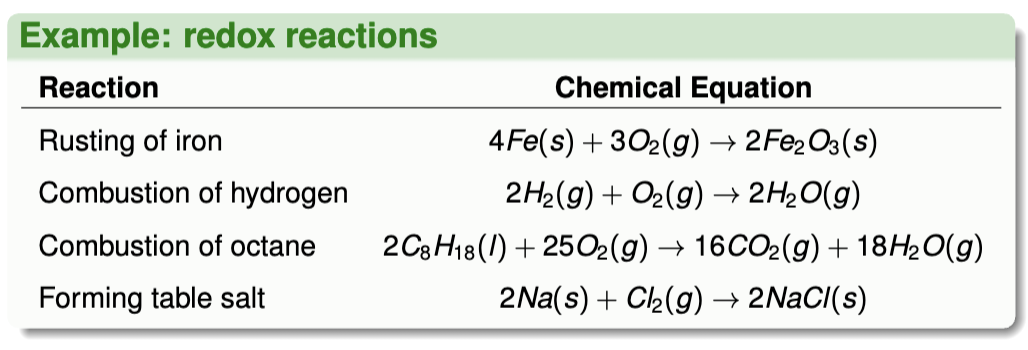
_ are reactions in which electrons transfer from one reactant to the other
Oxidation-reduction reactions
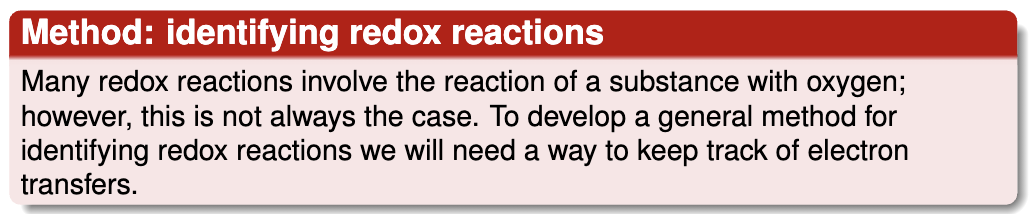
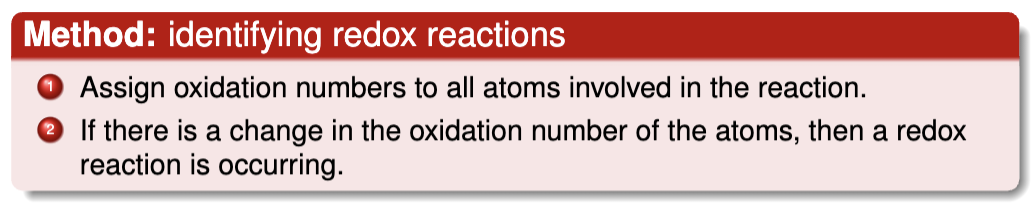
How to Identify Redox Reactions
The _ of an atom is the “charge” the atom would take if all shared electrons in a compound were assigned to the atom with the greatest attraction for those electrons
Oxidation number or state
How to Denote Oxidation State

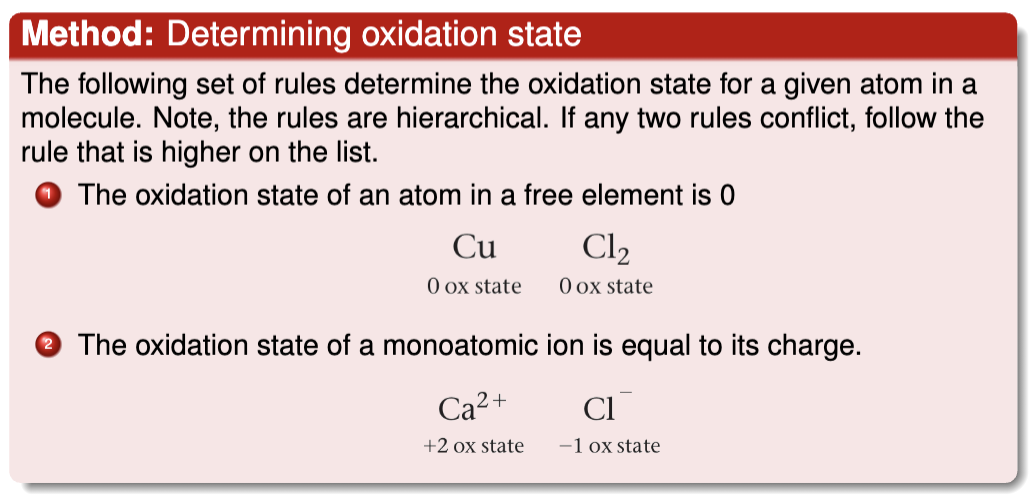
How to Determine Oxidation State
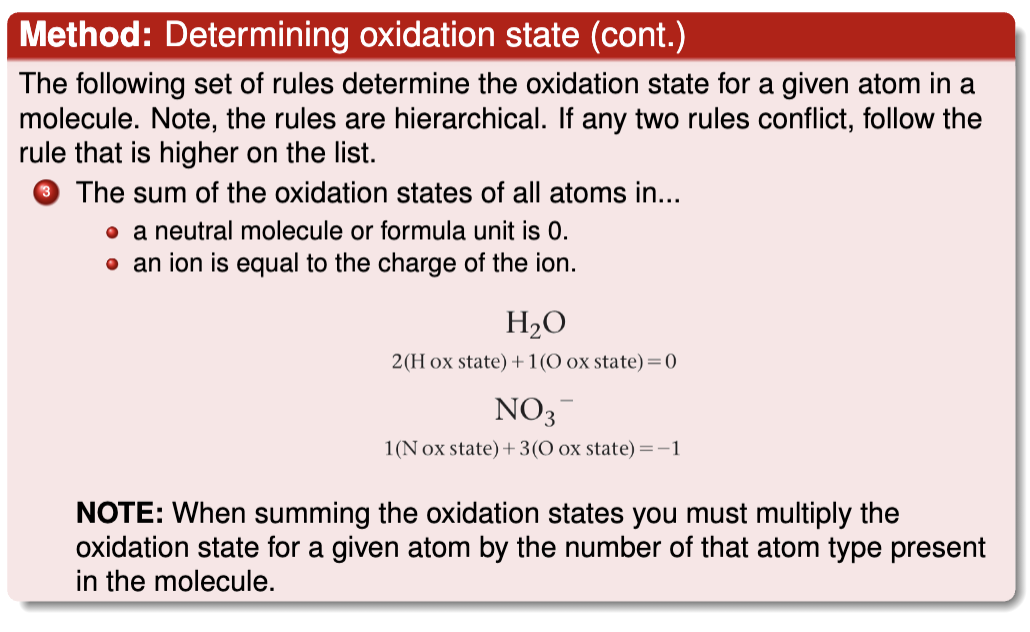
How to Determine Oxidation State (Cont.)
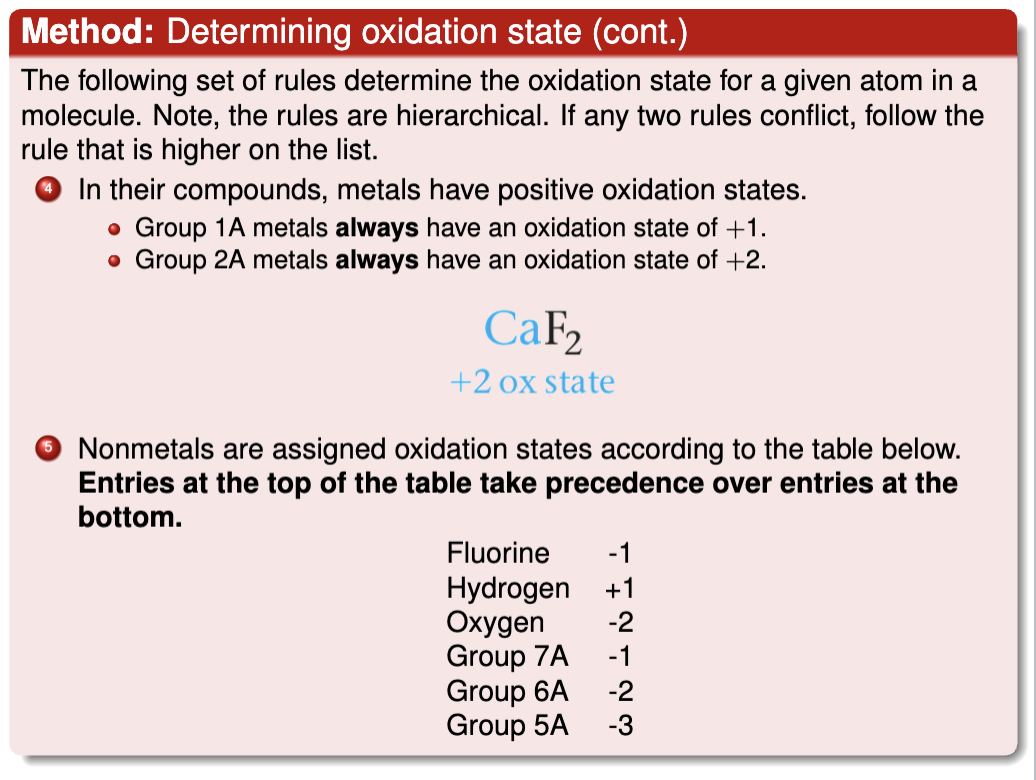
How to Identify Redox Reactions
An atom is said to be _ (or to have undergone oxidation) if there is an increase in oxidation number. If the oxidation number increased, then the atom lost electrons
Oxidized
An atom is said to be _ (or to have undergone reduction) if there is a decrease in oxidation number. If the oxidation number decreased, then the atom gained electrons
Reduced
A substance that causes the oxidation of another substance is an _. The agent is always reduced
Oxidizing agent
A substance that causes the reduction of another substance is a _. The agent is always oxidized
Reducing agent
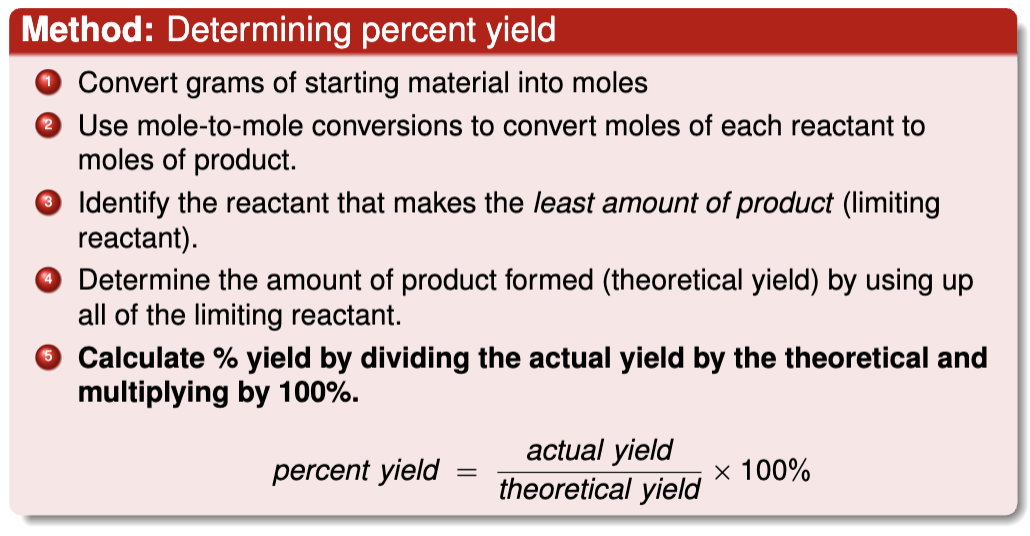
The _ is the reactant that is available in the smallest stoichiometric quantity. The limiting reactant will be completely consumed in the reaction, and it limits the amount of product that can be made
Limiting reactant
Any reactant that does not limit the amount of product is called an _
Excess reactant
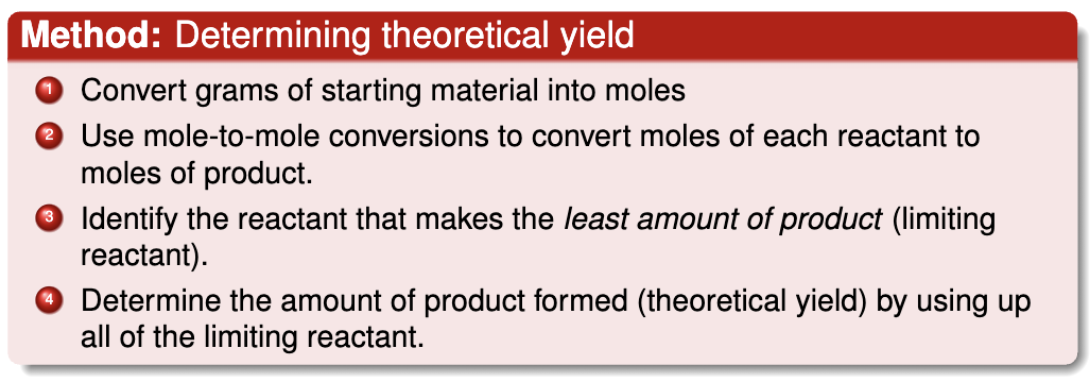
The amount of product that can be made by completely using up the limiting reactant is the _
Theoretical yield
How to Determine Theoretical Yield
The _ is the amount of product actually produced by a chemical reaction
Actual yield
The _ is the ratio of the actual yield over the theoretical yield multiplied by 100%
Percent yield = actual yield/theoretical yield x 100% (.100)
How to Determine Percent Yield