3.8 Non-homogenous Differential Equations
 Call Kai
 Learn
Learn Practice Test
 Spaced Repetition
 Match
Match Flashcards
 Knowt Play
1/3

There's no tags or description
Looks like no tags are added yet.
Name | Mastery | Learn | Test | Matching | Spaced | Call with Kai |
|---|
No analytics yet
Send a link to your students to track their progress
4 Terms
Second-Order, Linear, Non-homogenous Differential Equation Form
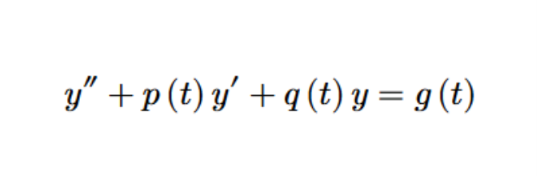
The non-homogenous aspect comes from the fact that there is now a forcing function in the form of g(t); with homogenous equations, however, we only ever have 0 on the right-hand side.
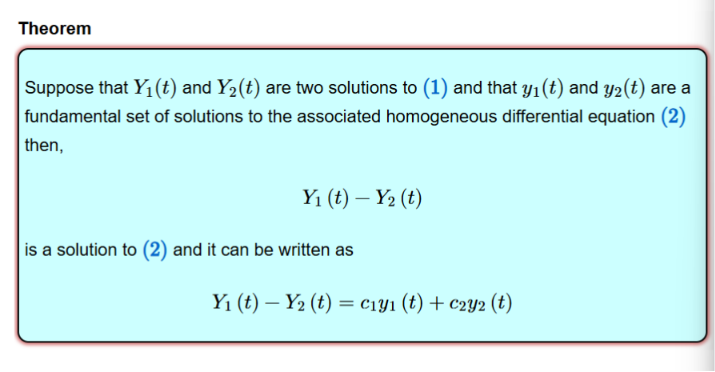
Fundamental Theorem for Non-Homogenous Equations
If Y1(t) and Y2(t) are solutions to the non-homogenous form of a differential equation and y1(t) and y2(t) are the solutions to the homogenous form of the differential equation, then we have:
Y1(t) - Y2(t) = c1y1(t) + c1y2(t)
General Solution to a Non-Homogenous Equation
The solutions to Non-homogenous Equations will always be written in the form of:
y(t) = yc(t) = YP(t)
yc(t) — the complementary solution that acts as the solution to the homogenous form of the differential equation
YP(t) — the particular solution that acts as the solution to the non-homogenous differential equation.
The final (general) solution is the linear combination of the two solutions themselves.
filler
filler