Chromatograph
 Call Kai
 Learn
Learn Practice Test
 Spaced Repetition
 Match
Match Flashcards
 Knowt Play
1/23

There's no tags or description
Looks like no tags are added yet.
Name | Mastery | Learn | Test | Matching | Spaced | Call with Kai |
|---|
No analytics yet
Send a link to your students to track their progress
24 Terms
Types of chromatography
TLC, Flash Chromatography
Size-exclusion chromatography
Reverse-phase chromatography (RP)
Ion-exchange chromatography
Gas chromatography
Thin layer chromatography (TLC)
Typical stationary phase: SiO2, Al2O3
Typical TLC plate backing support: glass, aluminium,
plastic
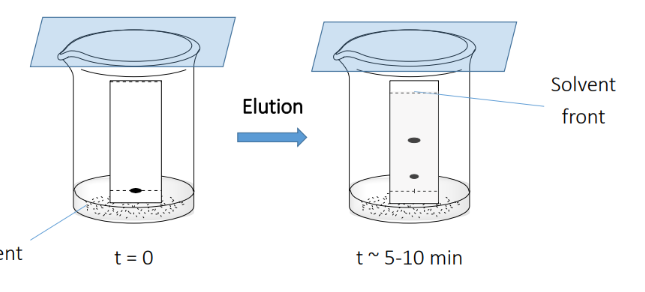
Detection of TLC
Staining
KMnO4
Cerium ammonium nitrate
Iodine
Functional-group specific stains
Ninhydrin (for primary and secondary amines)
Dinitrophenylhydrazine (DNP, for aldehydes and ketones)
UV
Mechanism for chromatograph
A mobile carrier phase flows over a supported stationary phase.
Solute molecules moves back and forth between the stationary and mobile phases, and their presence in the stationary phase decreases the rate at which they are carried by the mobile phase.
SiO2 chromatography
Phase interactions: H bond. dipole-dipole and London forces
Polar compounds interact more strongly with stationary phase (move more slowly)
Comparing TLC with column chromatography
The product that runs the faster in TLC will be the products that is eluted first from the column.
TLC advantages
Quick
Simple
Low tech
Very little training needed
Non-expensive
TLC disadvantages
Chemical nature of compounds must be confirmed with other techniques
Usually qualitative
Flash chromatography
Uses compressed gas – e.g. N2 or air - to push solvent through the column
Allows for faster flow rates of the solvent, as opposed to simple gravity flow.
Uses a finer particle size for the stationary phase e.g. silica gel (60 Å)
High-Performance Liquid Chromatography (HPLC)
Can be seen as a highly improved form of column chromatography.
Solvent is forced through under high pressures of up to 400 atm.
Detection
Detection include: UV-vis, fluorescence, MS, refractive index, evaporative light scattering
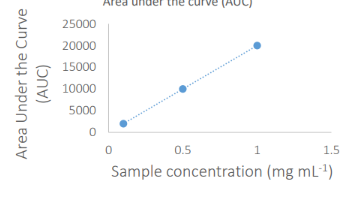
The area under the peak is proportional to the amount of product which has passed the detector, and this area can be calculated automatically by the computer linked to the display
Retention time
measure of the time taken for a solute to pass through a chromatography column. It is calculated as the time from injection to detection
Total retention volume
volume of mobile phase entering the column between sample injection and the emergence of the peak maximum of the sample component of interest, or the corresponding time.
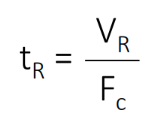
Retention time (tR) vs. Total retention volume (VR)
where Fc is the mobile phase flow rate
Theoretical plates (N)
The number of theoretical plates (N) of a column gives an indication of how efficiently it can separate a mixture of products into its individual components.
Number of theoretical plates
This efficiency is based on the retention time of the components and the width of the peaks
tR (retention time) is measured from the injection peak (or zero) to the intersection of the tangents.
wb (width of the base of the triangle) is measured at the intersection of the tangents with the baseline.

Part 2) N
For a given retention time, tR the column that produces peaks with narrower bases, wb, will be more efficient – have a greater N value.
Conversely, a column that produces wider peaks will be less efficient – have a smaller N value.
This is because a smaller denominator, wb, will yield a larger overall number and a larger denominator will yield a smaller number
Size exclusion chromatography (SEC)
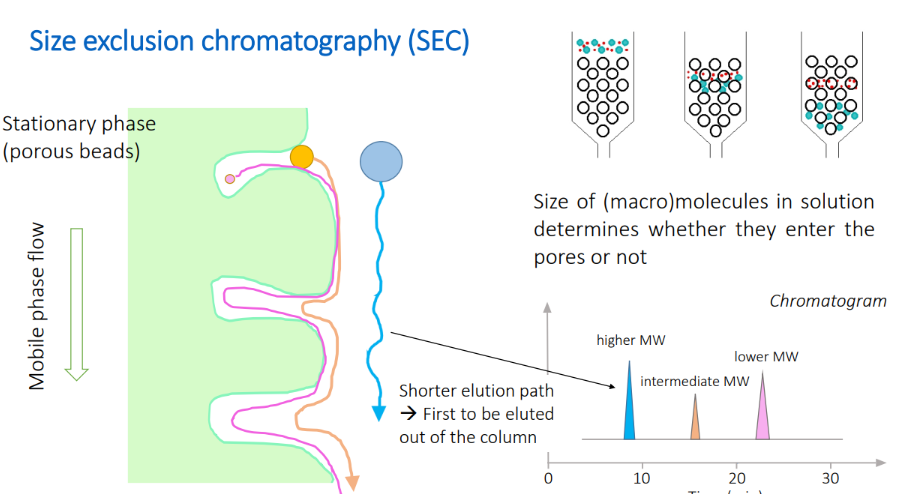
Separation of different compounds occurs according to their size in solution (hydrodynamic volume*). Typically used for analysis or purification of macromolecules,
e.g. proteins and other (co)polymers
SEC
Stationary phase (porous beads)
Size of (macro)molecules in solution determines whether they enter the pores or not
Shorter elution path→ First to be eluted out of the column
Reversed-Phase chromatography
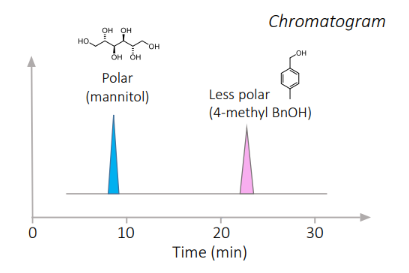
Stationary phase incorporates hydrophobic groups instead of the polar ones (e.g. Si-OH in silica) used in normal phase chromatography.
Reversed-phase chromatography the stationary phase is nonpolar (e.g. C18) and the mobile phase is polar.
RP
Key information: separation of molecules based on hydrophobicity. Hydrophobic compounds tend to interact more strongly with the stationary phase than polar ones.
NOTE: this elution trend of polar first, non-polar later is exactly opposite from that observed in normal phase chromatography (where it is non-polar first and polar later)
Ion-exchange chromatography
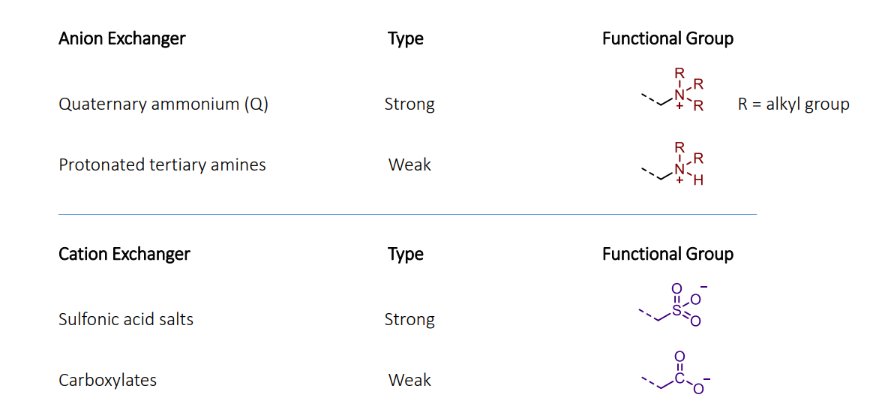
Separates compounds based on their overall charge → limited to purification of ionisable molecules
Different types of molecules will bind to a charged stationary phase with affinities that depend on both the conditions used and the types and number of individual charged groups.
• Anion Exchange
• Cation Exchange
Type of Ion exchangers
n/a
Gas chromatography
Used to isolate volatile components of a mixture depending on differences in the mode of partitioning between a flowing mobile phase and a stationary phase.
Injection: analytes are vaporized, ideally without decomposition
Mobile phase: Inert gas carrier (typically He, N2, Ar).
Stationary phase: can be
i. a solid adsorbent (gas–solid chromatography, GSC), or
ii. a liquid on an inert support, e.g. silicone-based oils (gas–liquid chromatography, GLC)
Detectors: common detectors include flame ionization detector (FID), thermal conductivity detector (TCD), and mass
spectrometer