CBNS 106 Lecture 3 Neuronal Membrane
 Call Kai
 Learn
Learn Practice Test
 Spaced Repetition
 Match
Match Flashcards
 Knowt Play
1/7

There's no tags or description
Looks like no tags are added yet.
Name | Mastery | Learn | Test | Matching | Spaced | Call with Kai |
|---|
No analytics yet
Send a link to your students to track their progress
8 Terms
Membrane Potential
Overall
Membrane potential (Vm) = difference in electrical charge across the neuronal membrane
Measured in millivolts (mV)
Resting membrane potential ≈ -65 mV (inside negative)
💡 Why it matters:
This electrical gradient is required for action potentials and signaling
Requirements for Resting Membrane Potential
Charge separation
Membrane separates ions → creates voltage
Selective permeability
Ion channels allow specific ions through
Concentration gradients
Created + maintained by ion pumps
**Electrical vs Concentration gradient
a) driven by diff forces
b) At rest (-65mV) they are competing
Resting membrane potential is created because K⁺ freely leaks out down its concentration gradient, leaving behind negative charges inside the cell, which then pull K⁺ back in via the electrical gradient; at rest these opposing forces are nearly balanced (with minimal Na⁺ leak), so the membrane stays at a stable negative voltage (~–70 mV)
Nature of the membrane
Chemical Environment (Water + Ions)
Water = polar solvent
Ions = charged particles:
Cations (+): Na⁺, K⁺
Anions (−): Cl⁻
💡 Key detail:
Ions are hydrophilic (charged + surrounded by water)
→ Cannot cross lipid membrane alone
Phospholipid Bilayer + Proteins
Lipid bilayer = hydrophobic barrier
Prevents ion movement
👉 Movement requires proteins:
Ion channels
Ion pumps
Receptors
💡 These proteins control all electrical signaling
**Because the lipid bilayer has a hydrophobic (nonpolar) core that repels charged, water-associated ions, ions cannot cross the membrane on their own and therefore require ion channels to provide a selective pathway for movement
How membrane protein create and control electrical activity
Protein Structure
a) made of amino acids
b) Types
Primary
Secondary
Tertiary
Quaternary
**structure is what allows to become channels, pumps, receptors
Ion channels/how ions move
a) proteins form pores (channels)
Types:
Leak channels
always open
set resting membrane potential (VERY important)
Always open
Found throughout neuron
Cause high K⁺ permeability
K⁺ leaves cell → makes inside negative
→ Major driver of resting potential (Vm)
Voltage-gated channels
open when voltage changes
action potentials
Ligand-gated channels
open when neurotransmitters bind
synaptic signaling
Ion Pumps
Na/K pump uses atp
3 Na in 2 K out
How Leak channels, VG channels, and Na/K pump all relate
K over time degrades the gradient with constant leak
VG channels only work when they detect change in electrical gradient
The Na⁺/K⁺ pump maintains long-term Na⁺ and K⁺ concentration gradients by using ATP to counteract passive leak, ensuring the resting membrane potential and electrical excitability can be sustained. (WORKS CONSTANTLY AT REST)
Key Terms
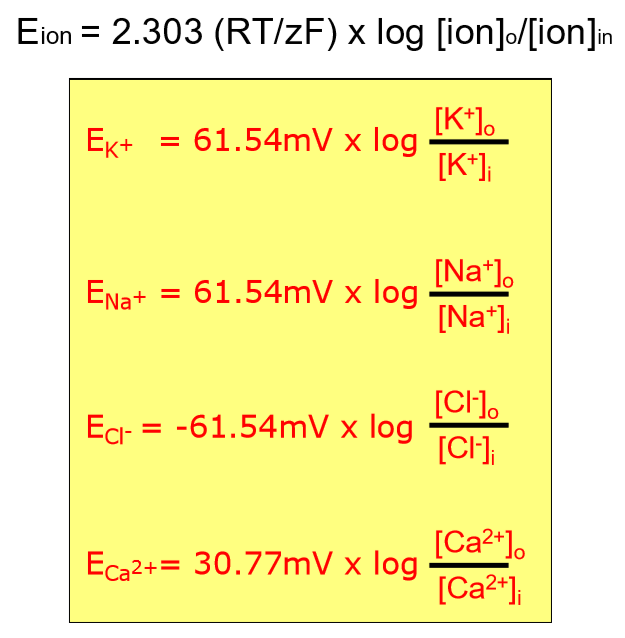
1. Equilibrium Potential (Eion)
The membrane voltage where no net movement of a specific ion occurs
At this point:
Electrical force = Diffusion force
Each ion has its own Eion (depends on gradient + charge)
💡 Think: “where the ion is perfectly balanced”
2. Driving Force
The force that actually pushes ions across the membrane
Formula:
Driving force = Vm − Eion
💡 Interpretation:
Large value → strong ion movement
Zero → no movement
3. Ion Flux
The actual movement of ions across the membrane
Happens only if:
Channels are open (permeability exists)
AND driving force is present
💡 Ion flux = what physically changes Vm
4. Membrane Permeability
How easily an ion can cross the membrane
Depends on:
Number of open channels
Type of channels (leak vs gated)
At rest:
K⁺ >>> Cl⁻ > Na⁺ > Ca²⁺
💡 Means:
K⁺ dominates membrane potential
5. Law of Permeability (CRITICAL RULE)
The membrane potential always moves toward the Eion of the ion with the highest permeability
💡 This is why K⁺ dominates resting potential
K+ and Na+ importance
Potassium (K⁺) – The Main Player
High inside, low outside
→ Diffusion pushes K⁺ OUTInside is negative
→ Electrical force pulls K⁺ IN
👉 Balance occurs at:
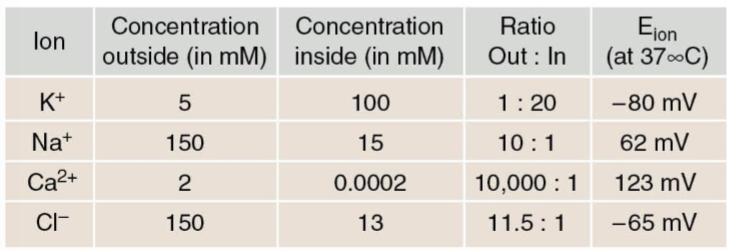
EK ≈ -80 mV
Sodium (Na⁺) Comparison
High outside, low inside
→ Diffusion pushes Na⁺ IN
👉 Equilibrium:
ENa ≈ +60 mV
Important Table- Ion concentrations for a “typical” neuron
Plug into Nernst equations
Nernst Equations
Resting Membrane Permeability