Section 8 CH 20 Gene expression
 Call Kai
 Learn
Learn Practice Test
 Spaced Repetition
 Match
Match Flashcards
 Knowt Play
1/12

There's no tags or description
Looks like no tags are added yet.
Name | Mastery | Learn | Test | Matching | Spaced | Call with Kai |
|---|
No analytics yet
Send a link to your students to track their progress
13 Terms
All the types of gene mutations: there are 6
Substitution: When a nucleotide on the DNA is replaced by another nucleotide
This can cause stop codons to be formed sometimes, making the polypeptide premature
Formation of another amino acid that causes the polypeptide to be ineffective
No effect, because the genetic code is degenerate
Deletion: causes a frame shift, where each base moves TO THE LEFT by one, more impact if deletion occurs at the start of the sequence
Addition: extra base inserted into the sequence, frame shift TO THE RIGHT
Duplication of bases: One or more bases are repeated, causes a frame shift
Inversion of bases: when a group of bases become separated from the DNA sequence and rejoin at the same position but in the reverse order
Translocation of bases: A group of bases become separated from the DNA sequence of one chromosome become inserted into the DNA sequence of another chromosome
Causes of mutations:
Gene mutations occur spontaneously during DNA replication, that are permanent changes in the DNA. The rate of mutations can be increased by mutagenic agents:
high energy ionisation radiation: that can disrupt the structure of DNA
Chemicals: Nitrogen dioxide, chemical in tobacco smoke
Mutations have benefits of producing genetic diversity, however almost always mutations are harmful and produce an organism that is less well suited to its environment. Mutations that occurs in body rather than gametes leads to disruption of normal cellular activities.
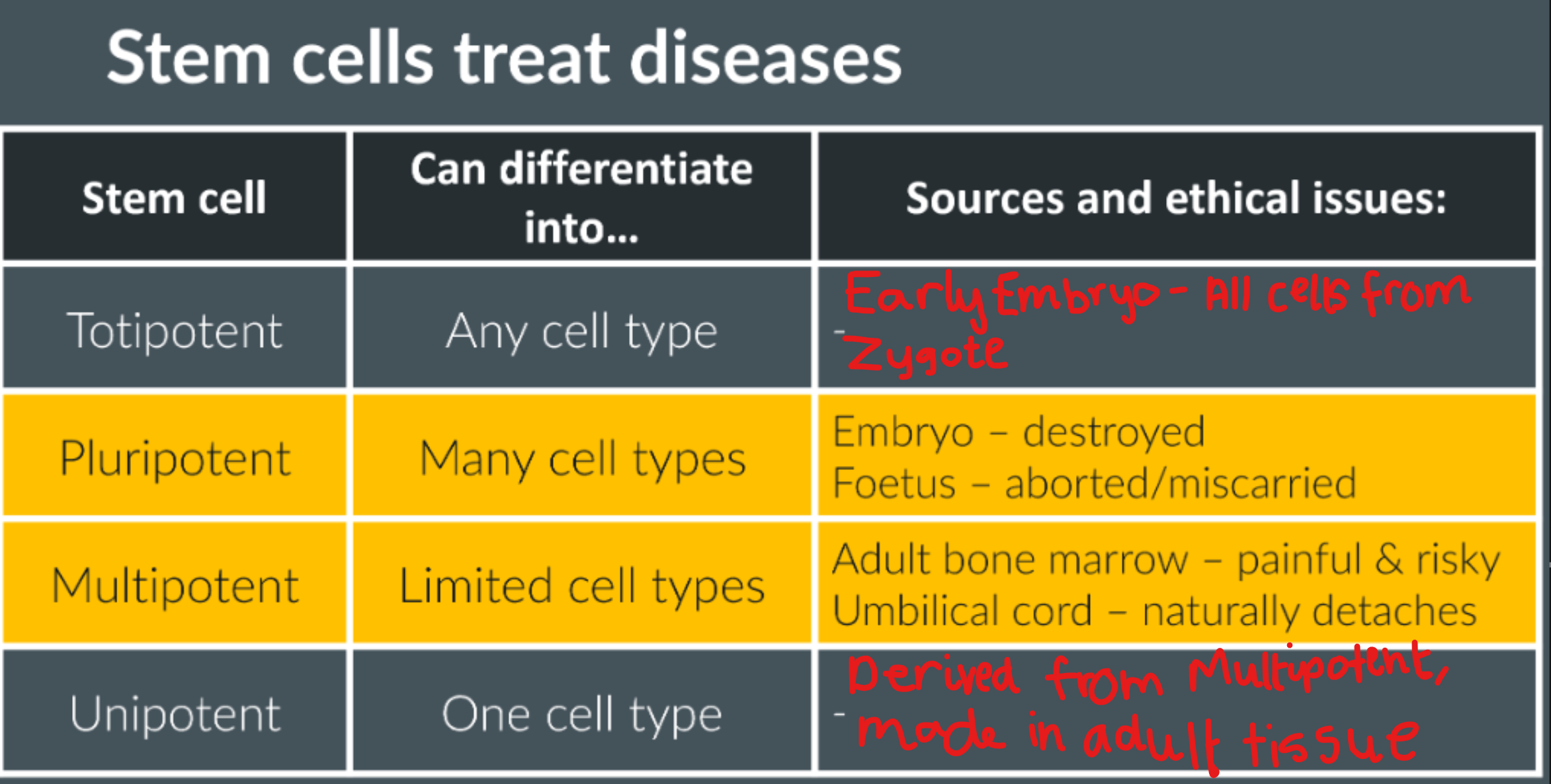
Define the four types of stem cells and how differentiation occurs
The acronym: Today People Must Understand
A differentiated cell means only certain genes in their cell is transulated, giving each cell its specialised function. This is irreversible, because when specialised cells divide they can only form more of the same cell.
The importance of genes being switched on and off:
Proteins only synthesised that are useful for the cell, so no waste products and converse energy
A stem cell, can form new stem cells or differentiate into other cells.
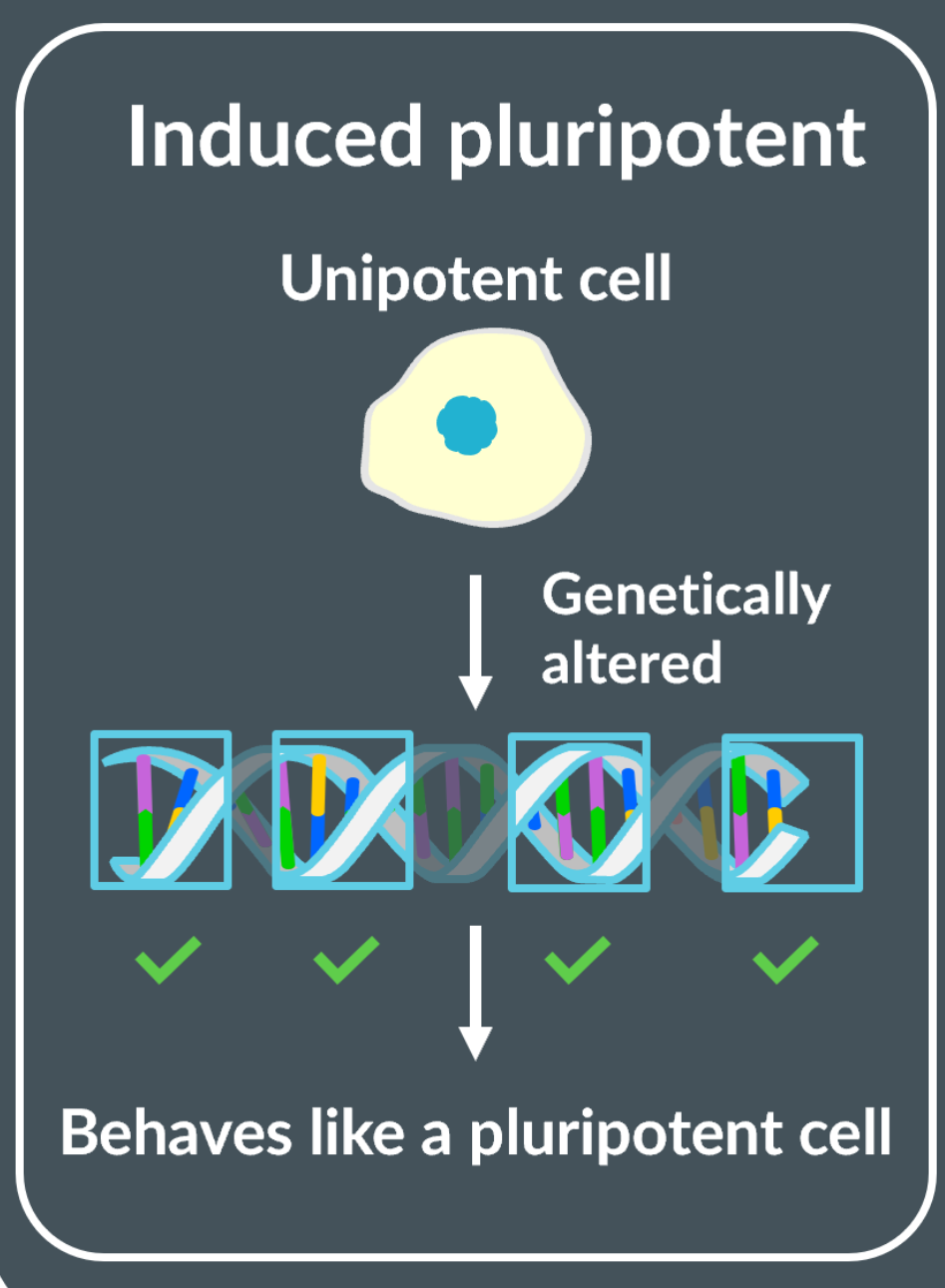
The formation of induced pluripotent cells:
Unipotent cells can be almost any cell in the body (as they can only differentiate into their own cell), are genetically altered to have many genes to be transcripted. Allowing the unipotent cell to acquire new characteristics involving inducing genes and transcriptional factors
Stem cells used in treatment Vs Gene therapy:
Stem cells are used as they can form new healthy cells
Prevent faulty cells from growing
Stem cells keeps dividing so longer-term impact
Gene therapy uses virus as vector, and may cause an immune response
Short term impact, as the previous faulty cells will still differentiate
The key idea of how genes can be switched on or off:
For transcription to begin the gene is switched on by specific molecules that move from the cytoplasm into nucleus.
The transcription factor has a site that binds to specific base sequence of DNA
When it binds this causes region of DNA to begin the process of transcription, where mRNA is formed then a polypeptide.
When gene is not expressed the transcription factor binds to the complementary DNA base and blocks transcription.
How can Oestrogen (hormone) switch on genes?
Oestrogen is lipid soluble so can pass through the phospholipid bilayer
Once inside the cell, Oestrogen binds with a site on a receptor molecule of the transcription factor
Oestrogen changes the shape of the DNA binding site on the transcriptional factor, which can now bind to the DNA (it is activated)
Transcription factor can enter the nucleus and travels through the nuclear pore and binds to specific base sequences on DNA
So, the transcription factor binding with the DNA stimulates transcription of the gene
Define Epigenetics:
Heritable changes (upon interaction with environment) in the gene function without changes to the base sequence of DNA)
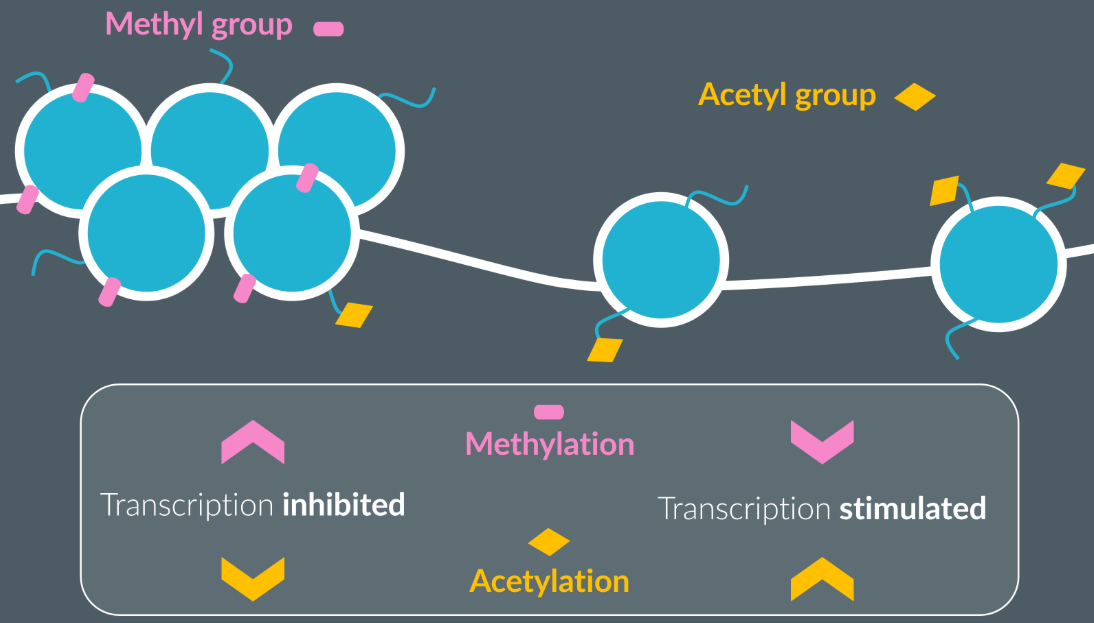
How the DNA-histone complex changes the rate of transcription (methylation and acetylation)
Both the histones and DNA are covered in tags, collectively known as the Epigenome
Acetyl groups bind to histones (AHHHH = Acronym)and Methyl groups bind to DNA
If the DNA-histone complex is tightly packed, then transcription factors and RNA polymerase are unable to bind to the base sequence, so transcription is inhibited (the opposite when DNA-histone complex is loosely packed)
With increased methylation and decreased acetylation, transcription is inhibited, as the DNA-histone complex is tightly packs
With decreased methylation and increased acetylation, transcription is stimulated as the DNA-histone complex is loosely packed.
Some of the epignome is inherited (as in what is more tightly packed and loosely packed), but no changes in the base sequence of the DNA
RNA interference:
In some Eukaryotes and prokaryroyotic cells RNA inhibits translation known as RNA interference.
micro RNA (miRNA): Short single strand RNA, binds with protein complex, forming an RNA induced silencing complex, binds to complementary bases on mRNA bringing the protein complex along with it. Translation is prevented by: preventing ribosome from attaching to the mRNA, OR the enzyme in the complex can destroy the mRNA
Small interfering RNA: Small double stranded RNA (forming an RNA Induced silencing complex), looses one of its strands forming single stranded RNA, and binds to mRNA bringing the protein complex along with it. Translation is prevented is a similar way.
Back ground information about Benign and malignant tumours:
Benign tumours grow slowly and remain in the tissue that they originate in.
Localised effects
Less likely to be life threatening bit disrupts organ function
Usually removed by surgery alone
Rarely reoccur after treatment
Malignant tumours grow quickly and are able to spread to other tissues.
Effects whole body
More likely to be life threatenting
Usually removed by surgery and another form of treatment
More commonly reoccur after treatment
Metastasis => method of spreading through the blood stream/ lympatic system
Tumour suppressor genes:
Tumour suppressor genes:
Code for proteins that slow down or prevent cell division
Code for proteins that repair mistakes in DNA
Code for proteins that tell abnormal cells to die
Promote Apoptosis: programmed cell death
They can be inactive
Through mutations that changes the structure in the proteins and make it non-functional
Increased methylation of DNA, causing the DNA histone complex to be more tightly coiled, and preventing transcription factors and RNA polymerase to bind
So, cannot control cell division
So, uncontrollable cell division leading to formation of a tumour
Or they can become very active:
mutation occurs this changes the base sequence of DNA
A non-functional protein to slow down cell division is transcripted and transulated.
So, cannot slow down cell division
So, uncontrollable cell division leading to formation of a tumour
Proto-oncogene:
Proto-oncogenes causes cell division (code for proteins that stimulate cell cycle), when they undergo mutations they form Oncogene, which increases the rate of cell division. This can increase the rate of cancer being developed. Key point in mark scheme: uncontrollable cell division
When mutation occurs:
increased growth factor OR increased receptor => increased cell division