Fluorescence microscopy
 Call Kai
 Learn
Learn Practice Test
 Spaced Repetition
 Match
Match Flashcards
 Knowt Play
1/11

There's no tags or description
Looks like no tags are added yet.
Name | Mastery | Learn | Test | Matching | Spaced | Call with Kai |
|---|
No analytics yet
Send a link to your students to track their progress
12 Terms
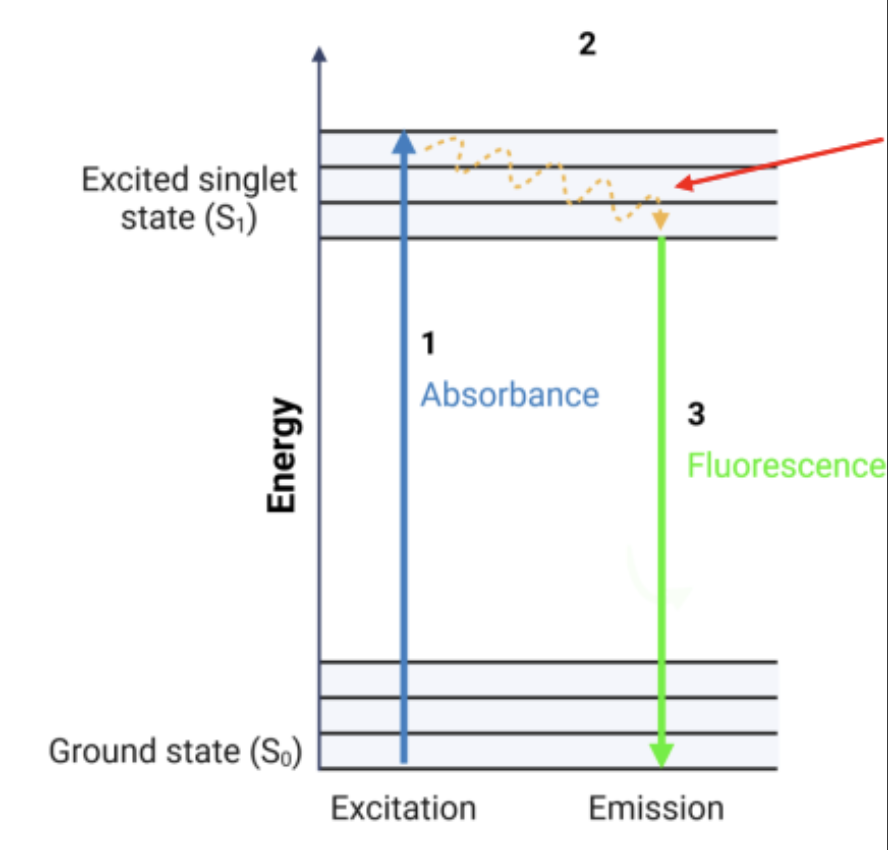
What are the 3 steps of the Jablonski diagram?
Excitation: a photon is absorbed and the fluorophore is raised from ground state (S0) to an excited state (S1 or higher)
Energy is lost non-radiatively, and the molecule relaxes to the lowest vibrational level of S1 → this happens extremely fast
Emission: the molecule returns to S0 by emitting a photon of the lower energy (longer wavelength), thus fluorescing
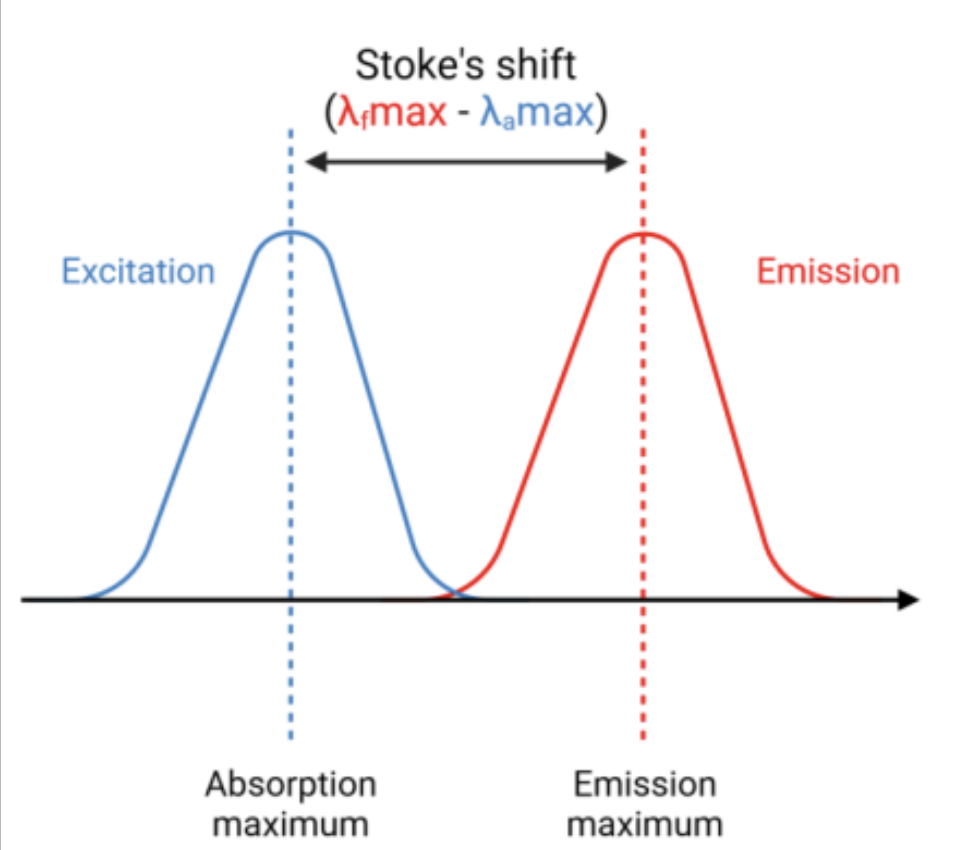
What is the Stokes shift?
It is the difference between the peak excitation (absorption) and peak emission wavelengths of a fluorophore.
Emission is always at a longer wavelength (lower energy) as energy is lost during vibrational relaxation.
Large Stoke shifts makes it easier to separate excitation from emission
What is Quantum Yield of a fluorescent moelcue?
The ratio of photons emitted to photons absorbed.
Ranges 0–1 → High QY = bright fluorophore
What is Quantum Efficiency of a detector?
The fraction of incident photons that are detected (converted to an electrical signal) by the detector/camera.
High QE → fewer photons are missed → good
Important for detecting weak signals
What is cross-excitation in multicolor fluorescence?
Occurs when the excitation light intended for one fluorophore also directly excites another fluorophore with overlapping absorption spectrum
E.g., 488 nm laser exciting both GFP (green) and a red fluorophore via its absorption tail
Can be avoided by: choosing better laser line, choosing better spectrally separated fluorophores
WRONG THINGS GET LIT UP!
What is bleedthrough/cross-talk?
Occurs when the emission of one fluorophore is detected in the channel intended for another because the emission spectra overlap
Can be improved by having a narrower emission filter, and choosing spectrally distinct fluorophores
RIGHT THINGS LIGHT UP BUT LIGHT LEAKS WHERE IT SHOULDN’T!
Conclusion of corss-excitation and bleedthrough
The outcome of both are the same (garbage signal), but when troubleshooting, it matters which one it is in order to fix it (change laser vs change filter).
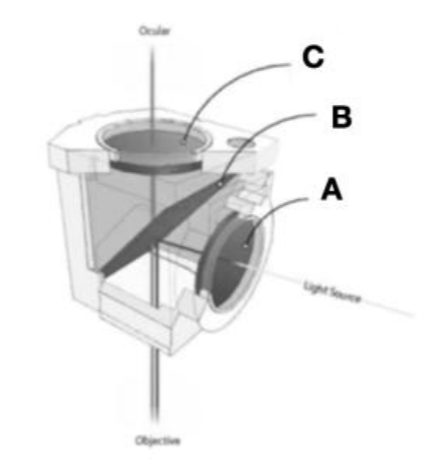
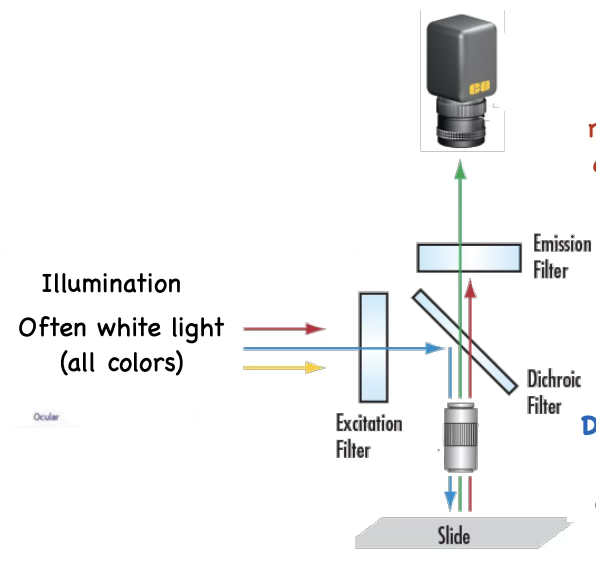
How does a fluorescent filter cube work?
A. Excitation filter = transmits only the excitation wavelength, blocking rest
B. Dichroic mirror = angled at 45, reflects the excitation wavelength toward sample, and transmits longer wavelengths to the detector
C. Emission filter = transmits only the emission wavelength range, blocking residual light
What are bandpass filters? Compare narrow and broad bandpass filters.
Transmit a specific band of wavelength, common as both excitation and emission filters.
Broad filters: more signal/brighter (as more photons are caught(, but also more background signal (less contrast)
Narrow filters: less background signal (more contrast), but lost light (less signal)
What is DAPI?
Blue-fluorescent DNA-binding dye
Binds to the minor groove of double-stranded DNA (AT-rich regions)
Used as a nuclear counterstain
Excited at ~360 nm, emits at ~460 nm.
Membrane-permeant in fixed/permeabilised cells; also enters live cells with compromised membranes
How are DAPI and propidium iodide (PI) used to distinguish live from dead cells?
PI: membrane-impermeable dye. It is entirely excluded by viable cells.
DAPI: membrane-impermeable dye in short-term assays, much like PI
Because DAPI and PI fluoresce at different wavelengths (blue vs. orange/red), they are frequently paired in fluorescence microscopy and flow cytometry.
Dead cell: PI + DAPI positive
What is ratiometric imaging? Give example
Using a probe that changes its excitation/emission spectrum in response to ion/molecule
The ratio of fluorescence at two wavelengths gives the ion concentration independent of probe concentration, focus, or illumination variation
Example: Fura-2 for Ca²⁺
Shifts excitation from 380 nm (unbound Ca²⁺) to 340 nm (Ca²⁺ bound)
The 340/380 ratio is proportional to [Ca²⁺].