12. Modalities
 Call Kai
 Learn
Learn Practice Test
 Spaced Repetition
 Match
Match Flashcards
 Knowt Play
1/44

There's no tags or description
Looks like no tags are added yet.
Name | Mastery | Learn | Test | Matching | Spaced | Call with Kai |
|---|
No analytics yet
Send a link to your students to track their progress
45 Terms
heat application increases
cardiac output
vasodilation
heart rate
respiratory rate
metabolic rate
heat application decreases
muscle activity
blood pressure
blood to internal organs
blood flow to resting muscle
stroke volume
cold application increases
joint stiffness
pain threshold
muscle activation (short duration cold application)
cold application decreases
collagen extensibility
blood flow (>15min)
capillary permeability
local metabolism
spasticity (Prolonged decreases muscle activity)
nerve conduction velocity
hot pack considerations
6-8 layers (4-6 layers for terry cloth)
20-30 minutes
158-167 degrees
ALWAYS WANT BLANCHING
peaks heat in first 5 min so check skin then
cold pack considerations
25 degrees F
10-20 minutes (for spasticity 15-20 minutes)
can be applied every 1-2 hours
stages of cold
CBAAN
intense cold
burning
aching
analgesic
numb
Superficial thermotherapy: contraindications
Over area of malignancy
Over area of compromised circulation
Thrombophlebitis
Impaired sensation or mentation
Bleeding or hemorrhage
Infrared irradiation of the eyes
Arterial disease
"MC TIBIA is HOT!!"
Superficial cryotherapy: contraindications
Cold intolerance
- Cold hypersensitivity
- Cryoglobulinemia - when proteins pull in the blood
- Paroxysmal cold hemoglobinuria - when hemoglobin is released in the urine
- Raynauds
Over regenerating peripheral nerves
Circulatory compromise
e-stim parameters for muscle strengthening/contractions
pulse frequency: 35-80pps
pulse duration: 125-200us for small muscles, 200-350us for large muscles
amplitude >10% MVIC in injured, >50% MVIC in uninjured
on off time: 6-10sec on, 50-120sec off, ratio 1:5 initially
ramp time: at least 2 sec
treatment time: 10-20 min for 10-20 contractions
times per day : every 2-3 hours awake
e-stim parameters for muscle reeducation
pulse frequency: 35-50pps
pulse duration: 125-200us for small muscles, 200-350us for large muscles
amplitude: sufficient for functional activity
on:off: depends on activity
ramp time: at least 2 sec
treatment time: depends on activity
times per day: NA
e-stim parameters for muscle spasms
pulse frequency: 35-50pps
pulse duration: 125-200us for small muscles, 200-350us for large muscles
amplitude: to visible contraction
on: off: 2-5 sec on, 2-5 sec off; equal on off times
ramp time: at least 1 sec
treatment: 10-30 min
times per day: every 2-3 hours until spasm is relieved
e-stim parameters for edema reduction using muscle pump
pulse frequency: 35-50pps
pulse duration: 125-200us for small muscles, 200-350us for large muscles
amplitude: to visible contraction
on:off: 2-5sec on, 2-5 sec off. equal on off times
ramp time: at least 1 sec
treatment time: 30 min
twice per day
pulse frequency
number of pulses per second
quick tapping, higher frequency = more comfortable
pulse duration
the actual time from the start of a pulse to the end of that pulse
longer pulse duration = more comfortable
whats the initial on off time ratio
1:5
ramp time
longer ramp = more comfortable
MVIC
max voluntary isometric contraction
How to increase patient comfort?
Ramp time - increase
Pulse duration - decrease duration to decrease discomfort (DDDD)
Electrode size and quality - big and sticky
Pulse frequency - increase
On:off time - increase off time
Estim currents: contraindications
PLEASE UNDERSTAND CURRENT THREATENS PREGNANCY
Pacemaker
Unstable arrhythmias
Carotid sinus
Thrombosis or thrombophlebitis
Near pregnant uterus - during no phase of pregnancy
HVPC - high voltage pulsed galvanic current (HVPC)
Used to treat wounds
Negative electrode = used to promote healing of the inflamed or infected wounds (think negative = bad so its an infected wound)
100pps
100 duration
amplitude - to produce comfortable tingling
45-60min
3-7d/week
Positive electrode = used to promote healing of the wound without inflammation
100pps
100 duration
amplitude - to produce comfortable tingling
45-60min
3-7d/week
electrodes placed in (saline soaked guaze so buffer) OR around the wound area
tissue healing inflammatory phase/infected treatment
wave form: HVPC
polarity: negative
pulse frequency: 100-105pps
pulse duration: usually preset to around 100us
amplitude: comfortable tingling
treatment time: 45-60 min
tissue healing proliferation phase/clean treatment
waveform: HVPC
polarity: positive
pulse frequency: 100-105pps
pulse duration: usually preset for HVPC at about 100us
amplitude: comfortable tingling
treatment time: 45-60 min
iontophoresis parameters
measured in mA-min
dosage = 40-80mA-min
current amplitude = 1-4mA
continuous direct current
polarity should be set to ion solution
10-20 minutes
negative polarity for iontophoresis
ISAD
I - iodine → scars
S - salicylate → analgesic
A - acetate → calcium deposits
D - dexamethasone → musculoskeletal inflammation
EVERYTHING ELSE IS + (water can be both +/-)
hyperhydrosis
use tap water iontophoresis
positive polarity for iontophoresis
zinc → dermal ulcers
-caine → analgesic
copper → fungal infections
-ase → edema reductions
calcium and magnesium sulface → muscle spasm
TENS for acute pain
type: sensory stim (HIGH RATE TENS; CONVENTIONAL TENS)
wave: biphasic or mono pulsed
pulse frequency: 100pps
pulse duration: 50-100usec
amplitude: comfortable tingling
duration: 20-30 minutes or during activities
TENS for chronic pain
type: motor stim (LOW RATE TENS; ACUPUNCTURE)
wave form: mono phasic or biphasic pulsed
pulse freq: <10pps
pulse duration: >150usec
amplitude: visible twitch
duration: 20-45 min
TENS brief intense
type: motor stim (COUNTER IRRITANT)
wave: monophasic or biphasic wave form
pulse freq: 100pps
pulse duration: >150usec
amp: strong muscle twitch
duration: < 15 min
TENS noxious stim
type: hyperstimulation (TRIGGER POINTS)
wave: DC or monophasic wave form
pulse freq: high: 100pps, low: 1-5pps
pulse duration: >250usec up to 1 sec
amp: highest tolerance/painful stimulus
duration: 30-60sec per area
US characteristics
Intensity :Amount of energy delivered per unit area (W/cm^2)
frequency: Cycles per second Hz, 1MHz or 3MHz
Superficial - 3
Deep - 1
Duty cycle = on time / (on time + off time)
Ultrasound: indirect vs direct coupling
direct coupling agent (gel, lotion) should be applied to txt area and transducer before power is on; face of transducer is parallel to skin at 90 degree angle
indirect coupling agent used on small, irregular shaped or unable to tolerate direct pressure from transducer; water immersion = body part of interest is in water and then transducer is parallel to treatment surface at a 0.5-3cm distance away from skin
pulsed or continuous ultrasound
Continuous has thermal effects pulsed does not
Example: 5 seconds on, 20 seconds off >> 5/25 >> 20% so this is a pulsed duty cycle and does not have thermal effects
Pulse is anything that is NOT 100%
ultrasound parameters in relation to acute/chronic injury
acute injury = pulsed (up to 3 weeks)
chronic injury = continuous (> 3 weeks)
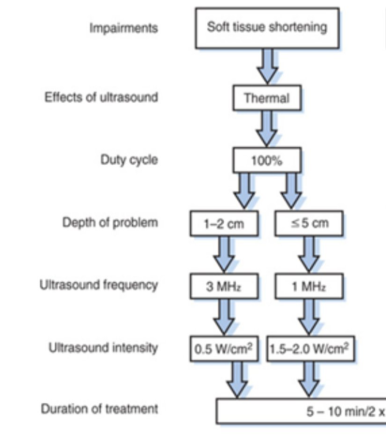
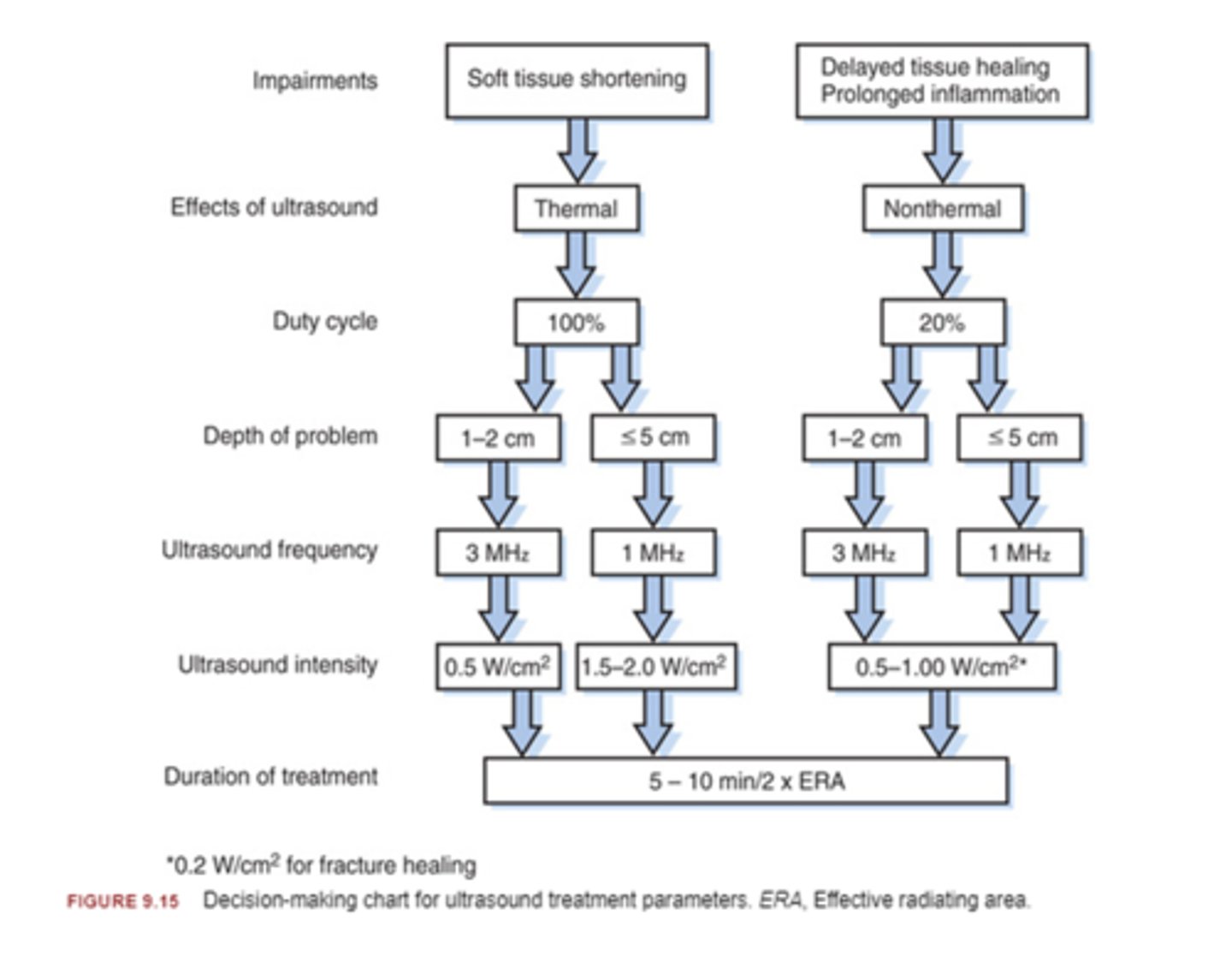
ultrasound soft tissue shortening and chronic pain parameters
thermal
100% duty cycle
depth: 1-2cm → 3MHz frequency → 0.5W/cm^2 intensity
depth: < or equal to 5cm → 1MHz frequency → 1.5-2.0W/cm^2 intensity
5-10min
delayed tissue healing prolonged inflammation US
non thermal
20% or 50% duty cycle
depth: 1-2cm → 3MHz
depth: < or equal to 5cm → 1MHz
0.5-1.00W/cm^2 intensity
5-10 min
Ultrasound contraindication
Malignancy
Pacemaker
Eyes
Organs of reproduction or pregnancy
Joint cement or plastic
CNS tissue
Thrombophlebitis
^^ my poor exhausted old joints cant travel
ultrasound hot spots: ways to alter treatment response
move sound head continuously 1.5in/second
add more gel
decrease intensity
change frequency to 3MHz
make sure txt area right size
change pulsed US to non thermal
EMG biofeedback initial parameters
muscle relaxation (inhibit; decrease spasm/muscle activity)
low sensitivity
closely placed
LOW AND CLOSE TO RELAX
muscle re-education (activation; strenghtening; fascilitating; increase tone; address atrophy)
high sensitivity
electrodes far apart
***if pt made progress then for each one (relaxation or re-education) do the opposite for txt
lumbar traction positioning
Supine position with pillow under knee - for intervertebral joints, facet joints, muscle elongation
Prone for posterior disc herniation
Places person in neutral or at least some extension
Supine: increase intervertebral space of:
L5-S1 = 45-60 degrees hip flexion
L3-L4 = 75-90 degrees hip flexion
Joint distraction parameters in traction(cervical and lumbar)
cervical
20-29lbs(max)
7% body weight
lumbar
50lbs
50% body weight
cervical traction: angle of cervical spine for upper, middle, lower cervical regions
upper cervical spine (C1-C2) = 0-5 degrees of flexion
mid-cervical spine (C3-C4) =10-20 degrees of flexion
lower cervical spine (C5-C7) = 25-35 degrees of flexion
Disc protrusion, muscle spasms, elongation parameters for traction (cervical and lumbar)
cervical - 11-15lb
*should feel pull at base of skull
lumbar - 25% body weight
initial treatment place pt in supine, knee extended, and sidebend trunk if it is a foramen issue on one side with 25% BW
Contraindications for traction
Joint hypermobility or instability
Immobilization
Peripheralization of symptoms with traction
Acute injury or inflammation
Uncontrolled hypertension
***H I P I H