Organisms Exchange substances with their environment
 Call Kai
 Learn
Learn Practice Test
 Spaced Repetition
 Match
Match Flashcards
 Knowt Play
1/7

There's no tags or description
Looks like no tags are added yet.
Name | Mastery | Learn | Test | Matching | Spaced | Call with Kai |
|---|
No analytics yet
Send a link to your students to track their progress
8 Terms
Organisms needing exchange - surface area to volume ratio affecting exchange
Organisms need exchange Living organisms need to exchange materials like oxygen, glucose, excretory products like urea, and heat with their environment. This exchange occurs across plasma membranes. |
Surface area to volume ratio affects exchange The rate at which substances diffuse across an organism's outer surface depends on its surface area to volume ratio (SA:V). How SA:V affects rate of diffusion:
Generally, smaller organisms have a higher SA:V while larger organisms have a lower SA:V. |
Calculating the surface area to volume ratio of a cube 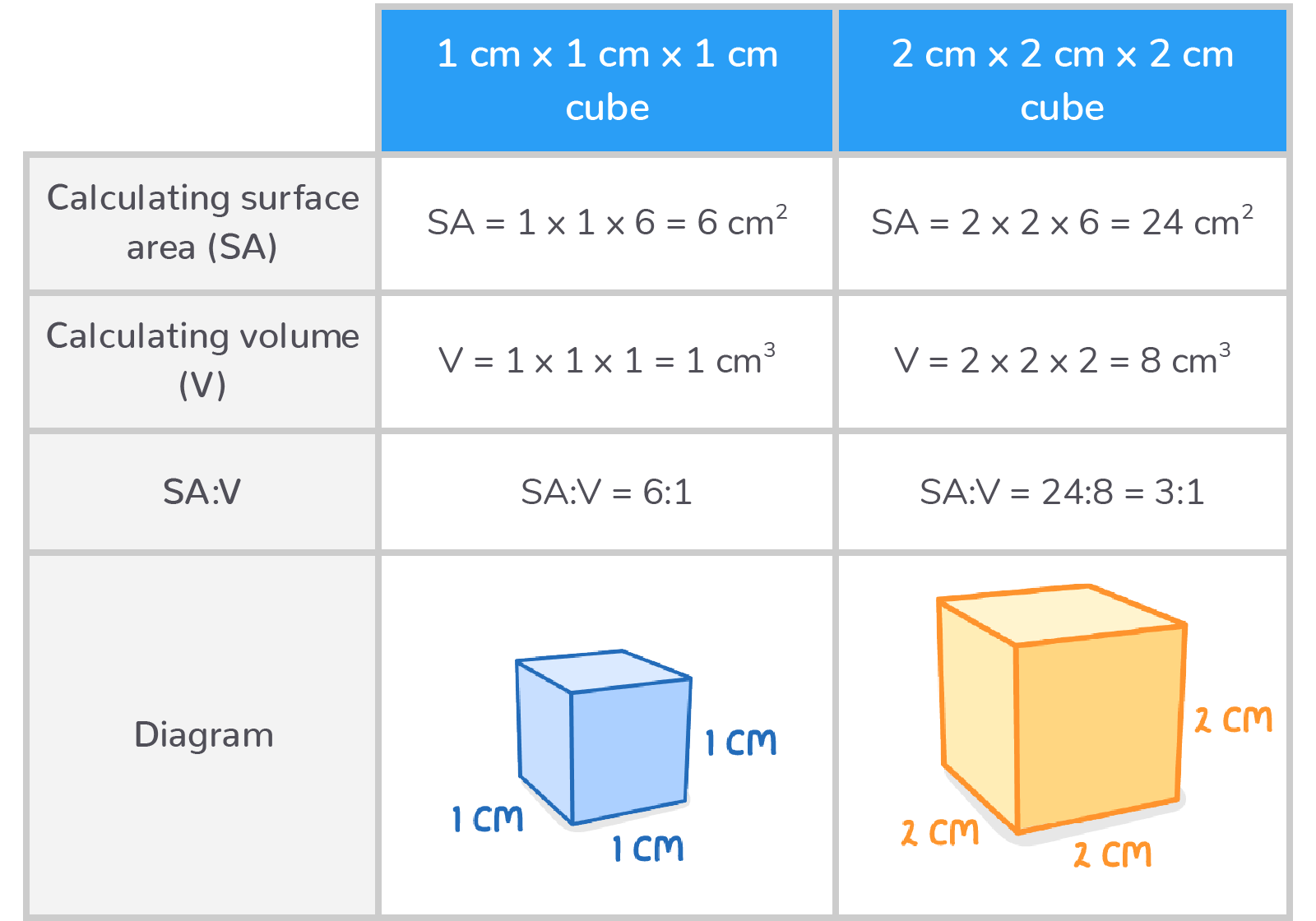 To calculate the surface area (SA) of a cube: SA = length x width x 6 To calculate the volume (V) of a cube: V = length x width x depth |
Give equations for volume and surface areas of cube, cuboid and cylinder
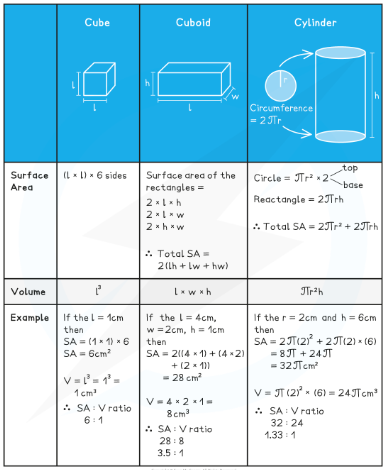
Adaptions to surface area to volume ratio:
Adaptations to overcome low surface area : volume ratio
As organisms get larger, their surface area : volume ratio decreases, meaning diffusion alone becomes too slow to meet the needs of all cells.
To solve this, organisms evolve adaptations that increase the efficiency of exchange and transport.
1. Large surface area
A larger surface area means:
more molecules can diffuse at the same time
faster overall exchange of substances
Example adaptations:
alveoli in lungs, gill filaments and lamellae in fish, microvilli in ileum
👉 Key idea: more surface = more “entry points” for diffusion
2. Thin exchange surfaces
Thin membranes reduce the distance molecules must travel.
This increases diffusion rate because:
shorter diffusion pathway, faster movement across membrane
Example:
alveolar epithelium is only one cell thick
👉 Key idea: shorter distance = faster diffusion
3. Transport systems (VERY IMPORTANT for AQA)
Large organisms have specialised transport systems like:
blood vessels (animals), xylem and phloem (plants)
These systems:
move substances quickly over long distances
connect exchange surfaces to all body cells
Why transport systems are important They help maintain a steep concentration gradient.
How?
They continuously remove or deliver substances
This prevents equilibrium from being reached too quickly
Why steep concentration gradient matters
The steeper the gradient: the faster diffusion happens
👉 So transport systems indirectly increase diffusion rate by maintaining gradients
4. Bringing substances close to cells
Transport systems also reduce diffusion distance inside the organism by:
delivering oxygen/nutrients directly to tissues
removing waste products quickly
So cells are never far from supply or removal systems.
Example: lungs + blood
oxygen diffuses into alveoli
blood immediately carries oxygen away
keeps oxygen concentration low in blood
→ maintains steep gradient for diffusion
5. Heat exchange adaptation (AQA link)
Some large animals also need efficient heat transfer.
Example:
elephants have large, highly vascularised ears
Why this helps:
large surface area = more heat loss
many blood vessels = warm blood reaches surface
heat transfers from blood → environment
👉 This prevents overheating
One-line summary (exam ready)
Organisms adapt to low surface area : volume ratio by increasing surface area, reducing diffusion distance, and using transport systems to maintain steep concentration gradients and rapidly move substances or heat around the body.
Metabolic rate explain
Metabolic rate is the rate at which chemical reactions occur in an organism’s cells over a given time.
In simple terms:
how fast an organism uses energy.
What it includes (AQA A-level)
Metabolic rate covers all energy-releasing and energy-using reactions, such as:
respiration (ATP production)
protein synthesis
active transport
movement (e.g. muscle contraction)
maintenance of body temperature (in endotherms)
Key idea
Higher metabolic rate = more energy used per second
Lower metabolic rate = less energy used per second
Factors affecting metabolic rate (common AQA links)
Body size (smaller organisms often higher per gram)
Activity level (more movement → higher rate)
Temperature (affects enzyme activity in ectotherms)
Age (younger organisms often higher growth rate)
Surface area : volume ratio (higher SA:V → faster exchange → higher metabolic demand)
One-line exam definition
Metabolic rate is the rate at which an organism carries out chemical reactions in its cells that release and use energy.
What does a mean alone NOT show
A mean alone does not show consistency of results, reliability of the pattern, whether groups actually differ significantly
to confidently conclude a relationship you would need multiple repeats for each stage, standard deviation/error bars and statistical tests these tell you whether differences are real (significant) or random
Standard deviation (AQA A-level Biology) — everything you need
What standard deviation is
Standard deviation is a measure of how spread out data is around the mean.
It tells you:
how much variation there is in a set of results
Key idea
Small standard deviation → data values are close to the mean → results are reliable/consistent
Large standard deviation → data values are spread out → results are more variable/less consistent
What it does NOT tell you
❌ It does NOT tell you if there is a difference between two means
❌ It does NOT tell you which mean is higher/lower
❌ It does NOT show cause and effect
How it is used in biology (AQA focus)
Standard deviation is used to:
show variation within data
assess reliability of results
compare spread between groups
Example contexts:
enzyme activity experiments
plant growth measurements
population studies
clinical trials
Mean vs standard deviation (important distinction)
Mean | Standard deviation |
|---|---|
average value | spread of values |
tells central trend | tells variation |
Interpreting error bars (VERY IMPORTANT for AQA)
Graphs often show:
mean ± standard deviation
What you look for:
If error bars overlap a lot → data may not be significantly different
If error bars do not overlap → difference is more likely significant
⚠ AQA note:
This is a rule of thumb, not a strict statistical test.
How standard deviation is calculated (you do NOT need full method)
You are NOT expected to calculate it manually.
But conceptually:
find differences from the mean
square them
find average
square root result
When AQA expects you to use it
You may be asked to:
describe variation in data using SD
compare reliability of results
interpret graphs with error bars
explain precision of results
Key exam phrases
Use these:
“data are closely clustered around the mean”
“shows low variation”
“results are consistent”
“high variation between repeats”
“data are more/less reliable”
Common mistakes
❌ Confusing SD with error
❌ Thinking SD = difference between two means
❌ Ignoring overlap of error bars
❌ Saying SD shows accuracy (it does NOT)
Accuracy vs precision (important link)
Standard deviation = precision
not accuracy
Precision means:
how close repeats are to each other
One-line exam definition
Standard deviation is a measure of the spread of data around the mean, indicating how much variation there is within a set of results.
Simplify the principle of using standard deviation
No overlap → likely significant difference
Overlap → difference not clear / may be due to chance
One-line summary
Non-overlapping error bars suggest a real difference between means, while overlapping error bars suggest the difference may not be significant and could be due to variation in data.
Summary of exchange and surface area part of this question
Size, Surface Area and Exchange Systems1. Importance of Surface Area : Volume Ratio (SA:V)
All organisms need to exchange substances with their environment, including:
oxygen
nutrients
waste products such as carbon dioxide and urea
heat
The efficiency of this exchange depends on the surface area : volume ratio.
Single-celled organisms
Have a large SA:V ratio
Large surface area compared to volume
Short diffusion distance
Diffusion across the cell-surface membrane is fast enough to meet demands
Multicellular organisms
Have a smaller SA:V ratio
Volume increases faster than surface area as size increases
Cells are further from the external environment
Diffusion alone becomes too slow to supply all cells
Therefore, large organisms require adaptations for efficient exchange and transport.
2. Adaptations of Multicellular OrganismsExchange surfaces
Specialised exchange organs increase surface area for diffusion.
Examples:
lungs
gills
alveoli
villi in the ileum
Efficient exchange surfaces usually have:
large surface area
thin membranes (short diffusion distance)
good blood supply
ventilation to maintain concentration gradients
Mass transport systems
Large organisms require transport systems to move substances quickly around the body.
Examples:
circulatory system in mammals
xylem and phloem in plants
These systems:
transport substances over long distances
maintain steep concentration gradients
bring substances close to cells, reducing diffusion distance
A steep concentration gradient increases the rate of diffusion.
3. Body Size, Shape and Heat ExchangeEffect of sizeLarge organisms
Smaller SA:V ratio
Lose heat more slowly
Better at retaining heat
Small organisms
Larger SA:V ratio
Lose heat rapidly
Require a higher metabolic rate to generate sufficient heat
This is why small mammals often:
eat frequently
respire at a faster rate
Effect of shapeCompact shapes
Smaller surface area
Reduced heat loss
Example:
Arctic fox with small ears and rounded body shape
Less compact / gangly shapes
Larger surface area
Increased heat loss
Example:
African bat-eared fox with large ears
4. Behavioural and Physiological AdaptationsWater conservation
Animals with high SA:V ratios may lose water rapidly by evaporation.
Adaptations include:
kidneys producing concentrated urine
reduced sweating
nocturnal behaviour in desert animals
Metabolic adaptations
Small mammals in cold environments:
have high metabolic rates
require high-energy diets
may use insulation such as fur
may hibernate to reduce energy demand
Cooling adaptationsPhysiological adaptations
Large animals in hot climates may increase heat loss using specialised structures.
Example:
elephants have large, highly vascularised ears
Large surface area and blood flow increase heat transfer to the environment.
Behavioural adaptations
Animals may alter behaviour to regulate body temperature.
Examples:
hippos spending time in water
reptiles basking in sunlight
animals seeking shade during hot periods
Key AQA Summary
As organisms increase in size:
SA:V ratio decreases
diffusion becomes less efficient
specialised exchange surfaces and transport systems are needed
adaptations help maintain efficient exchange and temperature regulation.