Microbiome Techniques Lecture 2
 Call Kai
 Learn
Learn Practice Test
 Spaced Repetition
 Match
Match Flashcards
 Knowt Play
1/76

There's no tags or description
Looks like no tags are added yet.
Name | Mastery | Learn | Test | Matching | Spaced | Call with Kai |
|---|
No analytics yet
Send a link to your students to track their progress
77 Terms
Culture Media
used to grow microorganism to identify, study, transport, and store in the laboratory
culture media is ___ or ___ preparation
solid, liquid
culture media must contain ___ the nutrients required by the organism for growth
all
classifications of culture media
- chemical constituents from which they are made
- physical nature
- function
chemical composition media
based on exact knowledge of properties. defined (synthetic), complex
physical nature media
based on solidifying properties. liquid, semisolid, solid
function media
based on goal of the culture. supportive (general purpose), enriched, selective, differential
defined or synthetic media
all components and their concentrations are known
complex media
contain some ingredients of unknown composition and/ or concentration
example of something unknown in complex media
beef extract: extract of a cow, but how much protein, fat carbs, etc?
peptones (media component)
protein hydrolysates prepared by partial digestion of various protein sources
extracts (media component)
aqueous extracts, usually of beef or yeast
agar (media component)
sulfated polysaccharide used to solidify liquid media; most microorganisms cannot
degrade it. is derived from seaweed, similar to jello
functional types of media
supportive, enriched, selective, differential
supportive or general purpose media
support the growth of many microorganisms, ex: tryptic soy agar (e. coli, s. aureus, fungus, etc)
enriched media
general purpose media supplemented by blood or other special nutrients, ex: blood agar
selective media
favors growth of some microorganisms, kills growth of others, ex: MacConkey agar-selects for gram negative bacteria
___ ____ and ____ _____ in MacConkey agar inhibit the growth of gram-positive bacteria
bile salts, crystal violet
many terms are ___
interchangeable
differential media
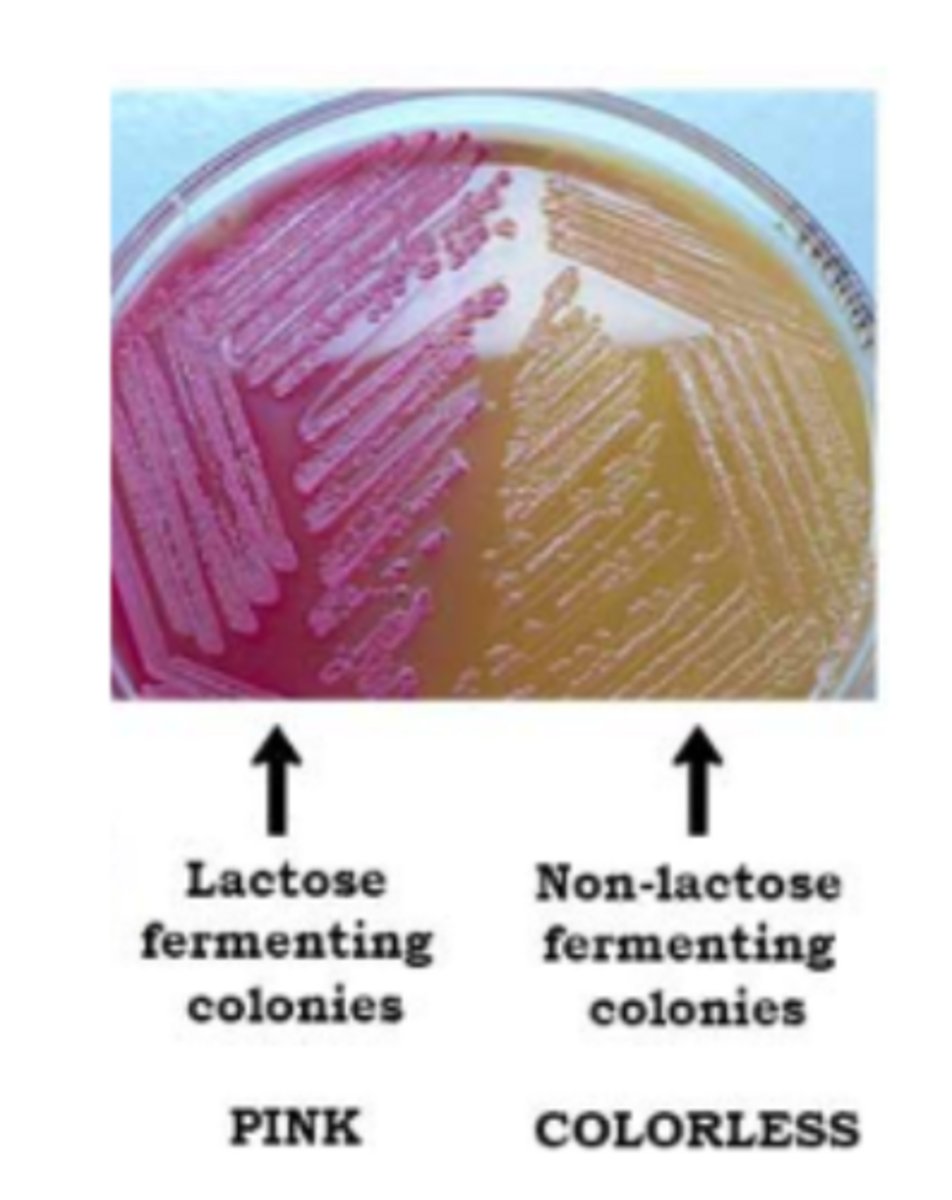
distinguish between different groups of microorganisms based on their biological characteristics ex: blood agar (hemolytic vs nonhemolytic bacteria), ex: MacConkey agar (lactose ferments vs nonfermenters)
MacConkey Agar
lactose fermenters vs nonfermenters; lactose fermenting colonies produce acid, drop in pH changes color of agar
blood agar
hemolytic (RBC's are lysed, there is a halo around it) vs nonhemolytic bacteria (area around cells unchanged)
MacConkey agar uses ___ ______ as a selective agent. it's differential substrate (indicator) is ____ to differentiate between ____ and _____. major organisms inhibited are ____ ______
bile salts, lactose (red), fermenters (e. coli, klebsiella), nonfermenters (salmonella pseudomonas), most cocci
Mitis salivarius uses ___ and ____ ______ as a selective agent. it's differential substrate (indicator) is ____ to differentiate between ____ and _____. major organisms inhibited are ____ _____ and ____ _______
tellurite, crystal violet, sucrose (trypan blue), big > 2 mm (streptococcus salivarius--oral cavity), small < 1 mm (streptococcus mitis, other streptocci), staphyloccoci, enteric bacilli
Mannitol salt uses ___ ______ as a selective agent. it's differential substrate (indicator) is ____ to differentiate between ____ and _____. major organisms inhibited are ____ and ______ _____
7.5% NaCl, mannitol (phenol red), big/ yellow (s. aureus), small/ pink (staphyloccus epidermidis) streptococci, enteric bacilli
Sabouraud uses ___ ______ as a selective agent. It's purpose is to kill ___ and select ____ ______. major organisms inhibited are ___ ______
low pH (5.6) ± antibiotics, bacteria, cream colonies (fungi), most bacteria
isolation of pure cultures is...
population of cells arising from a single cell developed by robert koch
pure culture isolation allows for study of
a single type of microorganism in mixed culture
techniques used to isolate pure cultures
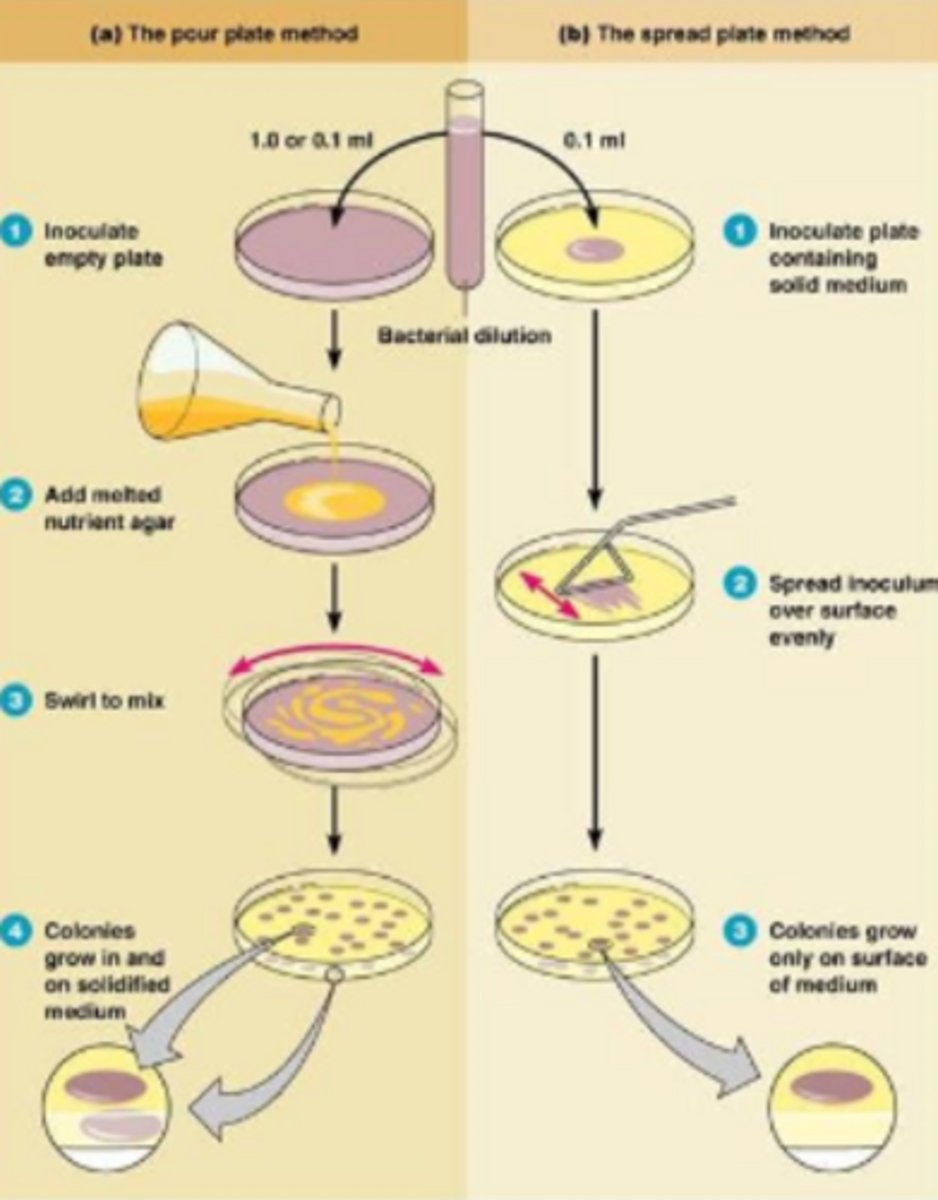
spread plate, streak plate, pour plate
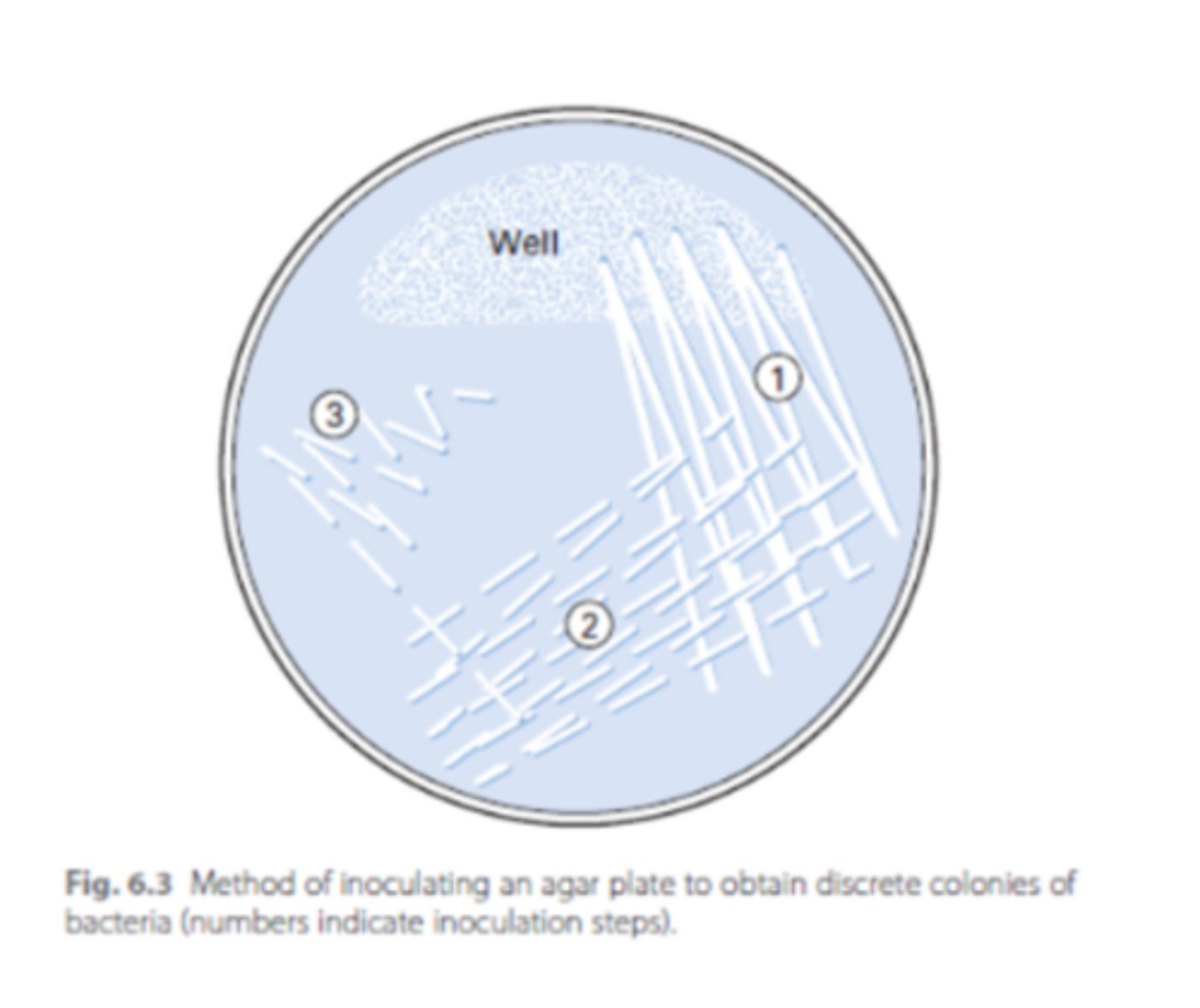
streak plate involves technique of
spreading mixture of cells on an agar surface so individual cells are well separated from each other, involves use of bacteriological loop
in streak plates, each cell can
reproduce to form a separate colony (visible growth or cluster of microorganisms)
in spread plates,
a small volume of diluted mixture containing approx. 30-300 cells is transferred, spread evenly over surface with a sterile bent rod
in pour plates,
sample is serially dilated, diluted samples mixed with liquid agar, mixture is poured into sterile culture (some bacteria may grow on bottom of plate)
both pour plates and spread plates may be used to determine the number of
viable microorganisms in an original sample
Streak plates are ____ to determine the number of viable microorganisms in the sample. Why?
not, loop being dipped in original culture and being streaked but you do not know how much you picked up loop
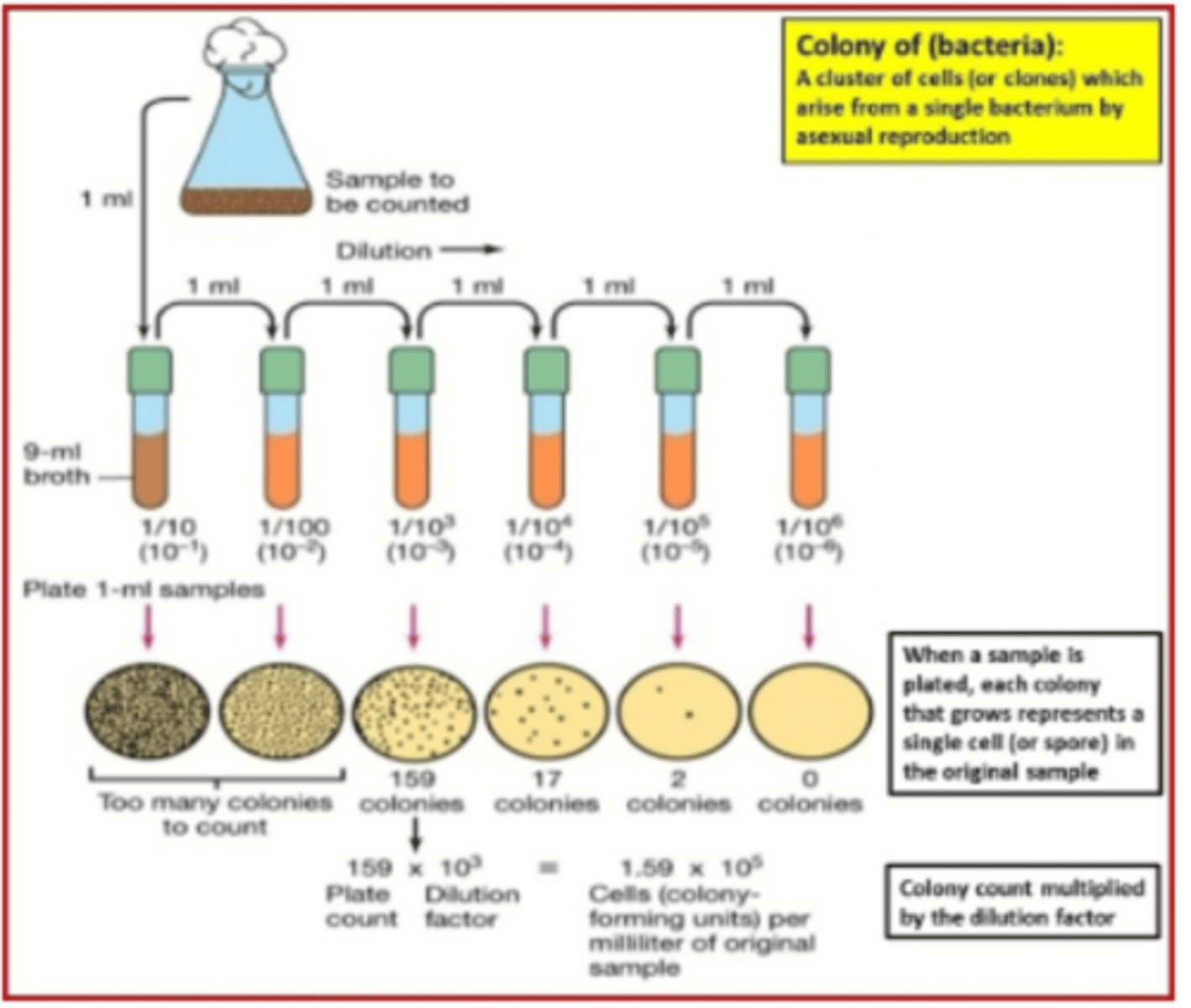
serial dilution
original mixture diluted to factor of 10 multiple times, ideal range is finding colonies that when dilated, have 30-300 cells
tntc
too numerous to count--too many cells in plate can be difficult to count
how to determine colony-forming unit (CFU) of original sample?
plate count x dilution factor
measurement of microbial growth can measure changes in ____ and ____ of cells
number (human), mass (bacteria)
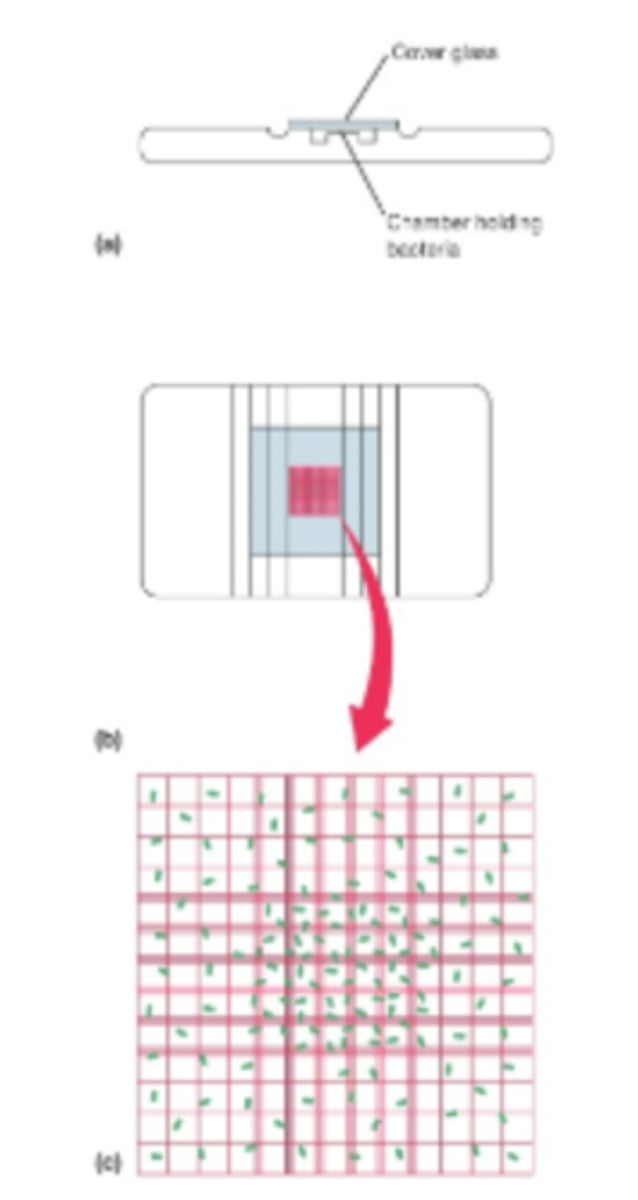
direct measurement of cell numbers can be done with
counting chambers
electronic counters-flow cytometry
on membrane filters
counting chambers
- easy, expensive, quick
- useful for counting both prokaryotes and eukaryotes
- cannot distinguish living from dead cells
direct count on membrane filters
• cells filtered through special membrane that provides dark background for observing cells
• cells are stained with fluorescent dyes
• useful for counting bacteria
• with certain dyes, can distinguish living from dead cells
Flow cytometry
• Microbial suspension forced through small orifice with a laser light beam
• As individual cells pass in a single file through a laser beam, the instrument
measures their physical characteristics (size and granularity) and specific fluorescent tags

viable counting methods
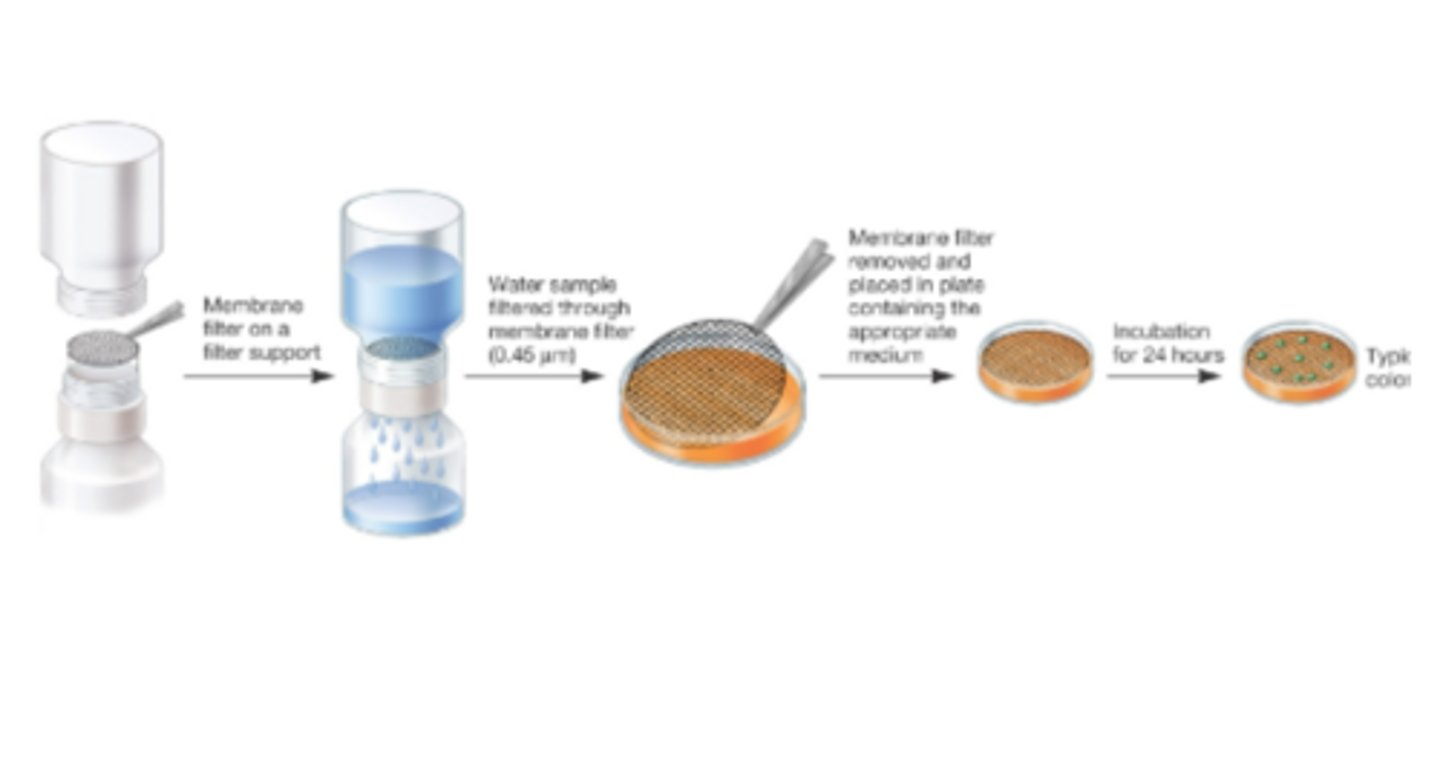
spread and pour plate techniques, membrane filter technique
how are viable counting method techniques counted?
after incubation number of organisms are determined by counting number of colonies multiplied by dilution factor, results expressed as colony forming units (CFU)
in membrane filter technique, bacteria from ____ samples are trapped on membranes of known pore size
aquatic
in membrane filter technique, membrane is ____ in culture media, colonies grow on ____, colony count determines number of bacteria in ____ ______
soaked, membrane, original sample
if microbe cannot be cultured on plate media, ____ are made and added to suitable media. _____ is determined to yield the most probable number (MPN)
dilutions, turbidity
measurement of cell mass can be determined by
dry weight, quantity of a particular cell constituent, turbidometric measures (light scattering, rate cloudiness of sample)
dry weight
time consuming and not very sensitive
quantity of a particular cell constituent
useful if amount of substance in each cell is constant (ex: protein, DNA, ATP, or chlorphyll
Turbidometric measures (light scattering)
quick, easy, and sensitive
turbidometric low absorbance
little/ no bacteria
turbidometric high absorbance
lot of bacteria
optical density (OD)
qualitative measure, not an exact number, related to turbidity
gram staining steps
1. crystal violet
2. gram iodine
3. alcohol
4. safranin (red dye)
crystal violet purpose
dyes cell same purple color
gram's iodine purpose
mordant (stabilizer), causes dye to form large complexes in peptidoglycan meshwork. thicker gram-positive cell walls are able to trap larger complexes
alcohol purpose in gram staining
dissolves lipids in outer membrane and removes dye from peptidoglycan layer of gram-negative cells
safranin purpose
gram-negative bacteria colorless, safranin acts as a counter-dye to indicate their presence
ways to distinguish microorganisms
• Colony characteristics
• Microscopic morphology
• Staining
• Growth conditions
• Biochemical tests (for definitive identification to species level)
how to determine if something is aerobic or anaerobic
pour agar into test tube, stab agar with loop. if it likes O2, it grows close to surface, if not, it grows away from surface
obligate aerobe
needs O2
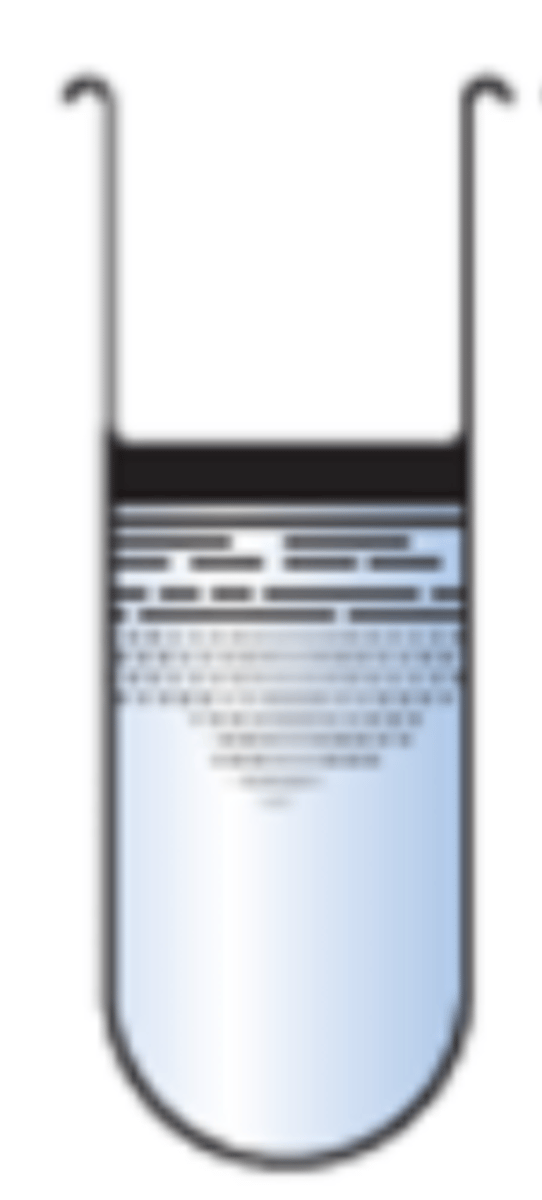
obligate anaerobe
doesn't like O2
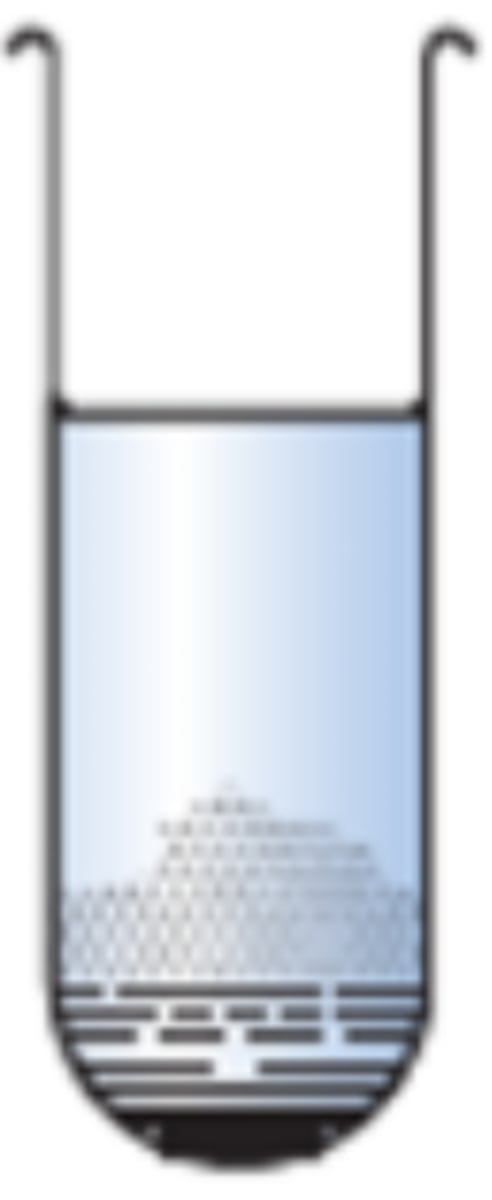
facultative anaerobe
could do with or without O2

microaerophile
likes some O2, but not a lot
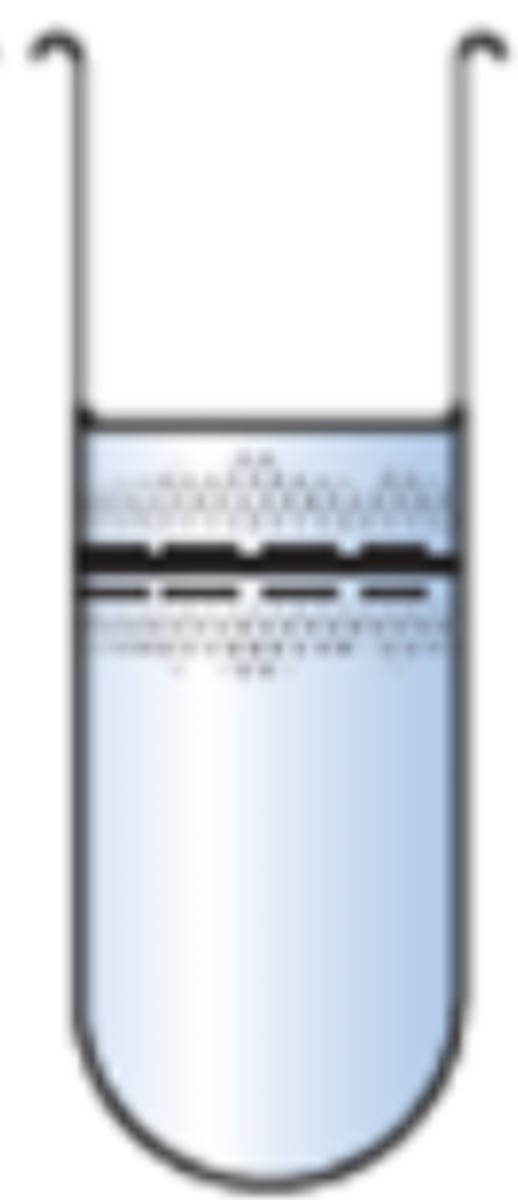
capnophilic organism
wants CO2 instead of O2

what bacteria is an obligate anaerobe?
porphyromonas gingivalis, associated with periodontal disease, grows deep into tissue
enzyme profile tests
color change tests, specific enzyme test
color change test
if the bacteria secretes a certain enzyme, it will catalyze a substrate that will in turn result in color change (ex: use dye that changes color when pH changes)
specific enzyme test
set up assay to see if an enzyme can make microorganism go from a to b, ex: coagulase produced by s. aureus clots plasma
commercial kits for biochemical identification of bacteria
have reagents in tubes for anything you'd use to test for normally
• Spectrum of specific enzymes secreted by bacteria
• Ability to ferment sugars anaerobically
• Ability to assimilate sugars aerobically
• Usually 20 tests
Antibiotic susceptibility testing can be done with
• Qualitative (disc diffusion assays)
• Quantitative (determining the exact concentration of antibiotics needed to control the growth)
1.MIC (minimal inhibitory concentration)
2.MBC (minimal bactericidal concentration)
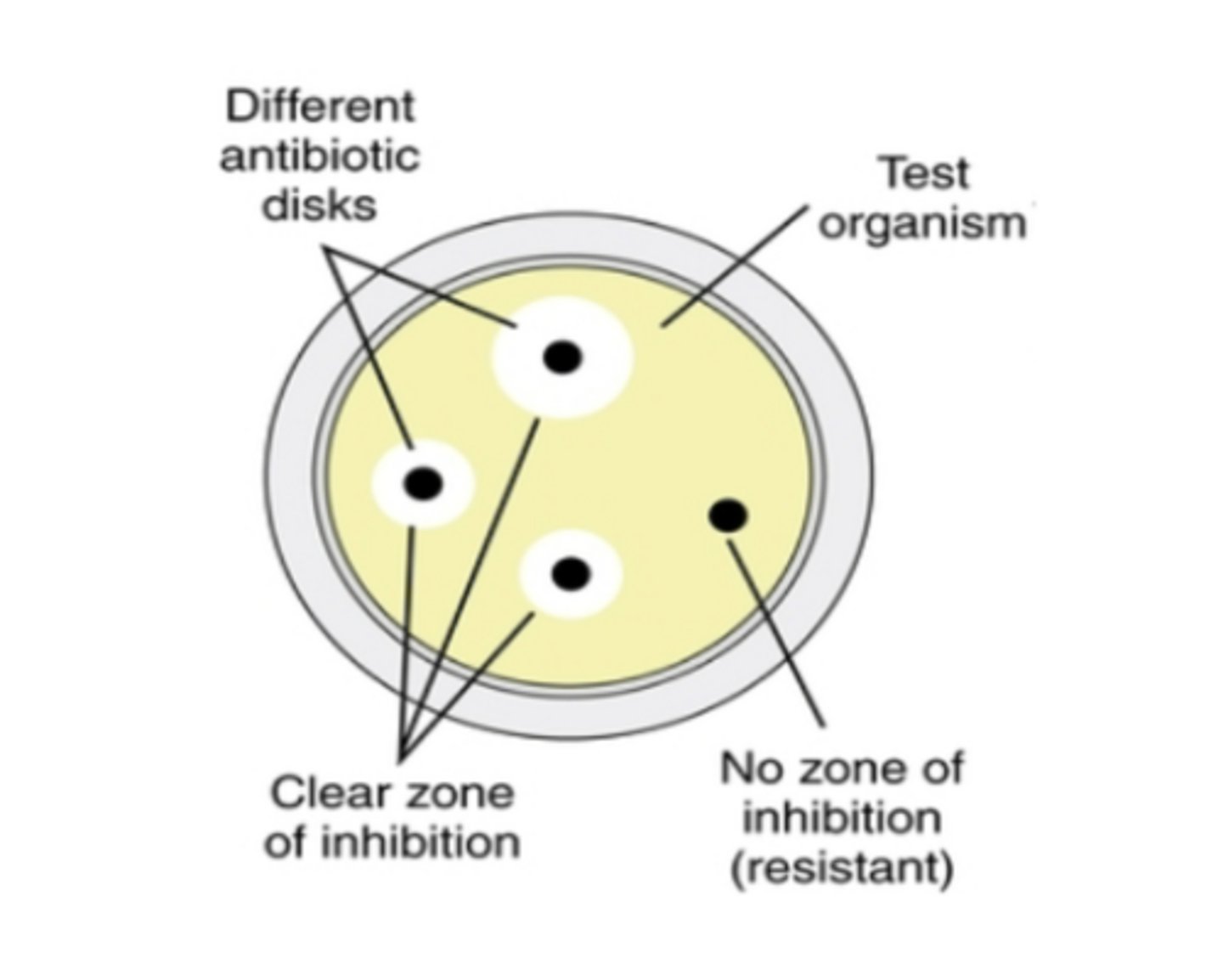
disk diffusion test
discs with different antibiotics placed on top of inoculated surface, bacterial sensitivity inhibits growth of test bacteria around disc, zone of inhibition (radius of bacteria free region) determines sensitivity extent, larger inhibition zone=greater sensitivity to particular antibiotic
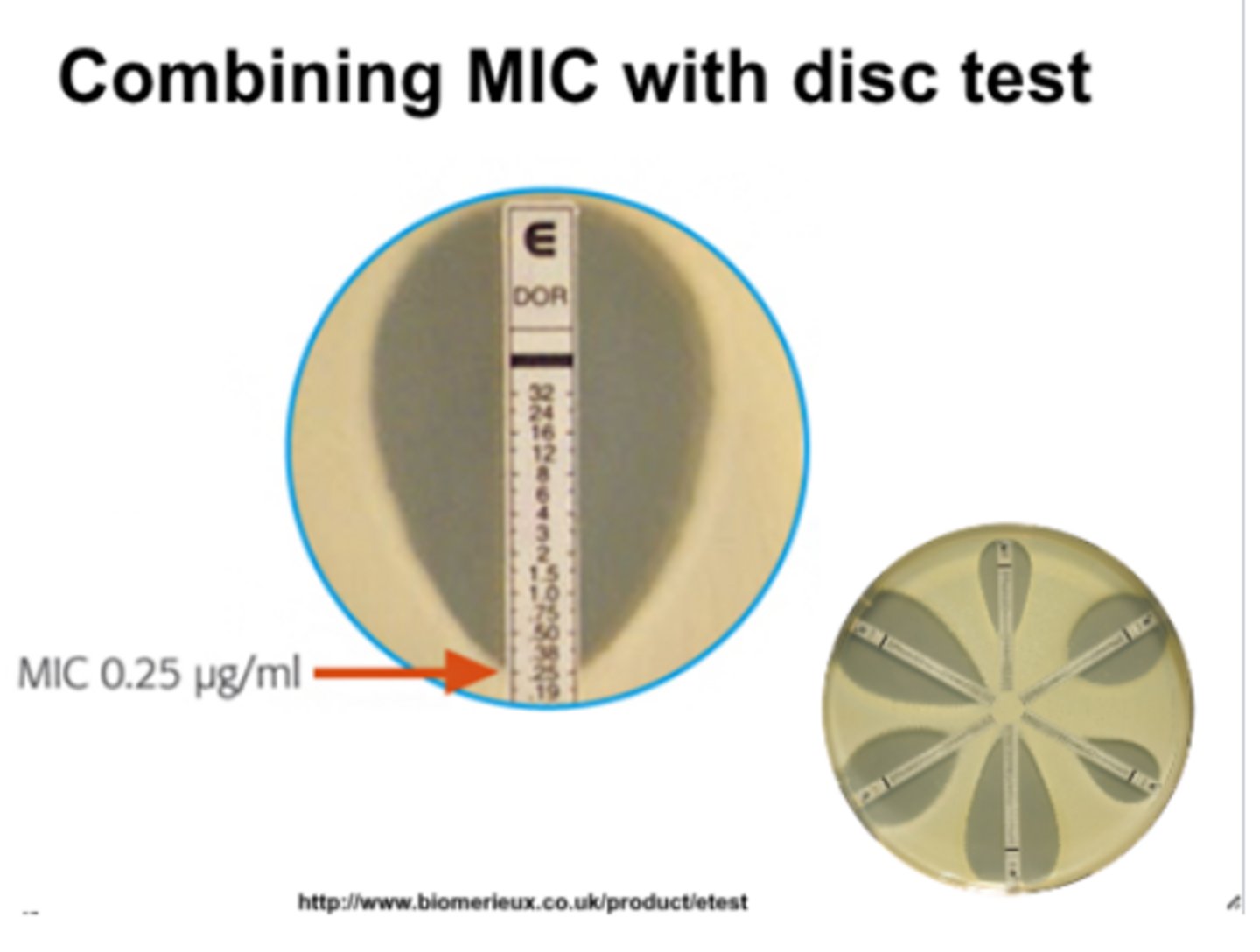
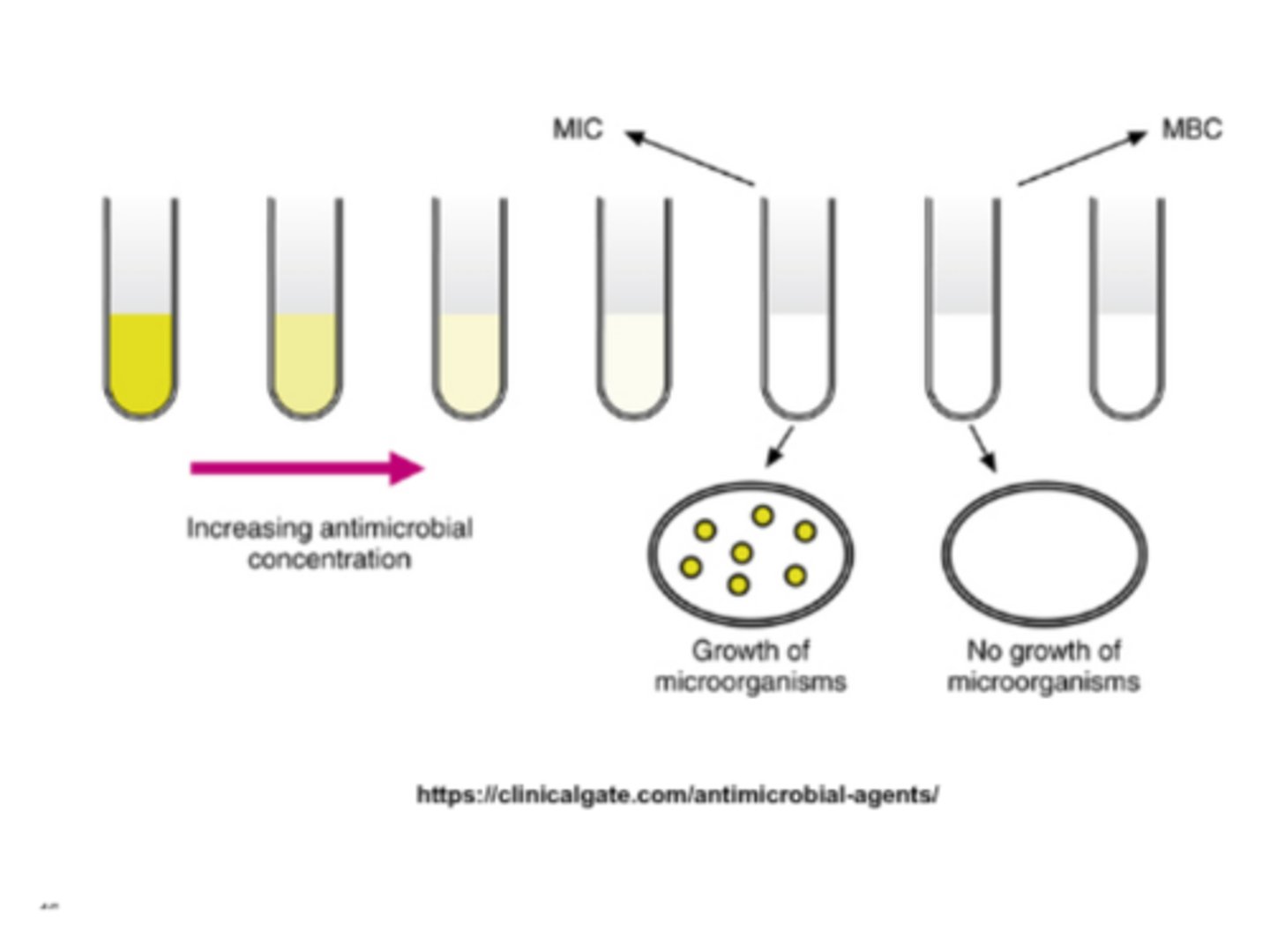
Minimal inhibitory concentration (MIC)
different serial dilutions of antibiotics placed in growth medium, least concentration of drug that inhibits growth in tube that can be VISUALLY recorded
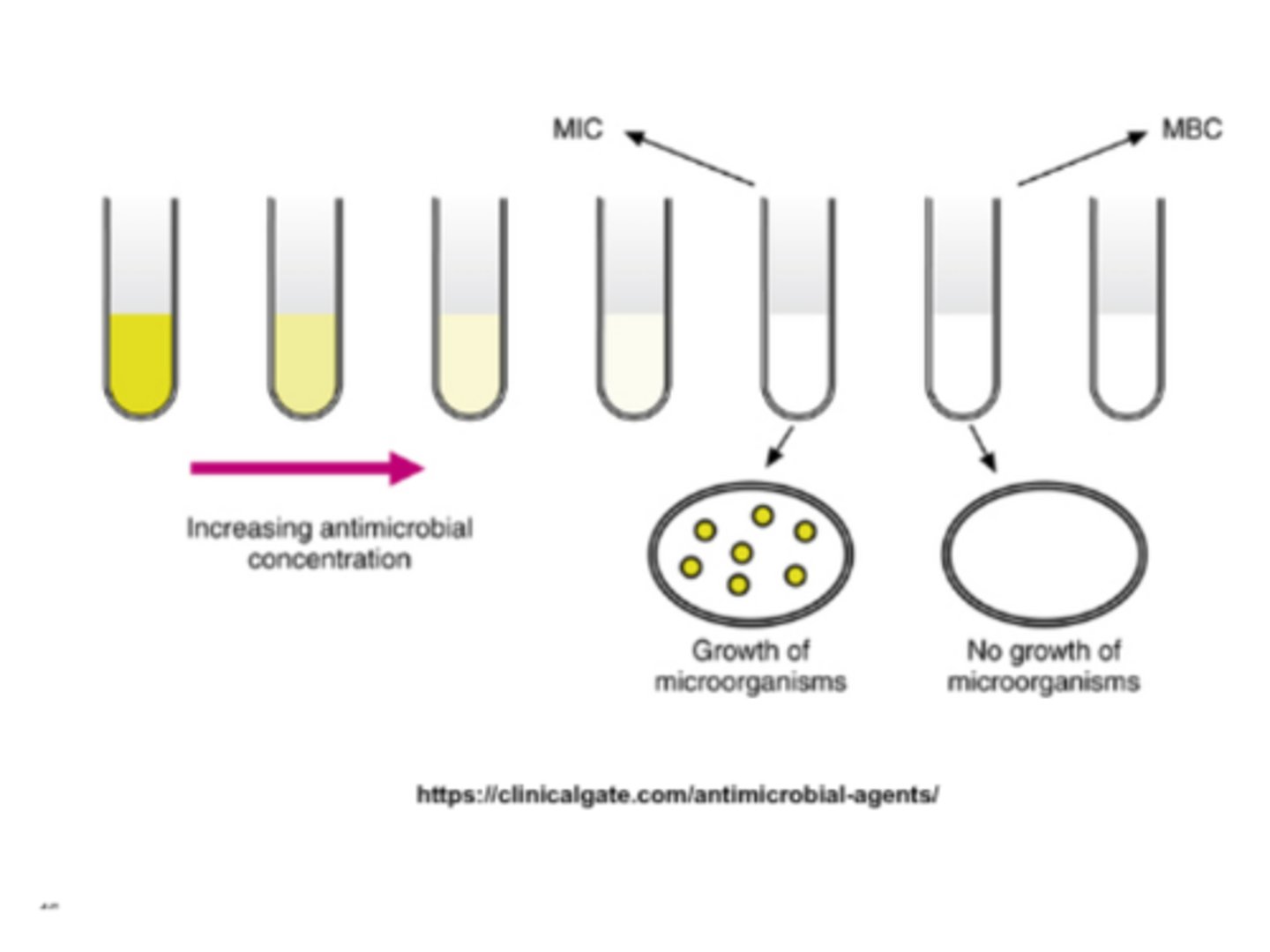
Minimum bactericidal concentration (MBC)
different serial dilutions of antibiotics placed in growth medium, least concentration of drug that KILLS ALL growth in tube that can be recorded
combining MIC with disc test
combine quantitative (MBC) with qualitative (disc/ MIC)