Regulation of Body Systems and Homeostasis
 Call Kai
 Learn
Learn Practice Test
 Spaced Repetition
 Match
Match Flashcards
 Knowt Play
1/76

Earn XP
Description and Tags
This set of flashcards covers mammalian and plant homeostasis, featuring thermoregulation, blood glucose control, water balance, and the organization of digestive and excretory systems.
Name | Mastery | Learn | Test | Matching | Spaced | Call with Kai |
|---|
No analytics yet
Send a link to your students to track their progress
77 Terms
Core body temperature
The temperature found in organs and deep tissues, which needs to be maintained in a narrow range.
Peripheral surface temperature
The temperature of cells on the outside of the body.
Thermoregulation
The process animals use to regulate body temperature through heat gain or loss.
Hypothalamus
A brain structure that acts as a control centre, responding to external temperature changes by coordinating heat loss or gain.
Vasoconstriction
The narrowing of blood vessels to reduce blood flow to the skin and minimize heat loss.
Vasodilation
The widening of blood vessels to increase blood flow to the skin, promoting heat loss.
Brown adipose tissue (BAT)
Specialized tissue that burns fat to generate metabolic heat through thermogenesis.
Conduction
Heat transfer occurring through direct contact between objects, such as feet on a cold board.
Convection
The transfer of heat from the body as air currents carry heat away.
Radiation
The loss of body heat through heat waves.
Evaporation
The process of losing heat as liquid sweat turns into gas on the skin.
Hypothermia
A medical state that occurs if the core body temperature falls below 35∘C.
Hyperthermia
A condition where the core body temperature is above 38∘C, including fever and non-fever types.
Homeostasis
The maintenance of a constant internal environment in the body regarding temperature, water levels, and glucose concentration.
Stimulus-response model
The process of monitoring a variable, detecting if it moves outside the normal range, and adjusting it through feedback.
Negative feedback
The counteracting effect of a response on a stimulus that returns a variable to its normal range.
Positive feedback
A loop that acts to increase the magnitude of a stimulus, moving it further from a set point, such as in childbirth.
Insulin
A hormone synthesized by the pancreas that acts to increase the uptake of glucose from the blood by cells and convert it to glycogen or fat.
Glucagon
A hormone produced by the pancreas that acts on liver cells to release glucose into the bloodstream by converting glycogen.
Gluconeogenesis
The production of glucose from non-carbohydrate precursors, occurring when the body is fasting.
Vascular plants
Plants containing specialized tissue responsible for transporting water, minerals, and sugars throughout the organism.
Shoot system
The part of a plant made up of reproductive sections like flowers and fruits, and non-reproductive sections like leaves and stems.
Root system
Typically underground structures that provide support and absorb water and nutrients from the soil.
Xylem
Vascular tissue composed of dead elongated cells that transport water and minerals from the roots to the leaves.
Phloem
Vascular tissue responsible for the transport of sugar manufactured in the shoot of the plant.
Metabolic water
Water produced within an organism as a result of metabolism.
Osmoregulation
The process of controlling the water content and solute concentration of the human body.
Anti-diuretic hormone (ADH)
A hormone released from the posterior pituitary that travels to the kidneys to increase water reabsorption.
Alimentary canal
The open tube in the digestive system consisting of the oesophagus, stomach, and small intestine.
Accessory organs
Solid organs, including the salivary glands, liver, gall bladder, and pancreas, that release digestive secretions into the gut.
Type 1 Diabetes
An autoimmune disease where the immune system attacks pancreatic beta cells, resulting in localized insulin deficiency.
Type 2 Diabetes
A condition where the pancreas cannot produce enough insulin or the body cells are insulin resistant.
Hyperthyroidism
A condition caused by an overactive thyroid gland producing excessive thyroxine, which increases the metabolic rate.
Receptor
A structure that detects a change in the environment (stimulus) and sends signals to the control centre.
Effector
An organ or cell that acts in response to a stimulus as directed by the control centre.
Control centre
Part of the stimulus-response model (like the hypothalamus) that interprets signals from receptors and coordinates a response.
Feedback loops
Mechanisms in the stimulus-response model that allow for the adjustment of responses based on the output signal.
Thermal receptors
Receptors that detect changes in temperature as part of the body's thermoregulation process.
Negative feedback in thermoregulation
A process where increased body temperature triggers mechanisms (like sweating) to reduce temperature back to normal.
Positive feedback in childbirth
A process where contractions increase in intensity due to hormone signals until delivery, moving further from the initial state.
Osmoregulation
The process of controlling the water content and solute concentration of the human body, crucial for maintaining homeostasis.
High water levels in the body
A condition known as hypervolemia, which can lead to dilutional hyponatremia, where sodium levels drop due to excess water.
Response to high water levels
The body reduces the secretion of anti-diuretic hormone (ADH), leading to increased urine output and a decrease in water retention to restore balance.
Low water levels in the body
A condition known as hypovolemia, which can result in dehydration and increased concentration of blood solutes.
Response to low water levels
The body increases the secretion of anti-diuretic hormone (ADH), which promotes water reabsorption in the kidneys, reducing urine output to conserve water.
Anti-diuretic hormone (ADH)
A hormone released from the posterior pituitary that increases water reabsorption in the kidneys, playing a key role in water balance regulation.
Negative feedback in osmoregulation
A self-regulating process in which changes in water levels trigger responses that correct the imbalance, helping to maintain homeostasis.
High glucose levels
A condition where the concentration of glucose in the blood exceeds normal range, triggering the stimulus-response model to initiate a response to lower glucose levels.
Response to high glucose levels
The pancreas releases insulin, which facilitates the uptake of glucose by cells, lowering blood glucose levels back to normal.
Role of insulin in glucose regulation
Insulin promotes the uptake of glucose from the bloodstream into cells, effectively reducing blood glucose levels and restoring homeostasis.
Negative feedback mechanism
The process by which an increase in a variable (like blood glucose) triggers a response (like insulin secretion) that counteracts the change, promoting stability.
Receptor in glucose regulation
Beta cells in the pancreas act as receptors that detect elevated blood glucose levels, initiating insulin release as a response.
Effector in glucose regulation
Muscle and fat cells are effectors that respond to insulin by increasing glucose uptake, contributing to the decrease in blood glucose levels.
Low glucose levels
A condition where the concentration of glucose in the blood falls below normal range, prompting a stimulus-response to elevate glucose levels.
Response to low glucose levels
The pancreas releases glucagon, which signals the liver to convert glycogen into glucose and release it into the bloodstream to raise blood sugar levels.
Role of glucagon in glucose regulation
Glucagon stimulates the liver to release glucose into the blood, counteracting low blood sugar levels and maintaining homeostasis.
High water levels in the body
A condition known as hypervolemia, which can lead to dilutional hyponatremia, where sodium levels drop due to excess water.
Response to high water levels
The body reduces the secretion of anti-diuretic hormone (ADH), leading to increased urine output and a decrease in water retention to restore balance.
Low water levels in the body
A condition known as hypovolemia, which can result in dehydration and increased concentration of blood solutes.
Response to low water levels
The body increases the secretion of anti-diuretic hormone (ADH), which promotes water reabsorption in the kidneys, reducing urine output to conserve water.
Anti-diuretic hormone (ADH)
A hormone released from the posterior pituitary that increases water reabsorption in the kidneys, playing a key role in water balance regulation.
Negative feedback in osmoregulation
A self-regulating process in which changes in water levels trigger responses that correct the imbalance, helping to maintain homeostasis.
Stimulus-response model in glucose regulation
The process by which the body detects changes in blood glucose levels and activates hormonal responses to restore balance, involving receptors and effectors.
Symptoms of hypoglycemia
Signs include dizziness, sweating, irritability, rapid heartbeat, and confusion due to inadequate glucose for cellular function.
Hypoglycemic response
A physiological reaction to low blood glucose, triggering the secretion of glucagon to increase blood sugar levels through glycogenolysis.
Impact of exercise on glucose levels
Physical activity can lower blood glucose levels as muscle cells utilize glucose for energy; thus, insulin sensitivity increases.
Role of liver in glucose homeostasis
The liver stores glucose as glycogen and releases it into the bloodstream during fasting or low glucose conditions to maintain stable levels.
Feedback mechanism in glucose regulation
A cycle where high glucose prompts insulin release to lower levels, while low glucose stimulates glucagon release to increase levels.
Metabolic response to fasting
During fasting, the body shifts to using stored glycogen and fat as energy sources, maintaining glucose levels through gluconeogenesis and glycogenolysis.
Importance of glucose for brain function
Glucose is a primary energy source for the brain, and low levels can lead to cognitive impairment and other neurological issues.
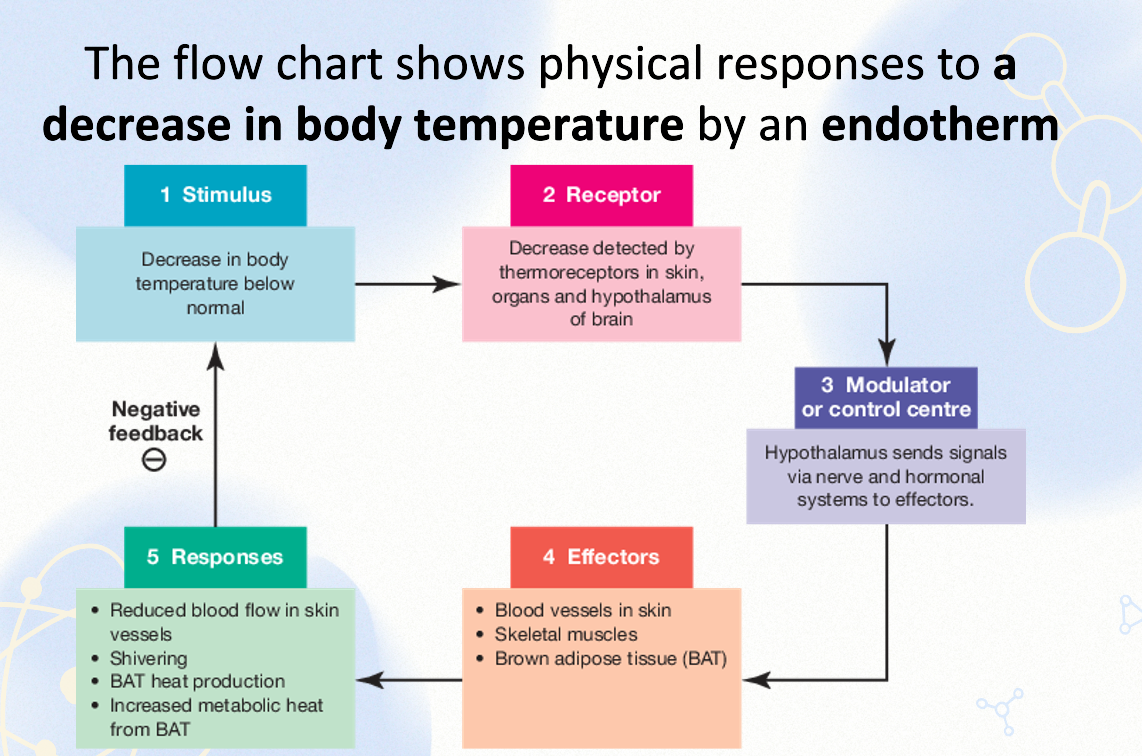
Stimulus for endotherm
Decrease in body temperature below normal
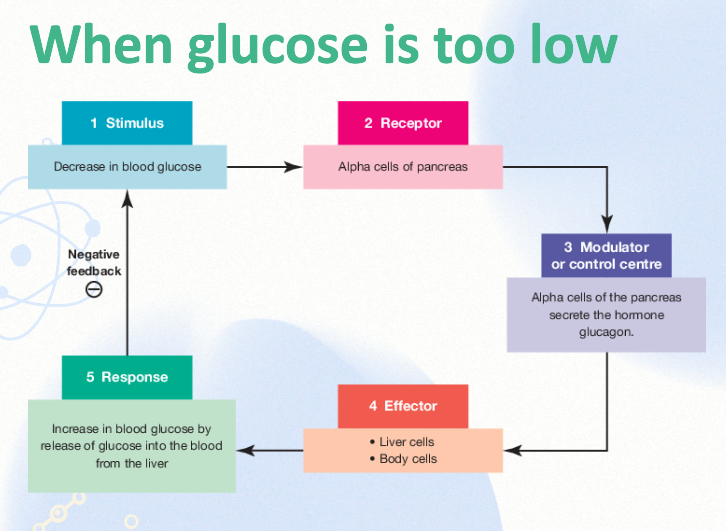
Control centre if glucose levels are too low
The control centre: alpha cells of the pancreas secrete the hormone glucagon and stimulate glucose release from the liver, increasing blood glucose levels.
Effecor role in the diagram if gluose levels are too low
The effector role involves the liver and other tissues responding to glucagon by increasing glucose production and releasing it into the bloodstream.
Guard cells in stomata
Guard cells regulate gas exchange by opening and closing stomata, controlling water loss and CO2 uptake in plants.
closing and opening guard cells in the stomata
The process by which guard cells change shape to regulate the opening and closing of stomata, controlling water transpiration and gas exchange in plants.