World History 1010 West Europe 10-18 Morris Bian Exam 2 Auburn
 Call Kai
 Learn
Learn Practice Test
 Spaced Repetition
 Match
Match Flashcards
 Knowt Play
1/57

There's no tags or description
Looks like no tags are added yet.
Name | Mastery | Learn | Test | Matching | Spaced | Call with Kai |
|---|
No analytics yet
Send a link to your students to track their progress
58 Terms
The meaning of Athenian Experience
Athenian democracy was a product of a set of historical conditions unique to Athens. There was nothing inevitable about the establishment of Athenian democracy.
In contrast to the primary political tradition of administrative centralization that developed in Persian &later Islamic empires, the case of Athens demonstrates that administrative decentralization characterized the Athenian political system.
European Civilization’s primary traditions
primary political tradition characterized by administrative decentralization & institutional pluralism
primary intellectual tradition characterized by a rational approach to human society & nature
primary socioeconomic tradition characterized by a market-oriented exchange economy
primary religious tradition characterized by the dominance of Christianity
Defining The Defining Moment
it refers to the period btwn 500 BC to 500 CE when major civilizatons developed their defining or distinguishing characteristics
moreover, major civilizations developed their defining or distinguishing characteristics during this period bc of contributions made by the creative minorities- political, intellectual, & religious leaders/thinkers who helped shape & define their civilizations.
Plato’s formative experience
He grew up during the Peloponnesian War (431-404 BC) & witnessed the collapse of the empire, the brutality of the tyrants, the execution of his master Socrates, and the revival of democracy in Athens. From these experiences, he developed not love but hatred for Athenian democracy & a profound distrust of ordinary people’s ability to tell right from wrong.
Plato: Socrates’s student
Plato’s Theory of Ideal Forms
The cornerstone of Plato’s thought was his theory of ideal forms.
World of Ephemeral & Material Forms → World of Ideal & Eternal Forms
According to Plato, only the world of ideal and eternal forms is genuine & real. To put it differently, the world in which you and I live is only a pale and imperfect reflection of the world of ideal and eternal forms.
Plato sketched an ideal state in the Republic, which was the first major work of utopian literature.
The first group (slaves) in this utopian Society is implied but never discussed
The second group consists of farmers, craftsmen, and tradesmen
The third group are the Auxiliaries. They were in part self-perpetuating & in part recruited from the most promising children of slaves.
The fourth group, the guardians, are selected from the best of Auxiliaries’ children. They undertake the task of governing upon completing training.
The guardians constitute the governing elite of the utopian state.
Aristotle: plato’s student
While Aristotle believed in the existence of ideal form, he thought form & matter were inseparable.
form: universal principle or ultimate reality.
matter: material manifestation of universal principle or ultimate reality
example: if form as the universal principle or ultimate reality constitutes the pattern for cars, then the concrete cars consist of matter, or material manifestation of form such as engines.
For aristotle, the potentiality of human beings is the capacity to reason.
what exactly is the potentiality of human beings? for Aristotle, this question turns out to be equivalent to asking what it is that is distinctive about human beings or what activity that is peculiar to men.
Aristotle identified three good forms of government in his politics.
monarchy
aristocracy
constitutional government
The potential problems:
monarchy → tyranny
aristocracy → oligarchy
constitutional government → radical democracy or anarchy
Meaning & implications of greek philosophy
Greek philosophy was a product of reason & a system of rational & logical analysis.
This rational approach to human society & nature formed the primary intellectual tradition of European civilization. Later, such an approach would form the basis of the European Renaissance, the scientific revolution, & the Enlightenment.
No deity/god was involved in the development of this system of rational approach to human society & nature. It was based almost entirely on reason rather than faith.
A brief introduction to Josef Pieper
the basic facts abt thomas aquinas & his life
thomas aquinas’s major religious, intellectual, & theological activities
the what, when, where, & why of these activities
author’s key terms & concepts
author’s main ideas, arguments, & explanations
presence of creeks/absence of major rivers
Much of the soil in Greece are made up of silty, sandy soil. Limestone is a characteristic type of soil found in Greece. The soil is not very fertile. Only about 30% of the total land area in Greece can support crops. Most farms are small bc there are no major river valleys in greece.
What does Mediterranean Triad refer to?
Grains
Olives
Grapevine
The ecological environment of ancient Greece was deficient in terms of its capacity to produce a sufficient quantity of life-sustaining resources. Consequently, ancient Greeks were driven by necessity to engage in commodity production and economic exchange, which led to the emergence of a market-oriented exchange economy.
up to half (50%) of the grain supply of the city-state of Athens was imported from the coastlands of the Black Sea!
what was the main cause of greek colonization?
The answer: population pressure. increased population further strained the already scarce food resources available in the rocky & mountianous greek peninsula & led the Greeks to establish colonies to relieve the population pressure.
Rome owed its existence to the flight of Aeneas, a refugee from Troy in Asia Minor.
Romulus & Remus, Aeneas’s descendants, almost did not survive infancy, for an evil uncle abandoned them by the flooded Tibet River
She-wolf saved romulus & remus
Romulus founded Rome (753 BC) & established himself as its first king.
the greeks provided artistic & cultural models for the romans
The Etruscans were the first people to dominate Italy, 8th-5th centuries BC
passed their architecture/construction techniques down.
In 509 BC the Romans expelled the last Etruscan king & established roman republic.
By 264 BC, Rome had conquered the entire Italian peninsula
The Consuls served as supreme civil & military Magistrates (magistrate refers to a principal official exercising governmental powers over a major political unit such as a country or a country within a country).
in 365 BC, the office of the Praetor was created
The praetor was an assistant consul, who was an annually elected magistrate, ranking below but having approximately the same functions as a consul.
The Roman Senate was a select group of 300 men (from Leading Families) who served for life.
The Senate’s advice had the force of law
The Assembly of Centuries: military assembly
The Assembly of Tribes: nonmilitary civilian assembly
How the assembly of tribes worked: each tribe received one vote. Once a majority of tribes voted in the same way on a given measure, the voting ended, and the matter was decided.
Defining Republic
The term republic refers to a political system or a form of government in which the supreme power is in the hands of representatives elected by the people.
The most noticeable element in social organization was the division btwn the Patricians & Plebeians
The Patricians were the noble families. about 5-7% of roman families belonged to the Patricians.
The Plebeians were the common people.
The struggle btwn the Patricians & the Plebeians, known as struggle of the orders, was a class struggle.
key episodes in the struggle of the Orders
institution of two new officials- tribunes -who were elected by the Plebeians to protect their rights from arbitrary acts of the Patrician magistrates (494 BC)
passage of a law allowing the right of intermarriage btwn Patricians & Plebeians (445 BC)
passage of another law making decisions by the assembly of tribes binding on the entire Roman community (287 BC)
The Roman Republic had established its dominance over the Mediterranean region by the mid-2nd century BC
expansion of the republic to 146 BC
Internal instability characterized the period of Roman history from 133-31 BC
The first important development took place in the Roman Senate
from 233-133 BC, the nobles controlled the magistracies & the senate
80% of consuls came from 26 families
50% of consuls came from 10 families
The second important development was the emergence of two types of artistocratic leaders- Optimates & Populares
nature & character of the struggle btwn the Optimates & the Populares
unlike the struggle of the orders, which was a class struggle in nature, the struggle btwn the Optimates & Populares was a struggle within the ruling class: the Optimates controlled the senate, wished to maintain their oligarchical privileges, & weaken the power of popular assemblies, while the Populares were other ambitious aristocrats who used popular assemblies as an instrument to break the Optimates’ dominance.
The sculpture of a Roman senator, named Gnaeus A Plautus, an Optimate
Tiberius Gracchus, the first Populare
The conflict btwn the optimates & populares & their supporters dominated the political landscape during the 1st century BC.
The Rise of Latifundia and the decline of Small farmers: Major Consequences
Latifundia: great landed estates
Since small citizen farmers had traditionally provided the foundation of the Roman army, the decrease in the number of small farmers meant that the number of men available for military service declined
Many of the landless small farmers drifted to cities like Rome, forming a large class of laborers who possessed no property. They constituted the new urban proletariat.
The protelariat were the lowest class of citizens without property in ancient Rome
In 133 BC, Tiberius Gracchus was elected Tribune. he was also the first Populare.
The solution offered by Tiberius Grachus was a radical program of land redistribution benefiting small farmers: limiting the property rights of the haves & gave some of the land to the have-nots.
Tiberius Gracchus holding a copy of his bill.
The senators beating Tiberius to death with clubs.
Gaius Gracchus was elected Tribune for 123 & 122 BC. Below, he presided over the Plebeian Council.
Gaius Gracchus fleeing from the elite & dying.
The lonely Gracchi brothers
During the 2nd century BC, Gaius Marius recruited an army from landless rural residents & urban workers.
The aristocratic class organized their own armies to protect their interests. their leader was Lucius Sulla
Sulla fought his way into rome
Lucius Sulla, “the blond butcher of rome”
What did Gaius Marius & Lucius Sulla have in common?
Despite their political differences, both generals recruited soldiers from the same segment of the population: the rural & urban poor
Julius Caesar 100-44 BC
in the context of chaos & disorder, Julius Caesar began the process by which Rome replaced its republican constitution with a centralized imperial form of government.
Caesar sponsored battles btwn gladiators & wild animals in the 60s BC
The conquest of Gaul by Julius Caesar
Caesar marched on Rome at the head of his legions
By 46 BC, Caesar had made himself dictator for life
he centralized military & politcal functions
he distributed confiscated land to army veterans
he launched large-scale building projects to provide employment for the urban poor
Roman senators stabbed Caesar to death, 44 BC
Gaius Octavian was Caesar’s heir & grandnephew. He took the western part of Rome.
Mark Anthony was Caesar’s ally & assistant. He took the eastern part of Rome
Mark Anthony entered into an alliance with the Egyptian queen Cleopatra, & fell in love with Cleopatra.
The Battle of Actium, 31 BC
Significance of the Battle of Actium: It marked the end of the Roman Republic
In 27 BC, Octavian proclaimed the “restoration of the Republic” which led the senate to award him the title Augustus (the blessed/fortunate)
Augustus/Octavian (27 BC-14 CE) was the FIRST EMPEROR of the Roman Empire (27 BC-476 CE)
Administrative Centralization under Augustus
He accumulated vast powers & took responsibility for all important governmental functions.
He created a new standing army & appointed commanders who pledged alliance directly to the emperor
He placed individuals loyal to him to all important positions
Evidence of political instability & chaos
for about half a century (235-284), only two of the 22 emperors did not meet a violent death.
During a campaign in 284 CE, the emperor was killed, so the soldiers acclaimed Diocletian as emperor.
Division of the Empire into Four Prefectures
Gaul
Italy
Illyricum
East
The Four Roman Emperors
where can you find them? corner of the facade, San Marco, Venice, Italy
this form of government- four persons sharing power simultaneously or the rule of four- is called tetrarchy
Eastern Roman Empire = Byzantine Empire (476-1453 with capital in Constantinople)
What happened to the Senate after the Roman Republic was transformed into the Roman Empire?
Unlike the Senate of the Republic, the Senate of the Emirate was not politically independent. With the loss of its independence to the emperor, the senate lost its prestige and much of its power. Following Emperor Diocletian’s reform, the senate became politically irrelevant and never regained the power that it had once held.
hebrew stuff
According to the Hebrew Scripture, the Hebrew Patriarch (Hebrew tribal leader) Abraham was a native of the Sumerian City Ur in Mesopotamia
Around 1300 BC, the Hebrews left Egypt for Palestine under Moses, the prophet and lawgiver
During the reigns of david & solomon, the Hebrews dominated the territory between Syria & Sinai Peninsula
Moses taught that there was only one supreme god- Yahweh, the creator & sustainer of the world
These elements came to characterize Judaism (Jewish religion & Jewish way of life) & exerted a profound influence on the development of Christianity
monotheism
scriptures
moral concerns
after jewish kingdom of david & solomon dissolved in 930 BC, the jewish people maintained their faith & communities under various imperial regimes
various imperial regimes
babylonian empire
achaemenid empire
Alexandrian Empire
seleucid empire
roman empire
The jews considered the pretensions of the state cults to be blasphemy (contemptuous act). As a result, they refused to pay homage to a mortal being who laid claim to divinity.
Roman forces defeated the rebels (jews) during the Jewish War, 66-70 CE
Jesus of Nazareth & the Rise of Christianity
Bethlehem: birthplace of Jesus of Nazareth
Nazareth: childhood home of Jesus
Baptism of Jesus by John the Baptist- the beginning of his public ministry
Jesus’s Sermon on the Mount, which epitomizes his moral teachings
The teachings of Jesus alarmed the romans bc jesus also taught that “the kingdom of god is at hand”
jesus before pontius pilate
crucifixion of jesus, 30 CE
The resurrection of Jesus
The Old & New Testament
Paul of Tarsus & the spread of christianity
Paul of Tarsus: second founder of christianity
Paul: a jewish rabbi from Tarsus of Anatolia
Paul’s converts included Gentiles
Gentile: one who is not of the jewish faith or is of a non-jewish nation; non-jews.
Paul conceived of Christianity as a universal religion
It was Paul of Tarsus who developed a comprehensive christian theology
According to this theology, the death & resurrection of Christ became the culminating event in the history of human civilization. Essentially, Paul’s doctrine demanded individuals to observe high moral standards & to place their faith ahead of personal & family interests. Pual’'s teachings also explained the world & human history as a result of god’s purposeful activity, so that it provided a framework of meaning for individuals’ lives. Finally, Paul’s doctrine promised a glorious future existence for those conscient observed the Christian faith.
Paul’s first missionary journey
paul’s three missionary journeys
paul’s captive journey to rome
The basic roman policy toward religion was one of toleration
Foreign gods were tolerated as the Roman Empire expanded
Foreign gods were granted citizenship of Mount Olympus located in Greece
Toleration was the hallmark of Roman Religious Policy
The persecution of Christians must be considered in the context of a fundamental conflict between the predominant religious belief of Roman society & the religious belief of a distinct religious minority.
Diocletian’s Edicts (303-304) ordered:
The destruction of Christian churches
The burning of Christian scriptures
The imprisonment of Christian clergy
The sentence to death for all those who refused to sacrifice to Roman gods
Constantine the Great: the first Roman Emperor to profess Christianity
The battle of Milvian Bridge near Rome, 312
Flaming cross Emperor Constantine saw at Milvian Bridge?
Significance: The Battle of the Milvian Bridge led to Constantine’s conversion to Christianity
Although Emperor Constantine did not get to have the Last Supper with Jesus Christ, he considered himself to be the 13th apostle.
The Edict of Milan (313 CE) officially declared the imperial policy of tolerating Christianity
“We decided that it was right that Christians and all others should have freedom to follow the kind of religion they favored”
Bian was one of a dozen scholars invited to attend an international symposium at the University of Bocconi in October 2008 in milan, italy
cathedral of Milan. took 5 centuries to complete, & is the 4th largest cathedral in the world
Christianity became State religion under Emperor Theodosius the Great (346-395 CE)
key elements of new european civilization
The new European civilization resulted from the coming together/fusion of three elements:
Germanic peoples
legacy of the Romans
Christianity (teachings & church)
germanic peoples & the formation of a new political landscape in western europe
The Germanic invaders originally came from Scandinavia, which currently includes the three countries of Denmark, Norway, & Sweden
by the beginning of the common era, the germanic peoples had movied to the areas north of the Rhine and Danube Rivers
The germans = goth eastern ostrogoths western visigoths
The establishment of the Frankish kingdom was the work of Clovis, who succeeded his father as king of the Franks in 481.
By the time Clovis died in 511, he had thoroughly transformed the Franks, making them the most powerful & dynamic of the peoples building new states in western europe
Baptism of Clovis & his Army, 497 CE
What explains the Frank’s Success?
The main reason was their conversion to Christianity. By adopting Christianity, the Franks attracted the allegiance of the Christian population of the former Roman Empire and the recognition & support of the Western Christian church
The successor of Clovis managed to hold on to power until the early 8th century, when another aristocratic clan of the Carolingians deposed the Frankish king & assumed the kingship of the Frankish state.
Pippin the Short (4’6”)
Pippin the Short vs. Pippen (Scottie)(the chicago basketball player), the tall
pippen (scottie) the tall: 6’8
pippin the short: 4’6
Papacy = Roman Catholic Church
The anointment of Pippin the Short not only marked the establishment of the Carolingian Dynasty; it introduced the idea of theocratic monarchy into Western Europe
The establishement of Carolingian Dynasty & empire building in europe
The founder of the Carolingian Dynasty was Pippin the Short
When Pippin the Short died in 768, his son Charlemagne succeeded him as king of the Franks.
Scottie Pippen (basketball) Vs Charlemagne
Scottie Pippen (basketball) (6’8)
Charlemagne (6’4)
extent of the Carolingian Empire
In order to bring about administrative centralization, Charlemagne relied on his aristocratic deputies, the so-called counts, to maintain order & stability in local society
Charlemagne had to travel (on horseback) throughout the empire in order to maintain his authority
Why did Charlemagne travel so much? The reason is that he did not have the resources to create an elaborate bureaucracy. The Carolingian Empire did not even have a permanent capital. As a result, Charlemagne & his court constantly changed their whereabouts, bringing with them the empire’s central government on their journey. The court was literally an itinerant court.
Charlemagne also appointed Missi Dominici (“envoys of the lord ruler”) to maintain control over local officials & prevent their integration into provincial aristocracy.
Despite the best efforts by Charlemagne & others, kings & emperors in medieval Europe never managed to bring about effective administrative centralization or centralized imperial rule. Instead of creating a centralized administrative bureaucracy, medieval European rulers developed a decentralized feudal system of government.
statue of charlemagne: perhaps a symbol of european integration?
The European Union (EU) is a political & economic union of 27 member states. On 31 January 2020, the UK became the first member state to leave the EU.
Disintegration of the Carolingian Empire: Cause & Consequence
It is the case of the Carolingian Empire, the empire became disintegrated after the mid 9th century.
cause for the disintegration of the Carolingian Empire
Louis the Pious, Charlemagne’s son, lost control of the counts and other local authorities. After Louis died in 843, his three sons divided the Carolingian Empire into three equal portions, each taking one portion to rule as king.
An equally important factor was a new wave of nomadic invasions during the 9th century.
Magyars: Descendants of a Nomadic People from Central Asia who had settled in Hungary
Magyar Invasion, 9th century
The vikings were truly outstanding sailors
they sailed shallow-draft boats
Viking Shallow-draft boats- the real thing
Major consequences of Nomadic invasions:
1) disintegration of the Carolingian Empire
2) formation of regional states
creating a feudal society in medieval Europe
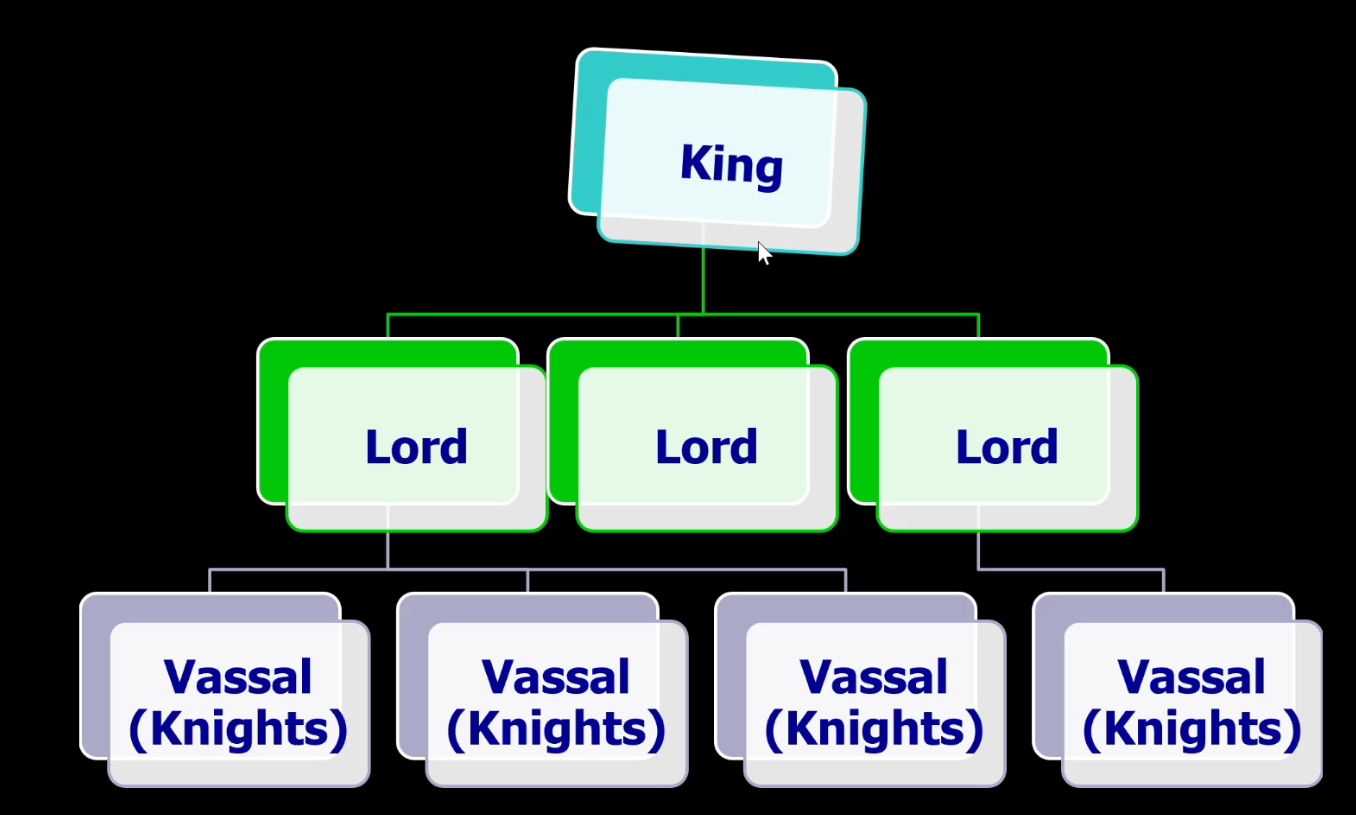
The devolution (transfer of power from a central government to local units) of central authority & nomadic invasions led to the emergence of a new type of political order known as feudalism. By definition, feudalism refers to political and social order of societies that decentralized public authority and responsibility rather than vest them in a central government
Medieval Europe built an elaborate feudal system, which revolved around political and military relationships, & one of these was the relationship between lord & vassal
The Lord provided the Vassal with a Grant known as a Benefice- typically grants of land
In exchange for a benefice, the vassal owed his lord loyalty, obedience, & military service
The relationship between a lord & vassal was characterized by reciprocity- the mutual exchange of favors
What explains the emergence of Serfs?
Beginning in the 7th century, rulers & administrators recognized intermediate categories of individuals who were neither fully slave nor fully free. These semi-free individuals became known as Serfs, who owed various obligations including labor services & payments of rent in kind (goods/produce). Over time, the institution of serfdom encouraged the development of the manor (a large estate) as the principal form of agricultural organization in Western Europe.
The life of serfs under the feudal system
As a decentralized political & social order, medieval feudalism represented an extension & expansion of the European civilization’s primary political tradition, which is characterized by administrative decentralization & institutional pluralism.
Expanding primary religious tradition: the development of Christian institutions
The first significant development in Christian institutions took place during the 4th century
The Christian community in each city had been headed by a bishop
The bishop at 4 cities possessed special powers
rome
jerusalem
alexandria
antioch
Subsequently bishops of Rome were considered the successors of Peter & came to be known as Popes.
Pope Gregory the Great defined the scope of the pope’s power & authority through a series of actions in response to threats posed by a Germanic people known as Lombards.
The Lombards: Germanic people originally from Scandinavia
The Lombards consolidated their hold & threatened Rome & the Roman church
It was Pope Gregory the Great who laid the foundation for the Papal States, 754-1870
Another major Christian institution which emerged during medieval Europe was the monastery
The first Dark Age in the evolution of European civilization: 1200-700 BC
The period between 1200 - 700 BC was one characterized by constant internal warfare and political, economic, and social depression. It was a period of sustained systemic crisis. Little to no artifacts, ruins, or other traces remain, which explains why this period is termed Dark Age
A crisis (an unstable & dangerous condition) is “sustained” when it lasts a long time. A crisis is “systemic” when it affects an entire society/civilization.
The second Dark Age in the evolution of European civilization: 476-1000 CE
The sustained systemic crisis during the second Dark Age gave rise to monasticism (monastic life or system)
Benedict of Nursia, 480-547 CE
Benedict founded a monastery at Monte Cassino & wrote a set of rules called the Benedictine Rule, which established the basic form & norms of monastic life. Since it was adopted by so many monastic communities, Benedict became known as the patriarch of Western monasticism.
Benedict founded his own monastery at Monte Cassino.
The Benedictine Rule established the basic form as well as norms of monastic life.
People who lived in monasteries were Monks
Four hours of collective prayer in chapel (4)
Four hours for meditation/Private reading (4)
Six hours for physical labor (6)
Ten hours for eating/sleeping (10)
Abbot: "Father” of a monastery
The monastery underwent a transformation and became absorbed into society as an institution of fundamental importance. Early medieval society was pitifully lacking in workable institutions that it had to impose social obligations on the monks & monasteries. Consequently, monks came to assume educational, religious, economic, & political functions.
At one point, 40000 monasteries in medieval Europe actually followed the Benedictine Rule
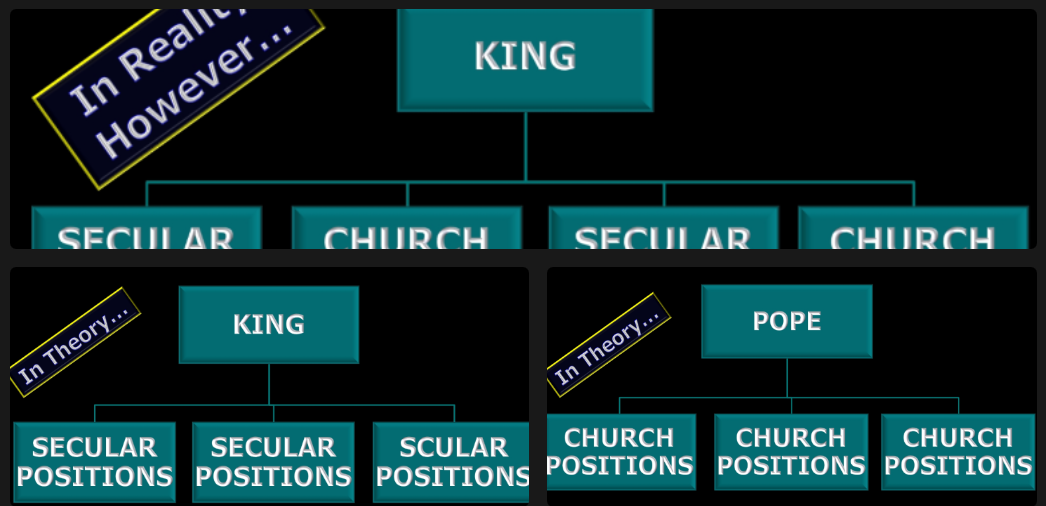
At the same time, as the Roman Catholic Church expanded its institutions, a new tradition of church-state competition & rivalry took place.
Forming a new tradition of church-state rivalry in Europe, 500-800
Pippin the Short came to power only with the sanction of the Papacy.
The roman catholic church formulated an ideology of papal authority in a famous medieval document known as Donation of Constantine
Constantine: the first Roman emperor to profess Christianity (reigned 306-337 CE)
According to the legend behind the Donation of Constantine, Constantine had a debilitating disease- Leprosy
Leprosy- leads to loss of sensation, paralysis, and deformation
The leper colony in the state of Louisiana: Carville/National Leprosarium, 1894-1999
Pope Sylvester (who was bishop of Rome from 314 to 335 CE) cured Constantine of Leprosy
The Pope presenting the Donation of Constantine to Pippin the Short, 754
The Donation of Constantine- the entire document was a lie. The so-called Donation of Constantine never took place! In fact, it was the best-known forgery in history. It was simply an attempt by the papacy to establish papal authority over secular rulers.
There was only one problem. The so-called Donation of Constantine was a lie. It never took place. The so-called Donation of Constantine, the document, represents an attempt by the Roman Catholic Church to establish papal authority over secular rulers.
The leadership in Europe was not in the hands of the bishop of Rome, but in the hands of King Charlemagne.
While conducting a military campaign, King Charlemagne received an urgent call for help from Pope Leo III
Pope Leo III took an oath purging himself of all charges during the trial.
Old St. Peter’s Basilica refers to the structure that stood from the 4th to 16th centuries. Construction began during the reign of Emperor Constantine I. The New St. Peter’s Basilica was built from 1506 to 1615.
Meaning of the coronation of Charlemagne
By successfully carrying out the coronation of Charlemagne, Pope Leo had demonstrated the supremacy of the religious power of the Roman Catholic Church over the secular power of the Frankish state.
Continued church-state competition and rivalry, Pope Gregory VII vs. King Henry IV
creation of the Papal States, 754-1870
The practice of secular rulers appointing individuals to ecclesiastical positions (such as bishops) in the Roman Catholic Church was known as lay investiture. Under lay investiture, secular rulers both chose & invested their nominees to church offices with the symbols of their office. Lay investiture is what prompted effort by Pope Gregory VII (1073-85)
Pope Gregory VII attempted to restore autonomy of Christian church by freeing the church from interference by secular rulers in the appointment of church officials.
Pope Gregory VII demanded that King Henry IV give up the institution of lay investiture
Pope Gregory VII excommunicated King Henry IV
King Henry IV was convinced that he needed to go to Italy to personally seek absolution (formal remission of sin imparted by a priest) from the Pope.
Canossa Castle was located in northern Italy. Pope Gregory VII had King Henry IV stand in the snow for three days. Pope Gregory heard King Henry’s confession and absolved him. King Henry was powerful enough to take vengeance by driving Pope Gregory from Rome to take refuge in Southern Italy.
The Investiture Controversy dragged on until 1122 when a new German king & a new pope reached a compromise called Concordat of Worms.
Key provisions of the Concordat of Worms
A bishop in Germany was first elected by church officials
After election, the nominee paid homage to the king as his feudal lord, who then invested him with the symbols of temporal (secular) office
A representative of the pope invested the new bishop with the symbol of his spiritual (religious) office.
to summarize the Investiture Controversy
The investiture controversy represented continued rivalry & power struggle between the Roman Catholic Church & secular rulers in Western Europe.
The idea of separate spheres of church & state emerged for the first time. It emerged precisely because of such rivalry & power struggle. This idea laid the intellectual foundation for the eventual separation of church & state in the West.
Synthesizing Primary religious and intellectual traditions: the development of Scholasticism, 1000-1300
Faith Vs. Reason
perceived conflict between faith & reason
The establishment of universities & the revival of the primary intellectual tradition facilitated the resolution of such a conflict.
Evolution of Schools and Universities
Cathedral of Notre Dame in Paris (built during 1163-1345. Fire date: 4/15/2019)
The faculty guilds had the effect of transforming cathedral schools into universities
The first universities included the University of Paris, founded around 1200
The University of Paris was noted for its instruction in theology and philosophy
Dr. Pieper had a lot to say about the University of Paris in his book Guide to Thomas Aquinas.
“The University of Paris became the most important university in the West, shortly after its establishment around 1200. The University of Paris, became, among other things, the university of paris became the most representative of the medieval universities, because among other things, it was founded in the most purest and radical way upon those branches of knowledge which are called universal in their own nature. Theology and philosophy.”
“The University of Paris in the 13th century took the lead in philosophical and theological examination of the world, thereby achieving a sort of supremacy.”
Rediscovery and translation of the works of Aristotle
How were the works of Aristotle discovered?
First, it had to do with the Byzantine connection
Second, it has to do with the Muslim connection
Muslim philosophers had translated the works of Aristotle into Arabic. Subsequently, Christian scholars in Sicily and Spain became aware of those Arabic translations, which they then re-translated into Latin.
What does translation mean? It means transmission of knowledge- making a body of knowledge available to people who read/write/speak a different language.
The translation of Aristotle from Arabic into Latin made Aristotle’s thought accessible to European Christian scholars.
Thomas Aquinas and the attempt to reconcile Faith and Reason
The attempt to reconcile faith and reason led to the development of scholasticism, which was the dominant Christian theological and philosophical school or system of the Middle Ages based on Aristotle and the church fathers. It sought to bridge the gap between faith & reason.
Thomas Aquinas was born into an elite family in Italy about 1225.
Thomas Aquinas spent 9 years at the Abbey/monastery at Monte Cassino founded by Benedict of Nursia
Thomas was exposed to the works of Aristotle for the first time at the University of Naples.
Saint Dominic founded in 1216 a new religious order called Dominicans.
In contrast to the traditional paternalistic form of government for monks in a monastery, the Dominicans had a democratic form of government in the form of Mendicant Friars- begging monks.
Dr. Pieper referred to this (mendicant friars- begging monks) as voluntary poverty movement.
In contrast to the traditional monastic life of prayer & manual labor, the Dominicans now pursued an active life of teaching and preaching.
Thomas Aquinas his family had Thomas kidnapped and kept him under captivity at the castle of Monte San Giovanni Campano. His family did not like that Thomas Aquinas wanted to transfer to the Dominican religion.
Averroes was a Spanish-Arab Philosopher. Averroes believed that faith and reason could be contradictory (mutually opposed).
The teaching of Averroes attracted disciples in the Faculty of Arts at the University of Paris.
Dr. Pieper pointed out that the school of thought established at the University of Paris is referred to in the literature as “Latin Averroism”
Condemnation of Thomas Aquinas, 1277
In 1277, the Masters of Paris, the highest theological jurisdiction in the Roman Catholic Church, condemned 219 propositions. Among these propositions, 12 were those of Thomas Aquinas. The penalty for anyone teaching the listed errors was excommunication.
Thomas saw no contradiction btwn aristotle & christian revelation, but rather saw them as complementary authorities. For Thomas, Aristotle provided the most powerful analysis of the world according to human reason while Christianity explained the world and human affairs as the result of a divine plan.
According to Aristotle, a Conscious Agent had set the world in motion.
Thomas Aquinas believed that the Conscious Agent who set the world in motion was God. In other words, The Conscious Agent = God.
What can we conclude from this discussion?
Scholastic theology or scholasticism represented the harmonization of the rational approach to human society and nature and the Christian religion or the synthesis of reason and faith.
Larger patterns of cultural & religious change emerged in the development of scholasticism.
Christian scholars responded to the challenge presented by the primary intellectual tradition by incorporating & appropriating its rational approach.
Commentaries Thomas Aquinas made on the Old Testament & New Testament became required readings for all Christians
Thomas Aquinas
canonized (declared a deceased person to be a saint) in 1323
named doctor (theologian) of the Roman Catholic Church in 1567
Proclaimed the protagonist (leading figure) of orthodoxy at the end of the 19th century