CHPT 8 - Electric resistance
 Call Kai
 Learn
Learn Practice Test
 Spaced Repetition
 Match
Match Flashcards
 Knowt Play
1/20

There's no tags or description
Looks like no tags are added yet.
Name | Mastery | Learn | Test | Matching | Spaced | Call with Kai |
|---|
No analytics yet
Send a link to your students to track their progress
21 Terms
what is resistance
a measure of the hindrance of the flow of electrons along a conductor, It is caused by collisions between electrons and the (metal) ions that make up a conductor
what does increasing the length of the wire do to resistance
increases the resistance
resistance equation
voltage = current x resistance
V = I x R
measure of resistance
Ohms, Ω
what is ohmes law
it relates the current through a conductor to the potential difference across it
(can also just say the equation linking them)
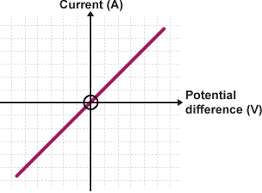
why do ohmic conductors obey ohm’s law
voltage is directly proportional to current
the resistance of the component is constant due to linear gradient
Line of best fit passes through the origin
an example of ohmic conductors
resistors
I-V characterisitic of a fixed resistor
directly proportional
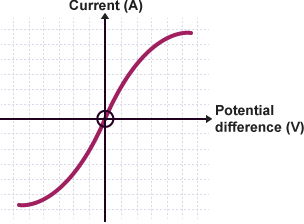
I-V characteristics Bulb
when the temp increases the atoms inside the wire vibrate more
the resistance increases
current decreases
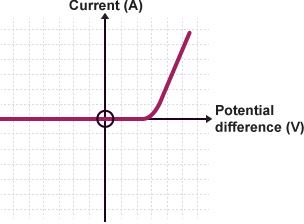
I-V Characteristics for a diode
only allows current to flow in one direction
what is a fixed resistor
a really long wire that is wound into a coil
resistance remain constant
what is a thermistor
Increasing temperature, decreases resistance
These are used to turn on/ off circuits that are temperature dependant
what is a L.D.R
As light intensity increases the resistance decreases
used in street lamps to turn on/ off circuits
what is a variable resistor
As the length of the wire increases the resistance increases
used to vary the resistance so you can vary voltage of the circuit
used in dimming lights
what happens if a thermistor is warm
its resistance is low , cold = high
what is the most well known semi conductor
silicon
advantages of a series circuit
It requires fewer wires
It will have lower resistance values
disadvantages of a series circuit
there is no independent control for each component
if one component breaks the whole circuit breaks
advantages of a parallel circuit
each component can be controlled independently
Even if one component breaks the others will continue to function
disadvantages of a parallel circuit
requires many more wires, more complicated set up
all branches have the same voltage as a supply making it more difficult to control the voltage for each individual component