BIO102 Exam3
 Call Kai
 Learn
Learn Practice Test
 Spaced Repetition
 Match
Match Flashcards
 Knowt Play
1/49

There's no tags or description
Looks like no tags are added yet.
Name | Mastery | Learn | Test | Matching | Spaced | Call with Kai |
|---|
No analytics yet
Send a link to your students to track their progress
50 Terms
Major Histocompatibility Complex
A set of proteins on the surface of cells
_________ are chemicals that allow cells to communicate with each other
Cytokines
An abnormal reaction by the immune system to a harmless substance
Allergy
The _____ helps the body maintain its balance of fluid between tissues and blood
Kidney
The female ureter is ______ than the male ureter
Equal
The female urethra is ________ than the male urethra
shorter
Which are fat-soluble vitamins?
A, D, E, and K
The action by smooth muscles moving food along the digestive tract is called:
Peristalsis
To increase surface area for absorption of nutrients, the epithelial cells lining the small intestine have:
villi and microvilli
The digestive tract section where vitamin K is produced and absorbed is the:
large intestine
What is malnourishment?
Lacking in calories, minerals
What does “essential” mean in nutrition?
Necessary and our bodies can’t make it, so it must be ingested.
Which molecules do we NOT need to ingest?
nucleic acids
What are the parts of the small intestine?
Duodenum, jejunum, ileum
What are minerals?
Inorganic molecules that we need to eat in small amounts.
What are vitamins?
Organic molecules that we need to eat in small amounts
Which part of the digestive tract has smooth and skeletal muscle controlling it?
Esophagus
Where is bile stored before it is released into the small intestine?
Gall bladder
What is a function of the liver in the digestive system?
To check, modify, and detoxify chemicals in blood coming from the small intestine
What does the pancreas produce to neutralize acidic chyme entering the small intestine?
Bicarbonate
Where does carbohydrate chemical digestion begin?
Oral cavity
Where does carbohydrate chemical digestion finish?
Small intestine
Where does protein chemical digestion begin?
Stomach
Where does protein chemical digestion finish?
Small intestine
Where does lipid chemical digestion begin?
Small intestine
Where does lipid chemical digestion finish?
Small intestine
Natural killer cells are a type of ________ cell
lymphocytes
The efferent arteriole has _______ diameter than the afferent arteriole
an equal
The lymph system has 2 main functions: to maintain ______ _______ between tissues and blood and protecting the body against _________.
osmotic balance, infection
A, B, and Rh (used to designate blood type), are _________ of the presence/absence of A, B, or Rh antigens on the surface of red blood cells
indications
Fluid transfer from the glomerular capillaries into the glomerular capsule:
is caused by high pressure in the glomerular capillaries
In a nephron, glucose and other molecules are returned to the blood from the filtrate by:
reabsorption
In a nephron, glucose and other molecules are put into the nephron tubule from the blood by:
secretion
In the kidney, blood cells are only in:
peritubular capillaries and other blood vessels
What are antigens?
foreign molecules that start an immune response
What starts any immune response by any part of the immune system?
A non-self or foreign cell or part of a foreign cell or a molecule
Stomach and vaginal acidity, mucus, coughs and sneezes, and lysozymes in tears and sweat are all examples of:
innate immunity
Cave art by early humans sometimes included pictures of humans showing signs of an inflammatory response. What might these signs be?
Swelling and redness
The complement protein system is made of:
proteins that attach to pathogens and draw attention to them or kill them by piercing holes in them.
“Innate” in the innate immune system means:
born with
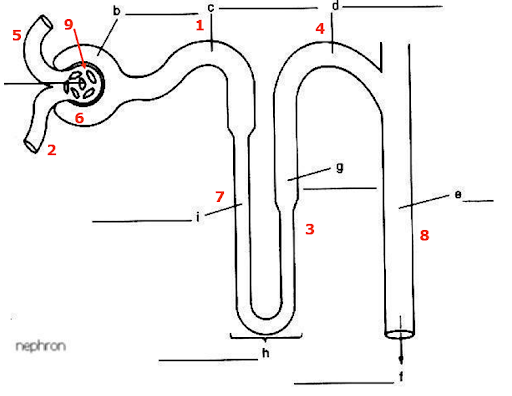
Identify number 1
Proximal convoluted tubule
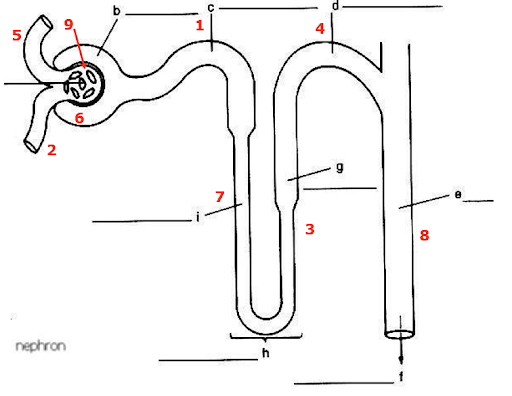
Identify number 2
Efferent arteriole
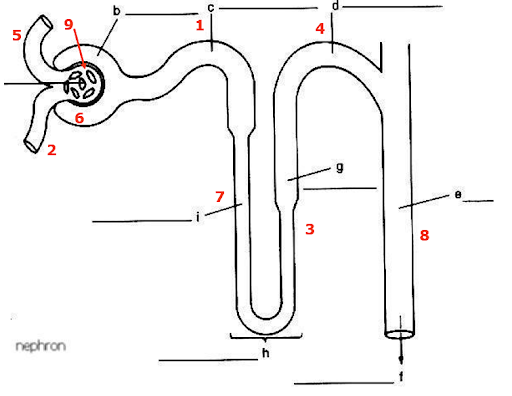
Identify number 3
Ascending limb of the loop of Henle
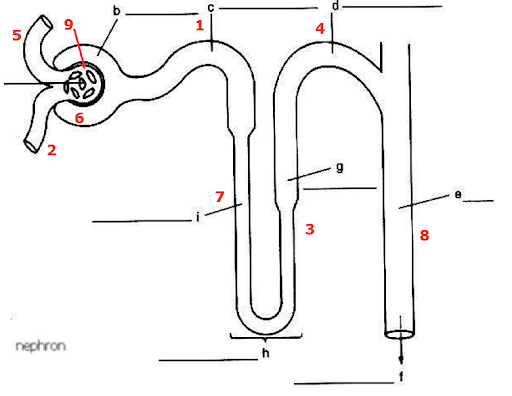
Identify number 4
Distal convoluted tubule
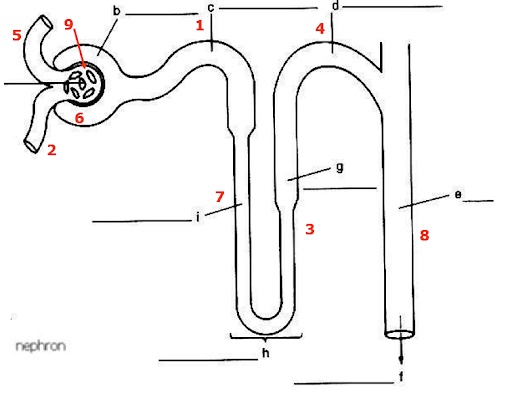
Identify number 5
Afferent arteriole
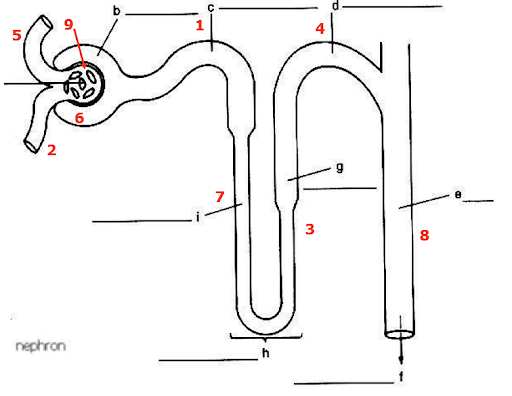
Identify number 6
Glomerular/Bowman’s capsule
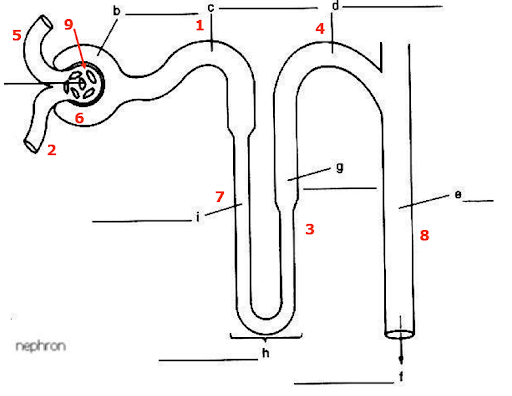
Identify number 7
Descending limb of the loop of Henle
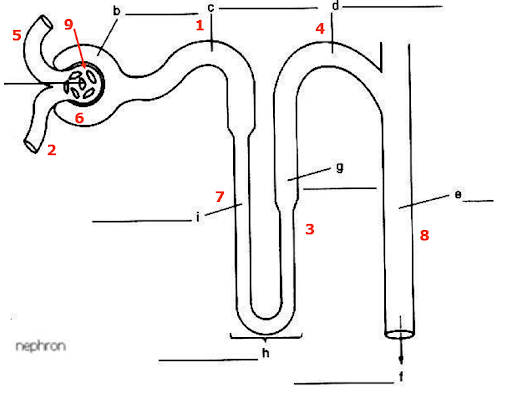
Identify number 8
Collecting duct
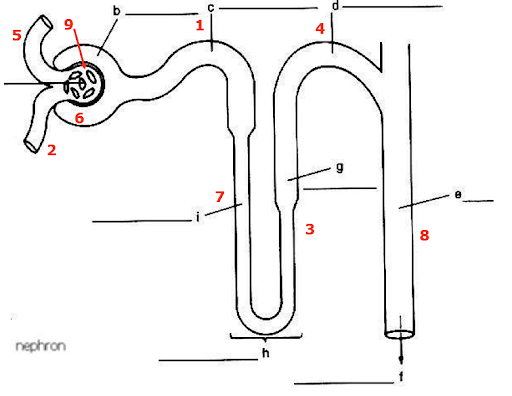
Identify number 9
Glomerular capillaries
What do the glomerular capillaries and the glomerular capsule make up?
The glomerulus