4 International Law and Municipal Law
 Call Kai
 Learn
Learn Practice Test
 Spaced Repetition
 Match
Match Flashcards
 Knowt Play
1/9

There's no tags or description
Looks like no tags are added yet.
Name | Mastery | Learn | Test | Matching | Spaced | Call with Kai |
|---|
No analytics yet
Send a link to your students to track their progress
10 Terms
•Are international law and municipal law: One unified system? or two separate systems?
•Scholars have developed three primary theories to explain how international and domestic law interact.
→ Monism legal school vs Dualism
Monoism
•Core idea: One single legal order.
•International law automatically applies domestically.
•No need for transformation.(no need for the domestic legislation must take action to use the PIL no need to do anything it happens automatically)
•International law may be supreme.
•This approach views all law as a single, unified system where international law sits at the top of a legal hierarchy. In this view, municipal law derives its validity from international law, and international rules can often be applied directly by domestic courts without transformation.
•Example:
•The Netherlands Constitution gives primacy to international treaties.
•Monism is often linked to natural law traditions and Kelsen’s hierarchy of norms.
Dualism
•Core idea: Two separate systems.
•International law governs states.
•Municipal law governs individuals.
•International law must be incorporated.
•This theory views international law and municipal law as entirely separate and distinct legal systems. Because they operate on different planes—international law between states and municipal law between the state and its citizens—international law cannot apply domestically unless it is "transformed" into local law through legislation.
•Example:
•UK treaties require parliamentary legislation before they apply domestically.
A Third Approach aka harmonization theory
•A Third Approach: Some jurists argue that the two systems never actually conflict because they occupy different spheres. Each is supreme in its own area (like the laws of two different countries), and any perceived "conflict" is actually just a conflict of obligations for the state.
There is no real legal conflict between the two systems — only conflicts in the state’s obligations.
in practice, states use a mix, and what happens depends heavily on context (type of law, court, constitution).
Can States Rely on Domestic Law Internationally?: Municipal Law in International Tribunals VERY IMPORTANT!!!!
•In the eyes of international courts, such as the International Court of Justice (ICJ), the following rules apply regarding domestic law:
•• No Defense for Breach: A state cannot use its own domestic laws (or even its constitution) as a defense for failing to fulfill an international obligation.
•• Treaty Obligations: Under the Vienna Convention on the Law of Treaties (Article 27), a party may not invoke the provisions of its internal (domestic) law as justification for its failure to perform a treaty.
•• Municipal Law as "Fact": International tribunals generally treat municipal laws as "facts"—evidence of a state's conduct or will—rather than as "law" that can bind the international court.
•Example:
•If Parliament fails to implement a treaty → state still internationally responsible.
“International tribunal = court for countries”
Article 46 VCLT – Simple Breakdown
The Basic Rule: International law doesn't care about a country's internal/domestic law when making treaties.
BUT there's an Exception — Municipal (domestic) law does matter if BOTH conditions are met:
Condition | Meaning |
|---|---|
1. Manifest violation | The breach was obvious to any reasonable state |
2. Fundamental importance | The internal rule broken was major (e.g., constitutional) |
Both must exist together. One alone is not enough.
Article 46 in plain English:
A country cannot use its own broken internal law to escape a treaty — unless the violation was obvious AND involved a very important constitutional rule.
Quick Example: A president signs a treaty but the constitution requires parliament's approval. If this requirement is well-known and he clearly ignored it → the country can invalidate the treaty. If the rule was obscure and not obvious → they're stuck with the treaty.
Exam Keywords to Remember:
Manifest = objectively obvious to any state acting in good faith
Fundamental importance = constitutional-level rule
Default = internal law is irrelevant to treaties
Exception = manifest + fundamental = consent can be invalidated
•1. Does customary international law apply automatically?
•2. Do treaties apply automatically?
•Some systems accept it automatically. (First approach) (aka monoism)
•Others require incorporation. (Second approach) (aka dualisim)
•
•UK traditional position:
•Customary international law is part of common law unless contrary statute exists.
YOU NEED TO KNOW THESE UK EXAMPLES
•Treaties differ from custom.
•In many states:
•Treaties require implementing legislation.
•Why?
•Because treaties create obligations between states, not automatically rights for individuals.
vvv vvvv imp read
attached
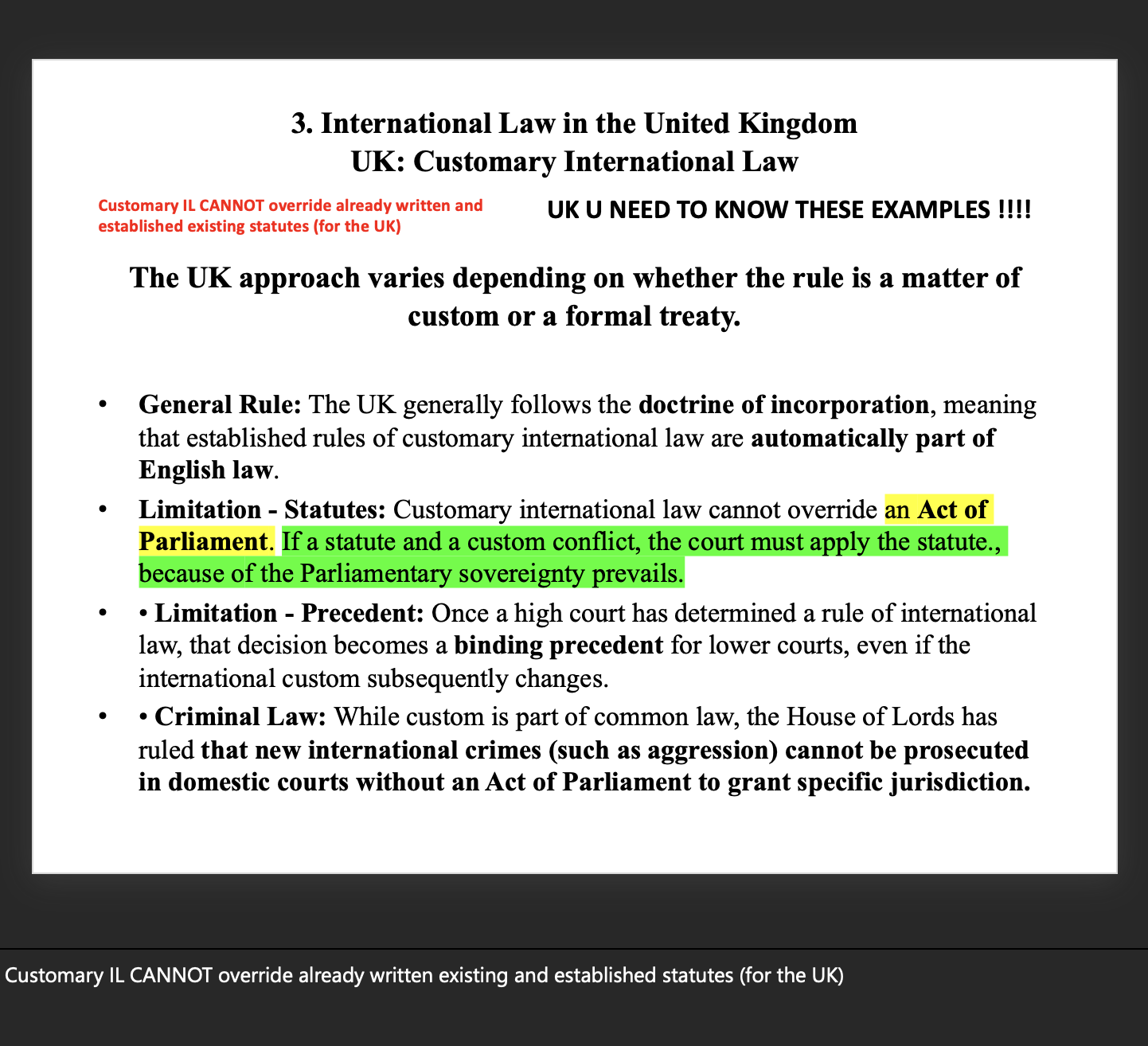
UK: Treaties (The Doctrine of Transformation)
attached
UK Treaties – Doctrine of Transformation (Simple Version)
The Basic Rule: Treaties signed by the UK do NOT automatically become UK law.
Why? Because only Parliament can change UK law — not the executive (Prime Minister/government).
So what happens? A treaty goes through 2 steps:
Ratification → UK signs/agrees to the treaty internationally
Incorporation → Parliament passes an Act to make it actual UK law
This is called "transformation" — the treaty gets transformed into domestic law.
The key example to remember:
European Convention on Human Rights ➡ became UK law through the Human Rights Act 1998
One liner to remember it:
Treaty signed by PM + Act of Parliament = becomes UK law
![<p>attached</p><p>UK Treaties – Doctrine of Transformation (Simple Version) </p><p class="font-claude-response-body break-words whitespace-normal leading-[1.7]"><strong>The Basic Rule:</strong> Treaties signed by the UK do <strong>NOT</strong> automatically become UK law.</p><p> </p><div data-type="horizontalRule"><hr></div><p> </p><p class="font-claude-response-body break-words whitespace-normal leading-[1.7]"><strong>Why?</strong> Because only <strong>Parliament</strong> can change UK law — not the executive (Prime Minister/government).</p><p> </p><div data-type="horizontalRule"><hr></div><p> </p><p class="font-claude-response-body break-words whitespace-normal leading-[1.7]"><strong>So what happens?</strong> A treaty goes through <strong>2 steps:</strong></p><p> </p><ol><li><p><strong>Ratification</strong> → UK signs/agrees to the treaty internationally</p></li><li><p><strong>Incorporation</strong> → Parliament passes an <strong>Act</strong> to make it actual UK law</p></li></ol><p> </p><p class="font-claude-response-body break-words whitespace-normal leading-[1.7]">This is called <strong>"transformation"</strong> — the treaty gets <em>transformed</em> into domestic law.</p><p class="font-claude-response-body break-words whitespace-normal leading-[1.7]"><strong>The key example to remember:</strong></p><figure data-type="blockquoteFigure"><div><blockquote><p class="font-claude-response-body break-words whitespace-normal leading-[1.7]">European Convention on Human Rights <span data-name="arrow_right" data-type="emoji">➡</span> became UK law through the <strong>Human Rights Act 1998</strong></p></blockquote><figcaption></figcaption></div></figure><div data-type="horizontalRule"><hr></div><p class="font-claude-response-body break-words whitespace-normal leading-[1.7]"><strong>One liner to remember it:</strong></p><figure data-type="blockquoteFigure"><div><blockquote><p class="font-claude-response-body break-words whitespace-normal leading-[1.7]"><em>Treaty signed by PM + Act of Parliament = becomes UK law</em></p></blockquote><figcaption></figcaption></div></figure><p></p>](https://assets.knowt.com/user-attachments/b46f3c26-ff40-4ffd-b1c4-136bc8198359.png)
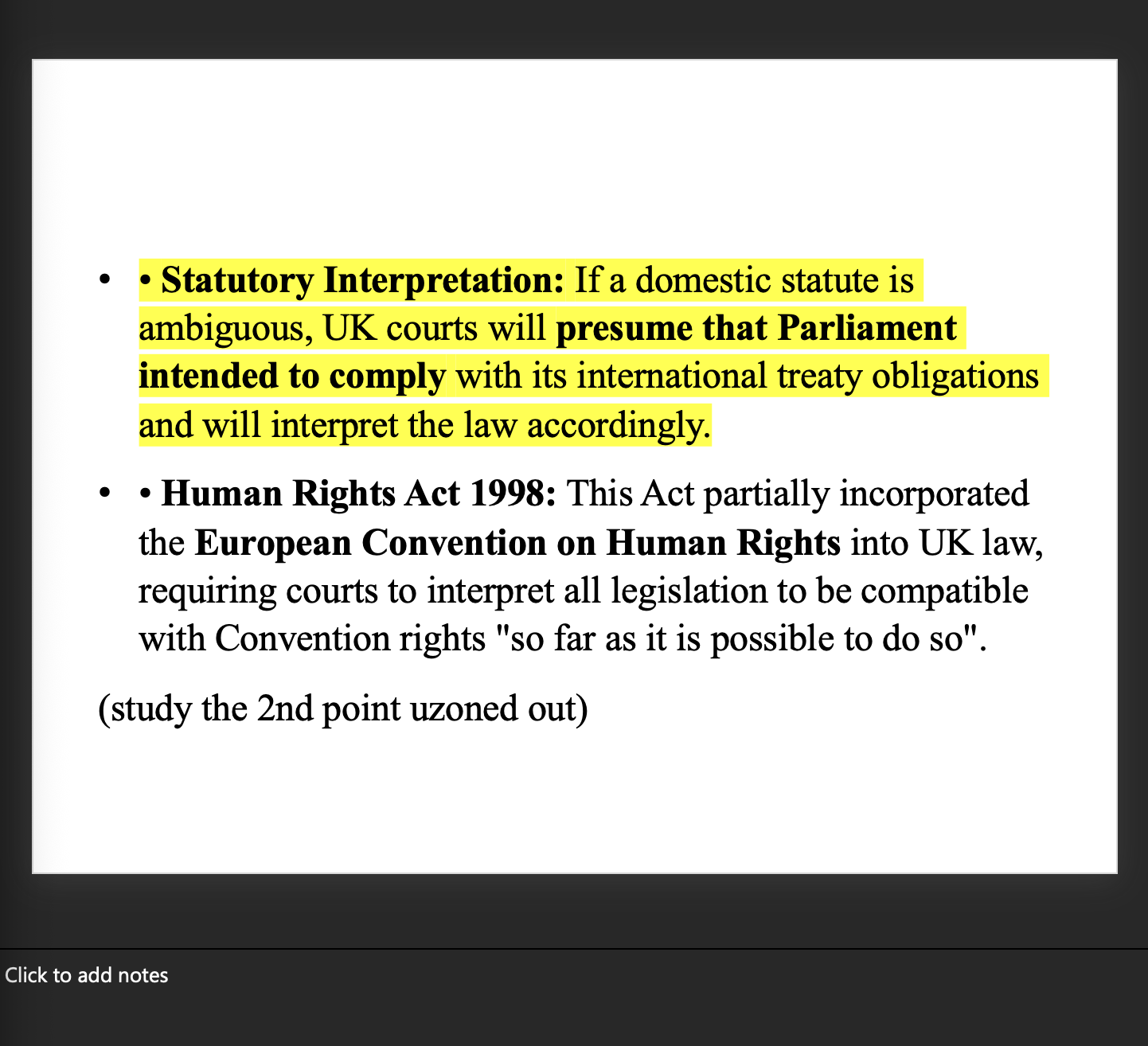
read the attached here then go to the back side
Simplifying These 2 Points
1⃣ Statutory Interpretation & Treaties
In simple terms: When a UK law is unclear/confusing, courts assume Parliament meant to follow international treaties when they wrote it — so they interpret the law in a way that matches the treaty.
Think of it like this:
Law is vague → court asks "what did Parliament mean?" → assumes they meant to follow the treaty → interprets it that way
Example logic:
If a law could mean A or B, and the treaty says B — the court picks B
2⃣ Human Rights Act 1998
In simple terms: This Act brought the European Convention on Human Rights (ECHR) into UK law. Now courts must try to read ALL UK laws in a way that's compatible with human rights.
The key phrase "so far as it is possible" means:
Courts will stretch the meaning of a law to make it HR-compatible
But if it's truly impossible, they can't rewrite the law — only Parliament can fix it
🔑 The Big Difference Between the Two:
Statutory Interpretation | Human Rights Act | |
|---|---|---|
When used | Any ambiguous law + any treaty | Any law + ECHR specifically |
How strong | A presumption (assumption) | A legal duty |
Bottom line: Courts always try to make UK law match treaties/human rights — but Parliament has the final say.
Sonnet 4.6
Adaptive
check attached very imp
![<p>Simplifying These 2 Points </p><div data-type="horizontalRule"><hr></div><p> <span data-name="one" data-type="emoji">1⃣</span> Statutory Interpretation & Treaties </p><p class="font-claude-response-body break-words whitespace-normal leading-[1.7]"><strong>In simple terms:</strong> When a UK law is <strong>unclear/confusing</strong>, courts assume Parliament <em>meant</em> to follow international treaties when they wrote it — so they interpret the law in a way that <strong>matches the treaty.</strong></p><p> </p><p class="font-claude-response-body break-words whitespace-normal leading-[1.7]"><strong>Think of it like this:</strong></p><p> </p><figure data-type="blockquoteFigure"><div><blockquote><p class="font-claude-response-body break-words whitespace-normal leading-[1.7]">Law is vague → court asks <em>"what did Parliament mean?"</em> → assumes they meant to follow the treaty → interprets it that way</p></blockquote><figcaption></figcaption></div></figure><p> </p><p class="font-claude-response-body break-words whitespace-normal leading-[1.7]"><strong>Example logic:</strong></p><p> </p><figure data-type="blockquoteFigure"><div><blockquote><p class="font-claude-response-body break-words whitespace-normal leading-[1.7]">If a law could mean A or B, and the treaty says B — the court picks <strong>B</strong></p></blockquote><figcaption></figcaption></div></figure><p><span data-name="two" data-type="emoji">2⃣</span> Human Rights Act 1998</p><p class="font-claude-response-body break-words whitespace-normal leading-[1.7]"><strong>In simple terms:</strong> This Act brought the <strong>European Convention on Human Rights (ECHR)</strong> into UK law. Now courts <strong>must</strong> try to read ALL UK laws in a way that's compatible with human rights.</p><p class="font-claude-response-body break-words whitespace-normal leading-[1.7]">The key phrase <strong>"so far as it is possible"</strong> means:</p><ul><li><p>Courts will <em>stretch</em> the meaning of a law to make it HR-compatible</p></li><li><p>But if it's <strong>truly impossible</strong>, they can't rewrite the law — only Parliament can fix it</p></li></ul><div data-type="horizontalRule"><hr></div><p> <span data-name="key" data-type="emoji">🔑</span> The Big Difference Between the Two:</p><table style="min-width: 75px;"><colgroup><col style="min-width: 25px;"><col style="min-width: 25px;"><col style="min-width: 25px;"></colgroup><tbody><tr><th colspan="1" rowspan="1"><p></p></th><th colspan="1" rowspan="1"><p>Statutory Interpretation</p></th><th colspan="1" rowspan="1"><p>Human Rights Act</p></th></tr><tr><td colspan="1" rowspan="1"><p><strong>When used</strong></p></td><td colspan="1" rowspan="1"><p>Any ambiguous law + any treaty</p></td><td colspan="1" rowspan="1"><p>Any law + ECHR specifically</p></td></tr><tr><td colspan="1" rowspan="1"><p><strong>How strong</strong></p></td><td colspan="1" rowspan="1"><p>A presumption (assumption)</p></td><td colspan="1" rowspan="1"><p>A <strong>legal duty</strong></p></td></tr></tbody></table><div data-type="horizontalRule"><hr></div><p class="font-claude-response-body break-words whitespace-normal leading-[1.7]"><strong>Bottom line:</strong> Courts always <em>try</em> to make UK law match treaties/human rights — but Parliament has the final say.</p><p class="is-empty is-editor-empty before:!text-text-500 before:whitespace-nowrap"></p><p>Sonnet 4.6</p><p>Adaptive </p><p><strong><mark data-color="#b60099" style="background-color: rgb(182, 0, 153); color: inherit;">check attached very imp</mark></strong></p>](https://assets.knowt.com/user-attachments/bdceda95-b111-48a1-a468-18486de3763a.png)
watch the ppt video and read notebook u didnt read pls read
11 mins that summarizes everything
note imp
attached
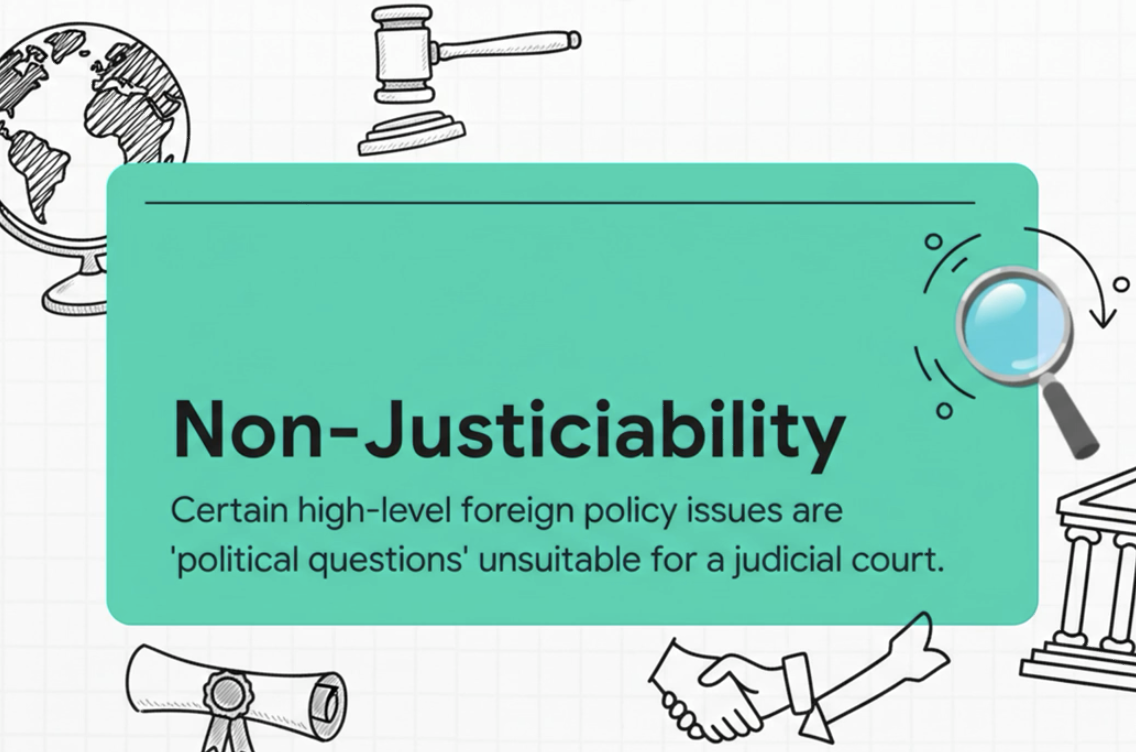
another imp note
attached
A court will refuse to act as a judge for the legality of what another country did inside their own country
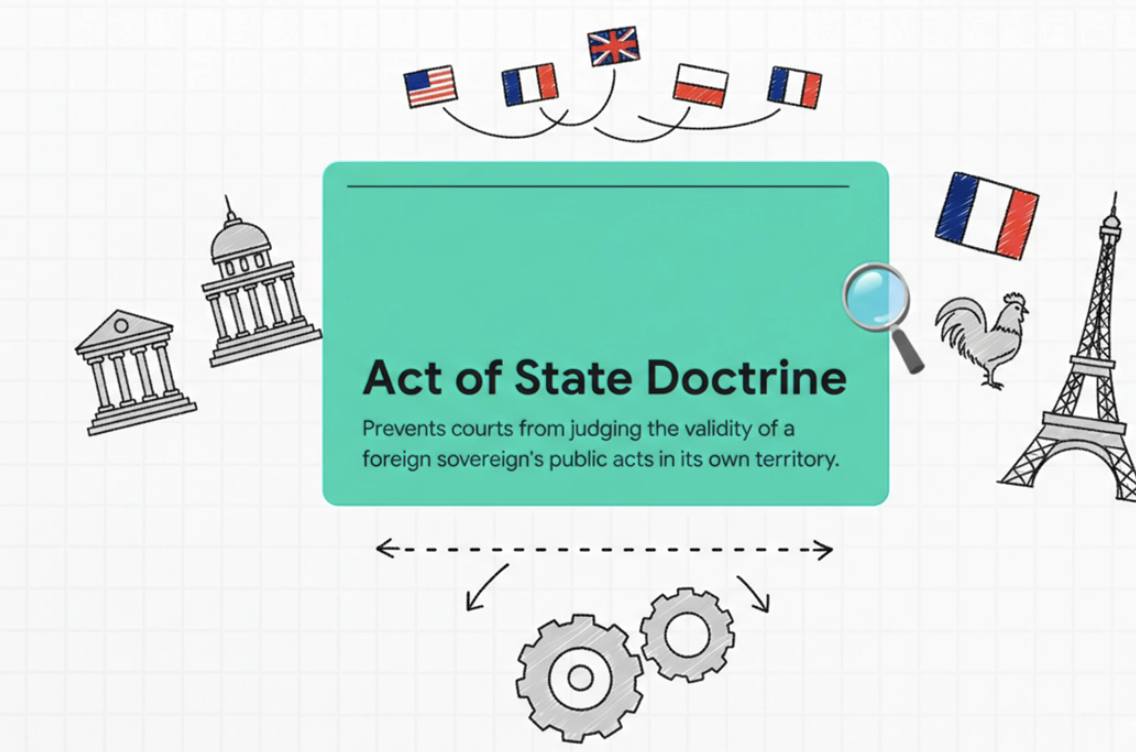
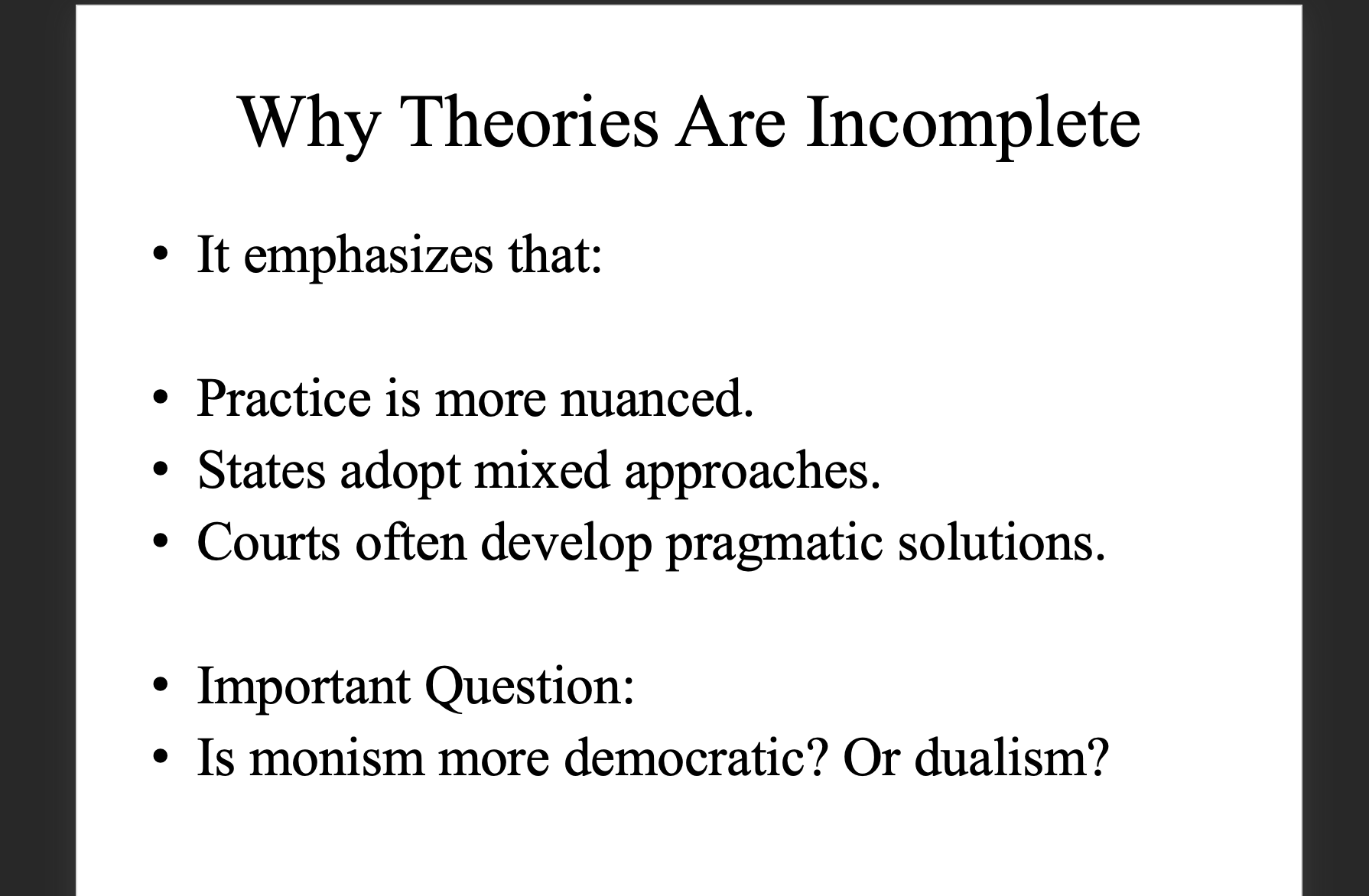
attached here is a question answer in the back
Is Monism More Democratic? Or Dualism?
Neither is inherently more democratic — it depends on context:
Monism can be seen as more democratic because international law (e.g., human rights treaties) automatically applies domestically, protecting individuals without waiting for parliamentary action.
Dualism can be seen as more democratic because parliament must deliberate and incorporate international law, giving elected representatives control over what becomes binding domestic law.
In practice, courts blend both approaches pragmatically, which is exactly why neither theory alone is complete.
Pragmatic means practical and realistic — focusing on what actually works, not just ideas.
Easy way to remember:
👉 Pragmatic = “does it work in real life?”