Sociolinguistics Exam Three
 Call Kai
 Learn
Learn Practice Test
 Spaced Repetition
 Match
Match Flashcards
 Knowt Play
1/36

There's no tags or description
Looks like no tags are added yet.
Name | Mastery | Learn | Test | Matching | Spaced | Call with Kai | Chat |
|---|
No analytics yet
Send a link to your students to track their progress
37 Terms
Language maintenance/shift
What type of languages have the majority of speakers / list three of these languages
Dominant languages
Chinese, English, Spanish
Language maintenance/shift
_% of the world’s population speaks __% of the world’s languages
4, 96
Language maintenance/shift
What is the Graded Intergenerational Disruptions Scale and its purpose
a framework used in sociolinguistics and language planning to measure the vitality of a language and the extent to which it is threatened by extinction
Purpose is to help communities and researchers determine exactly how "endangered" a language is so they can apply the correct revitalization strategies.
Stage 8 (most endangered) to Stage 1 (most secure)
Language maintenance/shift
Why do languages shift?
It is usually a pragmatic response to shifting social, political, and economic pressures
Social: what is seen as “cool”, push languages out of social domains
Political: Having a required language in education
Economic: The dominant language is the only one used in trade and high-paying jobs
Language maintenance/shift
Shifting Languages
The child-bearing generation can use the language among themselves, but it is not being transmitted to children
Language maintenance/shift
Moribund Languages
The only remaining active users of the language are members of the grandparent generation and older
Language maintenance/shift
Dormant Languages
Languages with no fluent speakers, but still have an identifiable function for the community
Language maintenance/shift
Extinct Languages
No speakers and no function within a community
Language maintenance/shift
Warning Signs for language shift / death
Functionality decreases (domains)
Dramatic increase in code-switching
Grammar changes (inflections/function words)
Vocabulary gaps
Language maintenance/shift
Linguistic imperialism
The exploitation of the ideological, cultural and power of colonizing languages for the economic and political advantage by those who can speak that language (English, Portuguese, Spanish, Dutch) ← Class slides
Suggests that the dominance of a language like English is a form of hegemony. This means the dominant group (usually Western powers) maintains its status not just through military or economic force, but by making its language and culture seem "superior" or "essential." ← makes more sense to me
Language maintenance/shift
Three impacts of language loss
Eroding human database
Loss of cultural heritage
Lose human cognition
Language maintenance/shift
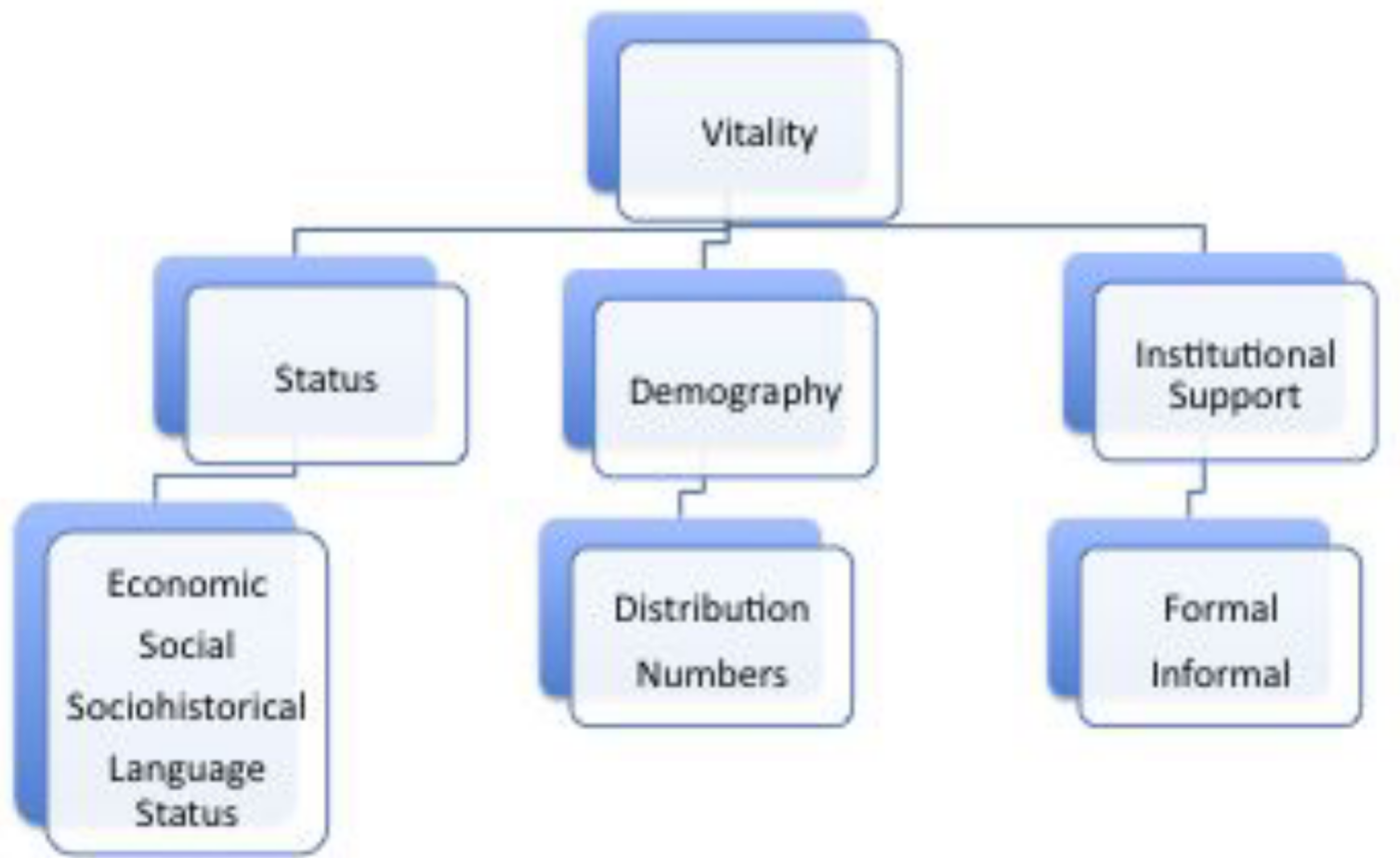
Pillars of vitality
Status, demography, institutional support
economic/social/sociohistorical/language status, distribution numbers, formal/informal
Language maintenance/shift
Language loss and oppression
Linguistic Discrimination
The education system
When the state makes the dominant language the only gateway to employment and healthcare
Language maintenance/shift
Case study of Maori (Status, demography, institutional support)
Pillar | 1970s Status | 2020s Status |
Status | Low; stigmatized; "dying" language. | High; official; source of national pride. |
Demography | Dispersed; aging speaker base. | Growing youth base; urban but connected. |
Institutional | Active suppression in schools. | Dedicated TV, schools, and legal rights. |
In 1987, the Māori Language Act declared Te Reo Māori an official language of New Zealand.
Cursing
What is happening in the brain?
-Seems to be right-brained-
cursing may be viewed as an automatic process, relying on the right hemisphere and the subcortical areas
Cursing
What is the psychological effect?
-Freezing water experiment-
The likelihood of cursing depends on one’s age, cognitive reasoning ability, emotional awareness, religiosity, impulsivity, and gender
Cursing
Frequency changes in cursing
Average person utters 80-90 swears a day (.3-.7%)
As of 2026, the data indicates a significant upward trend in the frequency of profanity in public and private life, driven by a shift in what society considers "offensive."
The primary trend is that scatological and sexual terms are losing their "shock value," while slurs (related to identity) are becoming the new high-level taboos.
Cursing
What is cursing?
Use of taboo words, non-literal interpretation, formulaic (not usually created on the fly), emotive
Cursing
Relationship between oaths and curses to modern-day cursing
Belief that the curse could bring about bad things
A pox upon your house!
The power of swearing is it’s taboo nature.
Cursing
Semantic areas in which taboos are frequent
religion, body parts, effluvia, ethnicity, sex
Cursing
Profanity is relatively stable
Damn and Hell have a long history
Cursing
Gender and cursing
Women tend to use milder swear words
45% of all swearing in public.
Women are expected to pay more attention to politeness
Cursing
Censoring of cursing on TV/film
● Profane content includes "grossly offensive" language that is considered a public nuisance.
● Factors in determining how FCC rules apply include the specific nature of the content, the time of day it was broadcast and the context in which the broadcast took place.
● Broadcasting obscene content is prohibited by law at all times of the day. Indecent and profane content are prohibited on broadcast TV and radio between 6 a.m. and 10 p.m., when there is a reasonable risk that children may be in the audience.
Cursing
Fighting words
-Cursing and protected speech (First Amendment rights)-
words which "by their very utterance, inflict injury or tend to incite an immediate breach of the peace.”
-The Court found that words which produce a clear and present danger are unprotected (and are considering fighting words), but words which invite dispute and even cause unrest are protected (and are not considered fighting words).
Accent Discrimination
Relationship to Title VII (make certain you can cite one example)
Under Title VII, it is unlawful for an employer “to fail or refuse to hire or to discharge any individual, or otherwise discriminate against any individual with respect to his compensation, terms, conditions, or privileges of employment, because of such individual’s race, color, religion, sex or national origin.”
Accent Discrimination
Learning accent discrimination through the media at a young age
-Categorization and Stereotyping-
Social Categorization: Grouping individuals based on social information (Sex, race, age, but also status, occupation, sexual orientation). Once that happens, we often respond to them as members of a social group and not as an individual.
Simplifies perception and cognition
Accent Discrimination
Standard Language Ideology
The standard is superior to all other varieties
Accent Discrimination
Stereotypes associated with accents
Competence, friendliness
hero vs villain
Accent Discrimination
Stereotyping that leads to discrimination
When stereotyping moves from a "mental shortcut" to an action that limits a person's rights or opportunities, it becomes linguistic profiling—the auditory equivalent of racial profiling.
Because we often associate accents with race, social class, or intelligence, these biases lead to measurable, systemic discrimination in critical areas of life.
Accent Discrimination
Preston's Folk linguistics/folk dialectology
Preston’s most famous experiments involved asking participants to draw lines on a map of the U.S. to show where they thought different dialects existed and to rate them based on two criteria: Correctness and Pleasantness.
Before Preston, linguists mostly cared about how people actually spoke. Preston shifted the focus to how non-linguists (the "folk") perceive those speech patterns.
Language Rights as Human Rights
Variety of Sign Languages
-Individual involved: L'Epee, Bell, Gallaudet-
Alexander Graham Bell (The Oralist)
Bell, though famous for the telephone, spent much of his life as a teacher of the deaf. His approach was Oralism, which focused exclusively on speech and lip-reading.
The Goal: Assimilation. Bell believed Deaf people should blend into hearing society as much as possible.
Edward Miner Gallaudet (The Manualist / Combined Method)
The son of Thomas Hopkins Gallaudet (co-founder of the first permanent school for the deaf in the U.S.), Edward was the first president of what is now Gallaudet University.
The Goal: Empowerment and Education. He believed the primary goal was to educate the mind, and that sign language was the most efficient way to do so.
Language Rights as Human Rights
Oralist vs manualist
Manualism (The Visual Way)
Manualism is based on the belief that Sign Language is the natural language of the Deaf.
Oralism (The Auditory Way)
Oralism is the practice of teaching Deaf individuals to communicate exclusively through speech and lip-reading
Deaf Rights
Education of the deaf - differences
Early 19th century
education of the deaf did include sign language
Late 19th Century
-Sign language was suppressed in schools
-Deaf were discouraged from using sign language
-Promoted speaking the national language
Deaf Rights
Language rights as part of citizenship
A 2009 Global Survey Report issued by the WFD, which positions
claims to equal citizenship for deaf people as a “paper status” unless
governments take measures to promote the use of sign languages and
allow deaf people to access information in sign language.
Deaf Rights
Language Policy for Sign Language
Status Planning: spheres of use
Corpus Planning: standardization
Acquisition Planning: access to education
Attitude Planning: favorable attitude
What’s the link between sign language and citizenship
The link between sign language and citizenship is deeply rooted in the transition of Deaf individuals from being seen as "legal minors" or "medical patients" to being recognized as autonomous, rights-bearing citizens.
Historically, the ability to use a language (specifically a spoken one) was often used as a litmus test for "full humanity" and, by extension, the right to participate in society.
Akouri vs State of Florida Department of Transportation
The Claim: Akouri alleged that the DOT discriminated against him by failing to promote him to a specific position (the "Atkins" position) due to his national origin and retaliated against him.
Jury Verdict: The jury found in favor of Akouri on the discriminatory failure-to-promote claim regarding the Atkins position, awarding him $148,000 for lost wages and $552,000 for emotional pain and mental anguish.
Damages: The court overturned the $552,000 emotional damages award, finding that Akouri did not present enough evidence of actual emotional harm to justify that amount, essentially reversing it to nominal damages.