[GENERAL CHEMISTRY] Chemical Kinetics and Chemical Equilibrium
 Call Kai
 Learn
Learn Practice Test
 Spaced Repetition
 Match
Match Flashcards
 Knowt Play
1/47

There's no tags or description
Looks like no tags are added yet.
Name | Mastery | Learn | Test | Matching | Spaced | Call with Kai |
|---|
No analytics yet
Send a link to your students to track their progress
48 Terms
a. Chemical kinetics
Study of reaction rates and reaction mechanism.
a. Chemical kinetics
b. Chemical dynamics
c. Biopharmaceutics
d. Pharmacokinetics
Reaction Rate
Change in concentration of a reactant or product concentration with time
a. Reaction Rate
b. Activation Energy
c. Rate Constant
d. Chemical Equilibrium
e. Half-life
f. Order of Reaction
f. All
In aA + bB —> cC + dD
• small letters are the coefficient that balance the chemical reaction
[CHEMICAL KINETICS]
Reaction rate:
a. Molar/second
b. Change in concentration of a reactant or product concentration with time
c. aA + bB —> cC + dD
d. a and b
e. b and c
f. All
c. Rate Law
[CHEMICAL KINETICS]
Expresses relationship of the rate of reaction to the rate constant (K) and concentration of reactants raised to some power
a. Arrhenius Equation
b. Equilibrium Constant Expression
c. Rate Law
d. Integrated Rate Law
e. a and c
Rate law:
a) Expresses relationship of the rate of reaction to the rate constant (K) and concentration of reactants raised to some power
b) Determined experimentally which is based on specific samples
c) Order of reaction is an important parameter considered
[CHEMICAL KINETICS]
Rate law:
a. Expresses relationship of the rate of reaction to the rate constant (K) and concentration of reactants raised to some power
b. Determined theoretically
c. Order of reaction is an important parameter considered
d. a and b
e. a and c
f. All
f. All
[CHEMICAL KINETICS]
Rate = K [A]^x [B]^y where x and y is the order of reaction which can be
a. 0th
b. 1st
c. 2nd
d. a and b
e. b and c
f. All
a. Collision theory
[CHEMICAL KINETICS]
Rate of chemical reaction is proportional to the number of collisions per time.
a. Collision theory
b. Transition theory
c. Combination theory
d. Transformation theory
d. a and b - appropriate temperature is not included.
[CHEMICAL KINETICS]
Requirements for effective collision:
a. Proper orientation
b. Activation energy (Ea)
c. Appropriate temperature
d. a and b
e. b and c
f. All
a. Activation energy (Ea)
[CHEMICAL KINETICS]
Minimum amount of energy required to initiate chemical reaction.
a. Activation energy (Ea)
b. Enthalpy
c. Entropy
d. Gibbs free energy
b. False
Low activation energy requires less energy of activation thus easier to undergo reaction.
[CHEMICAL KINETICS]
For reactants, the lower the activation energy (Ea) the longer it will take to undergo a reaction.
a. True
b. False
b. Transition theory
[CHEMICAL KINETICS]
Formation of intermediate complex wherein rate depends on Ea required to form intermediate state.
a. Collision theory
b. Transition theory
c. Combination theory
d. Transformation theory
c. Formed, broken
[CHEMICAL KINETICS]
In formation of intermediate state, new bonds are _____ and old bonds are ______.
a. Hindered, retained
b. Formed, retained
c. Formed, broken
d. Hindered, broken
a. Activation energy (Ea)
[CHEMICAL KINETICS]
In transition theory, the formation of intermediate state depends on:
a. Activation energy (Ea)
b. Enthalpy
c. Entropy
d. Gibbs free energy
f. None
[CHEMICAL KINETICS]
Factors affecting reaction rate except:
a. Nature of reactants
b. Concentration of reactants
c. Catalyst
d. Surface area
e. Temperature
f. None
a. Higher - or faster.
[FACTORS AFFECTING REACTION RATE]
The higher the reactivity the _____ the reaction rate.
a. Higher
b. Lower
c. Do not change
a. Higher
[FACTORS AFFECTING REACTION RATE]
The higher the concentration of reactants, the _____ the reaction rate.
a. Higher
b. Lower
c. Do not change
b. False
In zero order, the rate is constant thus the higher the reactant concentration or as reactant concentration increases, reaction rate is impaired and the system as saturated.
[FACTORS AFFECTING REACTION RATE]
In zero order reaction, the higher the reactant concentration, the higher the reaction rate.
a. True
b. False
a. Higher
Enzymes speeds up the chemical reaction by lowering Ea following the Michaelis Menten Kinetics.
[FACTORS AFFECTING REACTION RATE]
Effect of presence of enzyme on reaction rate.
a. Higher
b. Lower
c. Do not change
a. Higher
[FACTORS AFFECTING REACTION RATE]
Effect of higher surface area on reaction rate.
a. Higher
b. Lower
c. Do not change
d. a and b
Decrease particle size will lead to:
a) High surface area
b) High reaction rate
*c) Low reaction time - high reaction rate means shorter time for reaction to proceed.
[FACTORS AFFECTING REACTION RATE]
Decrease particle size will lead to:
a. High surface area
b. High reaction rate
c. High reaction time
d. a and b
e. b and c
f. All
e. None
[FACTORS AFFECTING REACTION RATE]
Increase in temperature will lead to the following except:
a. Increase kinetic energy
b. Increase mobility of molecules
c. Increase collision
d. Increase reaction rate
e. None
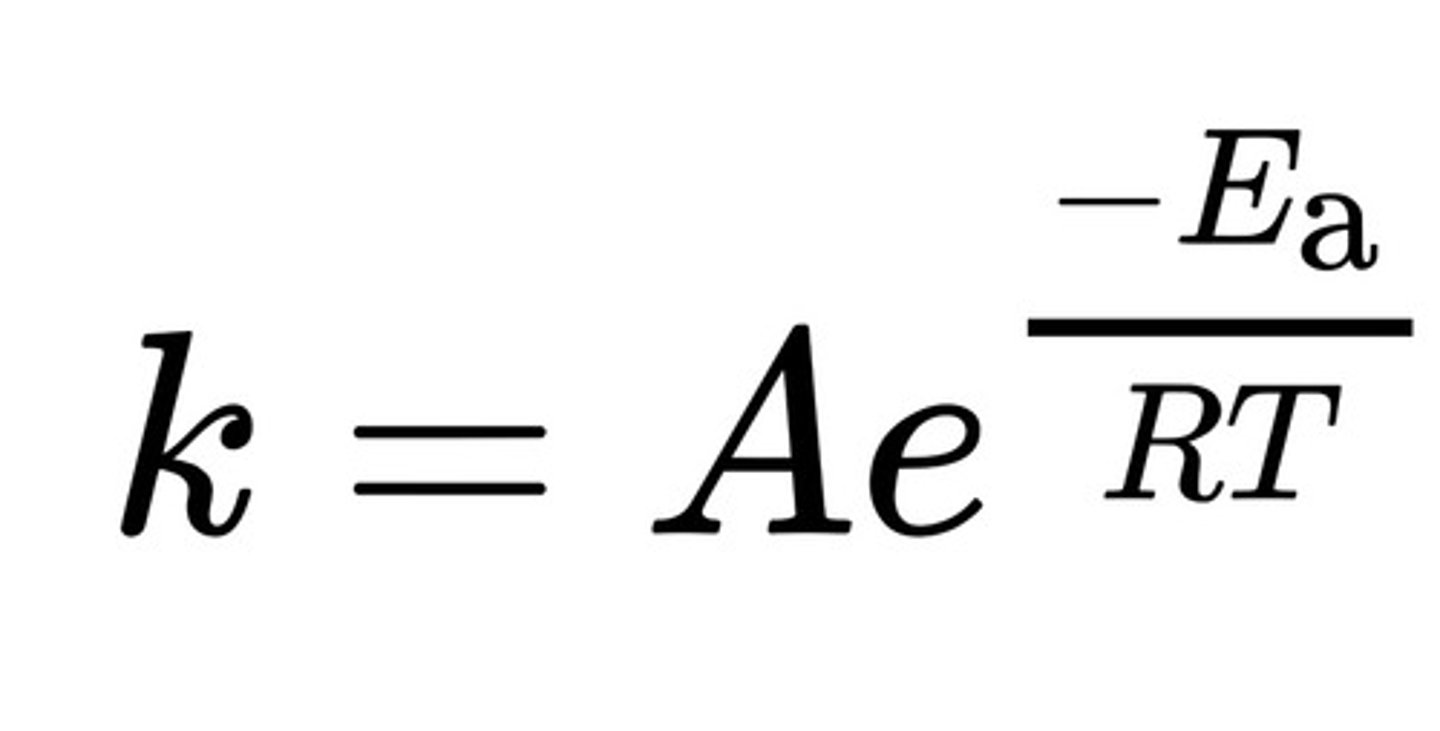
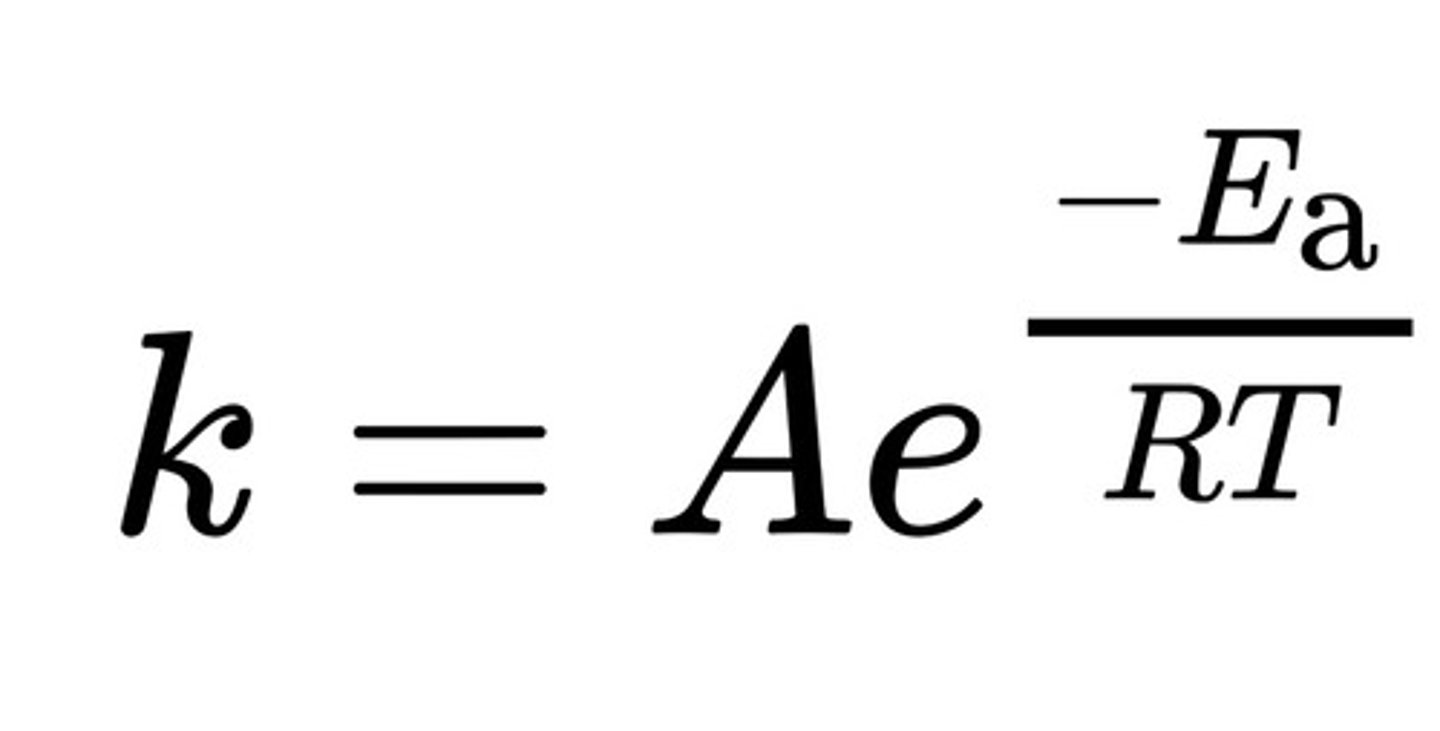
Arrhenius Equation
f. None
Parameters of Arrhenius equation except:
a. k (rate constant)
b. T (absolute temperature in K)
c. A (pre exponential factor)
d. Ea (activation energy)
e. R (universal gas constant)
f. None
b. Law of mass action
Reaction rate proportional to the product of the concentrate of the reactants to the power of its coefficient in a balanced equation
a. Law of conservation
b. Law of mass action
c. Zeroth law
d. Law of entropy
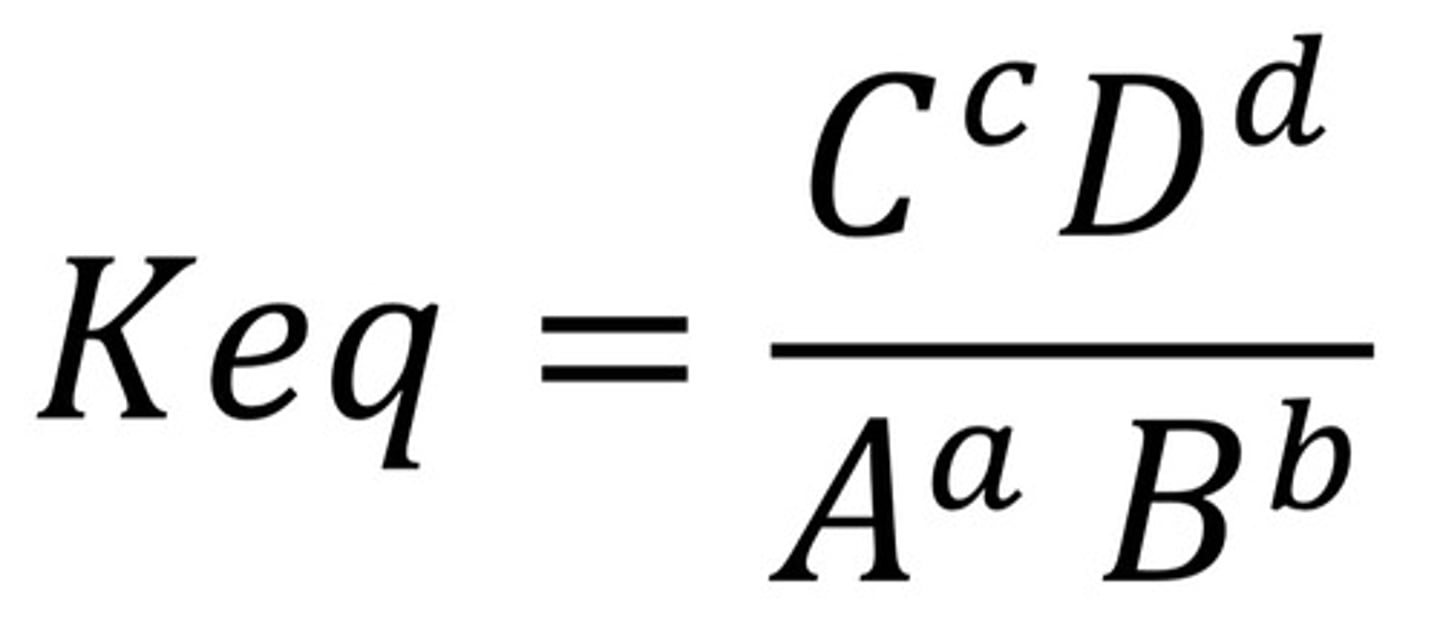
[CHEMICAL EQUILLIBRIUM]
Equilibrium constant:
a. No shift (in equilibrium)
[CHEMICAL EQUILLIBRIUM]
Keq = 1
a. No shift (in equilibrium)
b. Favors product formation (to the right/ forward reaction)
c. Favors reactant formation (to the left/ backward or reverse reaction)
b. Favors product formation (to the right/ forward reaction)
[CHEMICAL EQUILLIBRIUM]
Keq > 1
a. No shift (in equilibrium)
b. Favors product formation (to the right/ forward reaction)
c. Favors reactant formation (to the left/ backward or reverse reaction)
c. Favors reactant formation (to the left/ backward or reverse reaction)
[CHEMICAL EQUILLIBRIUM]
Keq < 1
a. No shift (in equilibrium)
b. Favors product formation (to the right/ forward reaction)
c. Favors reactant formation (to the left/ backward or reverse reaction)
e. b and c
Favors product formation:
a) Keq > 1
b) To the right
c) Forward reaction
[CHEMICAL EQUILLIBRIUM]
Favors product formation:
a. Keq < 1
b. To the right
c. Forward reaction
d. a and b
e. b and c
f. All
b. Le Chatelier's principle
[CHEMICAL EQUILLIBRIUM]
If an external stress is applied to a system at equilibrium, the system adjusts in such a way that stress is partially offset as the system reaches new equilibrium.
a. Aufbau principle
b. Le Chatelier's principle
c. Octet principle
d. Glenn Seaborg principle
b. False
[CHEMICAL EQUILLIBRIUM]
In Le Chatelier's principle, the new equilibrium is not reversible to the old equilibrium.
a. True
b. False
e. Catalyst - this does not affect equilibrium shift and equilibrium constant.
[CHEMICAL EQUILLIBRIUM]
External stressors or factors that can affect the equilibrium except:
a. Concentration
b. Pressure
c. Volume
d. Temperature
e. Catalyst
f. None
a. Equilibrium shift
[CHEMICAL EQUILLIBRIUM]
Concentration has effects on:
a. Equilibrium shift
b. Equilibrium constant (Kc)
c. Both
d. None
a. Equilibrium shift
Pressure and volume has effects on:
a. Equilibrium shift
b. Equilibrium constant (Kc)
c. Both
d. None
b. Lesser
Pressure is inversely proportional with gas moles (volume)
[CHEMICAL EQUILLIBRIUM]
As pressure increases, the reaction shift to the side with _____ gas moles.
a. Greater
b. Lesser
c. Same
a. Greater
Number of gas moles refers to the volume of gas thus the direct proportionality.
[CHEMICAL EQUILLIBRIUM]
As volume increases, the reaction shift to the side with _____ gas moles.
a. Greater
b. Lesser
c. Same
b. Shift to left
[CHEMICAL EQUILLIBRIUM]
Increased pressure effect on reaction with more gas moles in products:
a. Shift to right
b. Shift to left
a. Shift to right
[CHEMICAL EQUILLIBRIUM]
Decreased pressure effect on reaction with more gas moles in products:
a. Shift to right
b. Shift to left
a. Shift to right
[CHEMICAL EQUILLIBRIUM]
Increased pressure effect on reaction with more gas moles in reactants:
a. Shift to right
b. Shift to left
b. Shift to left
[CHEMICAL EQUILLIBRIUM]
Decreased pressure effect on reaction with more gas moles in reactants:
a. Shift to right
b. Shift to left
c. Both
[CHEMICAL EQUILLIBRIUM]
Temperature has effects on:
a. Equilibrium shift
b. Equilibrium constant (Kc)
c. Both
d. None
a. Shift to right
[CHEMICAL EQUILLIBRIUM]
Increase in temperature in endothermic reaction will lead to:
a. Shift to right
b. Shift of left
b. Shift of left
[CHEMICAL EQUILLIBRIUM]
Increase in temperature in exothermic reaction will lead to:
a. Shift to right
b. Shift of left
a. Shift to right
[CHEMICAL EQUILLIBRIUM]
Decrease in temperature in exothermic reaction will lead to:
a. Shift to right
b. Shift of left
b. Shift of left
[CHEMICAL EQUILLIBRIUM]
Decrease in temperature in endothermic reaction will lead to:
a. Shift to right
b. Shift of left
b. 25°C
[CHEMICAL EQUILLIBRIUM]
Equilibrium constant is determined at what temperature?
a. 20°C
b. 25°C
c. 30°C
d. 15°C
d. None
[CHEMICAL EQUILLIBRIUM]
Catalyst has effects on:
a. Equilibrium shift
b. Equilibrium constant (Kc)
c. Both
d. None
d. Temperature - Kc changes depending on the temperature.
[CHEMICAL EQUILLIBRIUM]
Only external factor that has effects on equilibrium constant (Kc).
a. Concentration
b. Pressure
c. Volume
d. Temperature
e. Catalyst