MGMT 320 - Quiz 3
 Call Kai
 Learn
Learn Practice Test
 Spaced Repetition
 Match
Match Flashcards
 Knowt Play
1/45

There's no tags or description
Looks like no tags are added yet.
Name | Mastery | Learn | Test | Matching | Spaced | Call with Kai |
|---|
No analytics yet
Send a link to your students to track their progress
46 Terms
Natural Capital
the world’s stock of natural assets including its geology, soil, air, water, and all living thingd
Renewable resources and non-renewable sources
What are the two natural assets type?
renewable resources
trees, water, and fish, naturally replenish
non-renewable resources
oil and coal, which once used are gone forever
sustainable development
development that meets the needs of the present without compromising the ability of future generations to meet their own needs
Sustainable Development Goals (SDGs)
a set of 17 goals designed to be “blue-print to achieve a better and more sustainable future for all”
economy, society, and biosphere
what are the three categories that Sustainable Development Goals are divided into?
Anthropocene
the period in which human activity has been the dominant influence on climate and the environment
Planetary boundaries
The idea that the planet (earth’s physical systems) create a set of boundaries for what the Stockholm Resilience Center’s researchers called a “safe operating space for humanity”
Ecological footprint
the amount of land and water a human population needs to produce the resources it consumes and to absorb its wastes, given prevailing technology
(ex: data shows that the Earth contains 4.2 acres of biologically productive area (farmland, forest, fresh water, etc) for each living human being)
Great Acceleration
the rapid intensification of human impacts on the environment from 1750 to 2010
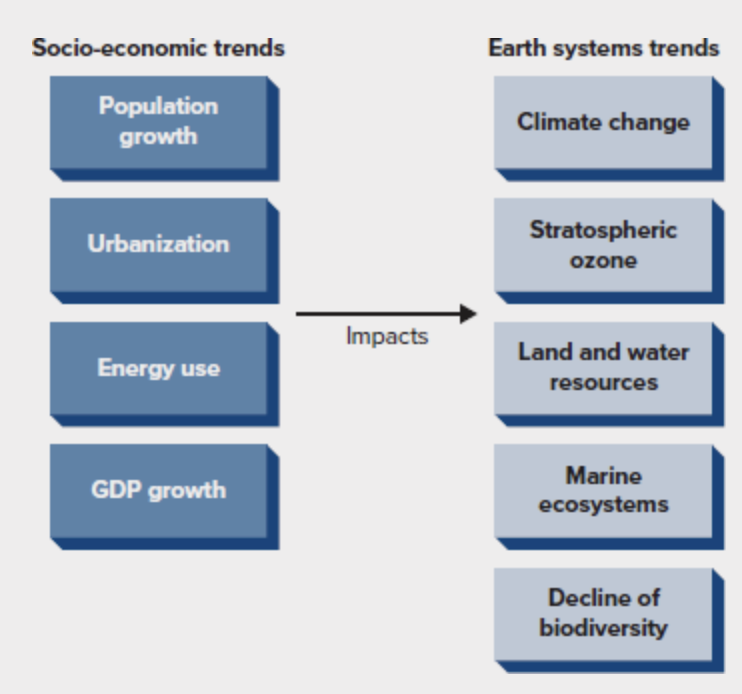
Population Growth
Urbanization
Energy Use
Growth in Gross Domestic Product (GDP)
What are the 4 socio-economic trends that have had a great impact on the health of the environment?
Urbanization
the percentage of people who live in a city or town as compared to rural areas within a given country
climate change
depletion of the stratospheric ozone layer
the degradation of land and water resources
the degradation of marine ecosystems
decline of biosphere diversity
What are the 5 Earth system trends?
Climate Change
changes in the Earth’s climate caused by increasing concentrations of carbon dioxide and other pollutants produced by human activity
Global Warming
the average surface temperature of the Earth to rise over time
Convention on Climate Change
The most important international treaty on global warming
It’s where the United Nations holds an annual confesernce of the parties (COP) where representatives of virtually all the world’s nations meet to hammer out agreements to cut fossil fuel emissions that cause global warming
Paris Agreement
aims to limit the rise in the average global temperature to well below 2 degrees Celcius above preindustrial levels
Ozone
a blueish gas, composed of three bonded oxygen atoms, that floats in a thin layer in the stratosphere between 9-28 miles above the planet
Marine ecosystem
oceans, the salt marshes, lagoons, and tidal zones that border them, as well as the diverse communities of life that they support
Biodiversity
the number and variety of species and the range of their genetic makeup
Life-cycle analysis (LCA)
collecting information on the lifelong environmental impact of a product, all the way from extraction of raw materials to design, manufacturing, distribution, use, and ultimate disposal
Industrial ecology
designing factories and distribution systems as if they were self-contained ecosystems
(ex: businesses can use wastes from one process as raw material for others)
extended producer product responsibility
product stewardship, the idea that companies have a continuing responsibility for the environmental impact of their product or services, even after they are sold
circular economy
a production system that is regenerative by design, that is, restores rather than wastes its inputs
Carbon neutrality
when an organization or individual produces net zero emissions of greenhouse gases
carbon offsets
investments in projects that removes carbon dioxide (or other climate-warming pollutants) from the atmosphere
technology cooperation
long-term partnerships between companies in developed and developing countries to transfer technology
Command and Control Regulation
government commands business firms to comply with certain standards and often directly control their choice of technology
Environmental-quality standard
one type of command and control regulation
given a geographical area may have no more than a certain amount or proportion of a pollutant in the air
Environmental-quality standard and emission standard
what are two types of command and control regulation?
emission standard
ex: the law might specify that manufacturers could release into the air no more than 1% of the ash (a pollutant) they generated
market-based mechanisms
the idea that the market is a better control than extensive standards that specify precisely what companies must do (command and control)
cap-and-trade
Allows businesses to buy and sell the right to pollute
Clean economy
sectors of the economy that produces goods and services with an environmental benefit
cost savings
brand differentiation
technological innovation
reduction of regulatory, liability, and climate change risk
strategic planning
What are the 5 ways effective sustainability management confers a competitive advantage?
[YT] The Wasteland
Denver, Colorado → Tacoma, Washington → Victoria Harbor, Hong Kong → Guiyu, China where there is a massive amount of waste (computer monitors), an abundance of LEAD
ISSUE: This is against both Hong Kong and US Law
The report investigates how millions of tons of American electronic trash—computers, monitors, and televisions—are being illegally shipped to developing nations instead of being safely recycled in the U.S. While many "recycling" companies claim to be environmentally friendly, they often sell the waste to brokers who ship it overseas to maximize profit.
Guiyu, China: has become a "wasteland" where workers use primitive and dangerous methods to recover valuable metals.
Health Hazards: The report notes that Guiyu has some of the highest levels of dioxin ever recorded. Residents face extreme health risks, including lead poisoning and respiratory issues.
The “Green” Deception
Executive Recycling: The segment tracks a Denver-based company called Executive Recycling. Despite its public promises of "environmentally friendly" disposal, investigators tracked their shipping containers directly to Hong Kong and mainland China.
[YT] SEC Disclosures
SEC Chair Gary Gensler explains that the Commission has finalized rules requiring public companies to provide consistent, comparable, and reliable disclosures regarding material climate-related risks that could impact their financial performance. While remaining merit-neutral on how companies manage these risks, the SEC aims to ensure that investors receive truthful and standardized information about greenhouse gas emissions and business strategies to make informed investment decisions
[NPR] Guyana
Guyana, a historically "green" nation with vast carbon-sequestering rainforests, is aggressively developing offshore oil fields discovered by ExxonMobil that hold an estimated 10 billion barrels of crude.
Despite facing existential threats from sea levels rising faster than the global average, the government argues it must pivot to fossil fuel wealth to fund critical climate adaptation and infrastructure that rich nations have failed to subsidize.
While GDP per capita is projected to skyrocket, the country faces significant risks from the "resource curse" and a contract that critics claim favors the oil giant over the Guyanese people.
[CP] How an M&M Sparked the Search for the Next Perfect Peanut
In the early 2000s, Mars faced a crisis of "rancid nut" complaints, leading to a partnership with the University of Georgia to develop the Georgia-09B, a high-oleic peanut that is healthier, stays crunchy, and resists spoilage.
Today, Mars has expanded this research through the Wild Peanut Lab, because of issues due to the fast-changing climate that threatens the world’s peanut supply, by investing millions to cross-breed commercial peanuts with resilient "wild" ancestors to combat climate change, pests, and diseases like nematodes.
Mars treats this genetic research as "open-source," sharing findings globally to help small farmers in places like Senegal and Nicaragua improve their yields.
[CP] Climate Change Will Cost Us Even More Than We Think
The authors argue that economists significantly underestimate the financial toll of climate change because their models rely on "stationarity" (the flawed assumption that past experience is a reliable guide for an unprecedented future)
This leads to the omission of "missing risks," such as the catastrophic tipping points in the climate system and the complex cascading effects where one disaster, like crop failure, triggers another, such as social and political instability.
Three difficulties
carbon dioxide is at its highest concentration
scientists do not feel they can adequately quantify (value of biodiversity, cost of ocean acidification)
Cascading effects - the harms of climate change are hard to fathom because they don’t occur in isolation but will reinforce one another in damaging ways
Ultimately, the article warns that current economic assessments fail to communicate the true magnitude and urgency of the risks, potentially leading to a feedback loop of fundamental destruction that humanity is unprepared to manage.
[CP] Trade Disruptions and Agricultural Risks
Trade:
Trump placing new tariffs on imports and renegotiating trade deals will be an issue from climate change
Extreme weather from global warming are certain to increasingly affect US trade and economy (import and export prices and businesses with overseas operations and supply chains)
Agricultural Risks
Rising temperatures, drought, wild fires, etc are expected to increasingly disrupt agricultural productivity in the US
The variable going forward, is the amount of carbon dioxide humans produce
[CP] EPA Plans to Shut Down the Energy Star Program
EPA is eliminating the Energy Star (a popular energy efficient certification)
For the past 33 years, Energy Star has been known for it's recognizable blue label, nearly 90% of American consumers recognize this label
It has helped households and businesses save more than $500 billion in energy costs
Paula (president of the Alliance to Save Energy) says that “Eliminating the Energy Star program is counterintuitive to this administration’s pledge to reduce household costs”
[CP] EPA Is Said to Plan Deep Cuts to Greenhouse Gas Reporting Program
EPA has ordered the elimination of a 15-year federal program that requires thousands of power plants, oil refineries, cement factories and other large industrial facilities to publicly report their greenhouse gas emissions
Plan to eliminate reporting requirements for ALL BUT ONE of the 41 categories
[CP] SEC moves to kill climate disclosure rule
The SEC is rolling back a rule that would require thousands of publicly traded companies to provide investors with detailed information about the impact of their businesses on climate and the environment