FUNDAMENTALS & PEDIATRIC DISORDERS EXAM STUDY GUIDE
 Call Kai
 Learn
Learn Practice Test
 Spaced Repetition
 Match
Match Flashcards
 Knowt Play
1/35

There's no tags or description
Looks like no tags are added yet.
Name | Mastery | Learn | Test | Matching | Spaced | Call with Kai |
|---|
No analytics yet
Send a link to your students to track their progress
36 Terms
What is a disorder?
A child whose language is
qualitatively different from normal younger children.
The language behaviors are not normal.
What is a delay?
A child whose language is
quantitatively impaired. Form, content & use are
normal for what is seen in younger children
What is a difference?
The language
features of a community differ from the
majority language (example: English as a
Second Language)
What are organic and functional disorders?
Organic means it arises from organs (examples can be cleft lip and palate/ cerebral palsy
Functional means it can effect their behavior including speech delays and residual errors
What are developmental and acquired disorders?
Developmental disorders begin during language acquisition which occurs while the child is developing. Acquired disorders mean that something happened such as an injury and then they got the disorder in result of that situation.
Global disorder?
Global disorders cause widespread deficits
Peripheral disorder?
This disorder has to do with the auditory system and the disorders can be caused by problems with the ear.
Localized disorder?
Effect specific functions such as language comprehension or speech production.
What is cleft lip and palate? Etiologies? (genetics and environment)
A cleft lip/palate is a birth defect that affects thousands of infants in the U.S. It is one of the most physically obvious type of communication disorder. Its an elongated opening resulting from failsure of parts of the mouth to fuse during prenatal development. Development of the face occurs during the embryonic
period of pregnancy.
• Embryonic period = prior to 10th week of pregnancy.
Etiologies: combined genetic and environmental factors (how the mother took care of herself during the pregnancy).
Embryologic development for cleft?
-It results from the disruption of prenatal
development.
-Degree of clefting is related to the
amount of embryonic damage to the lip
and palate.
• The lip and palate meet at midline and
develop from front (lip) to back (uvula).
•Around week 6-7 the lips and anterior
hard palate fuse, and by week 12 the
soft palate fuses.
Hard palate (anterior): fused by 7 weeks
Soft palate fused by 10 weeks
Speech and swallow deficits from cleft
▪ Usually none following surgeries (about 1-2 years old)
▪ Hypernasality due to the inability to regulate air flow through the nasal cavity during speech production. INADEQUATE VELOPHARYNGEAL CLOSURE
▪ Dentition affecting speech, especially if the alveolar ridge is affected. There can be missing and malformed denititons. Also, malocclusions (misaligned bite).
▪ Otitis media causing auditory impairment due to the connection between the ear and the pharynx, and the open middle ear space allows entry of bacteria. It can lead to infections, which leads to ear infections, then leading to speech deficits.
▪ Some infants with complete and partial palatal clefts will have issues with feeding (it affects their sucking ability for newborns and infants) (differentiation of naso and oropharynx)
Articulation disorders: phonological processes, what is fronting, stopping, and gliding?
Fronting (instead of pig, they’ll say “pid” because it's harder to produce) (change place of articulation) SOUNDS MADE IN THE BACK ARE REPLACED WITH FRONT SOUNDS!
Stopping: (turning fricative into a stop) (saying pish instead of fish)
Gliding: L AND R ARE REPLACED BY GLIDES SUCH AS W AND Y!(changes manner of articulation) (wabbit instead of rabbit)
Deletions: what is initial consonant deletion?
Leaving off consonants from the beginning of a word. Example is ‘at’ instead of cat. “The turns into “a”
I pu i i a hou
(I put it in the house)
Deletions: what is final consonant deletion?
Not pronouncing the final consonant in the word, saying “pi” instead of “pig”
Deletions: what is consonant cluster reduction?
[blue bu] [star tar] [drink dink]
-difficulty pronouncing consonant clusters and the pronuncation is reduced.
-the person simplifies the word or by omitting one of the other consonants
What is epenthesis?
Adding additional sounds in the middle of a word to make it easier to pronounce.
-usually a vowel
ex: Da water is bəlue
(The water is blue)
Dats my cupi
(That’s my cup)
I have a bəlack horse
(I have a black horse)
Phoneme distortions: what is a lisp?
Specific speech sounds are misarticulated and often replace “s” or “z” sounds with “th”. They can be caused by a tongue-tie (thick band of issue that prevents the tongue from touching the floor of the mouth) or dental issues, or a learned habit.
What are signs of apraxia of speech?
Signs include limited babbling as a baby, poor imitation skills, and frustration. Kids are saying words differenty and it is characterized by inconsistant errors.
What is the quantitative criteria for measuring severity of speech sound disorders
QUANTITATIVE: Includes the number of sounds misarticulated, percentage of consonants correct, and consistency of misarticulations. NUMBER OF CORRECT CONSONANTS DIVIDED BY THE TOTAL NUMBER OF CONSONANTS TIMES 100= PCC.
What is the qualitative criteria for measuring severity of speech sound disorders?
• % intelligibility among familiar listeners
• % intelligibility among unfamiliar listeners
• The particular consonant misarticulated.
• θ vs k [θumb] - [fumb] vs [kʊki] – [tʊti]
What are some treatment methods for developmental speech sound disorders?
Minimal pairs: • using sound to contrast meaningful
pairs, e.g., ‘cape’ and ‘tape’ (words that only differ by one phoneme)
Why? Demonstrates the differences in meaning errors may cause
Cycles: • cycling through processes for specific
time periods
-allows the child to focus on a specific speech error for a specific amount of time, then cycle through another one, and so on. Allows them to improve their whole speech sound system rather than mastering one area and then moving on to the next.
others:
-rhyme recognition (-make noises and repeat, make sure they can identify it)
-phoneme identification (-does mouse rhyme with cheese or house?)
Language disorders: what are the three components of language (Bloom and Lahey)
▪ Form: o Phonology (how speech sounds are used to create meaning)
o Morphology (how do tenses look?)
o Syntax (what do their sentences look like?)
▪ Content: o Semantics (are they getting across the meaning they intend?) (do they know what the words mean?)
▪ Use: Understanding implicatures and expressions such as social greetings
What is SLI and DLD?
SLI: SPECIFIC LANGUAGE IMPAIRMENT -a language disorder that occurs in the absence of a known cause. Occurs in approx 8% of all 5-year-olds (more boys than girls). -delay rather than a disorder -limited vocab and shorter utterances
DLD: DEVELOPMENTAL LANGUAGE DISORDER -interferes with learning and using language -may have trouble finding the right words.
LLD: LANGUAGE LEARNING DISABILITY -Subtle language disorder, but severe enough to interfere with use of language for learning and socializing.
-semantic and pragmatic deficit
-non-specific vocabulary
What are two fluency disorders and describe them?
Disfluency: A disruption of prosody affecting fluent output of speech.
Stuttering: Involuntary word and syllable repetition, interjections, or a combination of all of these. Can involve prolongations “The mmmmmusic sounds nice”
NEUROLOGICAL OR PSYCHOGENIC STUTTERING:
Cluttering: Involuntarily rapid, irregular rate of
speech with syllables being irregularly
produced, omitted, or compressed.
KEY DIFFERENCE: People who stutter know what they want to say while those who clutter may be unaware of their speech speed and it could be considered “unorganized.”,
What is the diagnostic criteria of stuttering?
Involuntary word and syllable repetition, interjections, or a combination of all of these. Can involve prolongations “The mmmmmusic sounds nice”
What are primary and secondary symptoms of stuttering?
Primary: Interjections
Sound/Syllable Repetition
Word Repetition
Phrase Repetition
Audible Sound Prolongation
Inaudible Sound Prolongation (Block)
Revision
Combination of any of the above
Secondary:
Overt body movements:
-facial grimaces
• head movements
• loss of eye contact
• Other extraneous movements / gestures
accompanying moment of stutter
Covert Psychosocial Behaviors:
• Fear
• Frustration
• Embarrassment
• Anger
• Word avoidance
Describe the iceberg? What’s beneath the surface?
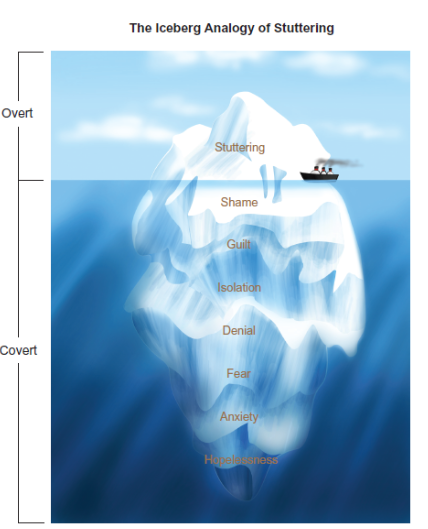
What are the 3 treatment approaches?
• Fluency Shaping: designed to modify all
aspects of the client’s speaking
behavior.
• Slow speech
• Stretchy speech (prolong vowels)
• Continuous phonation
• Easy onset
• BUT The overall naturalness of the speech is diminished.
• Stuttering Modification: designed to
address individual moments of
stuttering, as opposed to changing the
entire pattern of speaking behavior.
• Stuttering with less tension
• Light articulatory contacts
• Reduce situational fears and negative attitudes about stuttering
• Lidcombe program: behaviorist
approach relying on positive and
negative feedback from caregivers
during conversational speech. ( Considered by some to be ineffective and unethical)
Importance of counseling?
Allows the person to feel supported and less isolated. Lets them know that there’s many resources for them.
Autism spectrum Disorder: whats the diagnostic criteria?
Autism Spectrum
Disorder (ASD) refers to impairment in social interaction
and communication, and restricted repetitive and stereotypic patterns of behavior
Diagnostic criteria: (1) social communication deficit,
(2) fixed interests and repetitive behaviors,
(3) present since early childhood,
(4) the behaviors impair daily functioning, and
(5) the impairment is not better explained by
intellectual disability.
What are some ASD behaviors and communication patterns?
COMMUNICATION:
-Lack of pragmatic aspect of
language.
-Has difficulty
communicating needs or
desires.
-maintaining
joint attention, turn-taking,
and eye contact
-ECHOLALIA: Responds to a
question by repeating it,
rather than answering it.
SOCIAL:
-Prefers not to be
touched, held, or
cuddled.
-trouble understanding or talking about feelings
-Lack of apparent social
and emotion
reciprocity.
BEHAVIOR:
-rocking back and forth
-upset by certain sounds, smells, and food textures
-attachment to inanimate objects such
Describe the 3 levels of support
▪ 1 = some support
▪ 2 = substantial support
▪ 3 = very substantial support
What is the theory of mind?
Other theories of ASD
LABEL
LABEL