Gender and Religion pt.1 , + the Witchcraze
 Call Kai
 Learn
Learn Practice Test
 Spaced Repetition
 Match
Match Flashcards
 Knowt Play
1/49

Earn XP
Description and Tags
rest of stuff on midterm 2
Name | Mastery | Learn | Test | Matching | Spaced | Call with Kai |
|---|
No analytics yet
Send a link to your students to track their progress
50 Terms
basics of Gender + how it’s intertwined w/religion
Gender = an organizing group/category in society, based upon + shapes choices, opportunities, worldviews, personal ideology/values
^^^defined through the intersection of these 2 things
all religions have things to say on it, which strongly shape worldviews of gender, i.e. what men/women are like, how they should/do behave, etc…
S*x + gender differences (in contemporary society)
S*x = biological differences whereas, Gender = the cultural construction of ideas of M/F characteristics on a continuum
religious beliefs don’t traditionally recognize this difference, perpetuating the idea of
F= women, and M= men (a.k.a. binary understanding of gender)
Hijras pt.1
a legally recognized 3rd gender in India and Pakistan (via a 2014 court ruling), often born M and undergo voluntary castration, identifying as (including, not limited to), transsexual, transgender, trasnvestite, homosexual, asexual, intersex ppl, + ennuchs
^^^was previously accepted pre- British occupation/colonialism
seen as powerful/ dangerous, especially regarding fertility, + often persecuted
many perform stereotypical ideas of feminine gender roles, dress/behave/talk like women traditionally seen to do, might wear long hair/cosmetics/jewelry
Hijras pt.2
became perscuted under British rule/occupation in the Victorian era(as homosexuality, + similar identities, were punishable by death in Britain at this time)
by joining the community, individuals perceived as “failing” at conventional gender norms, such as marriage/bearing children
^^seen as deviant by mainstream society, often discriminated against + marginalized
have the power to curse/bless others(especially during young childhood + weddings) + see themselves as descendants of Bahchara Mata(meaning : mother)
Bahuchara Mata pt.1
daughter of a known warrior, was travelling w/a caravan alongside her sisters when they get hijacked by a notorious bandit (often depicted as a giant rooster + weilding a sword/trident, Mata = mothers)
culturally, dying at the hands of an enemy= unacceptable, would rather take their own lives
Bahuchara decides that it’s not her/her sister’s times to die, so she cuts off her/her sister’s breasts as a way to curse the bandit w/impotence
for the bandit to have the curse removed he must pay homage to her by dressing/behaving like a woman
Bahuchara Mata pt.2
cutting off her breasts —> secures deification for virtue/purity, in another variation she is assaulted by thieves + she curses them into becoming hijras
another variation —> Bahuchara is a powerful man or prince, when threatened he transforms into a woman via “spirtual power” she cuts off her breasts in defense so she is no longer feminine, she curses them to become hijras
^^^one commonality; Bahuchara’s creation of hijras is seen as a “curse” , + some hijras believe their identity is a punishment, explaining their low social status + derogatory treatment in society
example —> dedicated Shrine
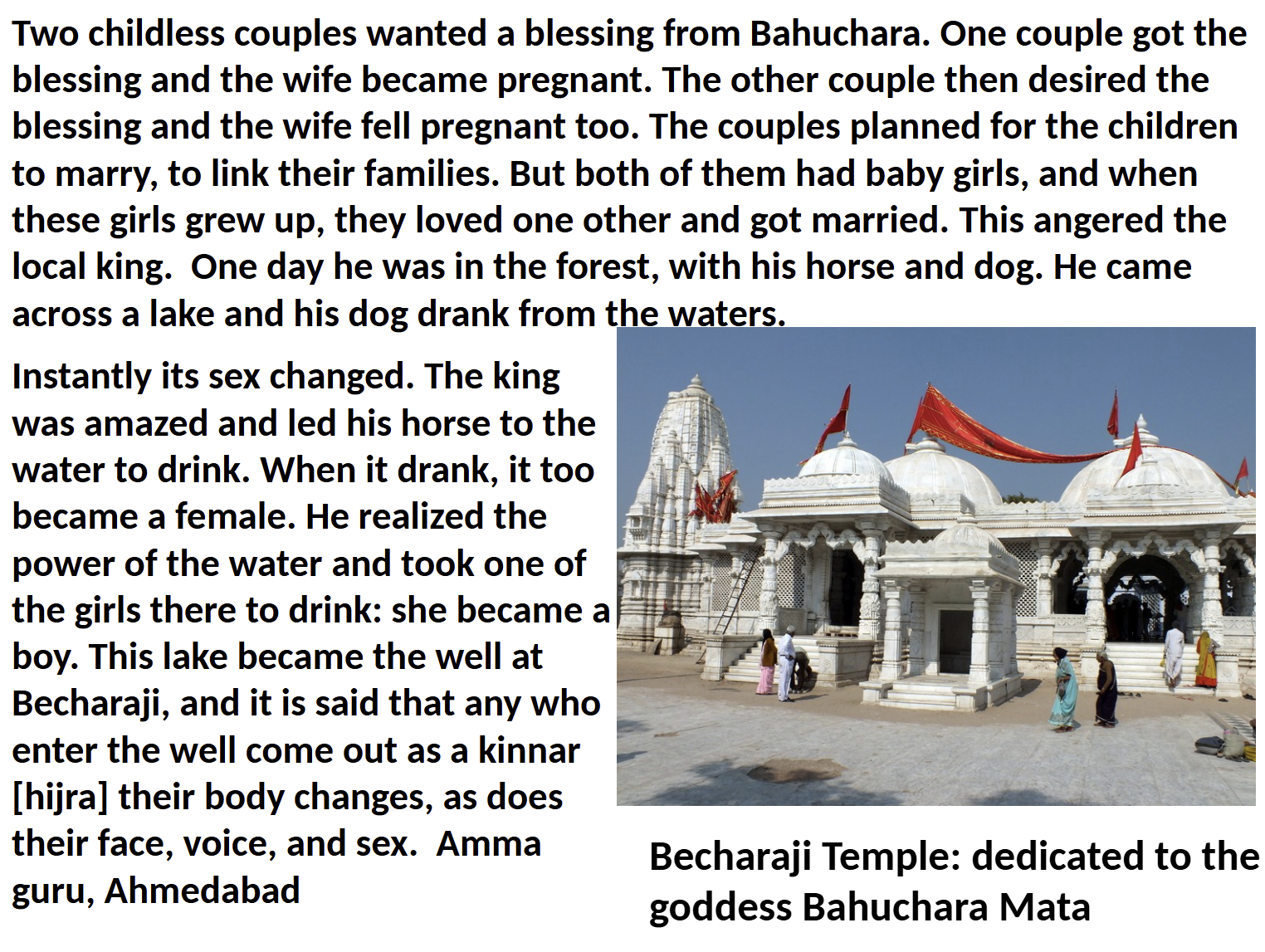
Bahuchara Mata pt.3
she is worshipped by many hijras, regardless of individual religious indentifications, particularly due to her association w/transgender identity,
^^^she’s also worshipped for her ability to bless newlyweds (+ childless couples) w/fertility, could also curse w/infertility
myths also have a theme of celibacy or impotence, in particular, M impotence i.e. M celibacy that is achieved through removal of genitalia, +/or gender transformation
Hijras pt. 3
these mythological narratives = essential for constructing hijras’ sense of identity, + they play a significant role in granting religious sanction/explaining + legitimizing behavioural patterns/ritual practices, + bodily forms of the hijras
^^^also informs their ‘role’ in society, w/the ability to curse/bless
reference to 3rd gender individuals in sacred texts produces a counter-discourse to the mainstream narrative, which portrays them as “deviant subjects” (often are ostracized, leading them to begging/s*x work in order to make ends meet)
movement —> to gain a measure of respect for this identity + alleviates some of their stigma, surrounding their identity/a place in society
Hijras pt. 4
many hijras earn their living as beggars/prostitutes + by dancing at carnivals, weddings, + births that require their unique blessing
they are A)feared —> ability to place curses B) pitied —> for being outcast children of Allah
It’s believed that they hold great power bc of their worship of the Hindu Mother (a.k.a. Banuchara Mata)
traditionally bless weddings/newborn children
^^^^ have a supernatural power, which religion plays into as well
Menstruating women barred from Sabrimala temple
this temple in Kerala, traditionally has banned women/girls of “menstruating age” defined as 10-50, prevented from entering the place of worship
^^^made a legal affair since 1972, to “preserve purity” in their shrines
Sept 2018 —> India’s Supreme Court ruled temples must open their doors to women “the right to practice religion is available to both men/women”
the precedent could affect 100’s of temples across India that do not let women inside for ideas ranging from issues around ‘purity’ to them being barred bc a guru or serious priest is in residence
Norman Rockwell INTRODUCTION
painted x4000 pictures, popular 1930’s- (late)60’sm had pictures on covers of magazines
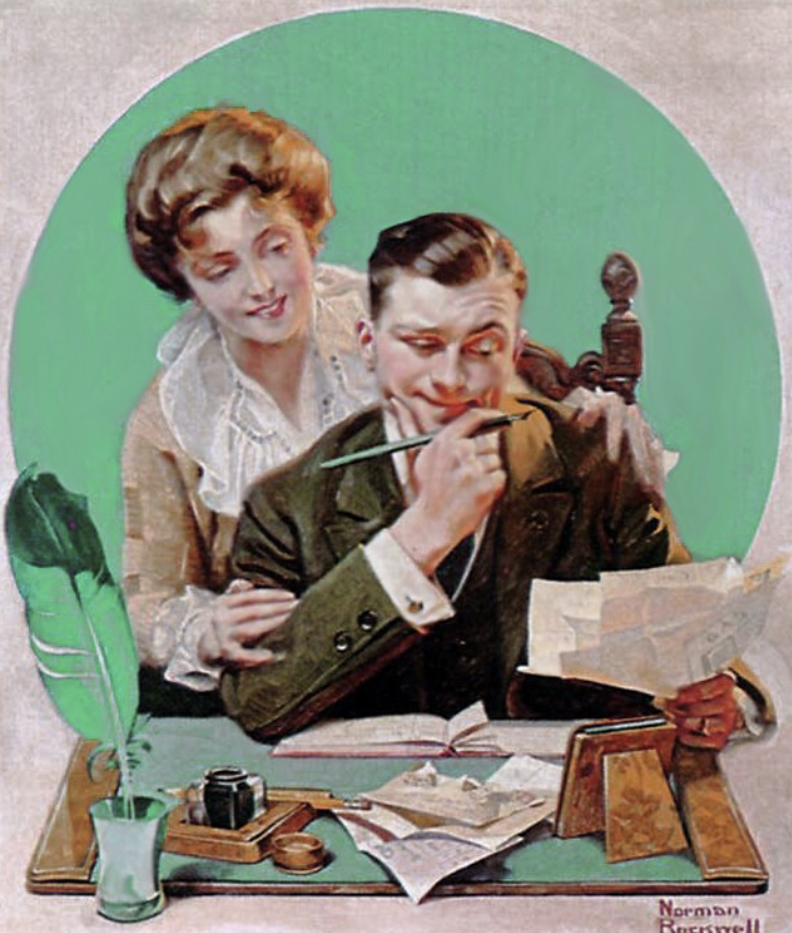
portrays an “ideal family”, w/the man in positions of power/superiority, often the head of the family, whereas women pay a subservient role in “2nd place” to their husbands, reflecting the view of (at the time) American society in regards to gender
e.g. Paying Bills —> “breadwinner” husband, at center stage w/ “dependent” wife dutifully behind him
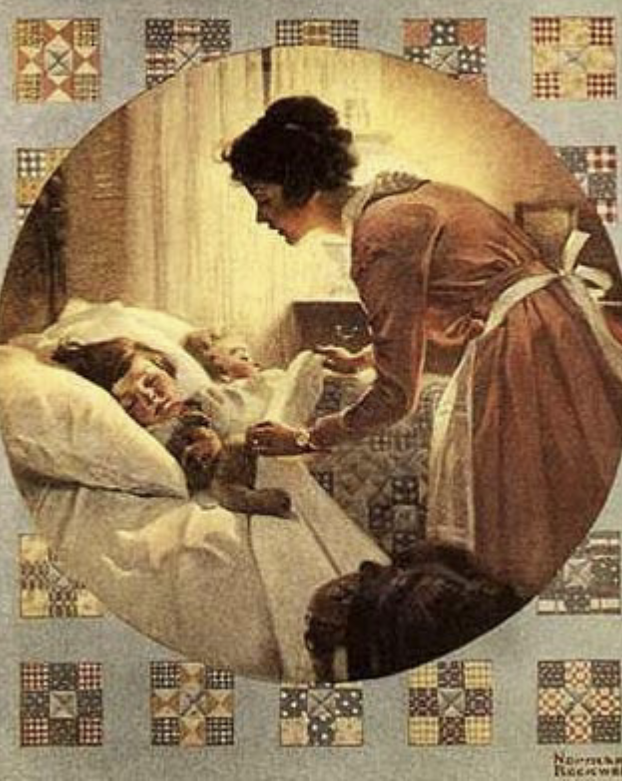
Norman Rockwell, “Mommy’s Little Angel”
only exception to the rule of men being center stage is when emotional bonding w/in the family is involved, where the mother takes the main role as a nurturer
^^^in this sort of scene, the “emotionally controlled” father takes a backseat role while his wife assumes her motherly role
^^^Nurturing mother —> another 1960’s conception in American society
Norman Rockwell —> WRAP-UP
In his paintings, Rockwell used symbolic templates
^^^^ these —> help men/women orient themselves as M + F and to each other
where do these come from? the idea comes from “breadwinner and home-maker models” of gender roles, outlining how Men/Women should behave/relate to one another
^^^much of this constructed social relationship b/2een Men + Women in the west —> rooted in Adam and Eve’s story of genesis, which has influenced respective gender representations in art + larger Western society (a.k.a. Christianity/religion-based viewpoint)
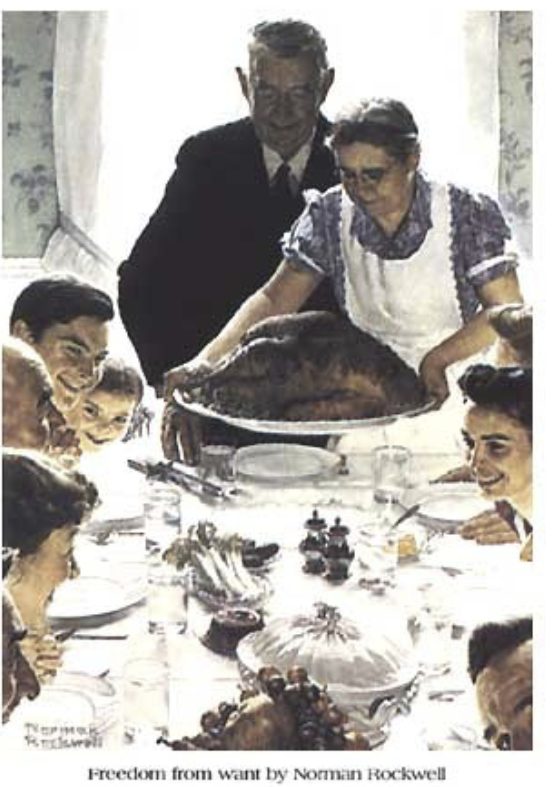
Freedom From Want painting —> subservient woman as a homemaker, does cooking on Thanksgiving, turkey carved by the man/father
Western religion gender + info
Religion —> used to control women’s bodies (i.e. abortion, reproduction, manner of dress), relative amount of power, relationships, economics (what jobs, bank accounts, etc..), polygyny, sex + gender constructions/concepts of normalcy(etc..)
for Westerners, the bible has historically represented a great deal of truth, the roles of men/women are undisputed
these ideas spread through Western colonization, and established a narrative of men as superior to women
w/the narrative itself being controlled by men, originally written in latin + controlled by priests (historically) —> being controlled by Western men
Genesis verses explicitly about gender
Genesis 2:
18 Then the Lord God said, "It is not good that the man should be
alone; I will make him a helper fit for him."
20 The man gave names to all cattle, and to the birds of the air,
and to every beast of the field; but for the man there was not
found a helper fit for him.
21 So the Lord God caused a deep sleep to fall upon the man,
and while he slept took one of his ribs and closed up its place
with flesh;
22 And the rib which the Lord God had taken from the man he
made into a woman and brought her to the man.
23 Then the man said, "This at last is bone of my bones and flesh
of my flesh; she shall be called Woman, because she was taken
out of Man. "
Genesis 3:
13 Then the Lord God said to the woman, "What is this that you have
done?" The woman said, "The serpent beguiled me, and I ate.“
16 To the woman he said, "I will greatly multiply your pain in
childbearing; in pain you shall bring forth children, yet your desire
shall be for your husband, and he shall rule over you."
17 And to Adam he said, "Because you have listened to the voice of
your wife, and have eaten of the tree of which I commanded you, 'You
shall not eat of it,' cursed is the ground because of you; in toil you shall
eat of it all the days of your life;
18 Thorns and thistles it shall bring forth to you; and you shall eat the
plants of the field.
19 In the sweat of your face you shall eat bread till you return to the
ground, for out of it you were taken; you are dust, and to dust you
shall return."
Genesis —> Analysis
for past 3000 years, Adam and Eve’s story in genesis has worked to communicate social/religious values to the West (specifically about what men/women are like, the value of being specific gender)
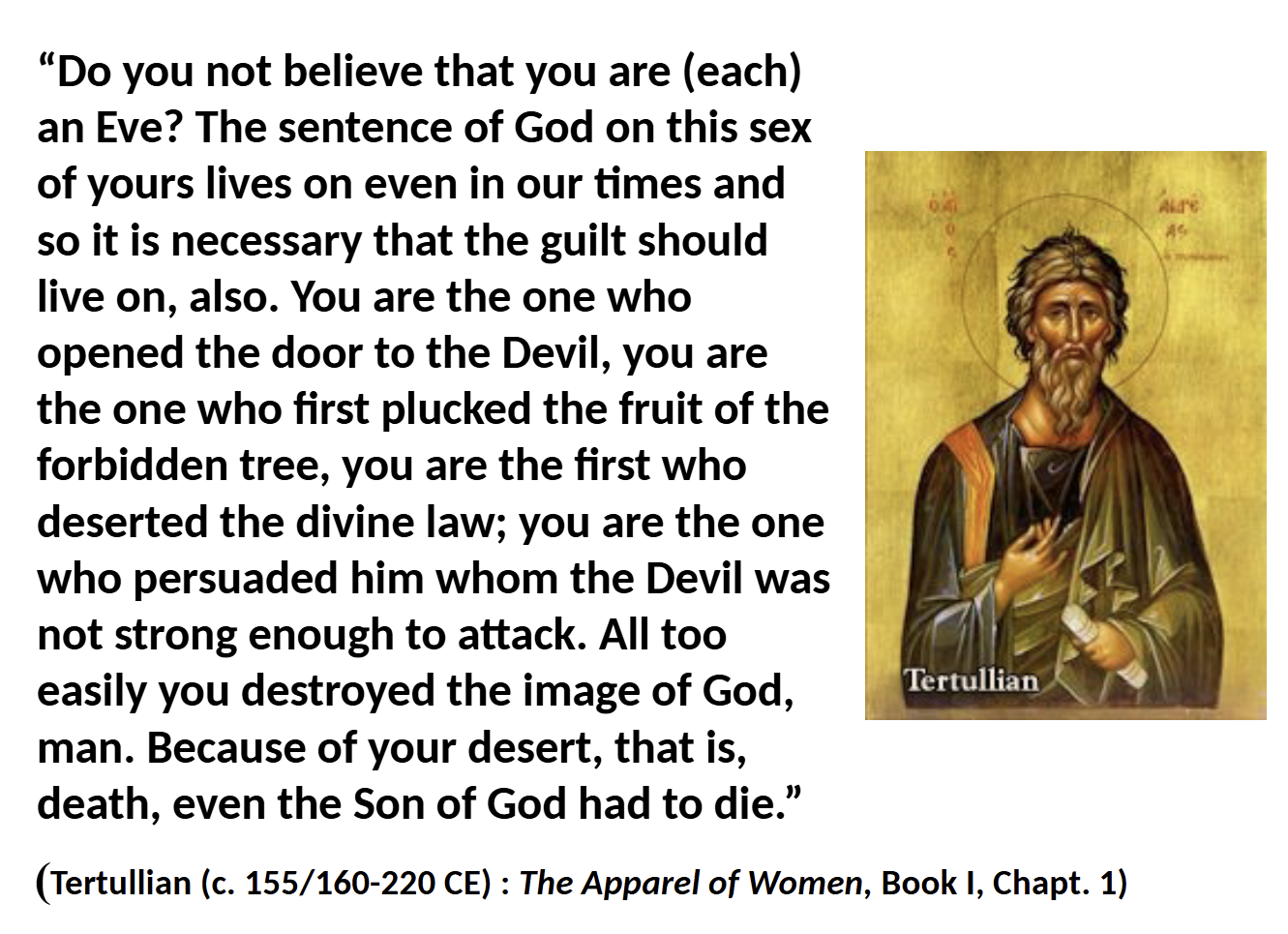
This led to the idea of Eve as the template/model of women, painting women as weak + untrustworthy/selfish, she represents what men should strive to avoid, + has been weaponized by men to control women
“For I do not allow woman to teach, or to exercise authority over men; but she is to keep silent. For Adam was formed first, then Eve. And Adam was not
deceived, but the woman was deceived and became a transgressor.”
(1 Timothy 2:12-14)creates a conception of an inherent/expected power imbalance b/2een men + women, women are to be subservient + simultaneous s*xual/non-s*xual beings that are ideally virgin but also child-bearing (+ created for this purpose), women are “weak-willed” compared to men as Eve is to blame, God gives Adam the “gift” of Eve, she came from his rib + man was created in his image
Further Analysis of Eve
Eve= what women are modeled after, seen as weak-willed + “lesser” than men, she ate the fruit in the garden, giving men/women hardship through which they can only learn to understand the will of God
Eve is to blame, as she is a “temptress” who led Adam into sin, Eve herself was not told that the fruit would do this, only Adam was, ironic
led to the idea of salvation in “finding God” despite hardship
Conceptions of women
explains what men/women are like, essentially women= evil/the cause of death
as a result of this sort of thinking? men force women into societally subservient roles, creating guilt + making them dependent on men, largely through marriage (e.g. women couldn’t have a bank account w/out a male to cosign it)
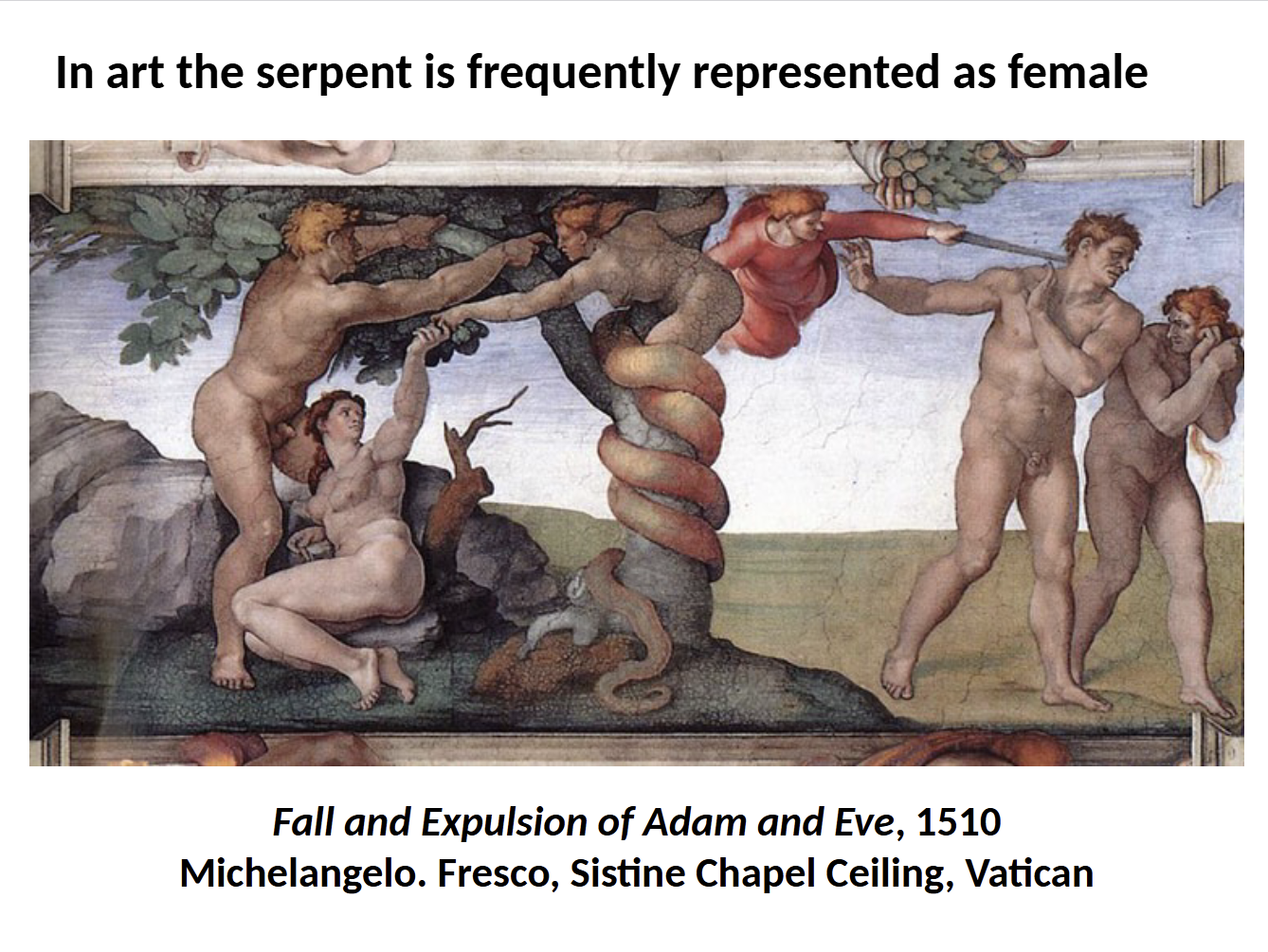
Additional biblical ideas of women
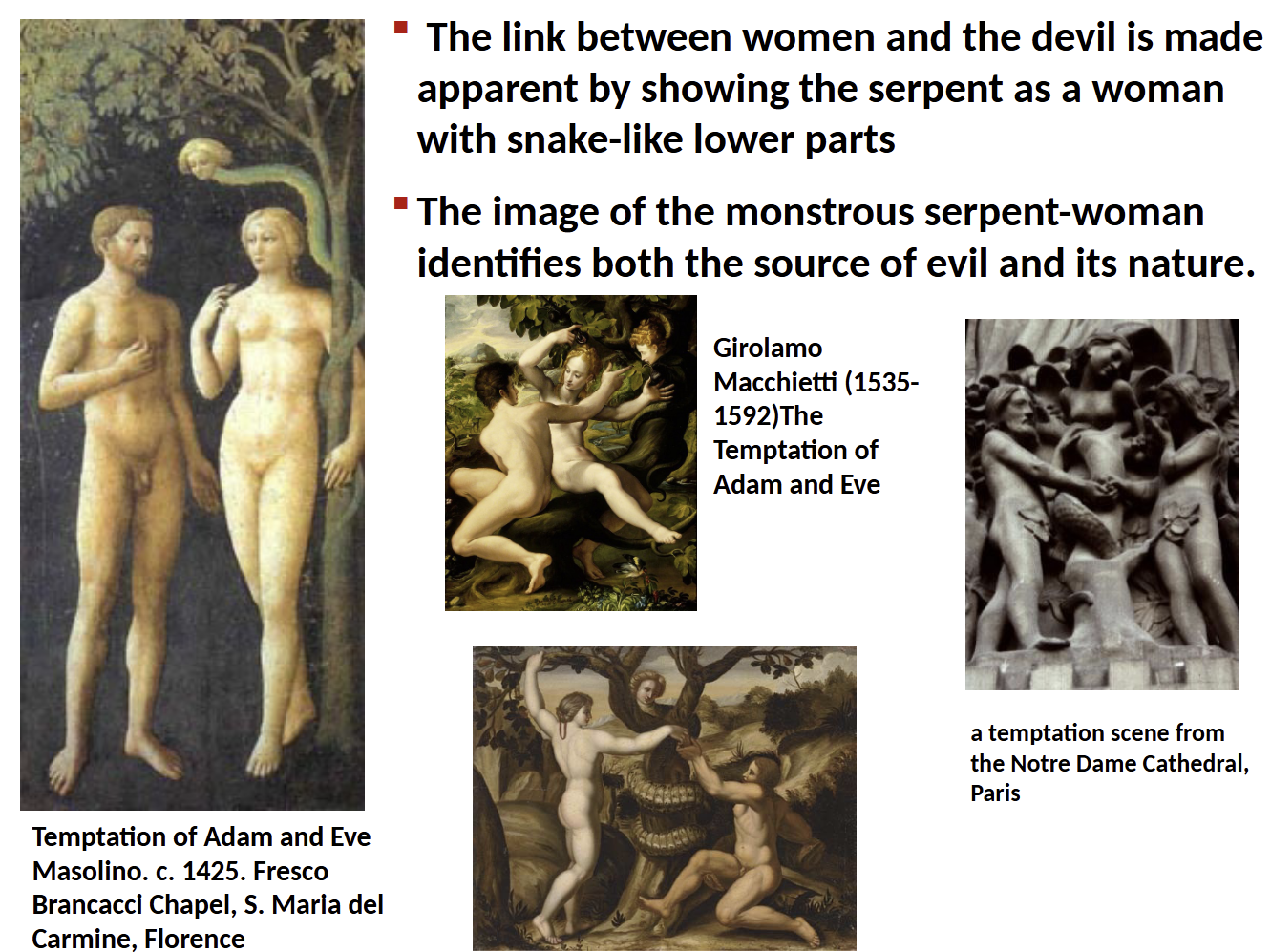
serpent often depicted as female (same w/the devil)
link b/2een women/the devil made apparent, by showing the serpent as a woman w/snake-like lower parts as depicted in these images
Pandora’s legend
bscly Zeus creates an Eden-like garden, populated by man
Prometheus steals fire + tricks Zeus into accepting only bones as a sacrifice, man is punished + Zeus decides to do something similar to Prometheus
said punishment is a box that Zeus creates to punish humanity, containing all the diseases/sorrows/vices/crimes that afflict humanity, alongside a woman named Pandora via his messenger Hermes
Prometheus didn’t trust Pandora + gifted it to his brother, she heard the box whispering telling her to open it + free those who are supposedly trapped in it
she does so + all of the ills placed in there fly out, leaving HOPE in the box
(this further paints women as to blame for the evils of the world sigh, revisionist attempts to paint women differently have occured since then)
Lilith Intro
a mythological F demon from Sumer in approx 6000 yrs before present
^^^similar to Pandora/Eve, though to bring illness/disease/death A.K.A. SIN on the world, yay I love when women are absolutely to blame
she is mentioned in the Bible in Isaiah 34:14, + in Jewish mythology she appears as a night demon who causes men to have wet dreams bc we all know desire is super evil obviously
the best known tale of Lilith originates from medieval work called “the Alphabet of Ben-Sira” AD 700-1000
The story of Lillith pt.1
Genesis 1:27, so God created man in his own image, in the image of God he created him; male and female he created them (God embodied the masculine/feminine parts of himself through humanity)
28, And God Blessed them, and God said to them “Be fruitful and multiply, and fill the earth and subdue it; and have dominion over the fish of the sea and over the birds of the air and over every living thing that moves upon the earth” (and men + women = here, both have dominion over the Earth, they are created to be equal + women are not subordinate)
“The LORD God said, "It is not good for the man to be alone. I will make a helper
suitable for him.“ (Genesis 2:18). He then created a woman for Adam, from the
earth, as He had created Adam himself, and called her Lilith.
Adam and Lilith immediately began to fight. She said, 'I will not lie below,' and he said, 'I will not lie beneath you, but only on top. For you are fit only to be in the bottom position, while I am to be the superior one.' Lilith responded, 'We are equal to each other inasmuch as we were both created from the earth.' But they would not listen to one another. When Lilith saw this, she pronounced the Ineffable Name (a.k.a. she took the Lord’s name in vain) and flew away into the air. Adam stood in prayer before his Creator: 'Sovereign of the universe!' he said, 'the woman you gave me has run away.' At once, the Holy One, blessed be He, sent these three angels [Senoy, Sansenoy, and Semangelof] to bring her back. "Said the Holy One to Adam, 'If she agrees to come back, what is made is good. If not, she must permit one hundred of her children to die every day.'
The story of Lillith pt.2
The angels left God and pursued Lilith, whom they overtook in the midst of the sea, in the mighty waters wherein the Egyptians were destined to drown. They told her God's word, but she did not wish to return. The angels said, 'We shall drown you in the sea.'
"'Leave me!' she said. 'I was created only to cause sickness to infants. If the infant is male, I have dominion over him for eight days after his birth, and if female, for twenty days.‘ "When the angels heard Lilith's words, they insisted she go back. But she swore to them by the name of the living and eternal God: 'Whenever I see you or your names or
your forms in an amulet, I will have no power over that infant.'
She also agreed to have one hundred of her children die every day. Accordingly, every day one hundred demons perish, and for the same reason, we write the angels names [Senoy, Sansenoy, and Semangelof] on the amulets of young children (given to protect them against demons).
When Lilith sees their names, she remembers her oath, and then child recovers.“ The Alphabet of Ben Sira Hebrew stories written in the Middle Ages
Lillith’s image
through this image —> Lillith is independently created with a much greater sense of agency than Eve. Adam attempts to force himself into a position of superiority over Lillith, and she says no and murders children
^^^a way to potentially justify women’s independence as evil (Lillith is literally a demon who lets her own children die so…yeah)
Lillith is an individual w/agency, she has the power to negotiate + is an adversary to Adam, God, and God’s angels (could even be seen as slightly stronger than Adam in certain lights)
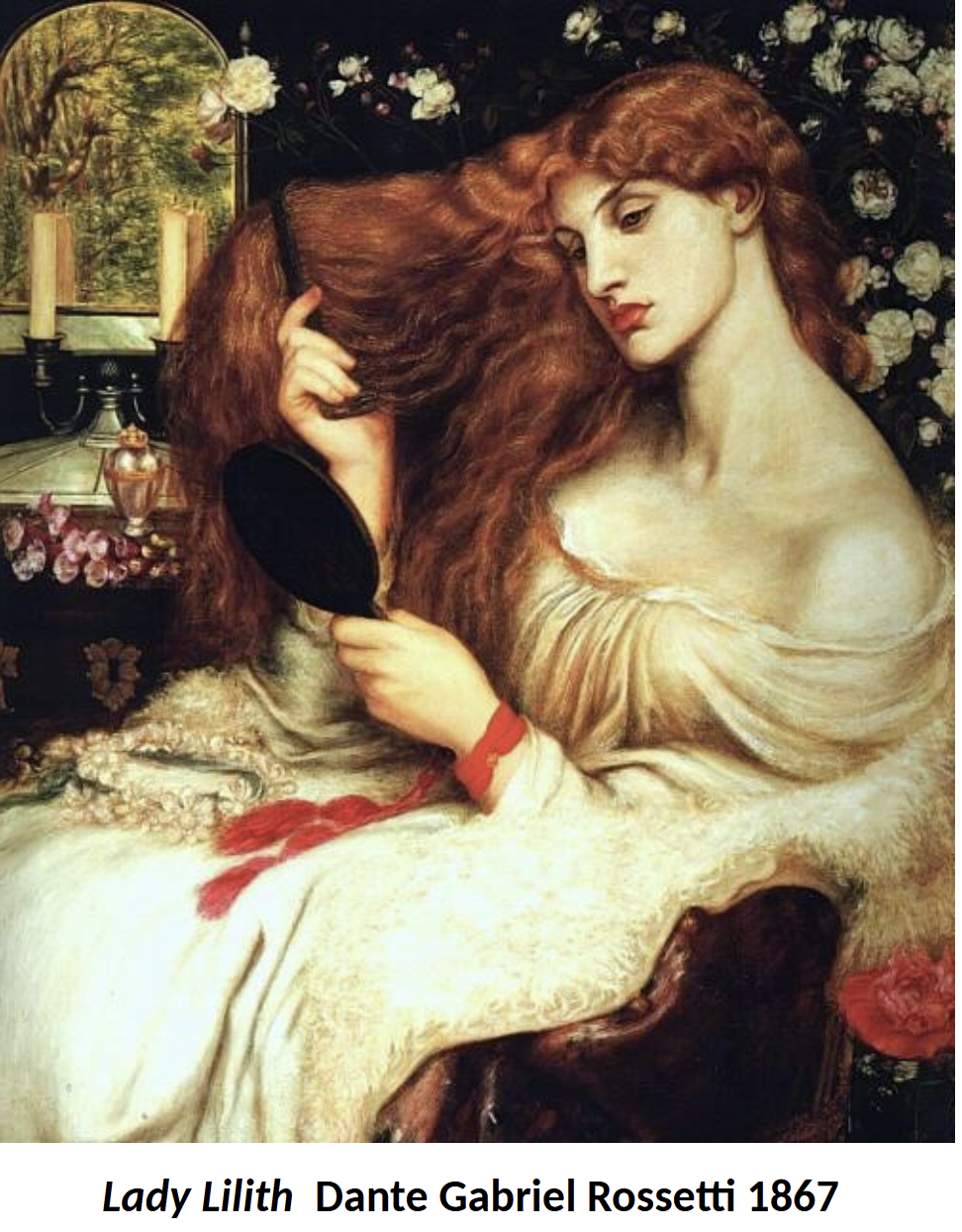
Lady Lillith Painting
the image focuses on Lillith, painting her as a beautiful figure, that posesses power of a s*xual/spirtual nature
the background is of a bedroom, but the lush mirror reflection suggests the Garden of Eden
Instead of a proper/rigid portrait of a Victorian woman made up in the latest fashions, Lillith reclines in her bedclothes w/out a corset + wearing her hair down + loose
^^^^ all of this this suggests her openess + freedom
symbolizes Rossetti’s views on the sexual power of spiritual love, + he does not paint her as a demon but instead a character that attracts the viewer w/her beauty
Lady Litllith Poem
Of Adam's first wife, Lilith, it is told
(The witch he loved before the gift of Eve,)
That, ere the snake's, her sweet tongue could deceive,
And her enchanted hair was the first gold.
And still she sits, young while the earth is old,
And, subtly of herself contemplative,
Draws men to watch the bright net she can weave,
Till heart and body and life are in its hold. The rose and poppy are her
flowers; for where
Is he not found, O Lilith, whom shed
scent
And soft-shed kisses and soft sleep shall
snare?
Lo! as that youth's eyes burned at
thine, so went
Thy spell through him, and left his
straight neck bent,
And round his heart one strangling
golden hair.
Dante Gabriel Rossetti 1868
(further embodying Rossetti’s views on both women and Lillith)
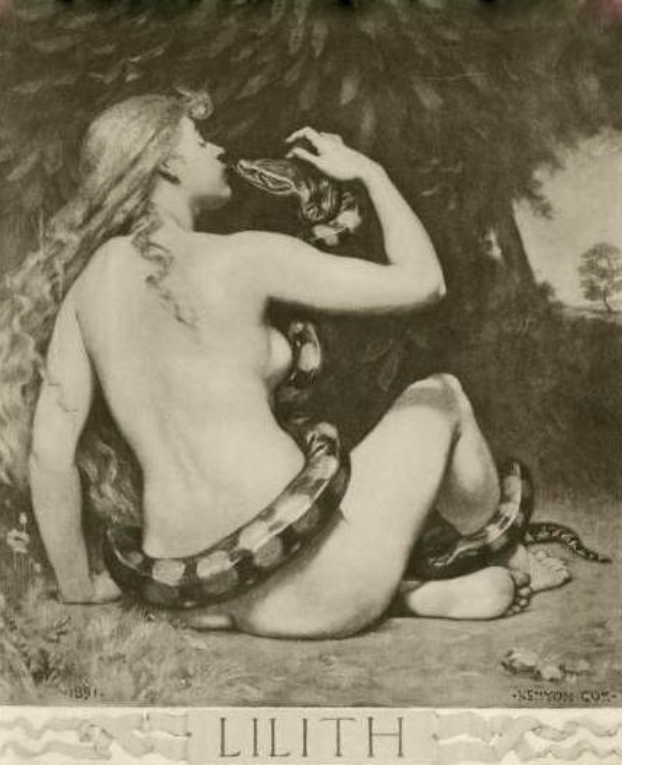
Lillith Modern Interpretations
for many feminists, Jewish + Neopagan women, Lillith = a symbol of female autonomy + independence (seeing her as a strong Female role model)
^^^both sexually and in general aspects of life
she bows down to no man, not even God Himself, she is the goddess of F sexuality for pleasure itself, rather than just for the purposes of reproduction
For men, Lillith also acts as an image of a powerful/independent woman
^^^^unfortunately still being seen as evil, as she is a woman w/both power + independence, Eve also seen as evil, but w/less agency, as her sin was being tempted/”weak-willed”

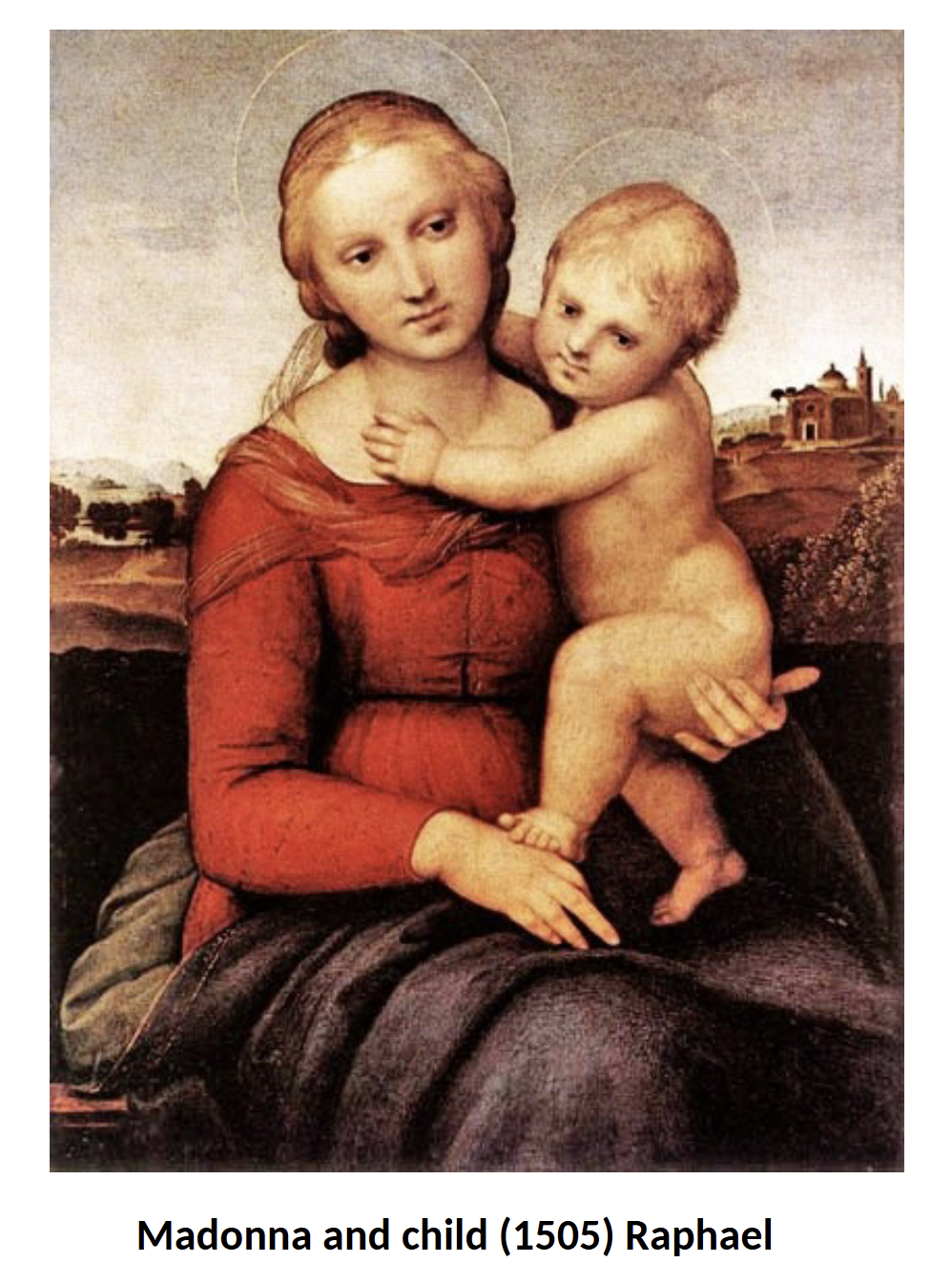
Mother Mary + culturally depicting motherhood
among Catholics/Orthdox believers Mary = the symbol of motherhood, painting her image as…
nurturing/supportive/motherly/self-sacrificing
image is unrealistic to a degree, as she is virginal + pure but still a mother, frames a nonsensical idea of how women are non-sexual in nature
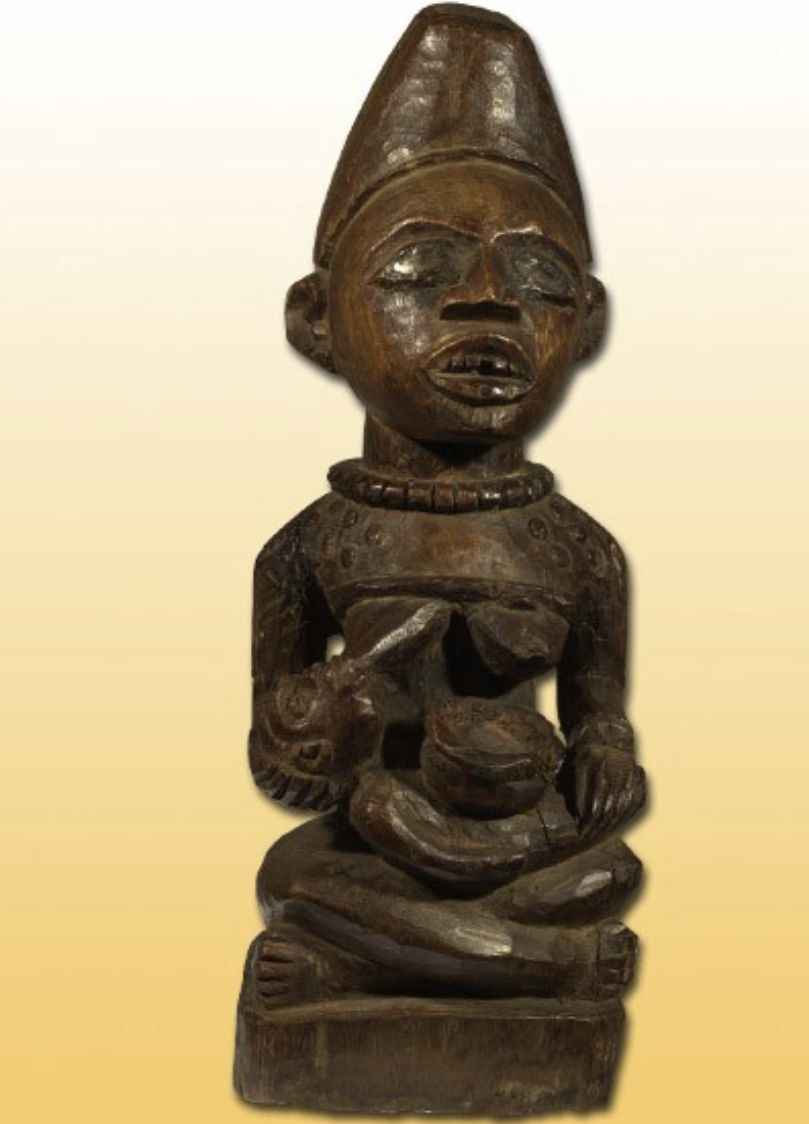
motherhood = a universal human reality, all cultures have embodied it in symbolizing/depicting their deities —> i.e. the idea of a nurturing mother Earth
or the Mother and Child Zaire(now Deomcratic Republic of Congo) figures
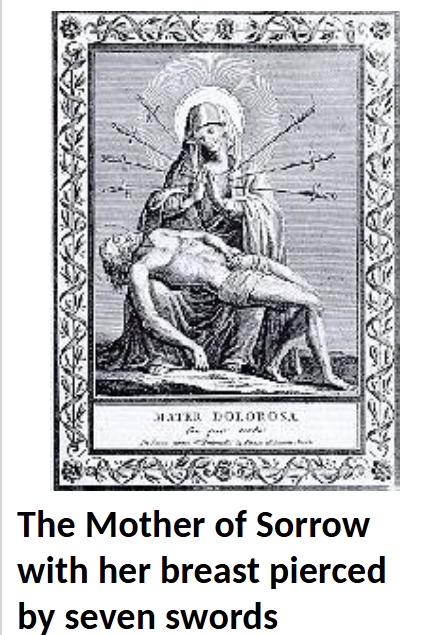
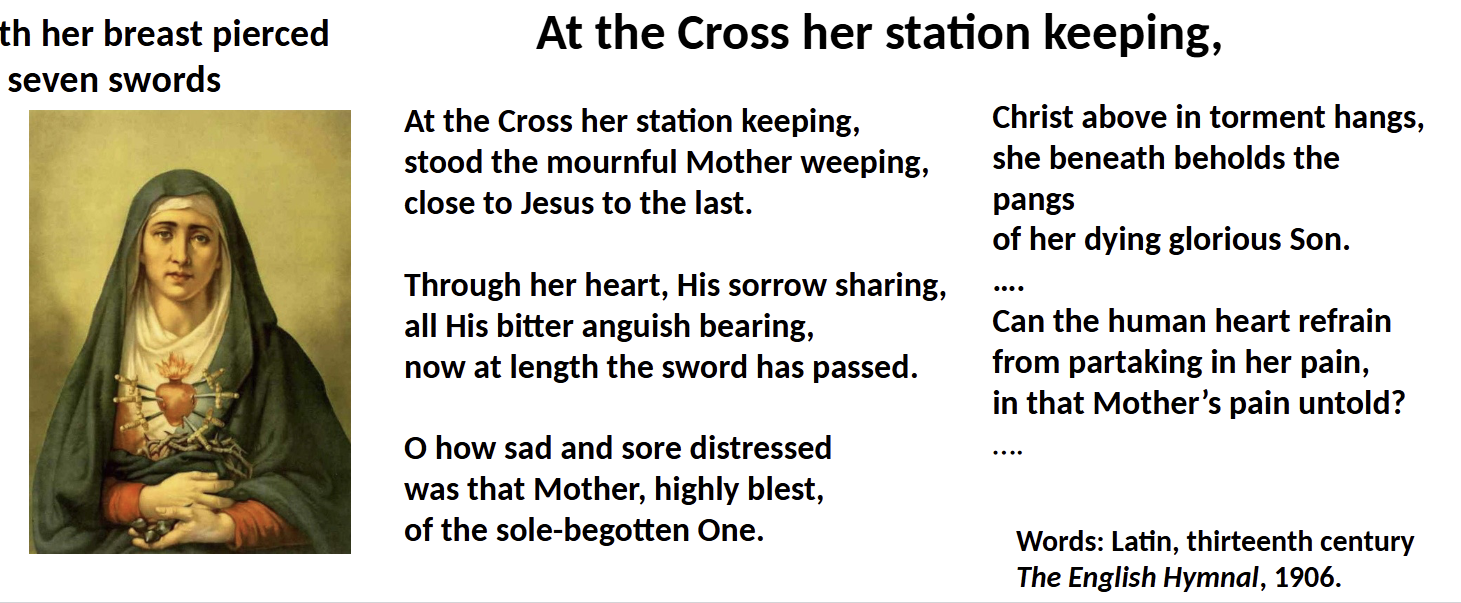
The Seven Sorrows of Mary
Mary, outside of just modelling motherhood, is the “Mother of Sorrow”, she is a woman who lost her son(Jesus)
the attached artwork has seven swords, each representing one of Mary’s seven sorrows, connected to Jesus’ crucifixion, his death for 3 days, sometimes bleeding
Makes the work of pain appear to be “gendered” —> especially in Western society where women bear the brunt of mourning sickness/death
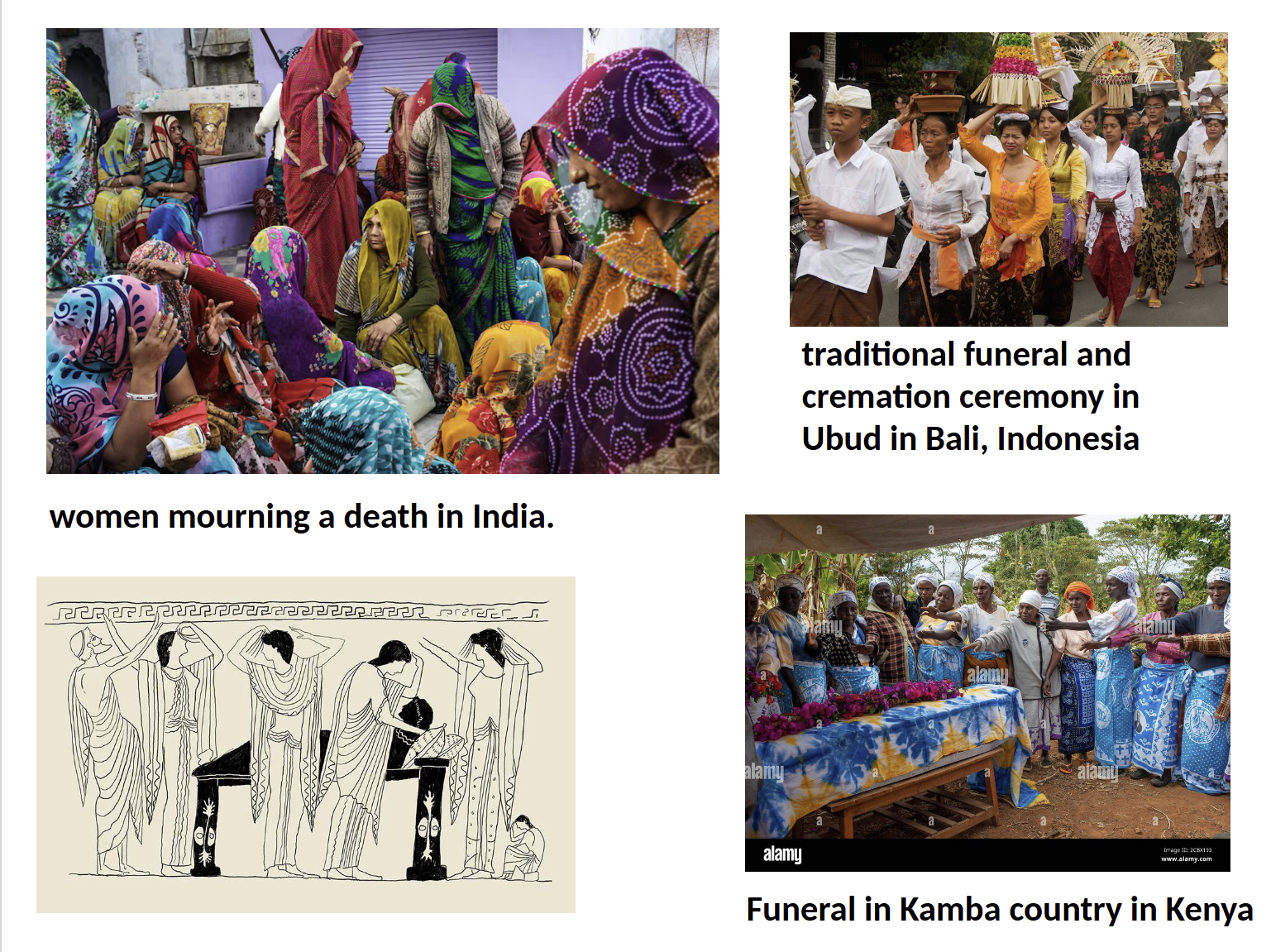
Gendered Mourning
ritual mourning often undertaken by women, a.k.a. the work of pain, is common to many societies, including pre-Christian Europe
Luke 23:28 “But Jesus turning unto them said, Daughters of Jerusalem, weep not for me, but weep for yourselves, and for your children.”
this expands to other cultures, where women undertake ritual moruning where men do not, which could tie into cultural concepts of men needing to be “strong” and not showing weakness (typically a “female” trait)
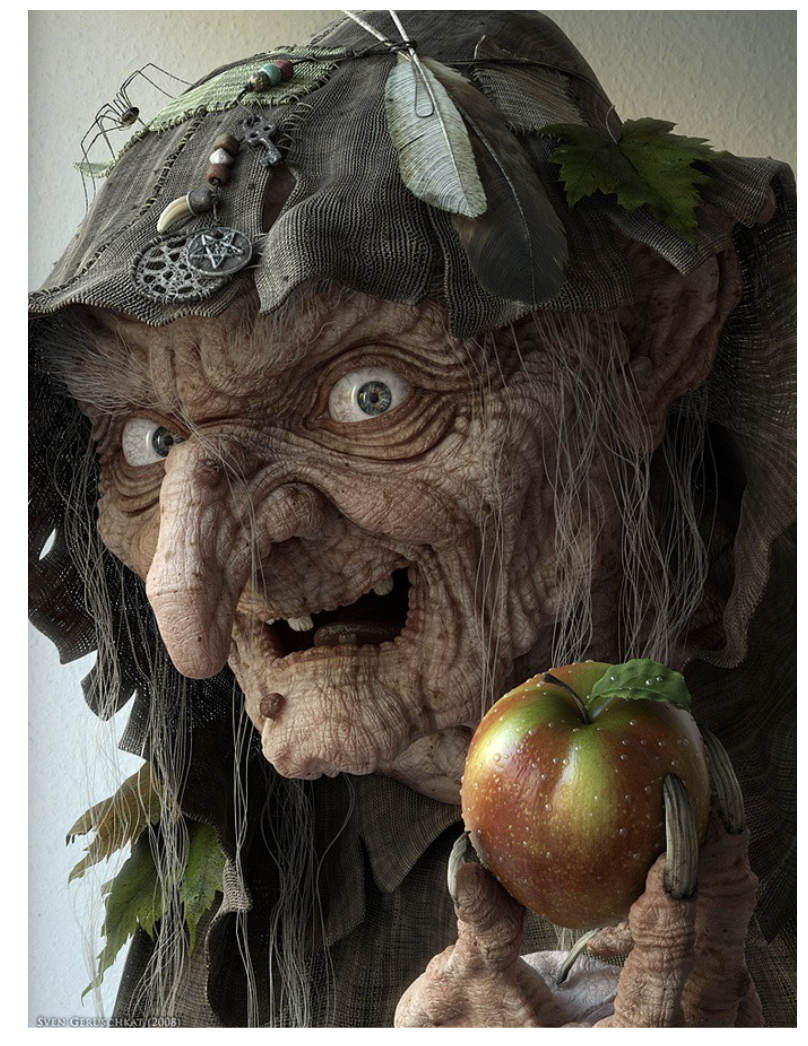
The image of a witch
witches tie into oracles + connects to both Western society and previously mentioned conceptions of gender
witches are often depicted as being close to nature, and “ugly”
w/ typical traits like a hooked nose, being old + haggered, w/warts or other facial blemishes (warts —> mark of the devil, indicator of a witch)
^^^often features opposed to Western beauty standards; i.e. opposing being delicate, young, pretty, + in good health, general Europen features
witches depicted to be unfriendly/mean/untrustworthy + nefarious in nature, often sporting black —> which is symbolic of death (+ bad omens to a lesser extent)
Halloween + Witches
1500’s —> witches thought to fly on brooms + wear conical hats that typically depicted a healer, co-opted for witch identification
often associated w/dark colours (for death) + things that are creepy, i.e. spiderwebs (evil, poisonous, harmful to us etc..)
Hallows Eve —> 31st of October, boundary b/2een regular + “holy” days (a.k.a. all saints day), during this window spirits can come from the world between ours + theirs via portals, dressing up in costume allowed you to avoid being detected by spirits + pumpkins were carved in the shape of lanterns to deter spirits (where dressing up + carving pumpkins come from), in Celtic times this was seen as a harvest celebration which occured at the end of Autumn, + the beginning of winter (interesting boundary found between seasons of “life” and “death” )
All Saints Day —> Nov. 1st, the day where martry’d saints are celebrated

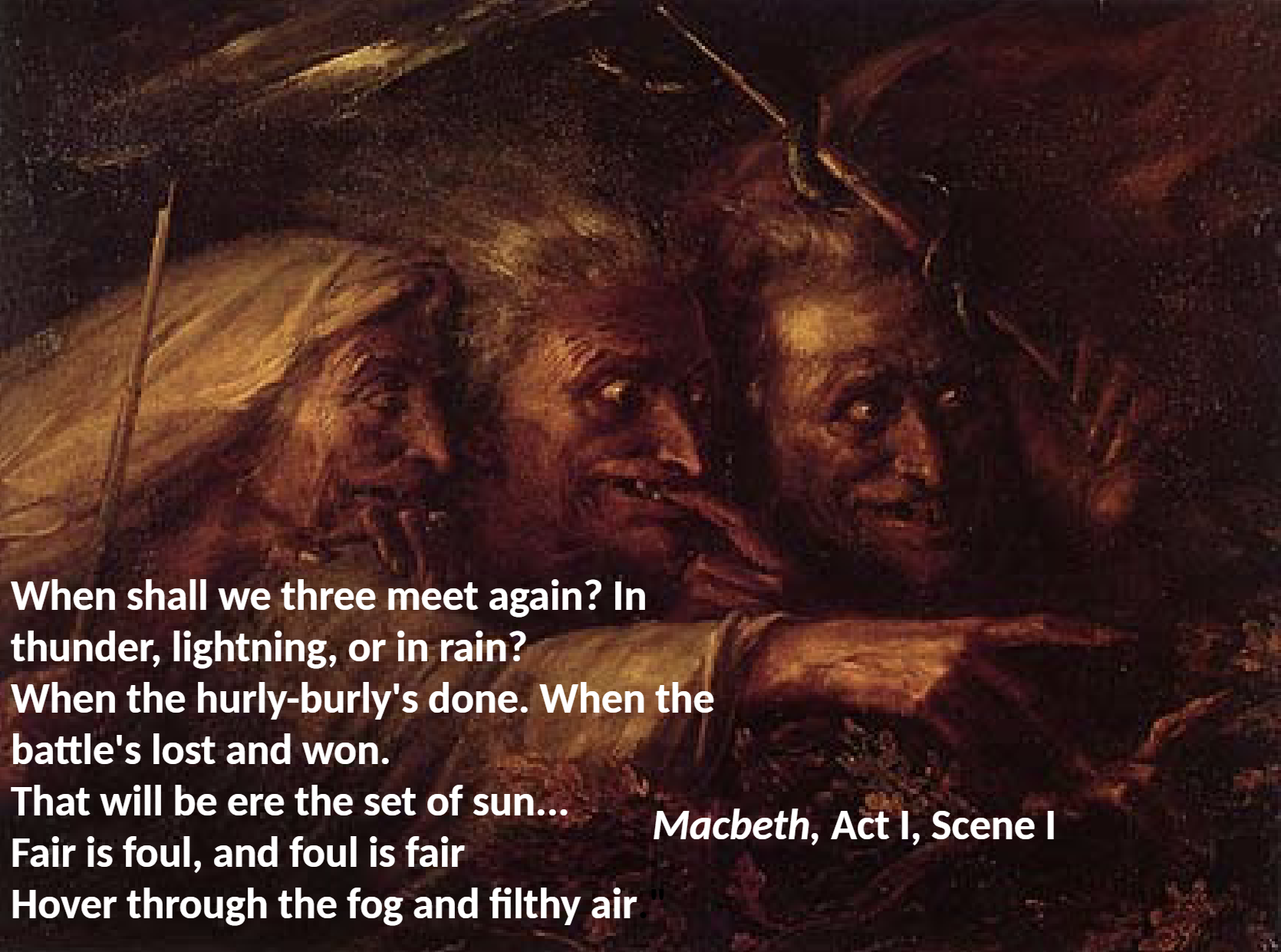
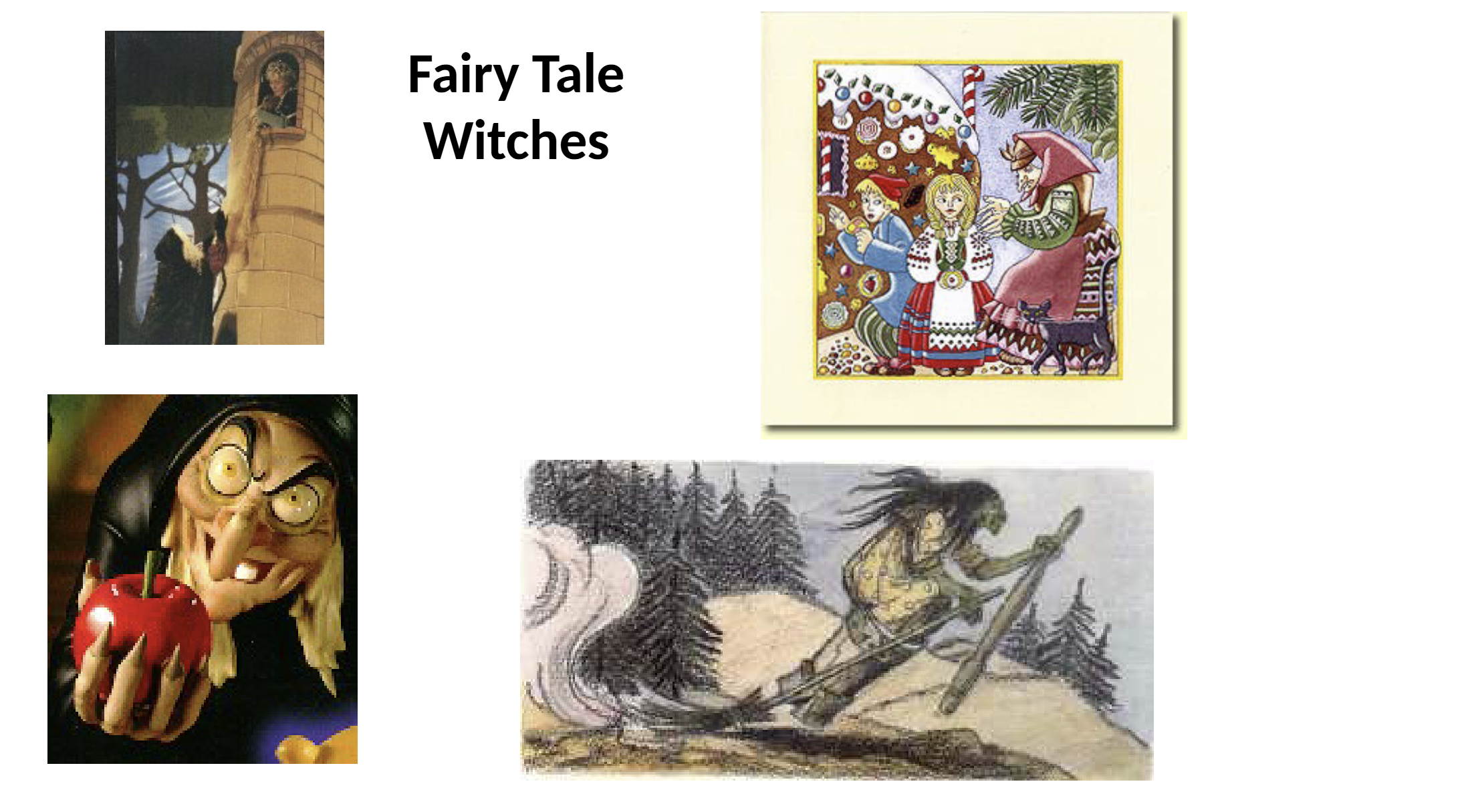
Fairytale + Literature-based Witches
often connected to Western folklore
examples?
Rapunzel, hungry wife, thieving husband, promises 1stborn to witch, 1st born locked in tower yada yada, witch = a baby stealer
Evil queen —> tries to kill Snow White out of jealousy, kills her dad I’m, pretty sure
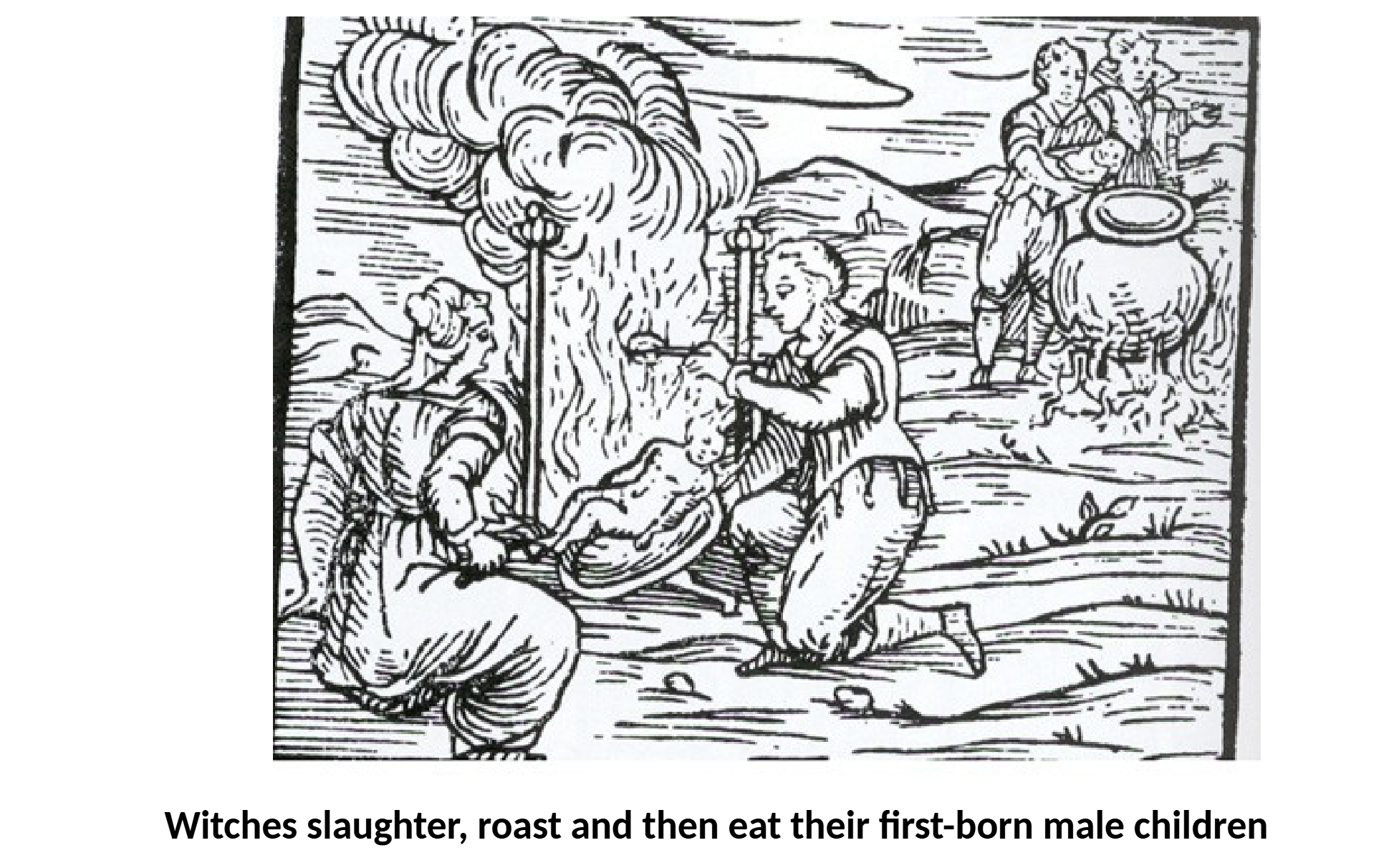
Hansel + Gretel —> cannibal witch who wants to eat kids
Baba yaga —> Russian witch who lives in a house made of chicken legs, she’s a cannibal who flies around on a broom carrying a mortar + pestle
Macbeth’s 3 witches —> seen as opposing social norms, meet @nightime in poor weather conditions to conduct evil practices, sometimes carry an idea/conception of homosexuality
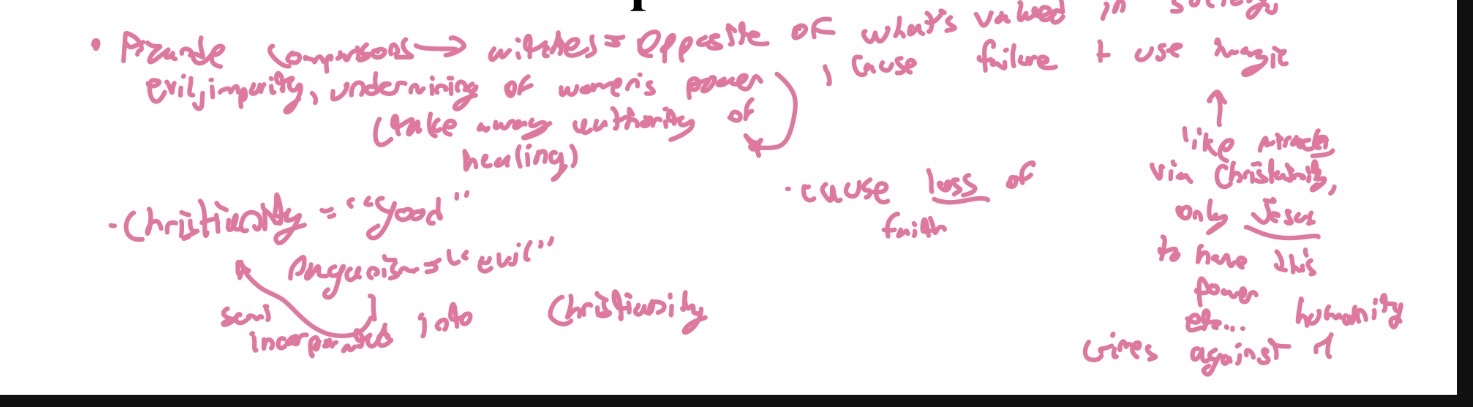
Witches as a Reversal of Normal Behaviour
in format of “Normal” Christian —> “Abnormal” Witch
white = predominant colour(purity/virginal) —> black as a dominant colour (death/evil), + Black masses
Chastity —> Orgies
Heterosexuality norm —> Homosexuality norm
Holy Communion —> Cannibalism
Day time mass —> nightime mass (often in bad weather)
Normal prayers —> prayers spoken backwards
Worship God —> Worship the Devil
Authority is divinely ordained —> authority from the devil
Where does this come from?
A: in the attached image
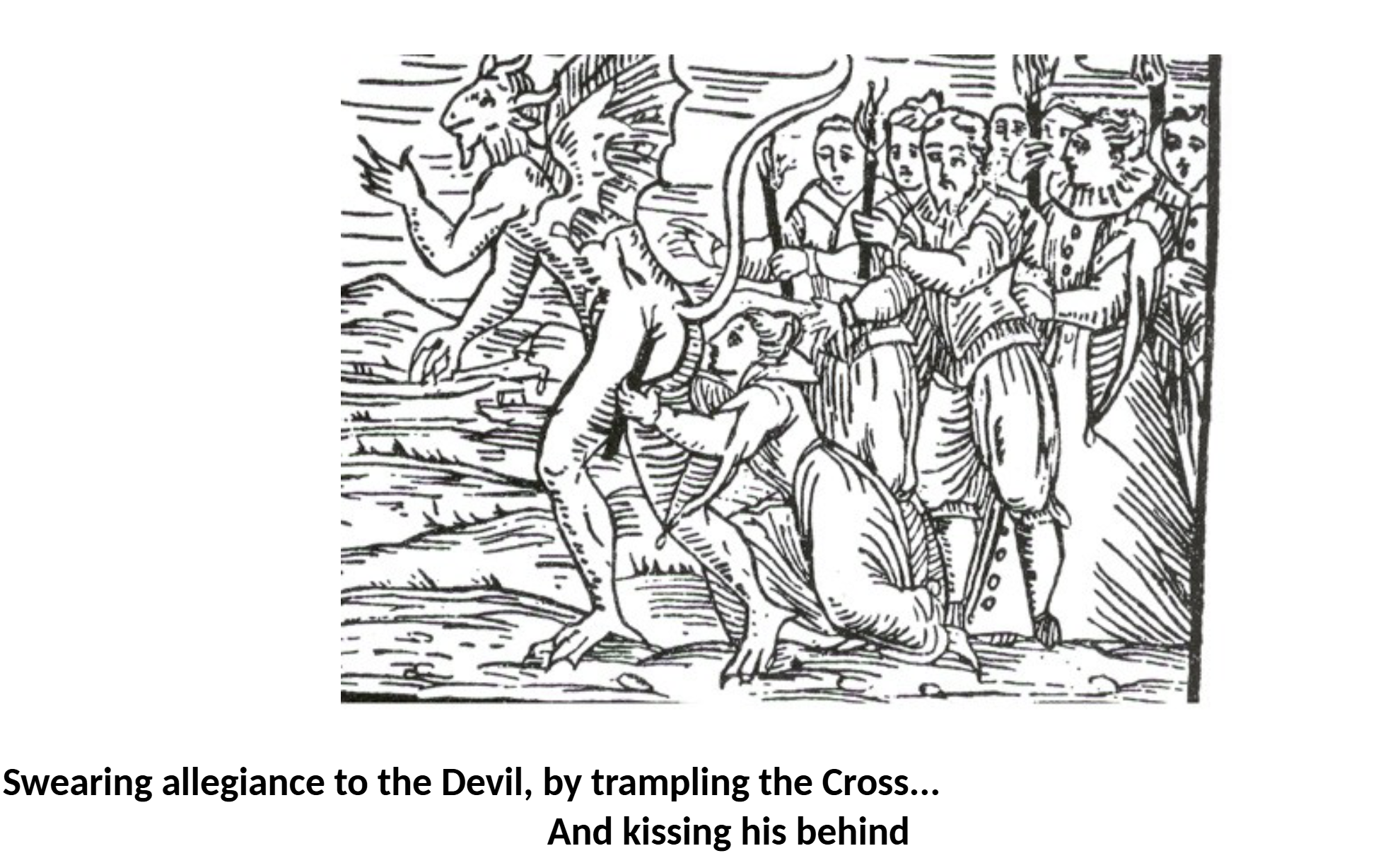
Witch images
look at attached images for more context on witches + surrounding stereotypes
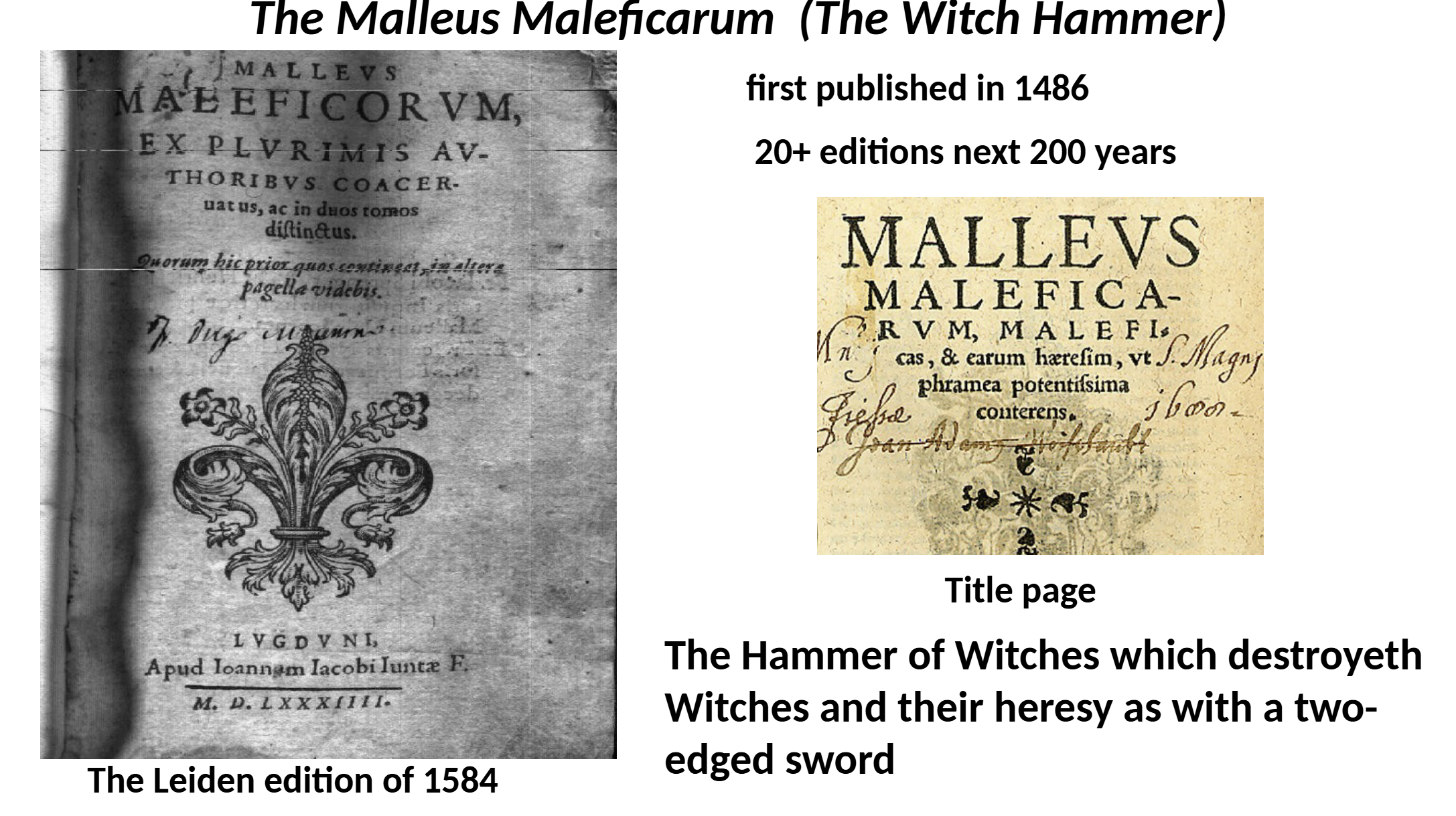
The Malleus Maleficarum (The Witch Hammer)
first published in 1486, 20+ additions created over the next 200 years, leads to the witchcraze in Europe
described witches; what they looked like, what they did, how to idenitfy/ detect/combat/punish them etc..
Maleficarum —> feminine noun, meaning to do harm —> women doing harm via sorcery/evil spells
“one of the most blood soaked books in Europe’s history”, caused a large #of deaths + acted as a source of validity for Christian beliefs
Pope Innocent V III issued a Papal bull in 1484 (a.k.a. official Pope/Vatican decree) it’s inclusion of ideas in the book on wc, made it appear the book had papal sanction
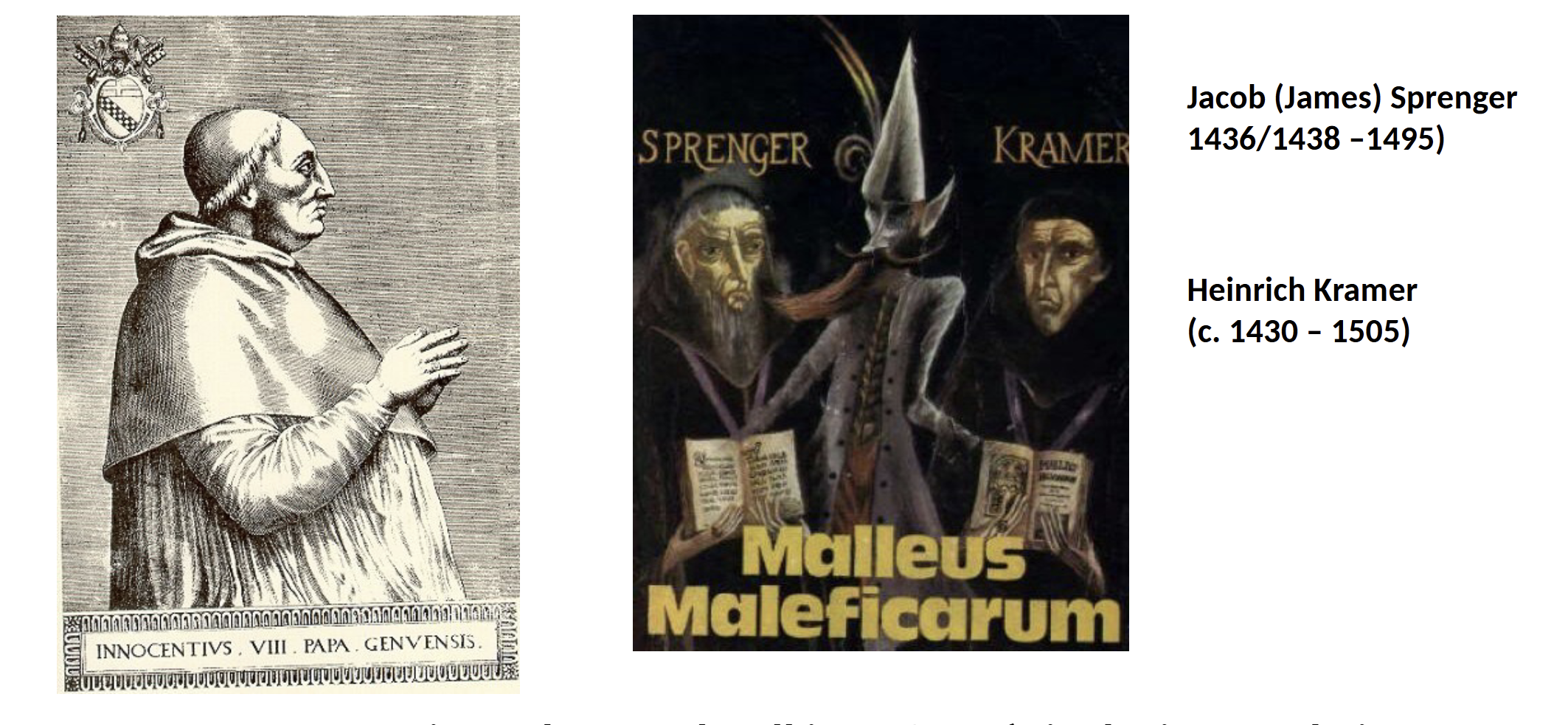
The Papal Bull 1484
“It has recently come to our ears, not without great pain to us, that in some parts of upper Germany, ... many persons of both sexes, heedless of their own salvation and forsaking the catholic faith, give themselves over to devils male and female, and by their
incantations, charms, and conjurings, and by other abominable superstitions and sortileges [magic], offences, crimes, and misdeeds, ruin and cause to perish the offspring of women, the foal of animals, the products of the earth, the grapes of vines, and the fruits of trees, as well as men and women, cattle and flocks and herds and animals of every kind, vineyards also and orchards, meadows, pastures, harvests, grains and other fruits of the earth.”(a.k.a. the devil has been driving people to hearsay + causing wc in men/women)
Who were witches?
typically women, as they were vulnerable + seen as “evil” and “weak-willed” which invites the devil in obvi
“What else is a woman ...but a foe to friendship, an unescapable punishment, a necessary evil, a natural temptation, a desirable calamity, a domestic danger, a
delectable detriment, and an evil of nature painted with fair colors [she is, furthermore] by her nature quicker to waiver in her faith which is the root of witchcraft.”
- Kramer and Sprenger, the Malleus Maleficarum
Where does witchcraft come from?
“ [wc] comes from carnal lust, which is in women insatiable… Wherefore for the sake of fufilling their lusts they consort even with devils”
women thought to be chronically oversexed, and seen not only as witches but whores
common insult —> “witch whore”
witch trials focus upon witches as being non-virgineous, sexual slaves of Satan, and through this virginity becomes the ideal state which women should aspire to have
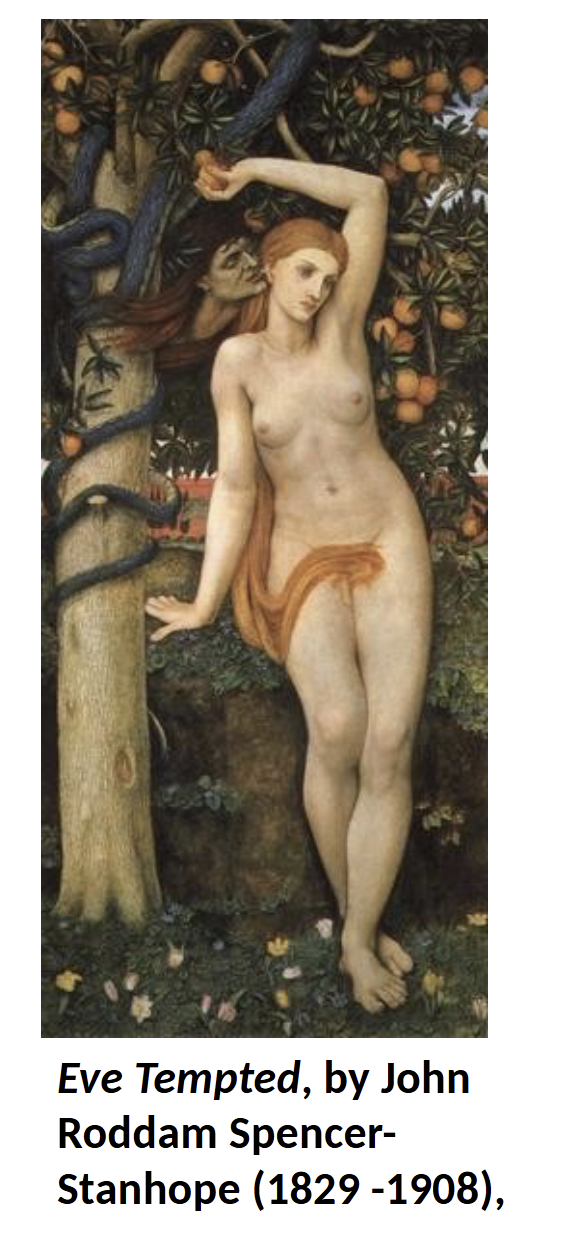
Eve tempted + the idea of women as “dangerous”
“Though the devil tempted Eve to sin, yet Eve seduced Adam. And as the sin of Eve would not have brought death to our soul and body unless the sin had afterwards passed on to Adam, to which he was tempted by Eve, not by the devil, therefore she is more bitter than death. More bitter than death, again, because that is natural and destroys only the body; but the sin which arose from woman destroys the soul by depriving it of grace, and delivers the body up to the punishment of sin. More bitter than death, again, because bodily death is an open and terrible enemy, but woman is a wheedling and secret enemy.” Kramer and Sprenger, p. 46 the Malleus Maleficarum
^^^a very misgonystic/oppressive approach that was taken towards women in nature —> depicting them as oversexual temptresses (wc therefore = a sex offense)
Malleus Maleficarium writings pt.1
“And what, then, is to be thought of those witches who in this way sometimes collect male organs in great numbers, as many as twenty or thirty members together, and put
them in a bird's nest, or shut them up in a box, where they move themselves like living members, and eat oats and corn, as has been seen by many as is a matter of common
report? It is to be said that it is all done by devil's work and illusion, for the senses of those who see them are deluded in the way we have said. For a certain man tells that, when he had lost his member, he approached a known witch to ask her to restore it to him. She told the afflicted man to climb a certain tree, and that he might take which he liked out of a nest in which there were several members. And when he tried to take a big one, the witch said: You must not take that one; adding, because it belonged to a parish
priest.” (Kramer and Sprenger, p. 121 the Malleus Maleficarum)
women's nymphomania was harmful to men and bewitchment could result in impotence,
or the disappearance of the penis itselfPenis theft was a capital offence
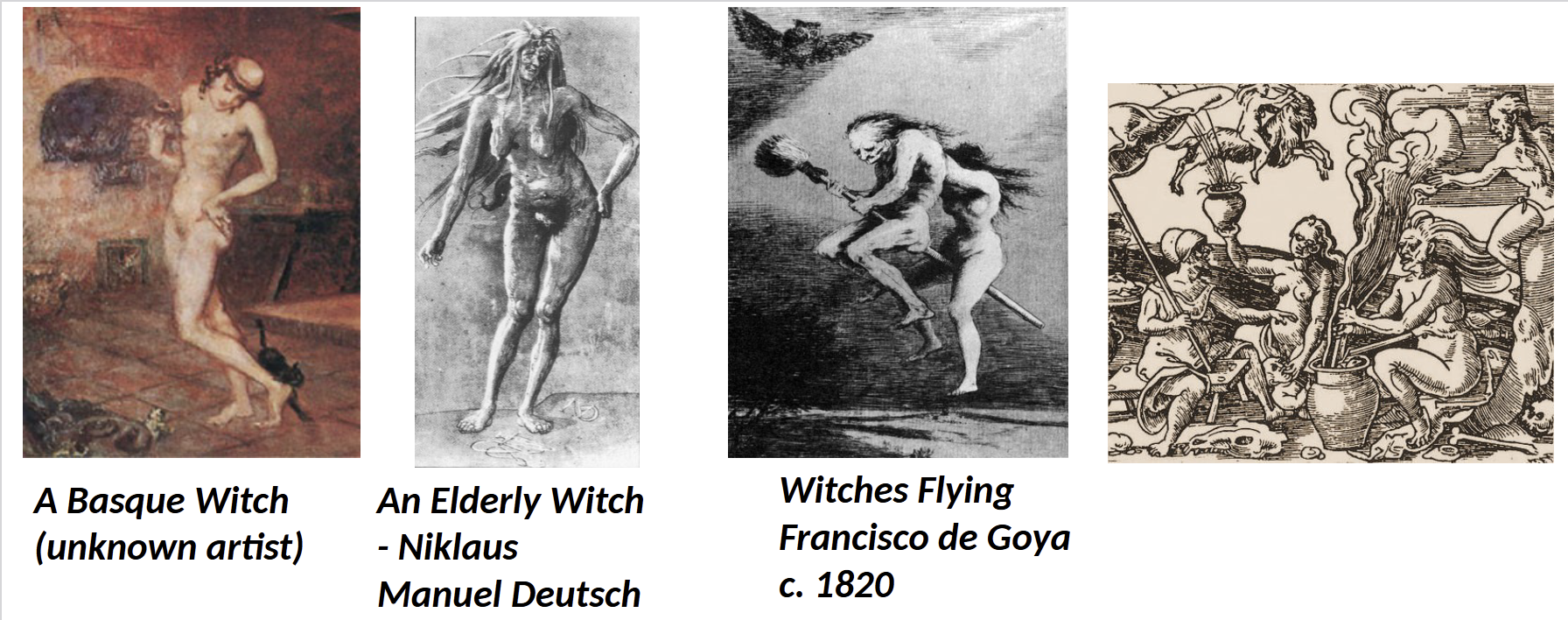
Artist renditions of witches
many artists of the time took advantage of artistic freedom that the subject provided to depict females/women as nude in a period of extensive censorship
Malleus Maleficarium writings pt.2
“Whether the belief that there are such beings as witches is so essential a part of the Catholic faith that obstinately to maintain the opposite opinion manifestly savours of heresy.” (similar to what was seen in the Azande, everyone believes in WC, there’s no way out)
“He must not be too quick to subject a witch to examination, but must pay attention to certain signs which will follow. And he must not be too quick for this reason: unless God, through a holy Angel, compels the devil to withhold his help from the witch, she will be so insensible to the pains of torture that she will sooner be torn limb from limb than confess any of the truth.”
believe witches are imprevious to pain in specific spots (a.k.a. marks/ “the mark of the devil” such as freckles/moles/birthmarks/visible blemishes) —> one reason as to why women were often shaved/had bodily searches conducted
guilty until proven innocent, all that was needed was an accusation
Witchcraft + Torture methods pt.1 (Matthew Hopkins)
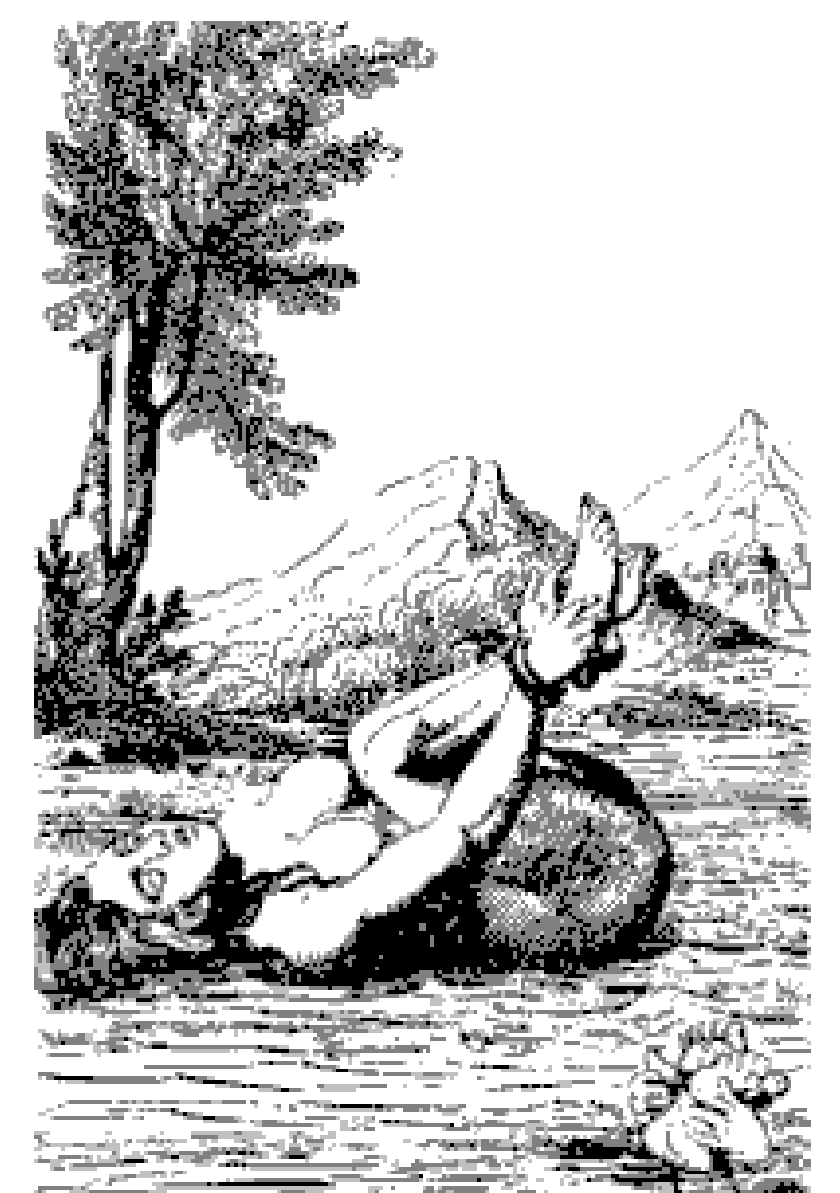
1 “foolproof” way to establish a witch was ducking, bscly the accused was plunged into a pond with their right thumb bound to their left toe, if she floated? proved an association w/the black arts, w/the body rejecting baptismal water, if she drowned? she was innocent, prisoner’s position made it much more likely they would float
in England, torture was not allowed against witches bc they were not believed to be conspirators, however Toremntum insomniae (torture via sleeplessness) was not considered to be torture so it was allowable
Matthew Hopkins —> England’s Witch-Finder General, was paid quite a lot to ascertain witches, write a book to explain how to identify witches/their familiars
^^^he used sleepless torture to his advantage in Essex, one instance John Lowe (70 year old vicar of Brandeston) was swum in the moat, kept awake for 3 days/night + then forced to walk w/out rest until his feet were blistered
he was believed to be responsible for death of 300 women 1644-1646
was accused of WC himself + put to death
Witchcraft + Torture methods pt.2
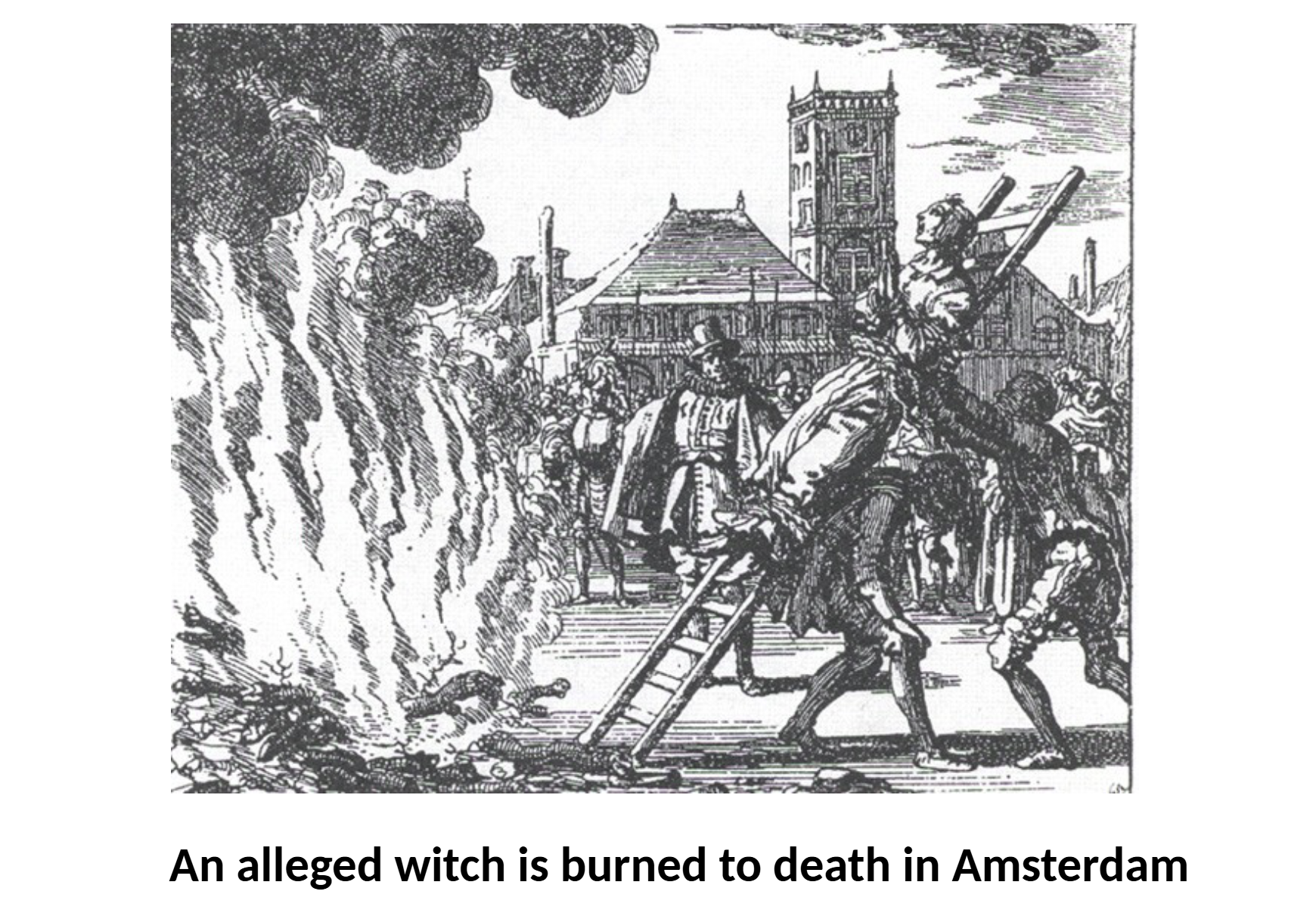
it was once commonly believed a witch’s power could be nullified by destroying her blood in a fire, hence the burning at the stake
uncooperative witches sometimes burned w/green wood, which took longer to kill them
burning of a witch was a great public occasion/spectacle, + this execution took place shortly after the sentencing
the witch would often be strangled first, then burned, if she was not dead + escaped the flames onlookers would shove her back into the flames
English Witches were often not burned @the stake/tortured in the popular continental manner
death @the stake was a fate reserved for traitors/heretics under the WC Act of 1563
superstitions surrounding witches/how to interact w/+ handle them
Approximately 1000 people were hanged for WC in England, of these 400 were hanged over a 14 month period by Matthew Hopkins
Some stats on Witchcraft
between 1450-1650 and approx 60 000- 100 000 people were executed by legal authorities for WC in Europe
75-90% accused were FEMALE, and majority of the accused were over 50
when torture was used to extract confessions, 95% of suspects were convicted, whereas when torture wasn’t only 50% were convicted
WC timeline
1542: English parliament makes witchcraft a capital crime, the legal code carries over to the new world colonies.
c.1580-1650: Height of witch-craze starts. (from mid 1500’s - mid 1700’s, particularly occured in France/Europe)
1580: The English witch hunts begin in earnest, over 1,000 are put to death. Where the sex of the dead is known, over 90 percent are women.
1585: Two German villages left with but one woman each after a witch purge.
1589: In Quedlinburg, Germany, 133 witches executed in one day.
1590: Rottenburg, Germany over 150 women executed for witchcraft in one year in one town.
1590 - 1700: Scottish witch hunts lead to over 3,000 accusations and about 1,300 executions.
1610 - 1630: The German witch craze is at its height. Tens of thousands die, more than 80 percent are women.
1692: 24 men and women are killed, 19 by hanging, in Salem, Mass
1782: Glarus, Switzerland carries out Europe’s last execution for witchcraft. (end of WC’s height)
1951: the British Witchcraft Act is repealed
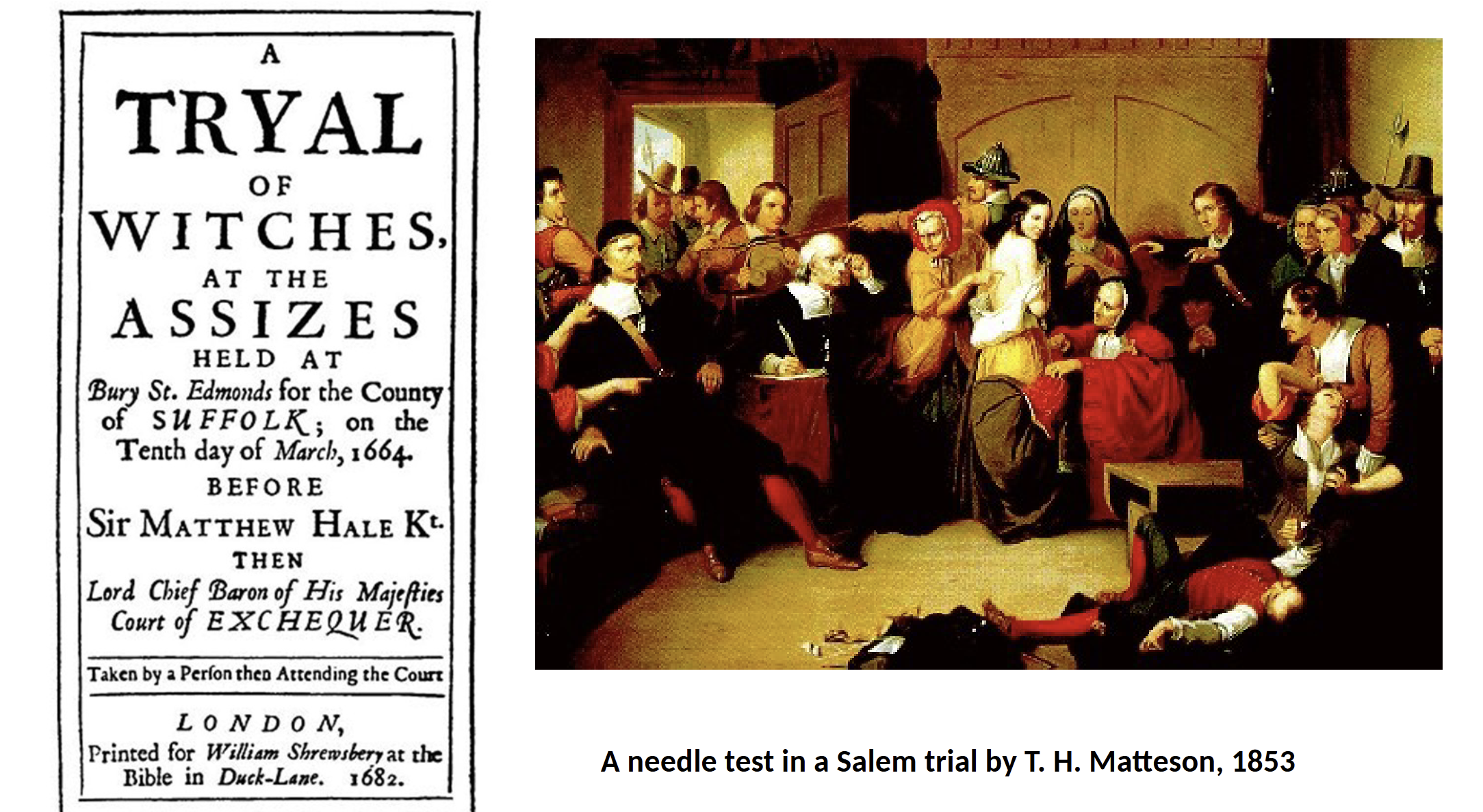
Wc then spreads —> the USA as the Salem Witch Trials, which is hypothesized to have actually resulted from poisoned rye bread which made people act “crazy” and “like witches”
Why did the WC arise when it did?
by 1500’s Europe had a well-developed tradition of persecuting outsider groups, + as Europe came out of feudalism, economic changes lead to a rise in individualistic behaviour + society became more diverse
great societal divisions, led to powerful emotions like jealousy/envy
political/economic/religious unrest (such as the Reformation) led —> insecurity/uncertainity
Reformation (1517) —> rise in Protestantism, via Martin Luther, ideas of wealth also shift w/this, Catholicism —> being wealthy is a sin, Protestantism —> wealth is the grace of God
^^^^ obvious Protestant/Catholic conflict ensues
hatred of wealth driven by the church manifests as envy + w/individualism, leads to accusations of WC, by those who wanted stuff posessed by women + children (who were vulnerable), also driven by women living longer than men
other factors led to it, such as the bubonic plague + the little ice age, which increased the need/desire to control nature, + nature has long been identified as F so… you really see the emphasis on M control w/in the family/society
demographic trends also come into effect w/this, typical witch was old/poor/ isolated, most women lived longer than men w/out Male protection patronage, threatened to upset M control of property + the social order
^^^especially women who stood up to inherit property due to no brothers/sons
also beginning of Scientific revolution, which is influenced directly by methods of the WC inquistion in terms of scientific method (Francis Bacon)
Why did WC die out?
decline in magic coincided w/ an increased understanding of the environment (no longer seen as being behind everything), beginning to understand sickness + crop failures
better food supplies/health conditions ensue, end of plague happens
better communications occur, contributed to a better sense of society
we have abandoned idea of misfortune being caused by personal malice
^^^stuff JUST happens
idea of WC is still pervasive in modern culture, has been altered by media idea of good/bad witches etc..
The Burning Times discussion
The Burning Times —> feminist perspective of what happened, i.e. bscly Catholic church supresses women + co-opts Pagan festivities/traditions
pre-Christian Pagan beliefs are naturalistic + egalitarian, women have roles as healers/prophets/etc.. , rituals cause events + are an attempt to control nature
1500-1600’s —> Women take roles as healers/midwives (bit of a limited scope in the film, i.e. also worked in fields)
WC arose bc of widespread + long history of persecution at the hands of the Catholic Church (according to film)
Early Renaissance Churches feared/persecuted women bc they had power over areas such as reproduction, economics (stealing men’s jobs allegedly) why they were largely accused/persecuted
the burning of witches ultimately acheived control over women for those who were scared of them (bc of perceived longevity, influence, + male insecurity)
Cult of Mary becomes popular bc a different vision of women was needed to the one being perpetuated, moving away from earlier conceptions of women, Eve/Lillith, Mary is also seen as a more “innocent” woman as she is a virgin + a devoted follower of Jesus
The Witchcraze has impacts of hindering the growth/development of society bc women couldn’t participate meaningfully
Similarities to WC in Contemporary Africa/The Azande, aspects of control + superstition as well as control of the vulnerable through persecution, guilty until proven innocent + often just confessed to it when accused (even when untrue)
Why did it die out? discussed previously but in summary, people are becoming more educated + the divine authority of the Catholic church is being questioned
Life during fedual/pre-Christian times, very romanticized by the film, sucked bc you could die of diseases + people lived in dirt hovels w/very short lifespans + very few material objects as they were expensive, also child labour was rampant so
final thoughts on the film —> vilifies Christianity a lot and promotes Paganism often romanticizing pre-Christian times, can cross the line of being more ideological than factual, strong proponent of Christianity being responsible for the removal of the Pagan religion