Biodiversity Final
 Call Kai
 Learn
Learn Practice Test
 Spaced Repetition
 Match
Match Flashcards
 Knowt Play
1/57

There's no tags or description
Looks like no tags are added yet.
Name | Mastery | Learn | Test | Matching | Spaced | Call with Kai |
|---|
No analytics yet
Send a link to your students to track their progress
58 Terms
Non-Timber Forest Products
Any product from a forest that is not wood which includes fruit, resins, fibers, medicines, and beverages
Stimulating Beverages
Any drinks with stimulants, typically caffeine or a similar compound. These drinks include coffee, tea, and cocoa
Caffeine
A type of alkaloid that works on the CNS to increase alertness but can also have negative effects
Coffee
Within the genus Coffea and includes 60 species but Coffea arabica is the most popular variety
Essential Oils
Volatile substances that give herbs and spices their scent, taste, and aroma
Herbs
Plants that lack a woody stem and grow in a temperate region. Includes four families, mint (Lamiaceae), parsley (Apiaceae), mustard (Brasicaceae), and allium (Amarylliaceae)
Spices
Produced from the seeds, bark, roots, or fruit of plants that grow in tropical regions
Poisonous Plants
Many poisonous plants to humans are used in landscaping and decorations including yews, American laurels, tulip, daffodil. Other plants are poisonous to livestock like white snakeroot, Indian hellebore
Plants Causing Mechanical Injury
Some plants can harm humans by cutting the skin (cacti, stinging nettle) or irritating the skin (St John’s wort)
Allergenic Plants
Cause allergic reactions in humans due to them inhaling the pollen or coming into direct contact with the plant. Some examples include, ragweed, tree pollen, poison ivy, latex allergy)
Biome
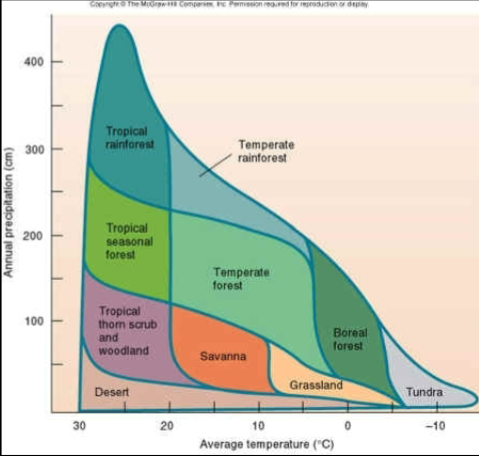
A large geographical area that is categorized by the animal life, plant life, and climate. There are 8-14 types of biomes the location of which is influenced by the latitude and precipitation
Tropical Rainforest
Most are found within 10 degrees of the equator and have hot temperatures and heavy rain fall year-round. The soil is nutrient poor due to the heavy rain fall and speedy decomposition. Trees are the dominant species and form four layers of the forest allowing for a lot of biodiversity
Tropical Dry Forest
Categorized by having hot temperatures by highly seasonal rainfall which results in many plant species entering a state of dormancy in the dry season. Most are in the range of 10 to 25 degrees from the equator past the tropical rain forests. Have decently rich soils but prone to erosion in the wet season. Plants have waxy layer and deep roots to maximize water. Has similar animal species as tropical rain forest
Ecosystem
Includes all the living things in a region interacting with their nonliving environment
Ecosystem Services
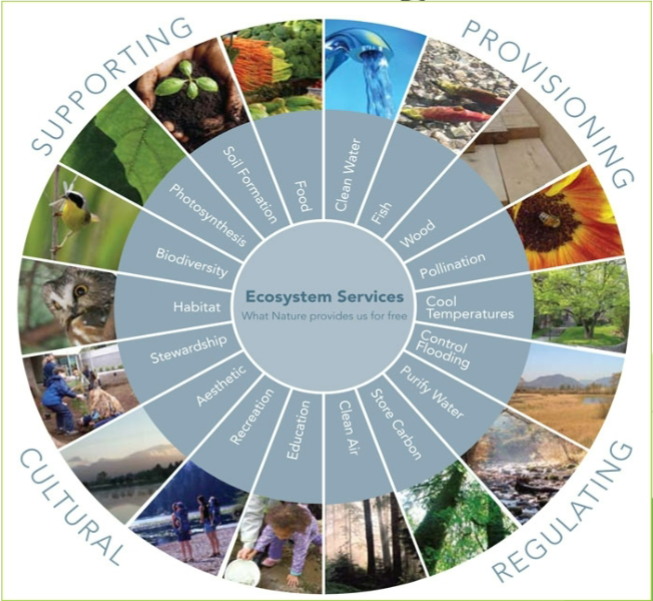
The goods that humans receive from the ecosystem that contribute to their wellbeing
Provisioning Services
Materialistic benefits received from the ecosystem including timber, medicine, food, fibers, water, and economic benefit
Regulating Services
Natural processes preformed by an ecosystem that are beneficial for humans such as flood control, air purification, pollination, and temperature regulation
Supporting Services
The ecosystem provides space for plants and animals to grow along with the soil needed to grow food
Cultural Services
Non-material ecosystem services that help to improve human mental health like recreational activities, tourism, research, education, and spiritual experience
Option Value
The value placed on maintaining a service even if it is unlikely to be used in the future so that it is not lost
Bequest Value
The value that is placed on a service in the context of it being crucial for future generations
Existence Value
A service is valued by people for it existing even if they do not directly use the service
Intrinsic Value
A service is important for existing even though people may not appreciate it
Threats to Biodiversity
The seven major threats are, habitat destruction, alteration of disturbance regimes, pollution, overexploitation, global climate change, invasive species, disease
Habitat Destruction
Many species are being lost as various biomes are being converted into land for human use. Loss of virgin forest (old growth) causes species to be lost that do not occur in new forests. This is the worst threat to biodiversity
Alteration of Disturbance Regimes
Natural disasters, especially fires and hurricanes are becoming more common and eliminating species who are not used to these conditions
Pollution
Biodiversity is lost due to the various environmental pollution. A persistent pesticide used from 1940-1960 called DDT caused major issues primarily with Peregrine falcons
Biomagnification
Harmful chemicals like pesticides become more concentrated higher up the food chain. This creates problems for humans and top predators
Theo Colborn
Discovered that some chemicals leeched into the environment were endocrine disruptors that negatively impacted the reproduction of wildlife
Overexploitation
The uncontrolled unsustainable harvest of natural resources for human use resulting in loss of species partially caused by the increase in human population
Domino Effect
As one species become rare due to overexploitation, harvesters will substitute it with another species and overexploit that one
Climate Change
Altered patterns in the global average temperature and other weather events. Human activity is producing more greenhouse gases which results in more heat being trapped in the atmosphere rather than being released into space
Weather
Daily fluctuations in temperature and precipitation
Climate
The long-term average weather that defines a particular region
Anomaly
A difference from a reference value or a long-term average relating to climate
IPCC
Intergovernmental Panel on Climate Change is a scientific body that was established by the United Nations that synthesizes data on climate change to advise policy
Phenology
The study of timing in animal and plant life cycles. Phenological shifts are occurring due to climate change frequently causing events such as budding to occur earlier in the season
Invasive Species
Second biggest impact on biodiversity loss as a result of invasive species taking the niches of native ones. Many of these are introduced accidentally or intentionally by humans although they are sometimes naturally introduced. One example is purple loosestrife
Native Species
Living within its natural range of dispersal
Non-native Species
Living outside its natural range of disperal
Invasive Species
A non-native species that causes harm to the ecosystem
Weed
A plant growing where it is unwanted, not necessarily non-native
Tens Rule
Of 1,000 species introduced only 100 will survive. Of the 100 that survive only 10 will establish. Of the 10 that establish 1 will become invasive
Direct Mechanisms
Invasive species compete for food and resources
Indirect Mechanisms
Invasive species fill or overtake a niche which skews the food pyramid
Disease
The consequences of human disturbances results in altered epidemiology of various concerning diseases. Increased stress makes wildlife more likely to become diseased
Crowding Effect
Habitat loss results in increased contact between species that increases the spread of diseases
Spill-over
The transmission of disease from domestic animals to closely related wildlife
Zoonotic
Refers to diseases that can be transmitted from animals to humans
Spill-back
Diseases that are spread from wildlife to closely related domestic species
Dilution Effect
The mechanism by which biodiversity inhibits infectious diseases. For example, having more variety of mammals prevents ticks from attaching to mice. This would limit the number of ticks that carry Lyme disease
Conservation Strategies
Includes in-situ and ex-situ conservation and policy change
Lacey Act 1900
Prohibits interstate trade of any wildlife, fish, or plants that were illegally acquired
The Marine Mammal Protection Act (MMPA) 1972
Prohibits the taking or trade of marine mammals or marine mammal parts
Endangered Species Act (ESA) 1973
It is illegal to harm or trade endangered species including their parts
Convention on International Trade in Endangered
Species (CITES) 1975
Regulates trade in living specimens and parts of species that are listed
Ecological Footprint
A global measure of the rate at which we are consuming resources and generating waste
Algae
Photosynthetic, aquatic organisms that lack true structures. Reproduce sexually or asexually. Are the ancestors of land plants. They are split into three major groups of green, brown, and red algae.