2.1 - outcome measures
 Call Kai
 Learn
Learn Practice Test
 Spaced Repetition
 Match
Match Flashcards
 Knowt Play
1/17

There's no tags or description
Looks like no tags are added yet.
Name | Mastery | Learn | Test | Matching | Spaced | Call with Kai |
|---|
No analytics yet
Send a link to your students to track their progress
18 Terms
functional lower-limb amputee gait (FLAG)
_________________ is an observational gait analysis for people with an amputation
RANCHO gait analysis (the massive, comprehensive assessment)
the functional lower-limb amputee gait (FLAG) outcome measure is a condensed version of the _______________
T (most of the time, long list of advantages - validity, reproducibility, sensitive to important changes, resistant to cognitive impairment, less influence by education/culture/language)
T/F: performance based tests are the gold standard
10 meter walk test
2 or 6 minute walk test
timed up and go
amputee mobility predictor (AMPpro/nopro)
comprehensive high activity mobility predictor (CHAMP)
list some examples of performance based measures used with the amputee population (5)
F (single item tasks are measures like 10mWT, 2/6MWT, TUG)
T/F: the AMPpro/nopro and CHAMP outcome measures are single item tasks
the EBAR ties an intervention to pts performance
what is the good thing about integrating the EBAR with the AMP outcome measure
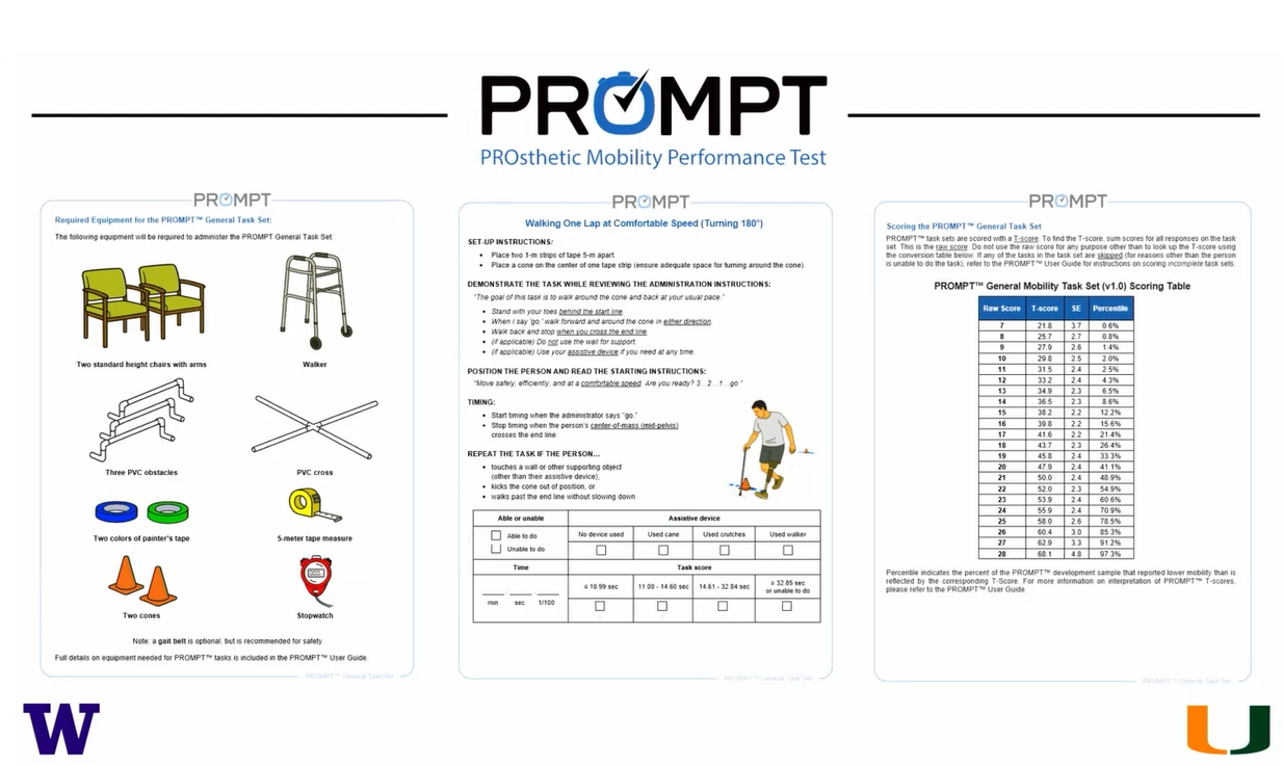
PROsthetic Mobility Performance Test
what does the PROMPT stand for
performance based
advantages of (performance based or self report):
Clear face validity
Good reproducibility
Sensitive to important changes
Resistant to cognitive impairment
Less influenced by education, culture and language
performance based
disadvantages of (performance based or self report):
Required large number of tasks to be comprehensive
NOT all tasks are relevant to specific patients
Space, equipment, time can be barriers
Administrators may need training
Score may be difficult to interpret
self report
advantages of (performance based or self report):
Provide unique information about individuals’ experiences, perceptions, and opinions
Ease of administration, minimal risk, and non-invasive nature
Can be more comprehensive
Can be customized (as appropriate)
self report
disadvantages of (performance based or self report):
Response bias (recall, frame shift, desirability/distortion, etc.)
Development often NOT rigorous (item development, validity, etc.)
activities specific balance confidence (ABC)
prosthesis evaluation questionnaire (PEQ)
orthotic and prosthetic user’s survey (OPUS)
prosthetic limb users survey (PLUS)
mobility (PLUS-M)
falls (PLUS-F)
attention (PLUS-A)
what are some examples of patient report outcome measures (PRO) for patients with prosthetic (4)
4 square step test
L test
(but the evidence and recommendations are always evolving)
as of now this point in time, what are the recommended performance based measures with people with prosthetics from literature reviews
ABC
PEQ (mobility)
PLUS-M
(but the evidence and recommendations are always evolving)
as of now this point in time, what are the recommended self-report measures with people with prosthetics from literature reviews
AMPnoPro
transfemoral fitting predictor (TFP)
single-leg balance test
basic amputee mobility score (BAMS)
(but the evidence and recommendations are always evolving)
as of now this point in time, what are the recommended performance based measures with people who are non-ambulatory from literature reviews
AMP
TUG
2MWT
CHAMP or 6MWT for high functioning
(but the evidence and recommendations are always evolving)
as of now this point in time, what are the recommended performance based measures with people with prosthetics from the ISPO COMPASS
PEQ (residual limb health, utility)
trinity amputation and prosthesis experience scales-revised (TAPES-R)
(but the evidence and recommendations are always evolving)
as of now this point in time, what are the recommended self-report measures with people with prosthetics from the ISPO COMPASS
F (THERE IS NO UNIVERSAL AGREEMENT ON ANY MEASURE)
T/F: the AMPpro/nopro and CHAMP are the best measure based on universal agreement