(3) Prejudice and reducing prejudice
 Call Kai
 Learn
Learn Practice Test
 Spaced Repetition
 Match
Match Flashcards
 Knowt Play
1/40

There's no tags or description
Looks like no tags are added yet.
Name | Mastery | Learn | Test | Matching | Spaced | Call with Kai |
|---|
No analytics yet
Send a link to your students to track their progress
41 Terms
What are the three main perspectives on human social cognition and behaviour?
Interpersonal processes, group processes, and intergroup processes
What are interpersonal processes?
The relationships between a small number of individuals such as friends, family members, and romantic partners
What are group processes?
The relationships and influence processes among members within a group
What are intergroup processes?
Relationships between groups, including prejudice, discrimination, and perception of people based on group membership
What is intergroup bias?
A systematic tendency to evaluate one’s own group or its members more favourably than an outgroup (Hewstone, Rubin & Willis, 2002)
What are the three components of intergroup bias?
Attitudes (prejudice), cognitions (stereotyping), and behaviours (discrimination)
What is prejudice?
A negative attitude or feeling towards members of a specific social outgroup; an affective response rather than a set of beliefs
How does Abrams (2010) define prejudice?
A bias that devalues people because of their perceived membership of a social group
What are stereotypes?
Beliefs about common characteristics assigned to members of a social group; often inaccurate and function as mental shortcuts
What is discrimination?
Negative behaviour directed towards members of social outgroups
Can someone be prejudiced without discriminating?
Yes, it is possible to hold prejudiced attitudes without displaying discriminatory behaviour
What did Abrams, Swift & Houston (2018) find about prejudice in Britain?
42% of respondents reported experiencing some form of prejudice in the previous year in a sample of 3000 participants
What reasons for prejudice were identified by Abrams, Swift & Houston (2018)?
Age, sex, physical or mental health, race, religion, and sexual orientation
What patterns of age and sex prejudice were found in Abrams et al. (2018)?
26% reported age prejudice, especially younger people; 22% reported sex prejudice, with higher reports among women
What are the main types of prejudice expression?
Direct and explicit prejudice, and indirect or subtle prejudice
What are indirect forms of prejudice?
Objections to equal rights and patronising or benevolent stereotypes about groups
What is old-fashioned or explicit prejudice?
Blatant expression of negative attitudes and stereotypes based on group membership
How have social norms affected explicit prejudice?
Overt expressions have become less socially acceptable due to changing norms and the Equality Act 2010
What did Charlesworth & Banaji (2019) find about prejudice over time?
Explicit attitudes became less extreme and moved towards neutrality across 4.4 million tests over 13 years
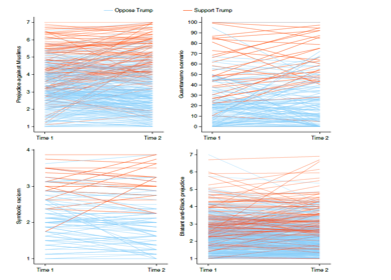
What was examined by Ruisch & Ferguson (2022)?
The relationship between populist leaders and expressions of prejudice
Supporters of populist leaders held more prejudiced views, but causality could not be established
What is modern or implicit prejudice?
Subtle and covert forms of prejudice that are often unconscious
What is modern racism according to McConahay (1986)?
The belief that discrimination is no longer an issue, minorities demand too much, and their gains are undeserved
What is affirmative action and why is it controversial?
Policies aimed at improving opportunities for minorities and women, often opposed due to implicit prejudice
What is aversive racism?
A conflict between explicit endorsement of equality and unconscious negative stereotypes, leading to subtle discrimination
they experience negative emotions about a group but don’t express these attitudes
When does aversive racism become apparent?
In situations with unclear social norms, where unconscious biases can influence behaviour
What is benevolent sexism?
Subjectively positive attitudes that portray women as inferior and in need of protection
What are the three components of benevolent sexism?
Paternalism (women are less powerful than men), gender differentiation (exagerated differences between men and women), and heterosexual intimacy (women are beauty objects)
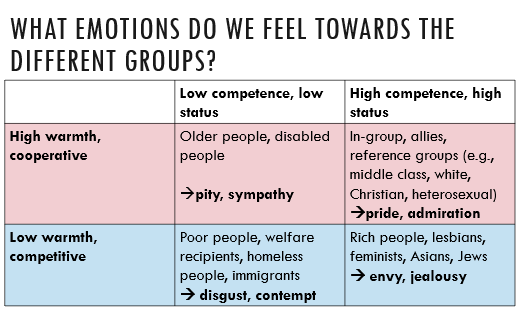
What is the stereotype content model (Fiske, 2012)?
A model proposing warmth and competence as two key dimensions in social perception
How do warmth and competence influence behaviour towards groups?
They affect whether groups are helped, ignored, or targeted negatively
How is prejudice measured using explicit measures?
Self-report questionnaires such as feeling thermometers that are conscious and prone to social desirability bias
What are implicit measures of prejudice?
Measures of automatic evaluations, often assessed using reaction times such as the Implicit Association Test
What is the Implicit Association Test (IAT)?
A reaction time task measuring strength of association between groups and evaluations
What did Greenwald et al. (2009) conclude about the IAT?
The IAT does not predict behaviour better than explicit measures and assesses hidden bias rather than prejudice itself
How does social learning theory (Bandura, 1977) explain prejudice
Children learn their attitudes by direct training or by observing and imitating their parents behaviour (in theory children should show no prejudice at an early age)
Limitations:
Mixed findings regarding correlation between children and parents attitudes
Empirical work does not always support the expected trajectory
How does Cognitive-developmental theory - Aboud 1990 explain prejudice
Prejudice is caused by information processing errors due to young childrens poor cognitive ability
Cognitively immature young children are prone to prejudice because they cannot process multiple classifications
Not necessarily negative
Peak in prejudice around 7-8 years, consistent with cognitive development stage
How does Authoritarian personality - Adorno et al 1950 explain prejudice
Trait and behavioural style for conventionality and respect to submission - more conventional views
Difficult upbringing leads to an authoritarian personality
Peterson et al., 2016 - authoritarian consistently negatively correlated with authoritarian personality to big 5 openness's
Limitations:
Widespread ethnic cleansing (not everyone who did this did these tradigeis)
Prejudice changes: both point to the importance of cultural influences over personality
How does Social dominance theory (Pratto, Sidanius & Levin, 2006) explain prejudice
All societies are made up of groups with relevant hierarchies - some people belive their groups is the correct one
Power relationships between groups are maintained through discrimination
How does Intergroup emotions theory (Mackie, Devos & Smith, 2000) explain prejudice
Looks at the appraisal on emotions -if it is relevant to use it elicits an emotional response
We react emotionally when an outgroup might threaten an ingroup - cognitive appraisal that this could threaten us, leading to anger and aggression
how does the intergroup contact approach work for adults
Bringing together members of different group should reduce prejudice under the right conditions (Allport, 1954)
Friendship is an effective form of contact - extended contact can reduce prejudice
Contact has a stronger effect of affect (feelings) than cognitions (stereotypes)
Limitations:
Intergroup anxiety arises - if they have high levels of this they will have low contact and therefore assume they are dissimilar - leading to prejudice
Why are childhood socialisation approaches to prejudice reduction limited?
assume childhood prejudice results from exposure and that teaching positive attitudes will reduce prejudice
often reduce prejudice initially-effects fade over time because children are not empty vessels and their cognitive, emotional, and social development increasingly shapes how they interpret group norms and identities
How does Nesdale et al. (2003) support this view of prejudice reduction?
showed that as children grow older, prejudice becomes increasingly influenced by ingroup norms and group identification rather than simple exposure, demonstrating that developmental changes mean early exposure-based interventions may not produce lasting reductions in prejudice