ethiopia awakening - meta warrick fuller
 Call Kai
 Learn
Learn Practice Test
 Spaced Repetition
 Match
Match Flashcards
 Knowt Play
1/60

Earn XP
Description and Tags
art section 4
Name | Mastery | Learn | Test | Matching | Spaced | Call with Kai |
|---|
No analytics yet
Send a link to your students to track their progress
61 Terms
when was ethiopia made
1921
what continent was one of the earliest non-western inspos for american art
asia
Starting in the (decade), (name), (name), and (name) started incorporating (country) visual strategies and motifs into their works.
1860s; James Abbott McNeill Whistler, Lila Cabot Perry, and John LaFarge; japanese
IMPRESSIONIST painters (name) and (name) also took compositional elements from Asian (blank), (blank), and (blank)
childe hassam and William Merritt chase; paintings, textiles, and decorative arts
after who displayed what in what year, did african influences begin to appear more in black and white American artists
alfred stieglitz 291 art gallery, African sculpture 1914
what movement began among the New Negro artists
pan African movement
the pan-african movement imagined shared (blank), (blank), and (blank) for African diasporic people in the (country) and the (country).
heritage, stories, symbolism; u.s. and caribbean
Archaeological digs in (continent) and (continent) also brought imagery of ancient civilizations to popular audiences.
africa and latin america
meta warrick fuller was one of the most important what in the 1920s
black sculptors
she was born in what year, state, type of family
1877 Philadelphia; large, affluent Black community
she learned sculpture where from what year to what year
paris in 1899-1903
who did she study with
auguste rodin
how did Auguste Rodin influence warrick
he had an interest in expressing human psychology through sculpture
After a brief career in (city), she married a (ethnicity) (occupation), (name), and they moved to (city), (state).
philadelphia; liberian doctor; Solomon fuller; Framingham, Massachusetts
why did warrick experience the 1920s differently from other new negro artists
she was older than them and lived in a small city outside major artistic cities
why did black intellectual leaders still recognize warrick’s works
her works were often political and dealt with issues of class and racial struggle.
what was her most famous sculpture
ethiopia awakening
when did she pass away
1968
After the (blank), the Pan-African movement stressed the need for (blank) among people of African descent who, it was believed, shared common struggles against (blank) and (blank).
First World War; solidarity; racism and colonialism
Pan-Africanism sought to connect people from all over the Black Atlantic world, including those from (blank), the (blank), and (blank) and (blank).
africa, Caribbean, north and south america
who was a friend of warrick and leader of the pan-african movement
w.e.b. dubois
w.e.b. du Bois organized (what) starting in (year) and was buried in the (blank) nation of (country).
Pan-African Congresses; 1919; west African; ghana
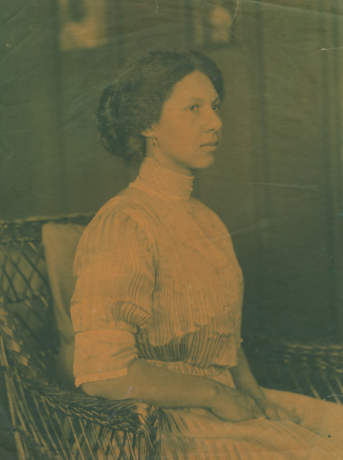
who is it and what year
meta warrick fuller 1910
Europe and the United States were increasingly interested in the (blank) qualities of African art, particularly (blank) and (blank), which used (blank)
aesthetic; sculpture and masks; abstract
european artists like who plundered African and oceania arts just for its
pablo picasso; visual elements
Black artists more intentionally incorporated African (blank) and (blank) as part of a move to reclaim and celebrate (blank)
motifs and visual styles; pan-african identities
(name), (name), (name) and (name) all incorporated motifs from African art into their works during the 1920s and 1930s.
Aaron Douglas, Palmer Hayden, Loïs Mailou Jones, and Sargent Claude Johnson; 1920s and 1930s.
The (blank) provided funding for Black American artists to visit the (blank) nation of (blank), a modern republic, which was founded by (blank) following an uprising against (ethnicity) colonial rule (year).
Rosenwald Fund; caribbean; haiti; formerly enslaved people; french; 1804
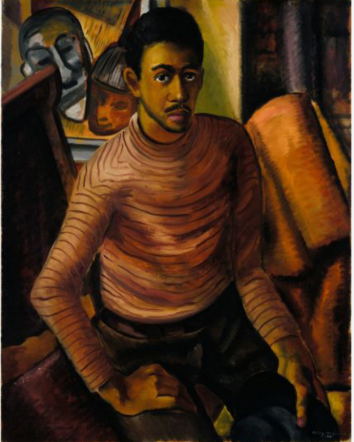
who is in it, what type of painting, year, material, what does it depict
Malvin Gray Johnson, Self-Portrait, 1934. Oil on canvas. Johnson’s portrait shows an image of several masks behind his shoulder.
art historian (name) writes, the adoption of African imagery in these years “symbolized a new radicalized black identity at the beginning of the (blank).”
Renée Ater; Harlem Renaissance
height of Ethiopia awakening
67 in talks around life-size
fuller’s original model was around what size
10-12 inches
There is at least one (blank) cast and one (blank) still in existence of Ethiopia awakening
bronze and plaster
plaster cast of Ethiopia awakening is painted (blank) and the bronze already has a (blank) color to symbolize what
black; brownish-gold patina; depict the race
As (name) has written, the traditional medium of white marble as a material for sculpture does not lend itself well to representing subjects with darker skin. Fuller’s selection of (blank) and (blank) help add to the sculpture’s (blank) and (blank).
Charmaine Nelson; material and coloring; presence and power
The work was commissioned by the (occupation) (name), an (position) for the (organization)
poet James Weldon Johnson; administrator for the National Association for the Advancement of colored people
what was the NAACP
National Association for the Advancement of Colored People (NAACP), a Black advocacy organization, for the 1921 America’s Making Exhibit.
the america’s making exhibit was held what year and where
1921 new york
what was exhibited at the america’s making exhibit
contributions of thirty-three different immigrant groups
according to planning documents, Black Americans were included as “(blank)”
honorary immigrants
(piece) was the centerpiece of the Black section of the show, where it spread important messages about (blank) and (blank)
Ethiopia Awakening; pan-africanism and black pride
ethiopia awakening depicts what
a black woman unwrapping herself with her right hand that is placed on her chest. her lower half is wrapped in bandages and she wears a nemes
what details reference ancient egypt and egyptomania
1) bandages wrapping lower half of statue body —> mummification
2) she wears a nemes
what hand rests on her chest
right hand
which hand holds the end of the bandage
right hand
the hand holding the bandage makes it seem like what
the statue is unwrapping itself
(name), an important magazine of the New Negro movement, had published several articles on recent (blank) in (country), (country), and (country)
crisis; archaeological digs; Egypt, Sudan, and Ethiopia
fuller wrote as she was compsong the sculpture that it was connected to what
the rule of the “negro kings” in egypt
the “negro kings” in egypt most likely reference to the (blank) pharaohs of the (century)-(century)
Kushite; 8th-7th century BCE
fuller’s sculpture intervened in what
a lonstanding debate on the racial identoty of ancient egyptians
european historians thought Egyptians were
white
the new archaeological evidence led Pan-African scholars to argue for “the (blank)” as part of an “(blank)”
blackness of the Egyptians; ancient and noble lineage
fuller states her opinion on the debate through her sculpture saying, (quote)
“Here was a group who had once made history and now after a long sleep was awakening, gradually unwinding the bandage of its mummified past.”
(country) and (country) were overlapping
and often interchangeable symbols of Black
power and history.
egypt and Ethiopia
Dating back to the (century), Black preachers had cited (verse) of the Christian Bible (which version): “(blank) shall come out of (country); (country) shall soon stretch out her hands unto God.”
19th; Psalm 68:31; King James Version; princes; egypt; ethiopia
psalm 68:31 was interpreted to refer to the (blank) in the (century) and, in the (century), to the (blank) and (blank) emancipation of modern Black people.
abolition of slavery; 19th century; 20th; spiritual and emotional
popular novel by (name), (book name) (year), also used (country) as a symbol of Black (blank) and (blank)
Casely Hayford; Ethiopia Unbound; 1911; ethiopia; political awakening, growing power
For many Americans, the modern nation of Ethiopia was a symbol of (blank) and (blank) to (blank), as the Ethiopians had expelled the (ethnicity) in (year).
resilience and resistance; colonial rule; Italians; 1896
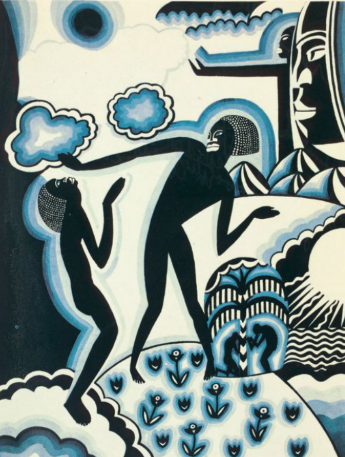
who is the artist and what is the piece called and what is the year
Winold Reiss, African Phantasy: Awakening, 1925
Reiss was a (ethnicity) artist who did (blank) of important (blank) and provided several illustrations for (name) (year) compilation. He was the teacher of (name).
Swiss; portraits of important New Negro Movement figures; Locke’s 1925; Aaron Douglas.
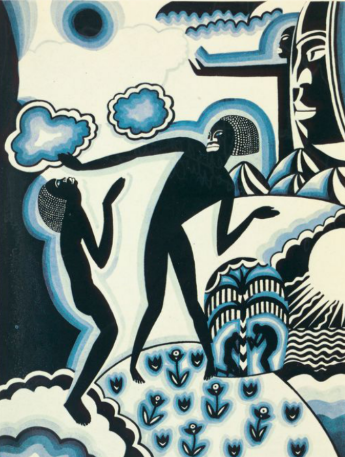
where is this painting placed today
new york public library