Topic 10
 Call Kai
 Learn
Learn Practice Test
 Spaced Repetition
 Match
Match Flashcards
 Knowt Play
1/91

Earn XP
Description and Tags
Transcription
Name | Mastery | Learn | Test | Matching | Spaced | Call with Kai |
|---|
No analytics yet
Send a link to your students to track their progress
92 Terms
whats the central dogma
The central dogma of molecular biology describes the flow of genetic information from DNA to RNA to protein in order to convert genotype to phenotype.This process includes replication, transcription, and translation.
what does DNA do
store genetic information
what gives the organism its phenotype
The phenotype of an organism is determined by the expression of genes, which produce proteins that affect traits and characteristics.
What happens in DNA replication
DNA replication involves the copying of a cell's DNA prior to cell division, where the double helix unwinds and each strand serves as a template to synthesize a new complementary strand.
what happens during transcription general
DNA is copied to RNA
what happens during translation general
RNA used to guide production of protein
whats the general central dogma pathway
DNA (replication > RNA (transcription) > Protein (translation)
Where does transcription and translation occur in prokaryotes?
both occur in cytosol
Why can transcription and translation happen at the same time in prokaryotes?
Because prokaryotes do not have a nucleus, so DNA, mRNA, and ribosomes are all in the same general area and can interact directly without spatial separation.
What is coupled transcription and translation?
It is when translation begins while the mRNA is still being transcribed.
where do transcription and translation occur in eukaryotes
Transcription occurs in the nucleus, while translation occurs in the cytoplasm.
What happens to eukaryotic pre-mRNA before translation?
It is processed into mature mRNA and exported from the nucleus.
do eukaryotes or prokaryotes have more control over gene expression
Eukaryotes have more control over gene expression due to their complex regulatory mechanisms that includes a barrier between translation and transcription
What did the one gene–one enzyme hypothesis originally state?
That each gene encodes a specific enzyme, each made by unique gens and that genes are responsible for producing proteins that catalyze biochemical reactions.
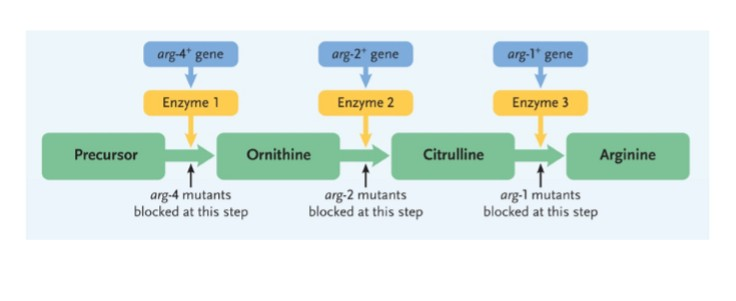
In the arginine pathway, what does each step require?
Each step requires a specific enzyme encoded by a specific gene.
Precursor > Ornithine > Citrulline > Arginine
Enzymes between eac step (>) in the pathway act as catalysts made by specific genes
Arginine catalyzied pathway
Which DNA strand is used to make mRNA?
DNA template strand which runs 3’ to 5’ and builds mRNA in the 5’ to 3’ direction.
What direction is the DNA template read?
It is read in the 3' to 5' direction.
What direction is RNA synthesized?
RNA is synthesized in the 5' to 3' direction.
What are the two main types of RNA genes can encode?
Coding RNA (mRNA) and non coding RNA (tRNA, rRNA,microRNA,snRNA)
What type of RNA codes for protein?
Messenger RNA (mRNA) is the type of RNA that codes for proteins.
What does tRNA do?
Transfer RNA (tRNA) is responsible for bringing amino acids to the ribosome during protein synthesis, matching them with the appropriate codons on the mRNA.
whats a codon
A codon is a sequence of three nucleotides in mRNA that corresponds to a specific amino acid or a stop signal during protein synthesis.
what does rRNA do?
Ribosomal RNA (rRNA) forms the core of ribosome's structure and catalyzes protein synthesis by facilitating the binding of tRNA and mRNA.
what does snRNA do
Small nuclear RNA (snRNA) is involved in the splicing of pre-mRNA by forming complexes with proteins to create spliceosomes that remove introns from the RNA transcript.
what does microRNA do
MicroRNA (miRNA) regulates gene expression by binding to complementary mRNA molecules, leading to their degradation or inhibition of translation.
What is the template strand?
The DNA strand that RNA polymerase reads to make mRNA.
What is another name for the template strand?
The non-coding strand or antisense strand
What is the nontemplate strand?
The DNA strand that has the same sequence as mRNA, except it has T instead of U, not used for templating it
What is another name for the nontemplate strand?
The coding or sense strand.
whats a gene made up of mainly
Promoter and transcriptional unit
What is a promoter?
A region of DNA where RNA polymerase binds to initiate transcription, usually located upstream of a gene.
What is the transcriptional unit?
The transcriptional unit is the segment of DNA that is transcribed into RNA, encompassing the coding sequence along with necessary regulatory sequences.
What is the TATA box?
The TATA box is a conserved DNA sequence found within the promoter region of genes in eukaryotes, crucial for the binding of RNA polymerase and initiation of transcription.
where does transcription start and how does it go
starts after promoter region and goes downstream until reaching terminator and stopping
where is the promoter located
it is located upstream (5”) of transcription starting site but on the non template strand however it initiates transcription on the template strand
what binds to the promoter
Transcriptional machinery along w RNA polymerase binds to the promoter, along with various transcription factors that assist in the formation of the transcription initiation complex.
Why is the promoter important?
It tells RNA polymerase where to begin transcription.
What does RNA polymerase do?
RNA polymerase synthesizes RNA from a DNA template during transcription, facilitating the creation of RNA transcripts based on the genetic information encoded in the DNA.
What direction does RNA polymerase synthesize RNA?
RNA polymerase synthesizes RNA in the 5' to 3' direction, adding nucleotides to the growing RNA strand.
What direction does RNA polymerase read the DNA template?
RNA polymerase reads the DNA template in the 3' to 5' direction
does RNA polymerase require a primer or helicase
RNA polymerase does not require a primer to initiate synthesis, as it can begin RNA synthesis de novo. Additionally, helicase is not needed, as RNA polymerase unwinds the DNA template itself during transcription.
does DNA polymerase need primer and helicase
DNA polymerase requires a primer to initiate synthesis, as it cannot start DNA synthesis de novo. Additionally, DNA polymerase also requires helicase to unwind the DNA template before replication.
To which end are new RNA nucleotides added?
New RNA nucleotides are added to the 3' end of the growing RNA strand during transcription.
What does RNA Polymerase I make?
RNA Polymerase I synthesizes ribosomal RNA (rRNA), which is a key component of ribosomes.
What does RNA Polymerase II make?
RNA Polymerase II synthesizes messenger RNA (mRNA) and some small nuclear RNAs (snRNA), playing a crucial role in transcribing protein-coding genes.
What does RNA Polymerase III make?
RNA Polymerase III synthesizes transfer RNA (tRNA) and other small RNAs, which are essential for protein synthesis and various cellular processes.
How many RNA polymerases do prokaryotes have?
1
Which RNA polymerase transcribes protein-coding genes in eukaryotes?
RNA Polymerase II transcribes protein-coding genes in eukaryotes.
What happens during transcriptional initiation?
During transcriptional initiation, RNA polymerase binds to the promoter region of the gene, unwinding the DNA strand and beginning RNA synthesis aka transcription
What is basal transcription?
Basal transcription refers to the basic or low level of transcription that occurs in cells, characterized by the minimal requirement of transcription factors and RNA polymerase to initiate transcription of genes.
how does basal transcription start
general transcription factors assemble at the promoter region, allowing RNA polymerase 2 to initiate transcription
whats transcriptional initiation
transcriptional initiation is the process where activator binds to enhancer regions that can be far away which causes DNA to loop and bring the two close together and helping RNA polymerase binds to the promoter region of a gene causing high lvls of transcription
how does transcriptional initiation work
Transcriptional initiation works by the binding of transcription factors and RNA polymerase to the promoter region of a gene, often facilitated by enhancer elements that bring distant regulatory regions closer together through DNA looping causing high lvls of transcription
What binds to enhancers?
Proteins such as transcription factors bind to enhancers, facilitating the looping of DNA to interact with the promoter.
Do enhancers cause basal or high levels of transcription?
Enhancers cause high levels of transcription by promoting the efficient binding of transcription factors and RNA polymerase to the promoter.
what does basal initiation result in and transcriptional initiation
Basal initiation results in low levels of transcription, providing a minimal level of gene expression. In contrast, transcriptional initiation enhances expression through the recruitment of additional factors and higher RNA polymerase activity.
what happens during transcriptional elongation
During transcriptional elongation, RNA polymerase synthesizes RNA by adding nucleotides to the growing RNA strand, unwinding the DNA helix and moving along the template strand.
how does rna grow
by adding nucleotides to 3’ end
What is the transcription bubble?
The transcription bubble is a localized unwinding of the DNA helix during transcription, where RNA polymerase accesses the template strand to synthesize RNA.
steps of transcription elongation
RNA polymerase reads the template DNA 3’ → 5’.
RNA is synthesized 5’ → 3’.
DNA unwinds ahead of RNA polymerase.
DNA reanneals behind RNA polymerase.
Ribonucleotides are added to the 3’ end of RNA.
A temporary RNA-DNA hybrid forms.
The growing RNA transcript is displaced from the DNA template.
What is transcriptional termination?
The stage where transcription stops and the RNA transcript is released/cleaved.
What sequence signals cleavage near the 3’ end of eukaryotic mRNA?
The polyadenylation signal, typically represented by the sequence AAUAAA, signals cleavage of the nascent mRNA transcript near its 3’ end.
what does CPSF do
CPSF, or Cleavage and Polyadenylation Specificity Factor, recognizes the polyadenylation signal in eukaryotic mRNA and plays a key role in the cleavage of the RNA transcript. It is essential for the proper processing of pre-mRNA into mature mRNA.
What happens after cleavage?
A poly-A tail is added to the 3’ end.
what are UTRS and are they turned to protein
UTRs, or Untranslated Regions, are segments of mRNA that precede and follow the coding sequences. They are not translated into protein but play crucial roles in regulating mRNA translation and stability.
whtas a ORF
An ORF, or Open Reading Frame, is a continuous stretch of nucleotide sequences in mRNA that has the potential to be translated into a protein. It typically starts with a start codon and ends with a stop codon.
what are shine delgarno sequences
Sequences on ribosomes that help with binding in prokaryotes
what are Kozak sequences
kozak sequences are conserved nucleotide sequences surrounding the start codon in eukaryotic mRNA that facilitate the initiation of translation by helping ribosomes identify the correct start site.
whats pre mRNA
Pre-mRNA is the initial transcript of a gene in eukaryotic cells that undergoes processing, including splicing and the addition of a 5' cap and poly-A tail, before becoming mature mRNA.
What is the 5’ cap step
The 5’ cap step involves the addition of a modified guanine nucleotide to the 5' end of pre-mRNA. This cap protects the RNA from degradation and assists in ribosome recognition during translation.
what are the post transcriptional modifications in eukaryotes to matur mRNA
Post-transcriptional modifications in eukaryotes include the addition of a 5' cap, splicing to remove introns, and the addition of a poly-A tail at the 3' end, all of which enhance mRNA stability and translation efficiency.
What is the poly-A tail?
The poly-A tail is a long chain of adenine nucleotides added to the 3' end of pre-mRNA, which enhances the stability of the mRNA molecule and regulates its translation in eukaryotic cells.
What enzyme adds the poly-A tail?
The enzyme that adds the poly-A tail is called polyadenylate polymerase,recruited by CPSF
What is one function of the poly-A tail?
It protects mRNA from degradation and increases mRNA stability.
Which end of mRNA gets the poly-A tail?
The poly-A tail is added to the 3' end of pre-mRNA, enhancing its stability and regulation.
whats a intron
An intron is a non-coding sequence of RNA that is transcribed from DNA but is removed during the RNA splicing process before translation into protein.
whats an exon
An exon is a coding sequence of RNA that remains in the mature mRNA after splicing and is expressed in the final protein product.
what happens during splicing
During splicing, introns are removed from the pre-mRNA, and the remaining exons are joined together to form the mature mRNA. This processed mRNA is then translated into protein.
can exons include UTRS
Yes, exons can include untranslated regions (UTRs) which are situated at the beginning (5' UTR) and end (3' UTR) of the coding sequence.
Processing of pre mRNA into mature mRNA steps
Addition of the 5’ cap
Addition of the poly-A tail
Removal of introns
Splicing together of exons
Export from nucleus to cytoplasm
where does pre mRNA processing occur
nucles of eukaryote
Where does mature mRNA go after processing?
It is exported to the cytoplasm for translation.
splicing steps
Spliceosome binds to intron-exon junctions.
The intron loops out into a lariat structure.
The intron is clipped at both exon boundaries.
The intron lariat is released.
Adjacent exons are joined togetherin a process called splicing.
whats a splicesome and made 8up of
what carries out splicing , made up of snRNAs and arranged snRNPs
whats a lariant structure
A looped structure formed during RNA splicing, where the intron is excised and forms a lariat before being removed.
what happens to exons in splicing
Exons are joined together to form a continuous coding sequence, allowing the mature mRNA to be translated into protein.
What is an isoform?
A different version of a protein made from the same gene.
What is alternative splicing?
Alternative splicing is when different combinations of exons are kept or removed to produce different mRNAs from one gene.
Why is alternative splicing useful?
It increases protein diversity without needing more genes.
How can different tissues make different proteins from the same gene?
They can splice the pre-mRNA differently, producing different mRNA and protein isoforms.
What is the big advantage of alternative splicing in eukaryotes?
t dramatically increases the number and variety of proteins encoded by the genome.