perception 7 -motion
 Call Kai
 Learn
Learn Practice Test
 Spaced Repetition
 Match
Match Flashcards
 Knowt Play
1/24

There's no tags or description
Looks like no tags are added yet.
Name | Mastery | Learn | Test | Matching | Spaced | Call with Kai |
|---|
No analytics yet
Send a link to your students to track their progress
25 Terms
Good temporal resolution link to motion perception
-magnocellular big and big means fast when it comes to neurons
-therefore good temporal info - so important for vision + motion percepton
(parallel pathway with parvocellular +koniocellular)
Do we really detect motion? Couldn't just notice that something is here and then there? -four ways to suggest we might?
• Spooky movements
• Motion aftereffect
• Apparent motion breakdown / disco
• Motion blindness
• Spooky movements
rotting snake illusion
-the circles you view as moving even though they aren't
-if you focus your eyes in one place - keep still - will see it isnt
-mainly due to some edges are high contras and others low, high contrast gets through
-gives visual system illusion of motion
Other animals also susceptible to this illusion
Motion aftereffect
(Waterfall illusion
• Prolonged movement in one direction (e.g., moving upwards) leads to a stationary image appearing to move in opposite direction
-looking at spinning wheel looks like spinning outwards
-then looks like bobs head is contracting if look directly at it
• So we see motion even in the absence of any movement
• We can also get "shifts in direction"
"shifts in direction" -aftereffects
• without adaptation a leftward moving pattern appear to move leftward!
• But if we adapt to motion up and left, a leftward moving pattern now appears to move down and left.
• Explanation is same as "tilt- aftereffect" (see earlier lectures) - must be a "place code" for motion direction
-channels get xhausted and firing rate decreases
-cells in MT in motion ones
Apparent movement
You may see one moving dot when three different dots are presented after each other on 3 frames changing direction
• TV - movies (6o frames a second, films 24)
• flick books
• but ... timing and spacing are all important to produce motion.
More dots
With simple dot stimuli hard to sort out movement vs there then there
-if give lots of dots can't be followed individually
-here if look in middle when moving get good idea of motion (or just flpping between the two?
Movement detector
• Delay and compare model
-Unit C "multiples" the impulse from both neurons
This one has a preferred direction of left to right
-time delay means when moves from left toright both impulses reach C at same time leading to large impulse
-whereas right to left increases the differences between the impulses so each one is "with a zero"
To too get opposite efffect flip them over or stick delay on b
This explains apparent motion just need smth here and then little time after here
-the stuff in berween doesn't count
-just need time and distances to be correct
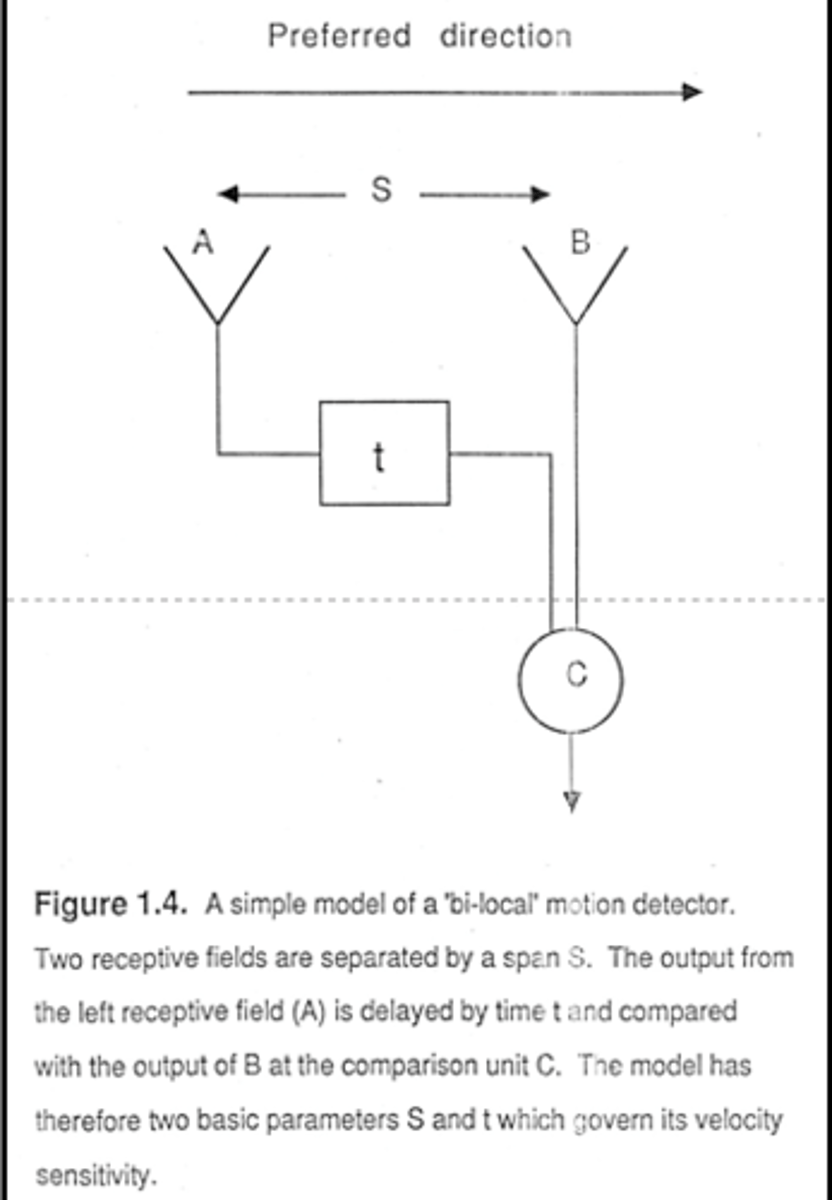
discovery of compare and delay models
• Scheme developed in 50s by Reichardt to explain flight of beetle (Reichardt detector)
-could see behvaiour and detect within eye these movement detectors which only came to action if movement in certain direction eg left vs right
(glue them so they think theyre flying but arent will move their legs in response)
So how far are things apart for this to work ? -delay + compare
-lots of research been done but all results contradictoy
-couldn't get around the fact that people can realise things have moved due position change
Then much later indtoruced these complex patterns
Random dot patterns And Random dot kinematograms (when theyre moving)
Random dot patterns and random dot kinematograms
-each dot randomly assigned a colour eg black + white
-then take little bit of pattern and move it to make a new pattern
-if how you the new pattern and the old pattern, and you look at them as two stationary patterns side by side, you have no idea which bit I moved. -too many dots to keep track
-but if show you one after the other quickly you clealry see the area move
-shows you didn't track each dot and where gone the movement simply happens
-stimulates motion derectors
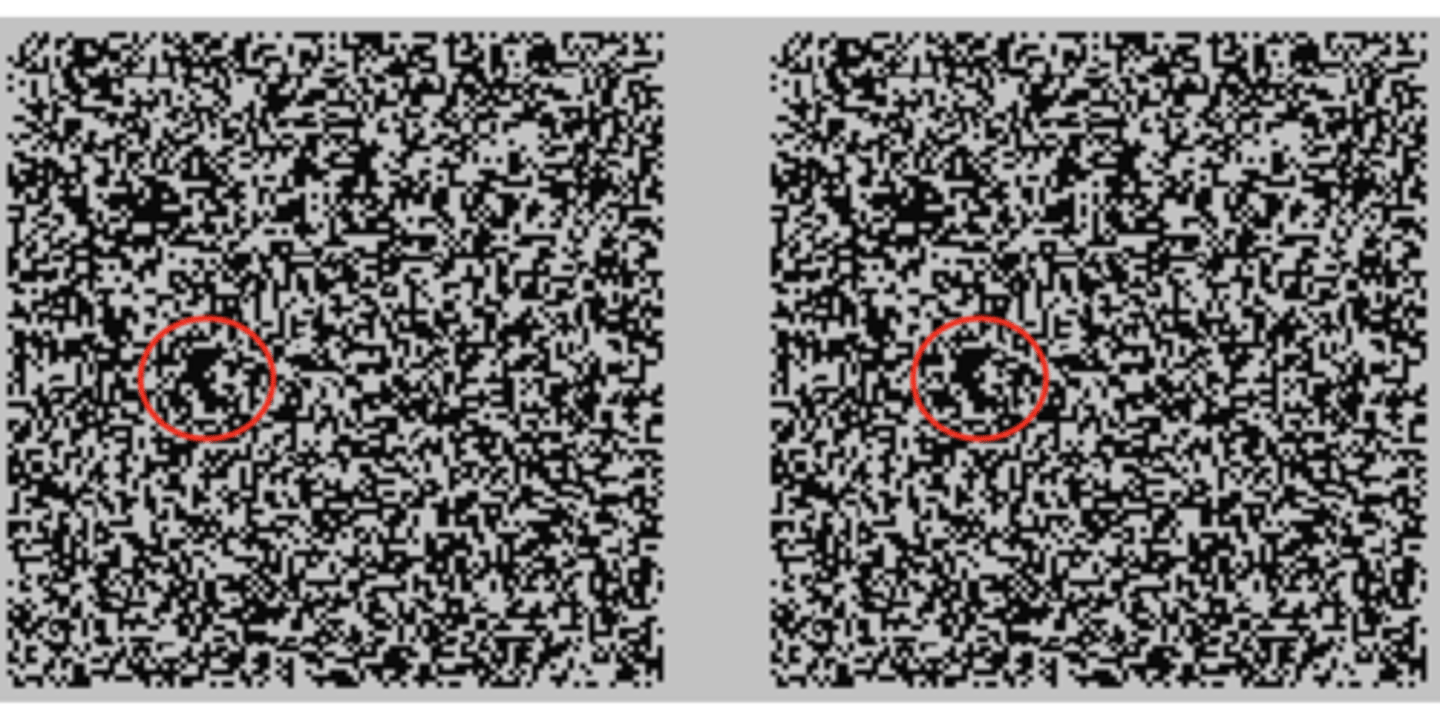
WHen people can detect motion
Braddick (1974, 1980)
Subjects tried to identify the orientation of a moving area of dots (vertical vs horizontal
People can do this very easily
ONLY POSSIBLE IF:
• small displacement (< 0.25 deg - degree is about width of thumb at arms length,)
• time intervals (<100 ms)
Now found displacement varies on how far presented but time quite constant
• present pattern to same eye
In Braddicks study AM could be detected by two methods
• 1) Short-range process (SRP) relying on response of low-level motion detectors (sort of genuine motion perception , stimulation reichart detectors)
• 2) LRP - cognitive process that tracks features from 1 position to another -he called long range process
Direction selective cells in different animals
• In all(?) animals tested such direction selective cells are found - because motion detection important
• Frogs - early papers ("what the frogs eye tells the frogs brain") show that they do not respond to stationary targets, but they have cells in retina that fire to moving blobs (bug detectors)
• Monkey (humans) - no directionally selective cells found in retina or LGN. (early in visual system) Some cells in V1 are directionally selective (those fed by magnocellular division of LGN),
Specifity + number directional cells
Millions
-telling you there is something over there moving like that
(think of video where electrode next to v1 activity and monitor its clicks when moving bar)
V5
-also known as MT
-middle temporal area - as there when discovered in new world primate
Directionally selective cells in V1 sent info to V5
-and nearly all cells in MT are directionally specific
-its where we concentrate info about motion
Direction Selective cell Area - MT - study
(Snowden et al, 1992)
-animal looking at cross
-worked out yellow crice is receptive fielld
-move dots in window in different patterns
-find cells give huge response down and to the left
-little down and little left and not much anywhere else
-done systematically with different neurons and show they cover other directions of motion
other methods of recording neuron receptive field
-place lectordes straight down/across MT
-down had the same acrross different
-seems we have direction columns in MT (like orientation in V1)
flashes mt study
Mikami, Newsome & Wurtz (1986) -
• Measured response of single MT neurons to series of flashes (apparent motion) occurring within their receptive fields
• Flashes separated by x in space and t in time.
• Over what range of x and t would cells show directional selectivity ?
Monkey look at fixation cross so you know recpetive field
Mikami, Newsome & Wurtz (1986) - results
Very directionally selective when have small jump and small time interval - this is what it wants (20ms, 0.4 degrees ideal)
-when jump gets bigger less selective
-when delay is larger (320 +160 ms) cell fires individually for each bar
-by time get to 20 really strong burst in prefferred - null seems to respond to first then shut down
Can plot the largest temporal and spatial itnerval each cell can stand
-degree effect by if looking central/peripheral
-humans vs MT cells what they can detect is identical
Another way to show cells are our perception of motion
If you put up a pattern with no real motionand tickle it (injection of elcetricity)
-if those cells prefer upward motion then will report seeing upward motion
-shows these cells are our perception of motion
using enigma patterns study -some people see movement others don't
Zeki, Watson and Frackowiak (1993)
• Looked at brain activity when looking at some 'illusory' motion - the Enigma pattern
• Control was a slightly modified version which didn't ellicit the motion
• Also recorded to moving random dot kinematogram
• Approximately the same extrastriate area is activated by both patterns - though some regions adjoining V5(?) also active
• Little or no activation of striate region (V1))
• Activation of V5 seems enough to elicit motion in humans (could be other way round but this seems sesnible)
• Doesn't tell us why this illusion occurs
Motion blindness
(Cerebral Akinetopsia)
-famous case study LM first reported by Zihl et al (1983)
-MT lesions
• Normal on test of acuity, colour vision, object recognition, binocular vision later studies (Hess et al, 1990) show reasonably normal spatial and temporal contrast sensitivity.
•she did not see individual cars moving but concluded that there must be movement since the cars change position with time.
-often saw stationary objects move .... this is apparently related to her own movements while walking"
Little or no motion aftereffect
No apparent motion
Poor or absent pursuit eye movements (cant move eyes smoothly unless following smth)
Fails to segment scene by motion (McLeod et al, 1989)
Looks like a MT lesioned monkey (Baker et al,1991)
detecting speed issues
• MT neurons also appear responsive to speed - but also responsive to contrast
• Thus may mistake less firing due to change in contrast, as less firing due to 'less motion'
We're bad at this almost everything we do changes how fast things seem, big things contrast to our speed
• Thompson (1982) demonstrated that things appear to slow down as contrast is reduced.
-low contrast light ret to dark ray rather than balck to white
driving study
Snowden et al (1998)
• Ss taught to drive in sunny conditions -at a specific speed- (simulator) then asked to drive at set speeds under different levels of fog
• Drove faster the foggier it got! (show movie)
• May help explain 'motorway madness'
-by big effect!