reducing prejudice + discrimination
 Call Kai
 Learn
Learn Practice Test
 Spaced Repetition
 Match
Match Flashcards
 Knowt Play
1/34

There's no tags or description
Looks like no tags are added yet.
Name | Mastery | Learn | Test | Matching | Spaced | Call with Kai |
|---|
No analytics yet
Send a link to your students to track their progress
35 Terms
what is Allport (1954)’s contact hypothesis + its 4 conditions
under certain conditions, contact between groups will reduce prejudice → these include:
equal status (no power differential) in the interaction
common goals
intergroup cooperation towards these goals
institutional support, e.g. from authorities, laws + social norms
however, how contact reduces prejudice isn’t adequately explained
what is the direct intergroup contact method of reducing discrimination + how effective is it according to Pettigrew + Tropp (2006)’s research
involves face-to-face interactions between members of different groups → examination of studies found that direct contact does reduce prejudice
greater reductions in prejudice are seen under the conditions specified by Allport, but these are not essential for prejudice reduction
what are 3 mechanisms underlying how direct contact reduces prejudice (Pettigrew & Tropp, 2008)
reducing intergroup anxiety at the prospect of interactions with the outgroup → shows anxiety is an important mediator
increasing empathy + perspective-taking
increasing knowledge about the outgroup (weakest mediator)
what is a practical criticism of direct intergroup contact + an example
this isn’t always possible/appropriate → e.g. peace walls were built in Northern Ireland in order to reduce severe intergroup conflict between Catholics + Protestants
what are 3 forms of indirect intergroup contact
vicarious contact
extended contact
imagined contact
what is vicarious contact (Vezzali et al., 2014) + what are 2 examples of its efficacy
observation of an interaction between ingroup + outgroup members, which can occur in media
children exposed to racially diverse TV shows (e.g. Sesame Street) showed more positive outgroup attitudes than children not exposed (Vittrup + Holden, 2011)
exposure to passages from Harry Potter books (depicting intergroup friendships + prejudice) predicted improved attitudes towards immigrants in children who identified more with HP → modelled behaviour
what is extended contact (Vezzali et al., 2014) + what are 2 examples of its efficacy
knowing that ingroup members have contact with outgroup members
white, Asian + African American undergraduate students who reported knowing more ingroup members with at least 1 outgroup friend reported less prejudice towards outgroups (Wright et al., 1997)
meta-analysis supports positive relationship between extended contact + intergroup attitudes (Zhou et al., 2019)
what are 4 mechanisms underlying how extended + vicarious contact work
mechanisms thought to drive effect of extended contact on prejudice reduction include:
reducing intergroup anxiety
increasing empathy
creating cognitive overlap between the self + outgroup members → close ingroup members are considered part of the self, so this extends to outgroup friends of those friends
we don’t want to hold negative views of the outgroup in order to keep positive sense of self
changing perceptions of social norms → observing interactions shows that that intergroup contact is positive + socially normative
how are extended + vicarious contact related to one another
researchers often see vicarious contact as a subtype of extended contact → extended contact is knowing people have interactions whether vicarious contact is observing them specifically
what is an issue with extended + vicarious contact
we cannot easily use extended contact as an intervention, as it would be difficult to deliberately manipulate whether someone from your ingroup has outgroup friends
however vicarious contact can be achieved through media
what is imagined contact (Crisp + Turner
mental simulation of a social interaction with a member/members of an outgroup category → this is easier to orchestrate experiments around as it doesn’t involve the interactions themselves
what the basic experimental method of imagined contact (Husnu + Crisp, 2010)
imaginary task → experimental condition are instructed to take a minute to imagine themselves having a conversation with an outgroup member where they find out interesting things, while control are instructed to imagine walking outdoors
take a measure of prejudice
what are 2 examples of imagined contact being effective at reducing prejudice
participants who imagined a positive interaction with an individual with schizophrenia reported more positive attitudes than controls (West et al., 2011)
meta-analysis supports effectiveness of imagined contact in promoting more positive attitudes, emotions, intentions + behaviour (Miles + Crisp, 2014)
what are the 2 mechanisms underlying how imagined contact works
reduced intergroup anxiety
increased trust in the outgroup
what did the ‘many labs’ replication project (Klein et al.,2014) find in regards to whether imagined contact efficacy replicates
when replicating Husnu’s study on whether imagined contact reduces religious + other forms of prejudice (across 36 samples), found a significant but very small average effect, contrary to the previous (large) effect
argued that imagined contact effects do not replicate, though Husnu agreed that some forms of prejudice will be harder to reduce than others, so intervention will be more effective on some social groups
what are 3 positives of imagined contact use
is worth assessing which social groups the intervention is more useful at reducing prejudice against → can be used in a more tailored way for groups with a larger effect size
though it may not have huge impact, it still has positive benefits + is not taxing to run → direct contact has larger effect size but may not always be possible
can be used as a preparatory tool in tandem with other interventions → participants more likely to proactively engage with outgroup (direct contact)
what are colourblind ideologies (Apfelbaum et al., 2010)
the notion that we shouldn’t see people in terms of the colour of their skin, but rather look beyond individual group differences to see them as individuals
manages diversity by deemphasising intergroup distinctions + considerations
what is the main issue with the colourblind approach + what does adhering to it result in
belonging to a minority group influences how others/the world interacts with you → due to structural discrimination, different social groups have disadvantages within society
if we ignore intergroup distinctions, we ignore their disparities + therefore discrimination → this is microinvalidation
what method did Apfelbaum et al. (2010) use to test the effects of the colourblind ideology
gave child participants a digital storybook on equality where a teacher took one of the following approaches:
colourblind → ‘we want to show everyone that race is not important + we are all the same
value diversity → ‘we need to recognise how we are different + appreciate those differences’
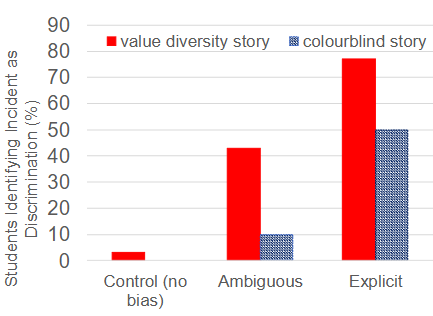
they were then told scenarios that varied in the degree to which they described racially biased behaviour with either no/ambiguous/explicit bias → DV = which scenarios showed racial discrimination
what were Apfelbaum et al. (2010)’s results + what does this imply
found children in the colourblind condition were much less likely to perceive discrimination relative to the value diversity condition, even when the discrimination was explicit
shows while colourblindness seems like a positive ideal, we do not live in a society where ignoring race is possible due to structural discrimination, making it a less effective approach of reducing prejudice
what are 3 examples of educational strategies of reducing prejudice
factual education to increase knowledge about different groups → addressing myths/stereotypes people might hold
consciousness raising → education about the existence of discrimination, implicit bias etc.
perspective taking → encouraging people to think of what it might be like to be a member of a certain outgroup
what is an older example of consciousness raising/perspective taking at reducing prejudice/discrimination (Elliot, 1968)
the ‘blue eyes/brown eyes’ exercise → Elliot conducted an exercise on her all-white year 3 class in which she separated them into brown eyes + blue eyes, and each day would marginalise one group
one group would get special privileges for the day, while the other would be denied access to these + would be stereotyped against → educated the students on the experience of a person of colour to increase awareness
what were previous criticisms of Elliot’s approach + how were these rebutted
some argued that the experiment was cruel due to white children not growing up with the harsh treatment they were faced with, claiming it would cause them ‘psychological damage’
rebutted with the fact that black children had to face this reality every day, whether white children could step away from it → though perspective-taking is uncomfortable, it doesn’t mean it shouldn’t be undertaken in order to reduce prejudice
what is a modern example of consciousness-raising in reducing prejudice/discrimination
the documentary ‘the school that tried to end racism’ → South London school undertook the first trial of a programme to educate children about racial bias
how did Hughes et al. (2007) assess the effects of consciousness-raising at reducing prejudice
exposed white American primary school children to history lessons (20 mins a day for 6 days) that included either
racism condition → explicit info about racism experienced by well-known African Americans
control → identical lessons that omitted the info about racism
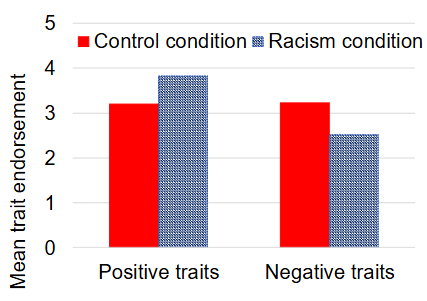
after, participants completed the black/white evaluative trait scale (BETS) as a measure of attitudes towards African Americans + white people (‘how many black/white people possess positive/negative traits’)
what were Hughes et al. (2007)’s results
found that participants who received history lessons discussing racism had significantly more positive + less negative attitudes towards African Americans than participants who received control lessons
in what two areas of research was education as a prejudice-reduction technique effective (Corrigan et al., 2012; Paluck et al., 2020)
reducing mental health stigma
small but significant effect of reducing prejudice against multiculturalism
what is prejudice confrontation
bystander anti-prejudice → directly confronting prejudice/discriminatory behaviour in others
this can be calling out (directly criticising prejudice after it occurs) or calling in (waiting until after the instance to call out in a less confrontational manner)
this can be enacted by the target of prejudice/someone of the same outgroup, or by an ally
is prejudice confrontation effective (Wood et al., 2025)
recent meta-analysis demonstrates that confronting prejudice significantly reduces intergroup bias, especially in reducing use of stereotypes + increasing intentions to control intergroup bias in future
more bottom-up approach to reducing prejudice, as anyone can call it out
how did Czopp et al. (2006) assess whether prejudice confrontation was an effective method of reducing prejudice in 3 stages
white participants completed a task with a white confederate which required them to take turns making inferences about sentences paired with photos of white + black people
critical trials (participants’ turn) → paired pictures of black men with sentences that could have both stereotyped + neutral interpretations (e.g. ‘that person can be found behind bars’ → assess what inference participants made)
in subsequent feedback task, participants were randomly assigned to receive feedback from the confederate in 3 conditions:
confrontation of prejudice → ‘I thought some of your answers seemed offensive’
confrontational control → ‘I thought some of your answers were odd’
no confrontation control → ‘I thought you did well’
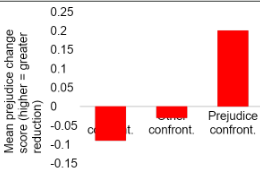
DV → participants completed 20-item ‘attitudes towards blacks’ scale at the beginning of the semester + end of study
what were Czopp et al. (2006)’s results + what does this imply
participants that were confronted about use of stereotypes reported a greater prejudice score change (reduction in prejudiced attitudes) than participants in the other + no confrontation controls → shows confrontation = effective strategy
how did Chaney et al. (2020) assess whether effects of confrontation of prejudice towards one group extend to other groups
white participants interpreted sentences paired with pictures of white or black people (same premise as Czopp) → half the participants who responded stereotypically were confronted by the experimenter
week later, participants completed a sentence inference task where sentences were paired with photos of white, black + Latino men
what were Chaney et al. (2020)’s results
found white participants confronted for using negative black stereotypes used fewer negative black + Latino stereotypes than white participants who weren’t confronted → shows prejudice confrontation extends to other races, so other marginalised groups
what is Stephan (2000)’s integrated threat model + its 4 aspects
identifies 4 sources of anxiety that people can experience about + in anticipation of intergroup contact
realistic threat → threat to the very existence of one’s group, wellbeing, political power etc.
symbolic threat → threat posed by the outgroup to one’s beliefs, values, morals + norms
intergroup anxiety → threat to self (embarrassment, fear of rejection) experienced by said interactions
negative stereotypes → fear of imagined intergroup anxiety based on negative stereotypes of an outgroup
in what 3 ways may direct contact between different groups improve attitudes towards the group as a whole (generalisation - Weber + Crocker, 1983)
bookkeeping → the accumulation of favourable info about an ingroup gradually improves the stereotype
conversion → dramatically counter-stereotypical info about an outgroup causing sudden change in attitudes
subtyping → stereotype-inconsistent info producing a subtype, so the outgroup stereotype becomes more complex (but the superordinate category remains unchanged)
direct contact is likely to improve attitudes towards individuals, but not generalise due to differences not being salient in the interaction