Coronary heart disease Pop & Env Case Study
 Call Kai
 Learn
Learn Practice Test
 Spaced Repetition
 Match
Match Flashcards
 Knowt Play
1/31

There's no tags or description
Looks like no tags are added yet.
Name | Mastery | Learn | Test | Matching | Spaced | Call with Kai |
|---|
No analytics yet
Send a link to your students to track their progress
32 Terms
What is cardiovascular disease (CVD)?
All diseases of the heart and circulation, including coronary heart disease (CHD).
What percentage of people globally died to CVD in 2022?
CVD was responsible for 32% of deaths and this is projected to increase beyond this to a more extreme level
What is CHD?
Where the arteries which supply the heart with blood are blocked by fatty deposits which means the heart doesn’t receive enough oxygen leading to heart attacks for example.
Also a type of Ischaemia where the heart receives inadequate blood supply and CHD is an example of this.
What is one type of risk factor for CHD that you can change and examples?
Modifiable risk factors include certain behaviours that increase your risk of developing a disease
The WHO suggests that there are various root causes of these factors such as globalisation and poverty.
Tobacco use
Poor diet with high fat/salt/sugar content
Overweight/obesity
Lack of physical activity
Excessive alcohol consumption
High blood pressure
High level of cholesterol
Diabetes types 1 and 2
Stress
What is the other type of unchangeable risk factor for CHD and examples?
Non-modifiable risk factors
Age: the efficiency of the heart reduces
Gender: males have a higher risk than premenopausal women
Family history: close blood relatives with coronary heart disease or stroke before 55/65 years.
Ethnic background: Bangladeshi, Indian, Pakistani and Afro-Caribbean are predisposed.
How many deaths were caused by CVD in 2022 in the UK, what percentage of deaths did this makeup and what portion was CHD of this?
In 2022, around 175,000 people in the UK died from CVD, accounting for about 27% of all deaths and CHD made up around 65,000 of this
How many in the UK have CVD?
It is estimated that more than 7.6 million people in the UK have cardiovascular disease (CVD)
How is the risk that an individual has to CVD composed?
50% due to genetics
10% to healthcare
40% for lifestyle choices
What is the UK CVD geographical divided?
There is a distinct North-South divide
Mortality to CVD is 50% lower in the south than in the north of England and Scotland.
How many people died due to CVD per 100,000 in Glasgow compared to Chelsea?
In Glasgow 128 deaths per 100,000 people die to CVD.
Meanwhile Chelsea residents had a rate of 39 deaths per 100,000 people.
What is national average for CVD deaths per 100,000?
202 deaths per 100,000 and 77 per 100,000 for premature under 75
In Scotland how do smoking rates differ for top 10% and bottom 10%?
Smoking rates were 11% for the top 10% most affluent people compared with 44% for the 10% least affluent areas.
How does CVD differ in Scotland?
CVD is highest for men with no qualifications between 45-64 years and women living in the most deprived areas.
This is due to them partaking in the highest levels of alcoholism, smoking, drug abuse and obesity.
How does CVD impact poorer nations and what percentage of CVD deaths are clustered?
In developing and lower income countries CVD is a rapidly growing disease as incomes rise leading to more risk behaviours taking place.
The WHO estimates over 80% of the worlds CVD deaths are clustered with these areas experiencing fastest growth due to the combination of risk factors like air pollution and poor diets.
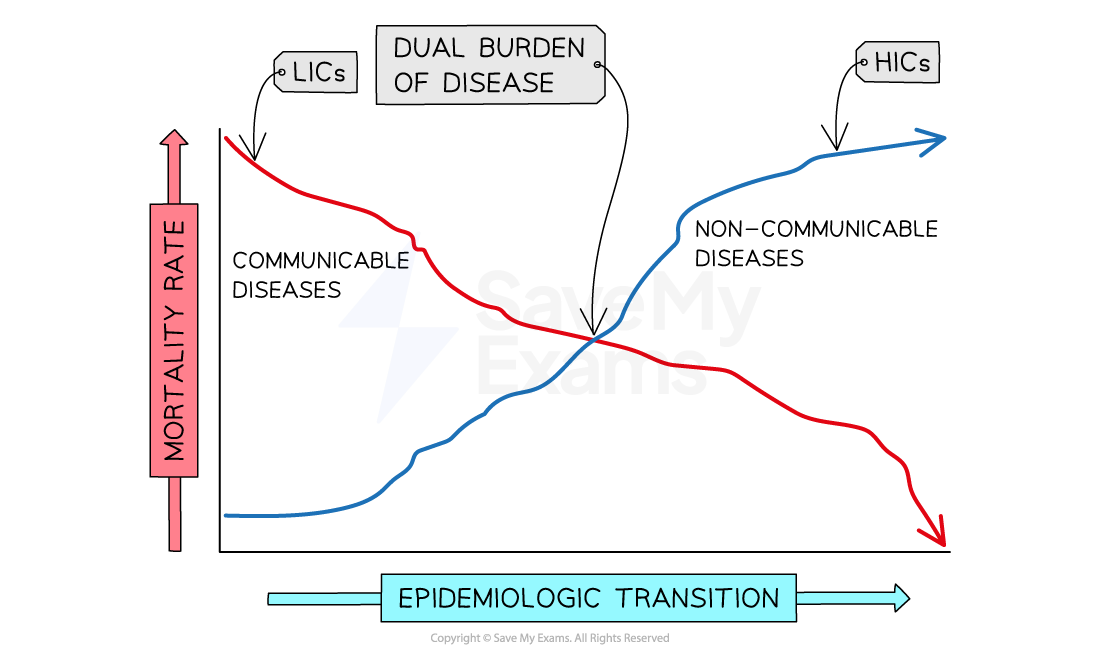
What is the epidemiological transition model?
Where as countries develop the leading cause of death in the country begins to rapidly shift from communicable to non-communicable diseases
This is due to risk factors such as higher exposure to tobacco and overnutrition where caloric intakes begin to climb too high leading to CVD.
The shift from infectious diseases such as malaria to CVD.
Impact of non communicable diseases including CVD on GDP in low and middle income countries, the cost and why?
It is expected to cost around $500 billion US dollars per year
In low and middle income countries the impacts of these diseases is estimated to reduce GDP by up to 7%.
This is largely due to the premature loss of young adults who contribute to the economy.
What is the dual burden of disease?
This is a pattern found in middle income countries population where a nation simultaneously faces significant challenges from both communicable diseases such as HIV and non communicable diseases like heart disease.
This is different to other stages of the epidemiological transition model where high income countries mainly face non-communicable disease and low income countries face communicable diseases.
What is an example of how CVD grows as a country develops?
Name the country, what will be the largest killer, what percentage of women in rural areas versus Kampala were overweight, why and where does most of the health funding come from?
According to the Uganda Heart Institute, heart disease will be the country’s leading killer.
This can be seen as a third of women in urban areas such as Kampala and 25% of women in rural areas are overweight or obese.
Which is largely induced by the introduction of western foods as a food transition occurs with higher fat, salt and sugar contents.
Alongside the issue that 33% of Uganda’s health budget comes from international donors whose priorities are largely on HIV/AIDS.
How has CVD become present in India, MCD, how many have diabetes and where is CVD main cause of death?
The first Mcdonalds opened in New Delhi in 1996.
The cultural preference for sweet foods, combined with a rapidly rising more affluent middle class wanting global branded fast foods has result in 50 million Indians having diabetes.
CVD is now the main cause of death in both urban and rural areas in India.
Showing how globalisation has led to massive increases in CVD.
What happened to obesity prevalence in adolescents between 2002 and 2007 in India and what is the impact of obesity on India’s economy annually?
Obesity prevalence had increased from 16% to 24% between 2002 and 2007.
Due to an adoption of more sugary and high fat foods compared to what was eaten locally in the past.
India loses $28.9 billion annually to the economic impacts of obesity such as more worker absenteeism and more young deaths equating to around 1% of GDP
Goals of the EU and WHO
The United-Nations WHO is an (IGO) with a goal to reduce premature CVD mortality by 25% by 2030.
The EU has set targets and legislation that is anti-obesity and food packaging policies that deceive people.
Where is death from ischaemic heart disease most common?
Pacific island nations such as Nauru, Vanuatu, Micronesia and the Solomon islands
As well as parts of Europe and central asia such as Ukraine, Uzbekistan, Turkmenistan, Belarus and Moldova.
These are largely induced by a rapid shift from traditional diets to cheap, processed, imported foods high in salt, sugar and fat.
How does air pollution impact CHD?
Air pollution is a significant environmental risk factor for CHD.
There is strong correlation between exposure to particulate matter PM, nitrogen dioxide (NO2), and other pollutants with increased cardiovascular mortality.
It leads to inflammation in the body, oxidative stress and autonomic nervous system dysregulation.
What socioeconomic factors influence CHD?
Built environment as it has a profound impact on physical activity levels. More walkable designs lead to more exercise.
Green spaces and mental health as access to green spaces improves physical activity and lowers stress. These both reduce risk factors for CHD.
How can climate change impact CHD?
It can exacerbate people’s health issues
Also it will increase air pollution and increase acute heart attacks as heatwaves and sudden weather events can place stress on the heart and cause physiological stress
Who is most vulnerable to CHD?
Elderly individuals as older adults are at greater risk for health-related illnesses.
Low income communities as they may lack resources for cooling during heatwaves or have pre-existing health issues due to higher smoking rates on average for example.
How many people does CHD kill globally?
Around 9 million people a year
How large of a killer is CVD in the UK?
It is the largest killer in the UK causing over a quarter of all deaths.
Out of every 10 women and every 10 men how many died from CHD in the UK and what percentage die of CVD?
1 in every 8 men and 1 in every 15 women die from CHD.
CHD is a type of cardiovascular disease which as a group CVD kills 25% of the UK
Why has CHD declined in the UK?
Successful initiatives leading to major reduction in smoking, better blood pressure controls (statins), improved treatments through things such as stents and public health campaigns.
How did CVD rates decline in the UK what were the rates per 100,000 in 1969 and 2021 and why?
Annual death rates from CVD have fallen considerably in the UK since the late 1960s. In 1969, the age-standardised death rate per 100,000 from CVD was 1,045 — this has fallen to 202 in 2021.
Due to dramatic reductions in smoking and better emergency care/treatment.
What is occurring with CHD in the UK?
Death rates to CHD are starting to increase again, especially in younger people due to rising obesity, diabetes and health inequalities.
Showing how hard CHD is to deal with especially when risk factors such as processed food are so ingrained in peoples daily lives.