CPE- PATIENT CARE
 Call Kai
 Learn
Learn Practice Test
 Spaced Repetition
 Match
Match Flashcards
 Knowt Play
1/340

There's no tags or description
Looks like no tags are added yet.
Name | Mastery | Learn | Test | Matching | Spaced | Call with Kai |
|---|
No analytics yet
Send a link to your students to track their progress
341 Terms
Microorganisms
grow in/ on host organism & cause disease (Infections)
Varicella (chicken pox) is what 2 isolation precautions?
Airborne
Contact
Bacteria
microscopic, single-celled organisms
May reside in host in a group or a cluster (colony)
Classification of bacteria through morphology (size or shape):
Cocci/ spheres
Bacilli/ rods
Spirals
Virus
cannot live outside a living cell
Depends on host cell to provide missing factors
Fungi/fungus
size much larger than bacteria
Some are medically important
Dimorphic
Medically important fungi (yeast or mold)
Protozoa
larger than bacteria
Classified by their motility
Live on or in other organisms at expense of host
Can ingest food particles, some are equipped with digestive systems
6 cycle chain of infection
Susceptible host
Pathogen
Reservoir
Portal of exit
Mode of transmission
Portal of entry
Microorganisms tend to like:
warm temperatures
Moisture
Darkness
Vector
Usually an arthropod
takes blood from 1 host & carries it to the other
Ex:
Tick/ insects
Fomite
Inanimate object that has been in contact with/ an infectious organism
Ex:
Food, water, radiographic equipment
Reservoir
Site where an infectious organism can remain alive & from which transmission can occur
Nosocomial Infection
specific to receiving infection at a hospital
Iatrogenic
infection that is a result of intervention w/ a physician
HIV vs AIDS
Human immunodeficiency virus
Acquired immunodeficiency syndrome
HIV leads to aids if untreated
Sequence for donning PPE
Gown
Mask/respirator
Googles/face shield
Gloves
Sequence for doffing PPE
Gloves
Goggles/face shield
Gown
Mask
Airborne examples
TB
Chickenpox (varicella)
Measles (rubeola)
**N95 needed
Droplet examples
rubella
Mumps
Flu
Adenovirus
Must wear surgical mask within 3 ft
Medical Asepsis
reduction in numbers of infectious agents, decreasing probability of infection
Not necessarily a reduction to zero
Surgical asepsis
used to prevent contamination of microbes before, during, & after surgery using sterile technique
Complete removal of microorganisms & spores
Sterilization
complete destruction or elimination of all living microorganisms by dry heat, moist heat, gas or chemicals
ABSOLUTE KILLING OF ALL LIFE FORMS
4 types of physical sterilization
Heat
Gas
Chemicals
radiation/ UV
Sterile vs nonsterile tape
Sterile= black lines
Nonsterile= white lines
Endotracheal tube placement
distal tip 1-2 inches (3-5cm) above tracheal bifurcation (carina)
Hemothorax & pleural effusion insertion
5th-6th intercostal space
Can go through 4th/8th space if needed
Pneumothorax insertion
2nd & 3rd intercostal space at midclavicular line
Central line placement
**most common is subclavian vein, internal jugular, or femoral
Superior vena cava
2-3 cm above right atrial junction
SCV is large & can withstand large infusions of IV fluid
**confirmation= chest-X-ray
PICC line
catheter inserted into peripheral vein & guided to a central vein
Port A cath placement
Distal tip of Cather into superior vena cava
What is the most common site for a central venous line?
Subclavian vein
Location considered proper placement of distal tip of Endotracheal tube
1-2 inches above carina
This pathogen requires an aerobic environment to live
fungi
This pathogen is classified by its motility and some even have their own digestive systems
Protozoa
A sterile gown is considered sterile from:
The waist up
The most common misplacement of the Endotracheal tube is the ___
Right main bronchus
judiciary has to do with
a system of courts
legislative has to do with
congress
executive has to do with
presidency
types of criminal law
felony (murder, robbery, rape)
misdeamnor
what is tort law
patients claim that he/she has been wronged or has sustained injury
violation of a duty imposed by general law on all persons involved in a transaction or situation
paintiff (patient) vs. defendant (person or organizaiton)
assault definition
any willful attempt or threat to inflict injury on the person of another, when coupled with the apparent present ability to do so, and give the victim reason to fear or expect immediate bodily harm
battery definition is
any unlawful touching of another that is without justification or excuse
libel
written defamation
ARRT
standards of ethics
code of ethics
rules of ethics
promote the protection, safety, and comfort of patients
“requirements” for newborn abandonment
infants up to 28 days of age
does not apply to victims of child abuse
Res ipsa loquitur means
“the thing speaks for itself”
respondeat superior
“the master speaks for the servant”
physician, supervisor, or health care faciltity may be liable in certain cases for the wrongful acts of employees or subordinates
advance directives is a
written, legal instructions regarding your preferences for medical care if you are unable to make decisions for yourself
guide choices for doctors and caregivers if you’re terminally ill, seriously injured, in a coma, in the late stages of demetia or near the end of life
living will
a written, legal document that spells out medical treatments you would and would not want to be used to keep you alive, as well as your preferences for other medical decisions, such as pain management or organ donation
health care proxy
type of advance directive in which you name a person to make decisions for oyu when you are unable to do so
implied (simple) consent
person’s agreement to allow something to happen which is not expressly given but rather inferred from a person’s action or inactions
non-verbal behavior indicates can mean agreement/disagreement
many radiology proceduures fall under this category
RT has responsibility to explain and teach thoroughly PRIOR to the procedure
implied consent- minors
consent is given through signing of “consent for treatment” when entering the healthcare environment (include inpatient, outpatient, ED patient)
best practice is to still have a discussion with the parent/guardian and obtain their consent
being informed includes:
purpose of proposed treatment
what patien tcan expect to feel or experience
intended benefit of proposed treatment
possible risks or negative outcomes
advantages and disadvantages of possible alternative treatments (including no treatment)
parental permission
required for all minors (under 18)
anti-kickback statute
prohibits asking for or receiving anything of value in exchange for referrals of federal healthcare program business
ethics in patient referrals act (EPRA) or “stark law”
limits physician referrals when a physician has a financial relationship with the hosptal or health system
Glasgow coma scale:
assesses neurological functions using 3 areas of functioning
Eyes open response
Verbal response
Motor response
Types of shocks
Hypovolemic
Distributive
anaphylactic
Neurogenic
Septic
Cardiogenic
Hypovolemic shock
caused by loss of blood or tissue fluid
Typically due to excessive diarrhea, vomiting, sweating, or excessive bleeding
Heart is unable to pump enough blood to the body
Distributive shock
results from excessive vasodilation & the impaired distribution of blood flow
Septic
Anaphylactic
Neurogenic
Septic shock
type of distributive shock from a bacterial infection
An infection in the body causes extremely low BP & organ failure due to sepsis
Most severe type of shock
What is the most severe type of shock?
Septic
Anaphylactic shock
distributive shock
AKA vasogenic shock
Most often caused by an allergy to food, insect bites, certain meds, or iodinated contrast in radiology
Mild to severe
Mild reactions of anaphylactic shock
itching
Urticaria (hives)
Nausea, vomiting
Neurogenic shock
Type of distributive shock from a
Can occur after a spinal cord injury
Body has trouble regulating BP, HR, & temp due to nervous system damage
Keeps O2 from reaching organs
Cardiogenic shock
heart can’t supply enough oxygen-rich blood to the body to meet its needs
Can cause organ failure
Most often:
MI or heart failure
Normal glucose level
70-110 mg/dL
Hyperosmolar coma
life threatening complication of diabetes
Occurs when blood glucose levels (sugar) are too high
Doesn’t have enough insulin to convert glucose to energy for a long period leading to severe dehydration
Ketoacidosis (DKA)
occurs when the body doesn’t have insulin or not enough insulin
The liver breaks down body fat for energy
Releasing “ketones”
Occurs slowly but can be fatal
Stridor
abnormal breathing sound that resembles wheezing/ creaking or whistling sound
Cardiac tamponade
blood/fluids build up around the heart, compressing it & preventing it from pumping blood
CPR
CAB
Circulation (compressions)
Airway
breathing
Patient needs oxygen to the brain within __ minutes
4
Ventricular tachycardia
a heart arrhythmia a rapid heartbeat that originates in the heart’s lower chambers (use an AED)
Result= hearts inability to pump blood
Minor emergencies:
nausea & vomiting
Epistaxis
Vertigo & syncope
Seizures
Wounds
Syncope
self-correcting, temporary state of shock & the result of lack of blood flow to the brain
Assist pt into a recumbent position w/ feet elevated
Loosen tight clothing
Moist cloth
Crepitis
“grating” feeling/sound when limb is moved
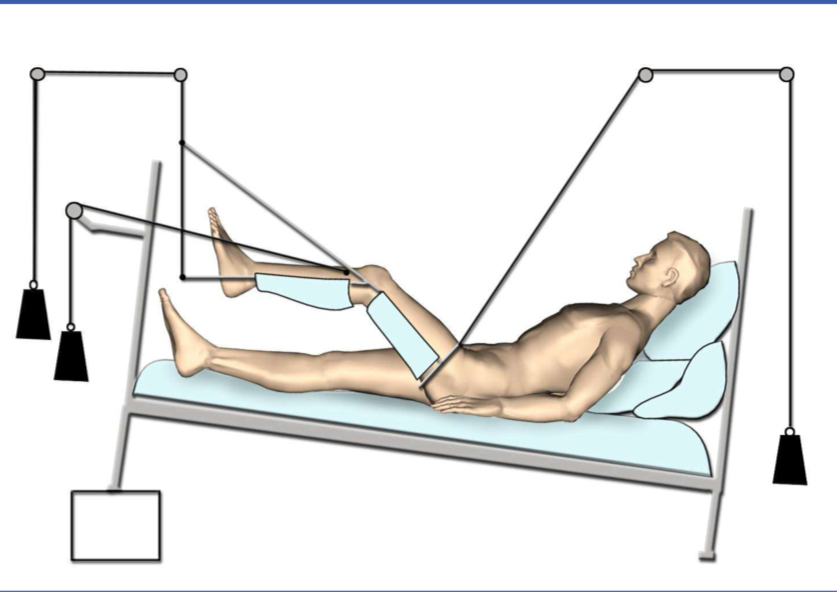
What immobilizer is this?
Traction
Professional liability
person who administers the drug is expected to know:
Safe doage
Safe route of administration
Limitations of the drug
Classifications of Pharmacology
Nomenclature
Chemical group (action)
Method of legal purchase
Mechanism & site of action
Primary effect
Nomenclature brand name
Tylenol
Chemical group (action or function)
grouped into families that have similar chemical actions
Relieve Pain—> analgesics
Treat High BP—> antihypertensives
Fight inflammation—> anti-inflammatories
Mechanism & site of action (MOA)
term used to describe how a drug or other substance produces an effect in the body
Provides info a/b the safety of the drug
Primary effect
desired therapeutic effect of the drug
Therapeutic index/ range
measures safety of a drug
The relation between dosage at which the intended effect of a drug is obtained & the amt that produces an unwanted effect
Analgesics
relieve pain w/o causing loss of consciousness
What are the 2 groups of analgesics ?
Opioid (narcotic)
Nonopioid (non-narcotic)
Benzodiazepines
used often as a pre-operative drug for procedures (anxiety), relieves muscle spasm, & seizures
Diazapam (Valium)
Lorazepam (Ativan)
Alprazolam (Xanax)
Midazolam (Versed)
Oral anticoagulants
warfarin (Coumadin)
Are generics lowercase or uppercase?
Lowercase
Antiseptic
kill microorganisms on your skin
Ex:
Chlorhexidine
Antibacterial dye
Peroxide & permanganate
Halogenated phenol derivative
NSAIDS
Nonsteroidal Anti-inflammatory analgesic drugs
Ibuprofen (Advil, Motrin)
Acetaminophen (Tylenol)
Bronchodilators examples
Albuterol
Tiotropium
Pharmacokinetics
study of how a drug is absorbed into the body, circulates within the body, is changed by the body, & leaves the body
Absorption
Distribution
Metabolism
Excretion (half-life)
Metabolism of drug
alternates chemicals in the body, done by the liver, how things interact w/ the body
Excretion of drug
kidneys excrete the drug out
Half life (100, then all the way to zero)
When the drug will be out of the system
Too slow= can reach toxic levels
Too fast= don’t get full effect
What is thought to be the 1st step of the Pharmacokinetics process?
Disintegration
Pharmacodynamics
study of the method or mechanism of drug action on living tissues or the response of tissues to chemical agents at various sites in the body
Drugs can alter physiological effects in the body