Nature based solutions
 Call Kai
 Learn
Learn Practice Test
 Spaced Repetition
 Match
Match Flashcards
 Knowt Play
1/5

There's no tags or description
Looks like no tags are added yet.
Name | Mastery | Learn | Test | Matching | Spaced | Call with Kai |
|---|
No analytics yet
Send a link to your students to track their progress
6 Terms
NBS def
UNEA 2022
seddon ey al 2020
NBS defs
“actions to protect, conserve, restore, sustainably use and manage natural or modified terrestrial, freshwater, coastal and marine ecosystems, which address social, economic and environmental challenges effectively and adaptively, while simultaneously providing human well-being, ecosystem services and resilience and biodiversity benefits”
"solutions to societal challenges that involve nature"
Examples
Cole 2026
Examples
Provides 1 or more sustainable benefits for people AND causes no loss of biodiversity or ecological integrity (or preferably a gain) compared to the pre-intervention state
Rewetted peatland - bringing back biodiversity and waterlogged environment to continue carbon sequestration
Wetland creation - habitats for rare bird and insect species, storing water for farmers to use in drier seasons
Wildflower meadow planting - pollination services for adjacent agriculture land, biodiversity, potential sequestration, human wellbeing
Conifer plantation - historical source of timber and now carbon sequestration
Challenges
Cole 2026
Nothing in definition to say emissions must be reduced
NBS are a small plaster being stuck in various places to mop up some of those crises and biodiversity loss
Rapid phase out of fossil fuels is the big overarching solution to CC
Expertly and elaborately marketed concept that has no real impact
We tend to invest a lot in new concepts, tools, programmes that direct us in a different way to solve the same problem
risk of trying to solve the problem with the same tools that created it
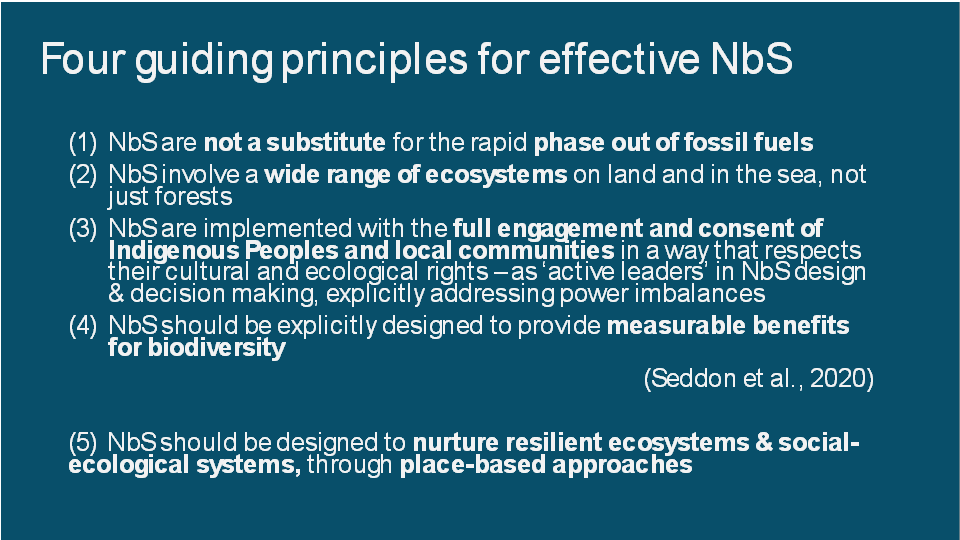
Effective NBS
Seddon et al 2020
Effective NBS
Indigenous principles for NBS
Reed 2022
Indigenous principles for NBS
Embrace humility
Express relationality
Uphold rights and responsibilities
Embed spirituality
Support reconnection
Incorporate interconnectivity
Ensure Indigenous leadership
Paper - challenges and recommendations
Chausson 2023
'NBS concept is dissociated with the social and economic drivers of these societal challenges, including the pervasive focus on market-based mechanisms and the economic growth imperative, promoting the risk of greenwashing.'
Often overlook root causes of CC etc
'nature is presented as a solution to human problems'
Mostly market-based solutions where private funders pay to restore nature
Estimations between 879 to 891 billion $
Challenges
Limits to scalability
Reinforcing the separation of people and nature
Limited view of barriers to scaling NBS
Challenges in governance and achieveing equity for IPLCs
Reinforcement of global north vs south power imbalances
Recommendations
Making NBS place-based and encouraging nature-human relationships like those in indigenous comms
Mutual relationships and responsibilities
Need to encourage connections between financial supporters of NBS and communites/NGOs etc on the ground and their relationships with nature
Embrace diversity of knowledge and opinions
Co-dependency rather than 'nature working for people'
Recognizing role of IPLCs
Including knowledge and supporting communities and entrepreneurship e.g. indigenous-led funds
Recognize alternative modes of finance
Shifting gov subsidies from ahrmful to beneficial industries e.g. fishing, FFs etc -> sustinable farmland
Current subsisidies in harmful industries could be costing US up to $1.8 trillion annually
Tax harmful activities - currently in CR and Columbia
Could gain up to $13 bill a year to put towards NBS
Direct funding of nature
Decolonial finance mechanisms - monetary aid or debt relief to help poorer countries
Shift away from imperative for econ growth
Should only be used for environmentally sustainable growth
Otherwise just fuelling causes of CC
Circular economies in harmony with nature