AQA A-Level Psychology - Attachment
 Call Kai
 Learn
Learn Practice Test
 Spaced Repetition
 Match
Match Flashcards
 Knowt Play
1/158

There's no tags or description
Looks like no tags are added yet.
Name | Mastery | Learn | Test | Matching | Spaced | Call with Kai |
|---|
No analytics yet
Send a link to your students to track their progress
159 Terms
What is attachment?
A close two-way emotional bond between two individuals for emotional security.
Why is attachment so importantfor infants?
Infancy – time before speech (latin ‘infans’ = without speech); only form of communication is non-verbal. These interactions form the basis of attachment.
Important for their social development
Attachment in early years of life lays the foundation for attachment in later life…
What are the 2 main types of caregiver-infant interactions?
Reciprocity.
Interactional synchrony.
What is reciprocity?
A description of how two people interact. Caregiver-infant interaction is reciprocal in that both caregiver and baby respond to each others signals and each elicits a response from the other. Turn-taking.
What is interactional synchrony?
Caregiver and baby reflect both the actions and emotions of the other and do this in a co-ordinated (synchronised) way. Mirror.
What are alert phases for reciprocity?
When babies signal to show they are ready for interaction *best time to interact!
Mothers typically pick these up two-thirds of the time; varies with skill & external factors (stress)
From 3 months increasingly frequent (Feldman, 2007).
What is active involvement for reciprocity?
Babies do not take a passive role; both initiate interactions and take turns
Interactional synchrony: What did Meltzoff and Moore (1977) find?
Method: adult model would display one of three facial expressions or hand movements. The (2 weeks old) child’s response was filmed.
Results: a significant association between infant behaviour and the adult model mirroring expressions and gestures – I.S begins early!
Interactional synchrony: What did Isabella et al (1989) find?
Method: observed 30 mothers and babies’ synchrony and quality of attachment
Results: high levels of synchrony associated with better mother-baby attachment – synchrony important!
What is a strength of caregiver-infant interactions? filmed observations.
P: One strength of the research on this topic is that caregiver-infant interactions are usually filmed in a laboratory.
EE: This means that activity that may potentially distract the baby can be controlled. Recording observations also means results can be replayed and analysed later so researchers will be unlikely to miss any key behaviours and capture fine details. Filmed data allows more than one observer to record data and establish inter-rater reliability. Finally, although it is technically an overt observation, babies don’t know they are being filmed so their behaviour does not change.
L: Therefore data collected like this should be reliable and valid.
What is a limitation of caregiver-infant interactions? Difficulty observing babies.
P: One limitation of research into caregiver-infant interaction is that research into caregiver-infant interaction is that it is hard to interpret a baby’s behaviour.
EE: However it is hard to interpret a baby’s behaviour as they lack coordination and much of their bodies are immobile. The observations are often just subtle movements or changes in expression. For example it is hard to determine whether a hand twitch is in response to a caregiver’s movement or if it is just random.
L: Thus you cannot be certain that behaviours observed in caregiver-infant interactions actually have a special meaning.
What is a strength of caregiver-infant interaction? importance research support.
P: One strength is that there is supporting evidence of the importance of researching caregiver-infant interactions.
EE: Isabella et al, (1989) found that achieving interactional synchrony predicted the development of a good quality attachment.
Evans & Porter (2009): interactional synchrony & reciprocity are important in developing a secure attachment type (Type B) which is linked with healthier and functional relationships with friends, partners and your own children.
L:Caregiver-infant interaction is likely to be important in development.
C/A: Simply observing behaviours does not tell us its developmental importance. Feldman (2012) pointed out that ideas such as reciprocity only give names to behavioural patterns observed but they do not tell us the purpose of these behaviours. We cannot be certain from observational research alone that these concepts are important to a child’s development.
What is a strength of caregiver-infant interactions? Practical implications.
P: One strength is that the research has practical implications.
EE: Crotwell et al (2013) found that just a 10 minute parent-child interaction therapy improved interactional synchrony in 20 low-income mothers and their pre-school children. This is especially important because there is a chance that those mothers may have been suffering from stress or other external factors which, like Finegood suggested, could harm their ability to reciprocate their baby’s alert phases, thus harming the attachment bond.
L: This suggests that there are real-world applications of research into caregiver-infant interactions.
C/A: However, this research is socially sensitive, as it can be used to argue that when a mother returns to work after having a baby the action could risk harming their baby’s development. Research could therefore be used to restrict freedom of choice.
What are stages of attachment?
Many development theories identify a sequence of qualitatively different behaviours linked to specific ages. In cases of ‘stages of attachment’ qualitatively different infant (Baby) behaviours are linked to specific ages, and all babies go through them in the same order.
What are the 4 stages of attachment?
Asocial stage.
Indiscriminate attachment.
Specific attachment.
Multiple attachments,
At what age does stage 1: asocial happen?
0-8 weeks.
What 6 behaviours happen in the asocial stage?
Behaviour between humans and non-human objects quite similar.
Recognise specific faces.
Happier in presence of humans than when alone.
Preference for familiar individuals.
Prefer faces to non-faces.
Smiles at anyone.
At what age does stage 2: indiscriminate attachment happen?
2-7 months.
What 4 behaviours happen in the indiscriminate attachment phase?
Recognise and prefer familiar people.
Smile more at familiar than unfamiliar faces.
Preference for people rather than inanimate objects.
Accepts comfort from any adult.
At what age does stage 3: specific attachment happen?
7-12 months
What 4 behaviours happen in the specific attachment phase?
Primary attachment to one particular individual (the person who shows the most sensitivity to their signals).
Shows stranger anxiety.
Shows separation anxiety.
Use familiar adults as secure base.
At what age does stage 4: multiple attachments happen?
1 year onwards.
What behaviour happens in the multiple attachments phase?
Form secondary attachments with familiar adults with whom they spend time (e.g. father, grandfather).
What was Schaffer and Emerson’s (1964) aim?
Measure separation and stranger anxiety for stages of attachment
Separation anxiety: asking mothers questions about their child’s behaviour during everyday separations (leaving the room)
Stranger anxiety: observing the infants’ response to unfamiliar adults (the researcher)
What was Schaffer and Emerson’s (1964) research method?
60 Scottish (Glasgow) babies (31 male/29 female)
Majority were skilled working-class families.
Visited every month at home for a year and again at 18 months.
What did Schaffer and Emerson (1964) find?
Between 25 and 32 weeks, 50% showed separation anxiety towards an adult (usually mother): specific attachment
What did Schaffer and Emerson (1964) conclude?
Primary attachment figure was the most sensitive: attachment to the most interactive and sensitive to infant signals and expressions (reciprocity) and not necessarily who spent the most time.
What is a strength of Schaffer and Emerson’s stages? Real-world application.
What is a limitation of Schaffer and Emerson’s stages? Poor evidence for asocial stage.
What is a strength of Schaffer and Emerson’s stages? validity.
Schaffer & Emerson conducted a longitudinal study; the same children were followed-up and observed regularly. This increases the internal validity as they do not have confounding variables of individual differences between ppts (ppt variables).
What is a limitation of Schaffer and Emerson’s stages? limited cultural application.
P: The large sample size in the study should help with the generalisability of Schaffer and Emerson's stages.
EE: However, the sample characteristics may make the sample less generalisable to other populations. This is because child-rearing practices vary so much between social groups/cultures.
E.g. Some researchers suggest that multiple attachments form from the outset in collectivist cultures (rather than through a specific attachment first), as families work jointly in child rearing.
So, patterns of attachment development in 1960s Glasgow may be quite different from that in, say, present-day Southampton or Liverpool.
L: Therefore, we cannot assume the same stage pattern would apply universally.
What is a limitation of Schaffer and Emerson’s stages? Conflicting ideas.
P: One limitation is that evidence on the timing of multiple attachments is conflicting.
EE: Bowlby (1969) argues that most babies form attachments to a single (more important) main carer before they are able to develop multiple attachments. But multiple attachments appear from the outset in cultures where multiple attachments are the norm (based on research by van Ijzendoorn 1993). Such cultures are called collectivist because families work together jointly in everything (e.g. producing food and raising children).
L: Cross-cultural research suggests Schaffer and Emerson’s stages of attachment may only apply to individualistic cultures, not collectivistic cultures as they may have undervalued the importance of secondary/multiple attachments.
What is a limitation of Schaffer and Emerson’s stages? Assessment.
P: Another limitation is that there may be a problem with how multiple attachment is assessed.
EE: Schaffer and Emerson used behaviours such as separation protest and stranger anxiety as indicators of attachment. However, an infant may show similar distress in response to their playmates – this does not necessarily mean that the individual is a 'true' attachment figure.
L: This suggests that the findings may not provide valid evidence for multiple attachments as they may not accurately reflect caregiver-infant relationships.
What did Schaffer and Emerson (1964) find about attachment to fathers?
The majority of babies became attached to their mother first (primary attachment) at around 7 months
Only 3% of cases where the father is the primary attachment
27% of cases where the father is the joint first attachment figure.
However, 75% of babies then form a secondary attachment to their father by 18 months. (separation anxiety)
What did Grossman et al. (2002) find about the distinctive role for fathers?
Grossmann et al. (2002) carried out a longitudinal study and suggests:
The quality of a baby’s attachment with its mother but not its father was related to attachments in adolescence. This suggests that attachment to fathers is less important than attachment to mothers
That fathers play a greater role in play and stimulation and less of a role in emotional development. This shows that fathers are important to attachment but in a different way from mothers.
What did Field (1978) find about fathers as primary attachment figures?
Found that fathers can be the more emotion-focused primary attachment figure.
Studied 4 months old babies and found that primary caregiver fathers (like mothers) spent more time smiling, imitating and holding babies (so showing reciprocity & interactional synchrony) than secondary caregiver fathers.
The key to the attachment relationship is the level of responsiveness not the gender of the parent.
What is a limitation of research into the role of the father? confusion over question.
P: One limitation into the role of fathers is lack of clarity or operationalisation over the question being asked.
EE: What their role is could be asking in terms of secondary attachment figures or as primary attachment figures. This affects how fathers are viewed; either having a distinct role to mothers or taking on a “maternal role”.
L: This makes it difficult to offer a simple answer as it depends on what specific role is being discussed.
What is a limitation of research into the role of the father? Conflicting evidence.
P: The role of fathers varies depending on the methodology used
EE: Longitudinal studies (Grossman’s) have suggested that fathers, as secondary attachment figures, have an important and distinct role in their child’s development – involving play and stimulation. However, this would suggest that children growing up in a single-mother or lesbian-parent family would turn out differently from those in 2-parent heterosexual families.
Studies (McCallum and Golombok, 2004) consistently show that children do not develop differently in any of these types of families.
C/A: These lines of research may not in fact be in conflict.
It could be that fathers typically take on distinctive roles in 2 parent heterosexual families and that parents in single-mother or lesbian-parent families simply adapt to accommodate the role played by fathers.
This means that the question of a distinctive role for fathers may be clear – when present, fathers do tend to have a different role, but families can adapt to not having a father.
What is a strength of research into the role of the father? Real-world application.
P: One strength of research into the role of the father is that it can be used to offer advice to parents
EE: Parents and prospective parents sometimes agonise over decisions like who should take on the primary caregiver tole.
For some this can even mean worrying about whether to have kids at all….
Mothers may feel pressured to stay at home due to stereotypical views of gender roles.
Equally, fathers may be pressured to focus on work rather than parenting.
In some families this may not be economically the best solution.
Research into role o the father can be used to reassure parents.
Eg Fathers are quite capable of becoming the primary attachment figure and not having a father around (lesbian-parent families) does not affect a child’s development.
L: This means that parental anxiety about the role of the father can be reduced.
What is a limitation of research into the role of the father? Research bias.
P: Observers may have preconceptions about how fathers do or should behave. EE: These could be created by stereotypical accounts and images of parenting roles and behaviour. For example a feminist might not expect to see something distinct in the role of the father.
These stereotypes (e.g. fathers are not primary caregivers, fathers are strict, etc.) risk observer confirmation bias so that observers may ‘see’ what they expect to see rather than recording objective reality.
However, psychologist-observers are trained in the issue of bias. They also have procedures like dual observations where different observers watch the same behaviour together and agree on what is taking place (inter-observer reliability).
L: So bias may affect some studies but psychologists may not be affected by bias as much as others.
What was Lorenz’s (1952) procedure for studying imprinting?
Lorenz took a clutch of geese eggs and randomly divided them into two groups. One group was left with their natural mother (control group), and the other group was placed in an incubator (experimental group) (where once hatched from the incubator, Lorenz was the first moving object they saw).
What was Lorenz’s (1952) results when studying imprinting?
Lorenz found that the geese which had hatched in the incubator continued to follow him, while those that had hatched naturally continued to follow their mother.
What was Lorenz’s (1952) conclusions when studying imprinting?
Lorenz concluded that goslings are programmed to imprint (attach) onto the first moving object they see, highlighting the rapid formation of attachment in animals.
Lorenz identified a critical period in which imprinting needs to occur (depending on species this can be as brief as a few hours after hatching/birth). If imprinting doesn’t occur within this time, chicks did not attach themselves to a mother figure.
What did Lorenz (1952) find about sexual imprinting?
Lorenz also investigated the relationship between imprinting and adult mate preferences. He observed that birds that imprinted on a human often later display courtship behaviour towards humans.
In a case study Lorenz described a peacock that had been reared in the reptile house of a zoo where the first moving object was a giant tortoise. As an adult this bird would only direct courtship towards giant tortoises – sexual imprinting had occurred in the peacock.
What is a strength of Lorenz’s (1952) research? research support.
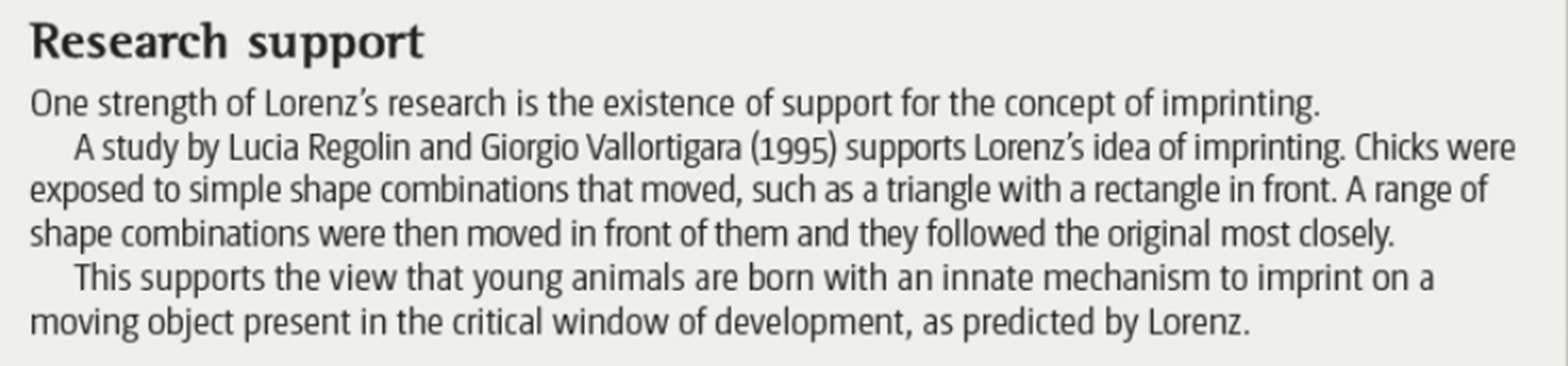
What is a strength of Lorenz’s (1952) research? Applications to understanding behaviour.
P: One strength is that Lorenz’s research can be applicable when trying to understand behaviour.
EE: It may be true that humans acquire some behaviour by means of 'imprinting'. This explains for example why so many people prefer the first computer system they use and struggle to adapt to others. This is known as Baby duck syndrome.
L: It can therefore be argued that Lorenz's research on imprinting is of value in understanding some human attachment-related behaviours.
What is a limitation of Lorenz’s (1952) research? Generalisability.
P: One limitation of Lorenz's studies is the ability to generalise findings and conclusions from birds to humans.
EE: The mammalian attachment system is quite different and more complex than that in birds. For example, in mammals attachment is a two-way process, so it is not just the young who become attached to their mothers but also the mammalian mothers show an emotional attachment to their young.
L: Given the unique complexities of humans, generalizing findings from non-human attachment studies may be inappropriate.
What is background context to Harlow’s (1958) research?
In the 1950’s “Learning theory” was introduced (aka as “Cupboard Love Theory”; this was based on the idea that you form attachments to whoever feeds you. However, Harlow conducted research to look into the importance of “contact comfort”.
What was Harlow’s (1958) procedure?
8 rhesus monkeys were placed in a cage with two surrogate mothers, one made of wire and one wrapped in cloth
For half of the monkeys, the food/ milk bottle was attached to the wire mother, whereas for the other half the food was attached to the cloth mother.
Harlow recorded the time spent with each mother, their reactions to frightening situations (noisy teddy bear) and the long-term effects (sociability, relationship to offspring, etc)
What were Harlow’s (1958) findings?
The baby monkeys spent most time cuddling the cloth-covered mother in preference to the wire one and sought comfort from the cloth one when frightened, regardless of which dispensed milk.
This showed that contact comfort was of more importance to the monkeys than food when it came to attachment behaviour.
The critical period for normal development: Like Lorenz, Harlow concluded that there was a critical period for attachment formation. A mother had to be introduced to a young monkey within 90 days for an attachment to form. After this, it was impossible, and damage done by early deprivation became irreversible
Monkeys as adults: Harlow et al also followed the monkeys who had been deprived of a “real” mother into adulthood to see if this early separation had a permanent effect. The researchers found severe consequences: those reared by wired mothers were the most dysfunctional. Even those with a cloth-covered mother did not develop normal social behaviour. They were more aggressive, less sociable and bred less often (unskilled at mating) than other monkeys. When they became mothers, some neglected their young and others attacked their children, even killing them in some cases.
What is a strength of Harlow’s (1958) research? Theoretical value.
P: One strength of Harlow's research is its theoretical value
EE: Harlow’s research refutes learning theory (aka “cupboard love theory”) showing that attachment is not a result of feeding but contact comfort.
Learning theory is seen as outdated and more recent research on human studies, like Schaffer & Emerson’s, support Harlow's research. Their research reinforces the importance of contact comfort (in the form of sensitive responsiveness) for forming attachments to primary attachment figures.
L: This shows how Harlow's research has helped our understanding of attachment processes in humans and animals.
What is a limitation of Harlow’s (1958) research? generalisation issues.
P: One limitation of using animals to study attachment is the difficulty in generalising research to humans.
EE: Although we share 94% of our DNA with rhesus monkeys, there are important differences such as human’s higher functioning brains and the greater emphasis on emotions in human attachment. There are also differences in “critical periods” between species and the rigid concept of it has been questioned in humans.
L: Given the unique complexities of humans, generalising findings from non-human attachment studies may be inappropriate.
What is a strength of Harlow’s (1958) research? Practical value.
P: One strength of Harlow's research is its important real-world applications.
EE: For example, it has helped social workers and clinical psychologists understand that a lack of bonding experience in neglect and abuse cases can be a risk factor in child development, allowing them to intervene to prevent poor outcomes (Howe, 1998).
L: This means that the value of Harlow's research is not just theoretical but also practical in helping improve the lives of vulnerable individuals.
What is a limitation of Harlow’s (1958) research? Ethical issues.
P: A final criticism of animal research is that it is often unethical.
EE: It could be argued that animals have a right not to be researched on and protected from harm. Separating monkeys from their “real” mother raises ethical concerns as it causes them emotional harm. The monkeys raised in Harlow’s experiment all displayed severe dysfunctional adult behaviour in later life. For example, they were more aggressive, less sociable, bred less often than other monkeys and had difficulties in parenting.
L: Despite the practical applications of the research (e.g identifying a lack of attachment as a risk factor), these animal studies are unjustifiable given the long-term distress inflicted.
Why is learning theory an explanation of attachment?
According to this behaviourist theory ALL behaviour is acquired through experience. Two types of learning theory apply to the development of behaviour/attachments: classical and operant conditioning.
Dollard and Miller (1950)’s learning theory is sometimes called “cupboard love theory” as it emphasises the importance of the caregiver as the provider of food.
(Attachments develop because infants associate a caregiver with feeding/kids learn to love whoever feeds them)
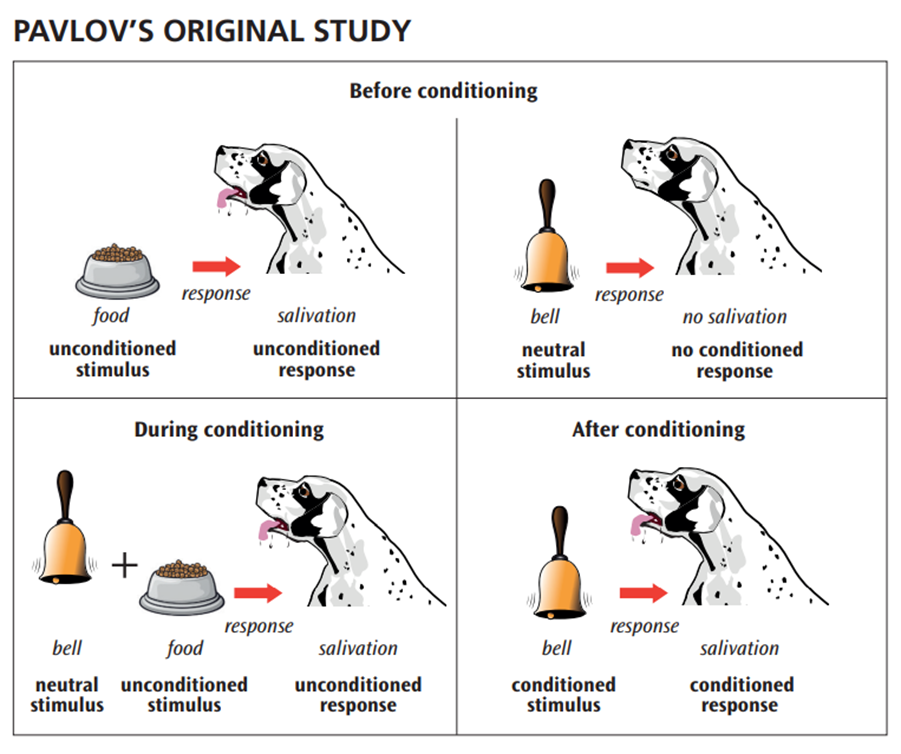
What is classical conditioning in the case of attachment?
It involves learning to associate 2 stimuli together so that we begin to respond to one in the same way as we already respond to the other.
Unconditioned stimulus (food) → Unconditioned response (pleasure)
Neutral stimulus (caregiver) → No response
Unconditioned (food) + Neutral stimulus (caregiver) → Unconditioned response (pleasure)
Conditioned stimulus (caregiver) → Conditioned response (pleasure)
What is an example of classical conditioning?
What is operant conditioning in the case of attachment?
It involves learning from the consequences of behaviour. If a behaviour produces a pleasant consequence, it is likely to be repeated again. The behaviour is said to be reinforced. If a behaviour produces an unpleasant consequence (punishment) it is less likely to be repeated.
How can operant conditioning explain why babies cry for comfort?
Crying leads to a response from the caregiver, for example feeding. As long as the caregiver provides the correct response, crying is reinforced. The baby then directs crying for comfort towards the caregiver who responds with comforting ‘social suppressor’ behaviour.
Why is reinforcement a 2-way process?
At the same time as the baby is reinforced for crying, the caregiver receives negative reinforcement because the crying stops. This interplay of mutual reinforcement strengthens an attachment.
How is attachment a secondary drive?
As well as conditioning, learning theory draws on the concept of drive reduction. Hunger can be thought of as a primary drive - it is an innate, biological motivator. We are motivated to eat in order to reduce the hunger drive. Sears et al (1957) suggested that, as caregivers provide food, the primary drive of hunger becomes generalised to them. Attachment is thus a secondary drive learned by an association between the caregiver and the satisfaction of a primary drive.
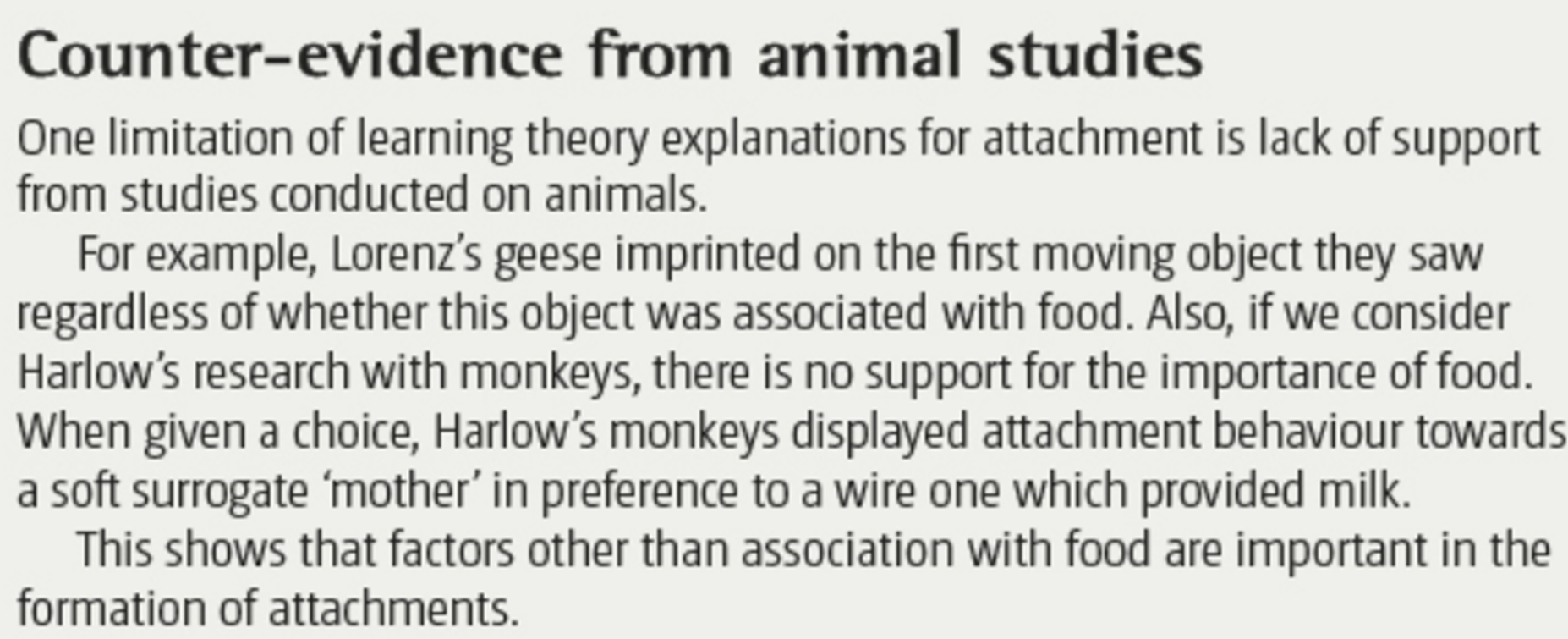
What is a limitation of learning theory as an explanation of attachment? animal studies.
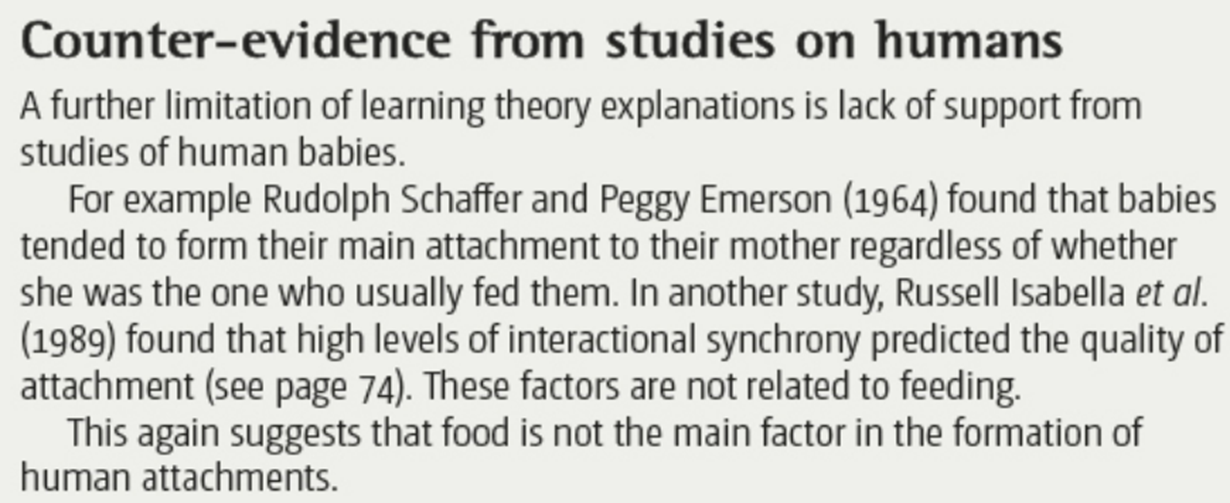
What is a limitation of learning theory as an explanation of attachment? human studies.
What is a limitation of learning theory as an explanation of attachment? other factors
P: Ignores other factors associated with forming attachments
EE: Research into early infant-caregiver interaction suggests that the QUALITY of attachment is associated with factors such as RECIPROCITY and good levels of INTERACTIONAL SYNCHRONY. In addition, studies have shown that the best quality attachments are with sensitive carers that pick up infant signals and respond appropriately.
L: Therefore it is unlikely that attachment develops primarily through feeding.
What is a strength of learning theory as an explanation of attachment? scientific.
P: One strength of learning theory is that it is plausible and scientific.
EE: Learning theory is grounded in the scientific principles of behavioral psychology, supported by controlled experiments that ensure reliability and replicability. While food is unlikely to play a central role in attachment, it is plausible that classical conditioning explains how the primary caregiver becomes associated with comfort and social interaction, helping to build the attachment bond.
L: This suggests that elements of conditioning contribute to the formation of attachments.
What is a newer, alternative explanation developed from learning theory?
Hay & Vespo (1988) suggest parents teach children to love them through modelling attachment behaviours (hugging) and reinforcing attachment behaviours (when babies display behaviours, parents give attention).
This social learning perspective is an improved explanation as it is based around the 2-way interaction between baby and adult
This fits better with research on the need for reciprocity, and gets around the passivity problem with earlier learning theories because it addresses the problem of links between feeding and attachment.
What does monotropic mean?
A term sometimes used to describe Bowlby’s theory. Mono means ‘one’ and tropic means ‘leaning towards’. This indicates that in particular attachment is different from all others and of central importance to a child’s development.
What did Bowlby believe?
The child’s attachment to one caregiver is different and more important than the other. The more time spent with the primary attatchment figure (The ‘mother’) the better.
What 2 principles clarified Bowlby’s beliefs?
The law of continuity stated that the more constant and predictable a child’s care, the better the quality of their attachment.
The law of accumulated separation stated that the effects of every separation from the mother add up ‘and the selfest dose is therefore a zero dose’ (Bowlby (1975)).
What are social releasers?
Bowlby suggested that babies are born with a set of innate ‘cute’ behaviours like smiling, cooing and gripping that encourage attention from adults. Their purpose is to activate adult social interaction and so make an adult attach to the baby.
What is the critical period?
The time within which an attachment must form if it is to form at all. Lorenz and Harlow noted that attachment in birds and monkeys had critical periods. Bowlby extended the idea to humans, proposing that human babies have a sensitive period after which it will be much more difficult to form an attachment.
When did Bowlby think the critical period was?
Around 6 months possibly extending up to age 2. (Bowlby viewed it as a sensitive period).
What is your internal working model?
Our mental representations of the world, e.g. the representation we have of our relationship to our primary attachment figure. This model affects our future relationships (i.e. friendships, romantic, parenting) because it carries our perception of what relationships are like.
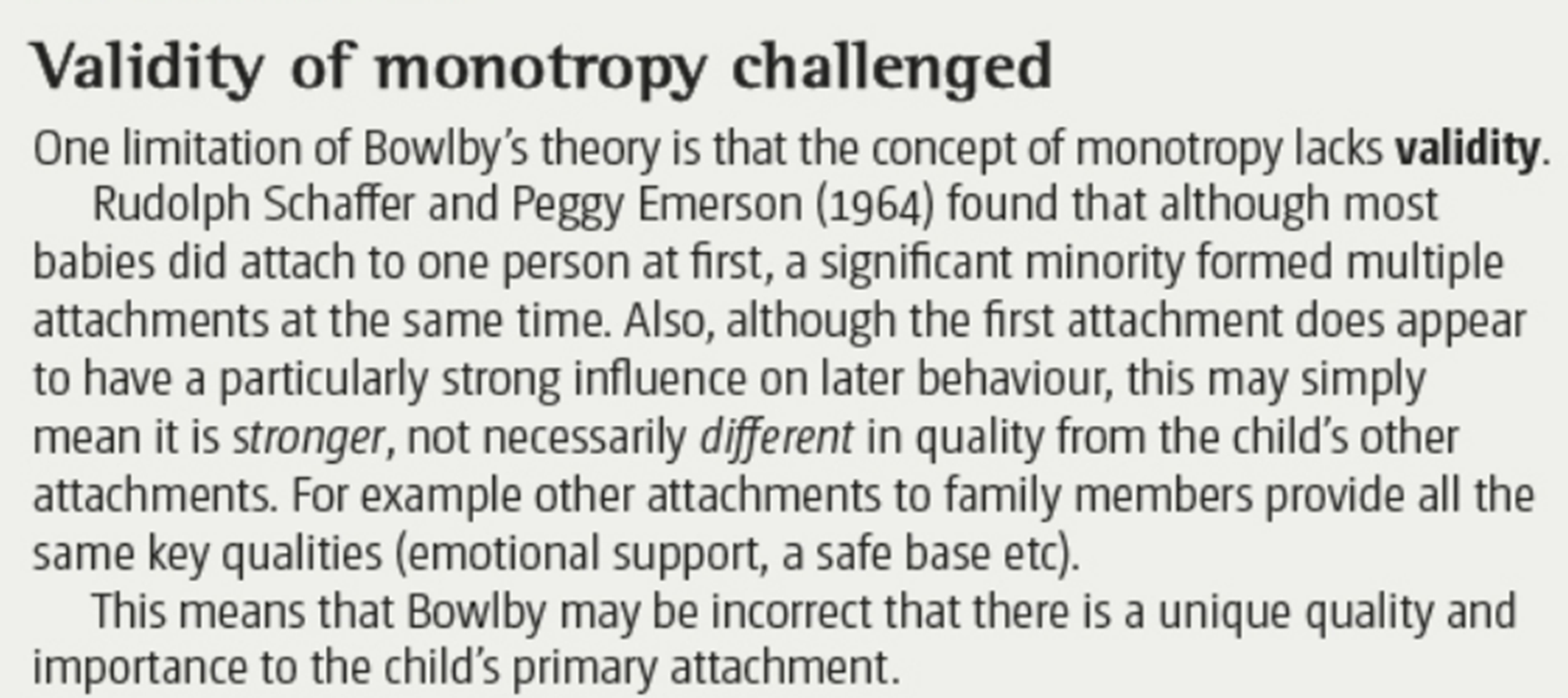
What is a limitation of Bowlby’s theory as an explanation for attachment? validity of monotropy.
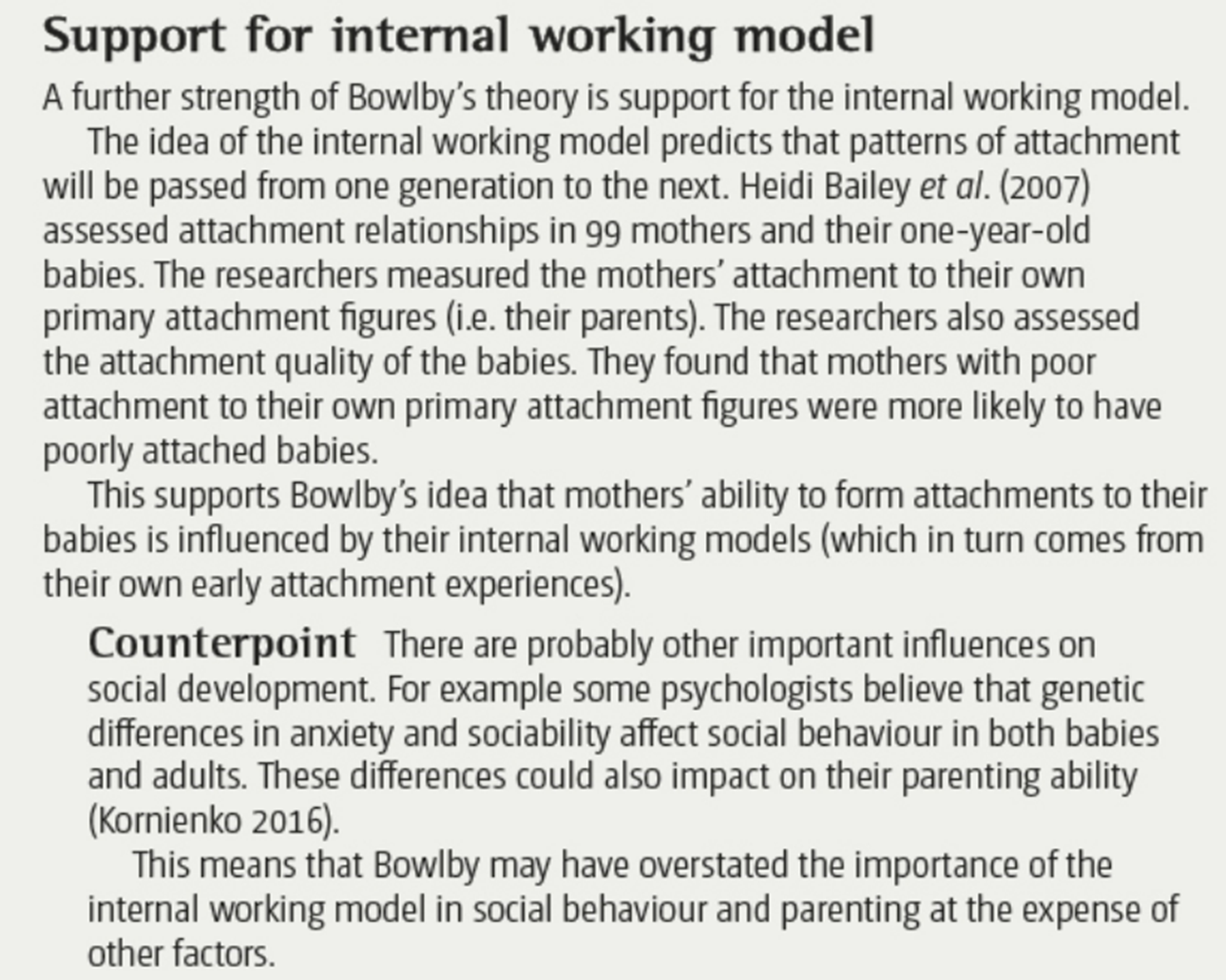
What is a strength of Bowlby’s theory as an explanation for attachment? Support for IWM.
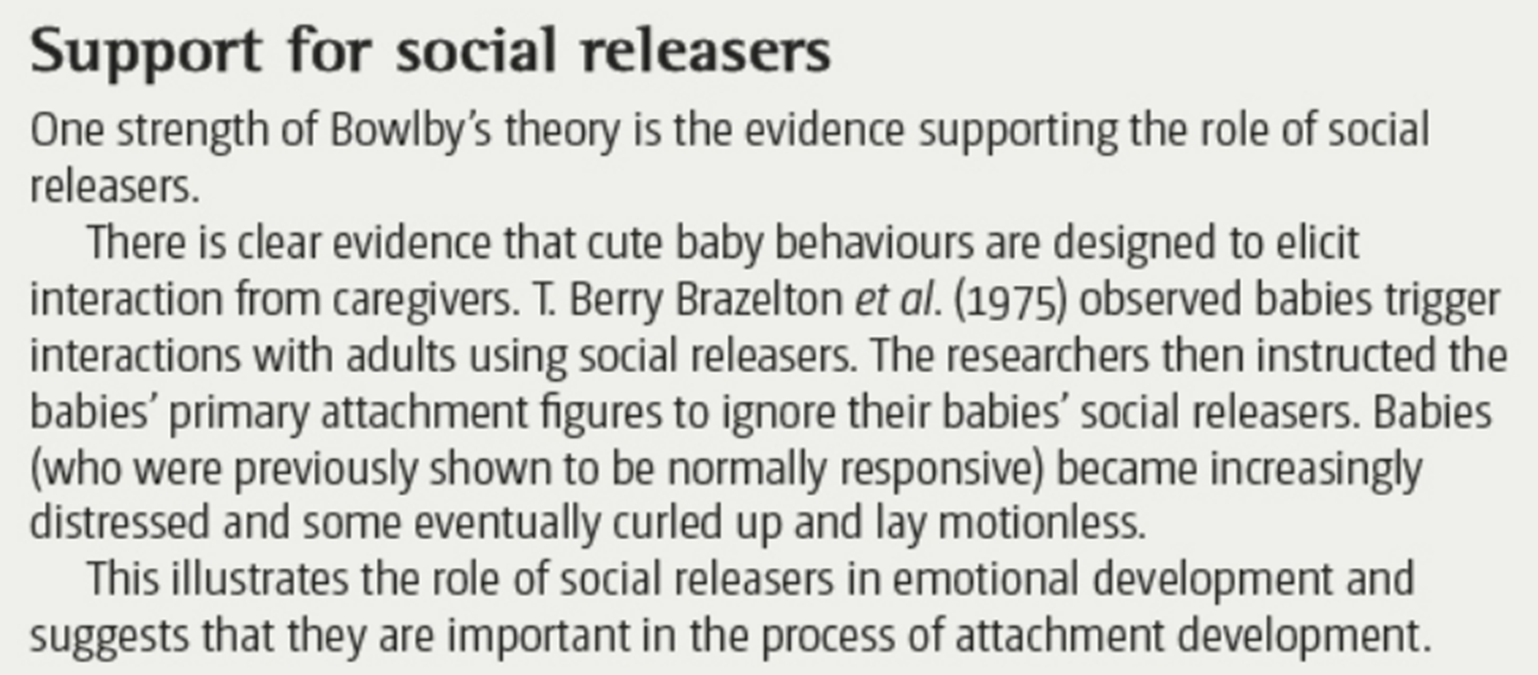
What is a strength of Bowlby’s theory as an explanation for attachment? Support for social releasers.
What is a limitation of Bowlby’s theory as an explanation for attachment? socially sensitive.
P: Bowlby’s laws of continuity and accumulated separation are socially sensitive.
EE: As primary caregiver tends to be the mother, his theory implies that working mothers can harm their babies.
Burman argues from a feminist perspective: Bowlby’s ideas can be used to blame mothers and restrict their activities – such as returning to work
Researchers need to be very careful about promoting an idea that is likely to have negative social consequences such as the oppression of women.
L: Suggests the role of the father is ECONOMIC in nature…
C/A: Bowlby’s law of continuity has practical applications
During Bowlby's time, people didn't think the mother's role was important, and, in fact, many custody disputes were settled in favour of the father
Law of continuity had led to the common use of key workers – nursery nurses responsible for building an attachment with particular babies in day care.
What was the aim of Ainsworth’s (1978) strange situation?
Measure the security of attachment an infant displays its caregiver.
What was the procedure of Ainsworth’s (1978) strange situation?
Controlled observation
Behaviour observed and taped: non-participant observation
Testing room was 81 square foot with area divided into 16 squares to help record movements.
Two-way mirror with raters observing child’s behaviour
Every 15 seconds, the category of behaviour displayed was recorded and scored on an intensity scale of 1-7.
What 5 behaviours were being observed in Ainsworth’s (1978) strange situation?
Proximity seeking.
Response to reunion.
Exploration and secure base behaviour.
Stranger anxiety.
Separation anxiety.
What were Ainsworth’s (1978) findings?
There were distinct patterns in the way that infants behaved and these could be divided into three main types of attachment:
Type A: Insecure-avoidant
Type B: Secure attachment
Type C: Insecure-resistant
What is type A: insecure-avoidant attachment?
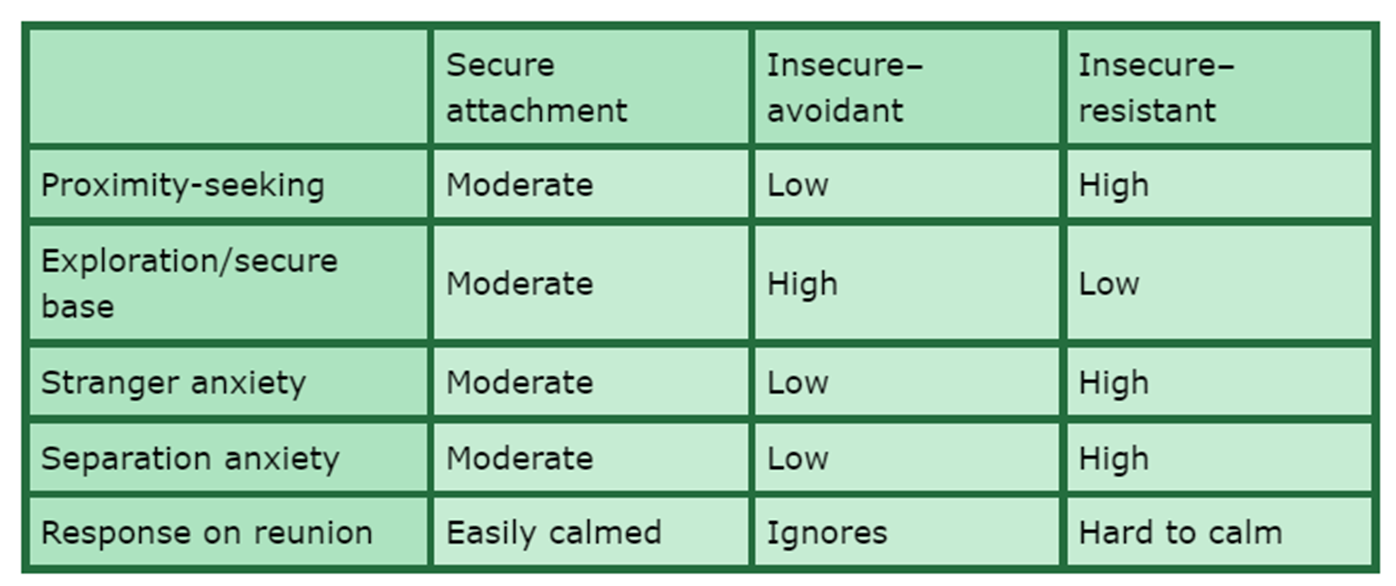
An attachment type characterised by low anxiety but weak attachment. In the strange situation this is shown by low stranger and separation anxiety and little response to reunion, maybe even an avoidance of the caregiver.
What is Type B: secure attachment?
Generally thought of as the most desirable attachment type, associated with psychologically healthy outcomes. In the Strange Situation this is shown by moderate stranger and separation anxiety and ease of comfort at reunion
What is Type C: insecure-resistant attachment?
An attachment type characterised by strong attachment and high anxiety. In the strange situation this is shown by high levels of stranger and separation anxiety and by resistance to being comforted at reunion.
What did Ainsworth (1978) find about Type A: insecure-avoidant babies?
20-25% of British babies.
Explores freely without bothering where mum is.
Is not at all upset when mum goes.
Not bothered by the appearance of a stranger.
Not bothered when mum comes back.
What did Ainsworth (1978) find about Type B: secure babies?
60-75% of British babies.
Explores happily while keeping an eye on mum.
Is moderately upset when mum goes.
A little wary of the stranger.
Is readily comforted by mum when she returns.
What did Ainsworth (1978) find about Type C: insecure-resistant babies?
3% of British babies.
Does not explore very much, keeps very near mum.
Is extremely upset when mum goes.
Does not like the stranger at all.
Is cross with mum on return and not easily comforted.
What is a brief explanation of the 3 attachment types behaviour during Ainsworth’s (1978) strange situation?
What is a strength of Ainsworth’s (1978) strange situation? validity
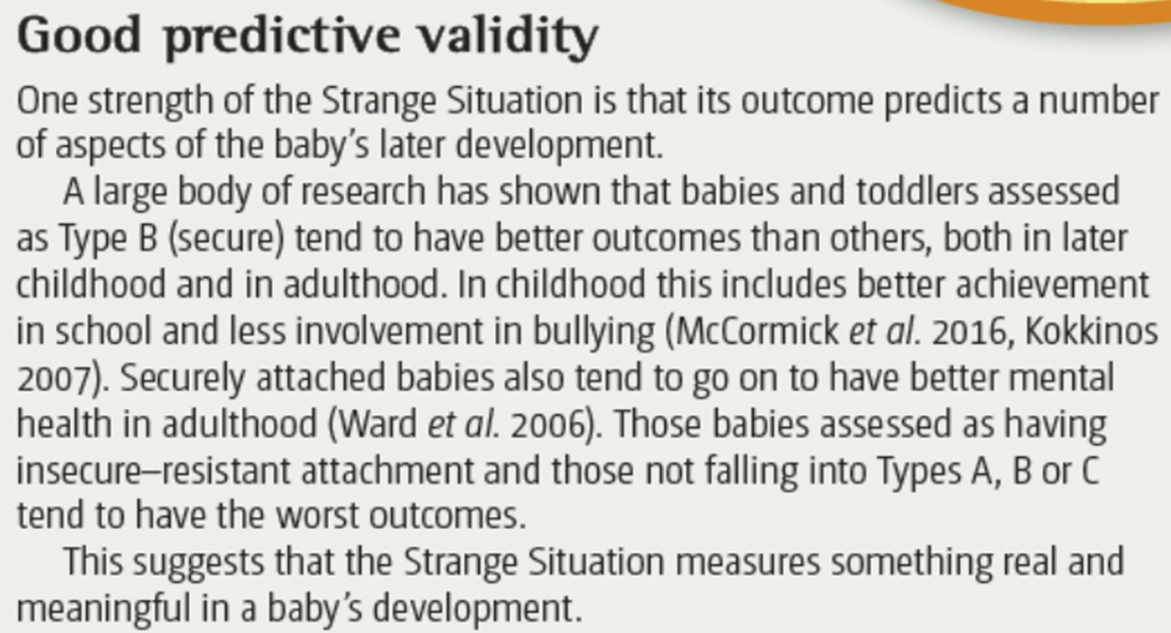
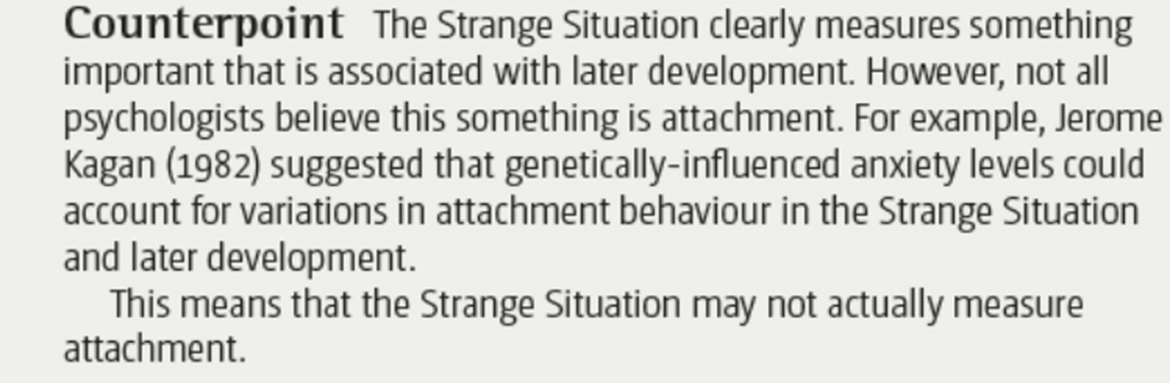
What is a strength of Ainsworth’s (1978) strange situation? reliability.

What is a limitation of Ainsworth’s (1978) strange situation? ethnocentric

Why was it important to tuy culture and attachment together?
If attachment is innate behaviour, then we would expect attachment types to be very similar around the world. If attachment is learned behaviour, then we would expect attachment types to be very different around the world.
What is an individualist culture?
Emphasises personal independence and achievement e.g. UK, USA, Germany.
What is a collectivist culture?
Emphasises importance of family and shared goals above individual needs and desires e.g. China and Japan.
What did van Ijzendoorn and Kroonenberg’s (1988) do?
Studied INTER-CULTURAL variations to study differences between cultures
Used meta-analysis to review the results of 32 ‘Strange Situation’ studies from 8 different countries (15 studies from the US)
They also looked at INTRA-CULTURAL differences to get an idea of variation within a culture.
In total 2,000 infants’ attachment types were studied.
What did van Ijzendoorn and Kroonenberg (1988) find?
No of Studies | Secure | Avoidant | Resistant | |
GREAT BRITAIN | 1 | 75 | 22 | 3 |
GERMANY | 3 | 57 | 35 | 8 |
NETHERLANDS | 4 | 67 | 26 | 7 |
SWEDEN | 1 | 74 | 22 | 4 |
JAPAN | 2 | 68 | 5 | 27 |
ISRAEL | 2 | 64 | 7 | 29 |
USA | 18 | 65 | 21 | 14 |
CHINA | 1 | 50 | 25 | 25 |
32 studies | 65% | 21% | 14% |
The most common attachment type, in all countries was Type B (secure attachment). The proportion varied from highest in Britain (75%) to the lowest in China (50%).
However, there were differences in the in INSECURE attachments
More type A (insecure avoidant) infants were found in countries like Germany, (35%) compared to countries like Japan ( 5%)
More type C (insecure resistant) infants were found in countries like Japan (27%) compared to countries like Germany (8%)
How are Japanese infants raised?
Children are encouraged to be very dependant on their mothers and they are rarely separated
Japanese infants in the strange situation tend to show extreme anxiety on being separated.
How are German infants raised?
Children are encouraged to be independent, so they are typically left alone, or with unfamiliar people, from a young age
German infants showed little anxiety on separation and responded no differently to the stranger or the mother in the strange situation
What were van Ijzendoorn and Kroonenberg’s (1988) additional findings?
Differences in attachments within each country were also found. This is known as an intra-cultural variation
For e.g., in the 2 studies carried out in Japan one had no type A children but in the other around 20% were type A
For e.g., in the US, one study found only 46% securely attached compared to one sample as high as 90%
Variation within countries was 1.5 times (150%) greater than variation between countries (inter-cultural variation)
What did Simonelli et al (2014) do? Italian study.
Whether the proportion of babies’ attachment types still matches those found in previous studies.
Assessed 76 babies aged 12 months using SS.